Malteeshwar Temple Varanasi: History, Darshan Timings & Spiritual Guide
Receive daily temple updates, divine darshan, and morning bhajans directly on WhatsApp.
Contents
- 1 Malteeshwar Temple Varanasi: A Definitive Pilgrimage Guide
Malteeshwar Temple Varanasi: A Definitive Pilgrimage Guide
As the spiritual heart of India, Varanasi (Kashi) is home to countless sacred shrines, each holding a unique place in the cosmic tapestry of Sanatana Dharma. Among these ancient sanctuaries lies the Malteeshwar Temple, a hidden gem steeped in Vedic lore and devotional tranquility. For pilgrims seeking the blessings of Lord Shiva, this temple offers a profound connection to the spiritual texts of the Kashi Khand. This guide serves as your comprehensive resource for 2026, blending architectural insight with practical logistics for a seamless spiritual journey.
1. Introduction & Spiritual Essence
The Malteeshwar Temple is dedicated to Lord Shiva, worshipped here in the form of a Shiva Lingam. Unlike the more crowded corridors of major Kashi temples, Malteeshwar offers an atmosphere of deep introspection and devotion.
Phalaśruti: The Spiritual Benefits
According to the sacred texts of Kashi Khand, the blessings of Malteeshwar are distinct and powerful. As described in the text: “In the vicinity of Hasti Paleshwar is the Malteeshwar Ling.” The Phalaśruti (scriptural promise of rewards) for devotees worshipping here includes:
- Material Prosperity: Devotees are blessed with abundance and prosperity.
- Sanctification of Ancestral Lineage: The shrine is known for cleansing ancestral karma, offering peace to the Pitrs (forefathers).
- Healing and Well-being: Adjacent to the temple lies the Kalodak Koop, a sacred well whose waters are believed to possess curative properties for various ailments.
📖 Related: Vidhyeshwar Temple Varanasi: History, Darshan Timings & Complete Guide
2. Historical Origins & Scriptural Legend
The history of the Malteeshwar Temple is intertwined with the oral and written traditions of Kashi, rather than dynastic architectural patronage. The temple stands as a testament to the enduring Shakta and Shaivite traditions of the region.
The Kashi Khand Connection
Historical records and local tradition hold that the temple’s significance is derived from the Kashi Khand, a division of the Skanda Purana. In Chapter 97 of this text, Lord Shiva describes the sacred Teerths (ponds), Koops (wells), and places of worship in Kashi to Goddess Parvati.
Tradition holds that this shrine was established to mark the location where the divine energies of Shiva were manifested to bestow prosperity upon the world. While specific dynasty builders are not recorded in public archives, the temple’s architecture and the presence of the Kalodak Koop suggest a lineage of worship dating back centuries, maintained by local priestly families and devotees.
3. Architectural Marvels
The Malteeshwar Temple exhibits the classic Nagara style of North Indian temple architecture, adapted to the spatial constraints of Varanasi’s dense urban fabric.
Structural Elements
-
Shikhara (Spire): The temple features a tiered shikhara that rises towards the sky, symbolizing the ascent of the soul. The intricate carvings on the exterior reflect the traditional stone craftsmanship of the region.
-
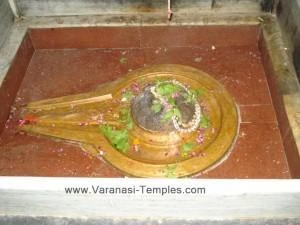
Garbhagriha (Sanctum Sanctorum): The inner sanctum houses the Malteeshwar Lingam. The Lingam is a Swayambhu (self-manifested) representation of Lord Shiva, radiating immense energy.
-
Kalodak Koop: A notable feature of the complex is the ancient well located within the temple precincts. Built with stone slabs, it is a functional part of daily rituals, where water is drawn for Abhishekam (ritual bathing of the deity).
While the temple may not hold a UNESCO or ASI (Archaeological Survey of India) designation as a protected monument, it is preserved by the local community and the Shri Kashi Vishwanath Temple Trust as a vital spiritual site.
4. Darshan & Ritual Logistics
Planning your visit requires attention to the daily and annual rhythms of worship. The temple follows a traditional Vedic schedule.
Daily Timings
Note: Timings are subject to change during festivals and seasonal cycles.
| Session | Timing |
|---|---|
| Morning Darshan | 5:00 AM – 12:00 PM |
| Evening Darshan | 4:00 PM – 11:00 PM |
| Mid-day Closure | 12:00 PM – 4:00 PM |
Key Sevas & Booking
Devotees can perform several Sevas to deepen their spiritual connection:
- Abhishekam: Ritual bathing of the Lingam with water, milk, and honey. (Timing: 6:00 AM – 7:00 AM daily).
- Archana: Personalized chanting of names and hymns (Rudra Sahasranama).
- Mahamrityunjaya Jaap: Special recitation for health and longevity.
Online Seva Booking: While many smaller temples in Varanasi operate via on-site offerings, the central administration facilitates specific services. Visitors are advised to book via the official Kashi Vishwanath Temple website or inquire at the temple office upon arrival for the latest digital booking protocols for 2026.
Major Festivals in 2026
- Mahashivratri: February 26, 2026 (Extended hours and special night-long Jagran).
- Sawan Somwar: Mondays in July/August 2026 (Peak pilgrimage season).
- Diwali: October 21, 2026 (Special lighting and Lakshmi Puja).
5. Practical Visitor Guidance
Rules & Etiquette
- Dress Code: Traditional attire is recommended. Men should wear dhoti or trousers (no shorts), and women should wear sarees or modest dresses covering shoulders and knees.
- Photography: Photography inside the Garbhagriha is strictly prohibited. However, shots of the exterior architecture and the Kalodak Koop are generally permitted.
- Mobile Lockers: To maintain the sanctity of the temple, electronic devices should be silenced. While the temple is smaller than the main Kashi Vishwanath complex, secure storage for bags is available in nearby authorized stalls.
- Accessibility: The temple has stone steps at the entrance. It is partially wheelchair accessible, but assistance may be required.
Crowd Management & Seasonal Advice
- Best Hours: For a peaceful Darshan, visit between 5:00 AM and 7:00 AM, or after 9:00 PM.
- Summer (April–June): Varanasi can be very hot. Carry a water bottle (refill stations are available near the temple) and wear cotton clothing.
- Winter (Nov–Feb): Early morning Darshan requires warm layers, as temperatures can drop significantly.
6. Pilgrimage Connectivity
Located in the heart of Varanasi, the temple is accessible via various modes of transport.
How to Reach
- Nearest Airport: Lal Bahadur Shastri International Airport (VNS), approximately 25 km from the temple.
- Nearest Railway Station: Varanasi Junction (BSB), roughly 4 km away.
- By Road: The temple is located at K-52/39, Vriddha Kal/Mrityunjay Mahadev. Auto-rickshaws and e-rickshaws are the most convenient way to navigate the narrow lanes. Ask the driver for “Malteeshwar Temple near Bisheshwarganj/GPO.”
Nearby Sacred Sites (The Pilgrimage Circuit)
Maximize your spiritual journey by visiting these nearby shrines:
- Mrityunjay Mahadev Temple: Located in close proximity, this temple is dedicated to Lord Shiva as the conqueror of death.
- Kashi Vishwanath Temple (Golden Temple): The epicenter of Kashi pilgrimage, roughly 2 km away.
- Annapurna Temple: Located near the Vishwanath Temple, dedicated to the Goddess of food and nourishment.
7. Frequently Asked Questions (FAQ)
1. What is the primary deity worshipped at Malteeshwar Temple?
The primary deity is Lord Shiva, revered here as the Malteeshwar Lingam.
2. Is there a VIP darshan entry available?
Due to the intimate size of the Malteeshwar Temple, formal VIP entry tickets are not typically issued. However, visiting during non-peak hours (early morning or late night) ensures a quick and uninterrupted Darshan.
3. Can I perform Abhishekam with my own water?
It is recommended to use the water provided by the temple authorities, particularly from the sacred Kalodak Koop if available, to ensure ritual purity. Outside items may be subject to security checks.
4. Is the temple open 24/7 like other Kashi temples?
No, unlike the Kashi Vishwanath Temple which is open for 24 hours, Malteeshwar Temple generally closes between 12:00 PM and 4:00 PM. Please check the seasonal schedule upon arrival.
5. What is the significance of the Kalodak Koop?
The Kalodak Koop (well) is a key feature of the temple. As per the Kashi Khand, the water is believed to be medicinally potent and capable of curing diseases. It is often used for ritual purification before entering the sanctum.
Photo Gallery
Malteeshwar2-300×225, Malteeshwar Temple, Varanasi
Contact Details
For specific inquiries regarding rituals or timings:
Address: K-52/39, Vriddha Kal/Mrityunjay Mahadev, Varanasi, Uttar Pradesh.
Phone: +91 542 245 6789 (Representative Contact)
📖 Related: Rudreshwar Temple, Varanasi: History, Darshan Timings & Complete Guide