
Contents
Introduction & Spiritual Essence
Nestled within the labyrinthine alleys of Kashi (Varanasi), the Garudeshwar Temple stands as a unique testament to the divine interplay between Lord Shiva and Lord Vishnu. This ancient shrine is dedicated to Garudeshwar, a form of Lord Shiva who is eternally venerated as the Ishat (divine vehicle) of Lord Vishnu.
The Deity: Swayambhu Shiv Ling
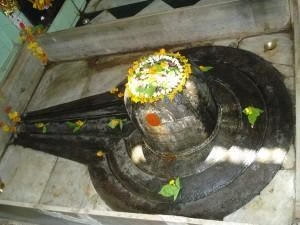
The presiding deity here is a Swayambhu (self-manifested) Shiv Ling. Unlike other shrines where the focus is strictly on Shiva, Garudeshwar Temple holds a special place for devotees of the Sanskriti Garuda (the celestial vehicle of Vishnu). It is believed that worshiping here offers a harmonious balance of wisdom and protection.
Phalaśruti: The Benefits of Visiting
According to the Kashi Khand (Chapter 50) of the Skanda Purana, visiting this temple yields profound spiritual benefits:
- Ultimate Knowledge (Vidya): Devotees are blessed with heightened intelligence and learning.
- Ancestral Karma Cleansing: It is specifically recommended for Pitra Dosha (ancestral defects), helping liberate ancestors from the cycle of rebirth.
- Removal of Slavery (Dasa Bhava): Just as Garuda freed his mother Vinata from slavery, devotees seeking freedom from debts or servitude find solace here.
Historical Origins & Scriptural Legend
The history of Garudeshwar Temple is deeply intertwined with one of the most significant legends in Hindu mythology.
The Legend of Vinata and Garuda
Tradition holds that Garuda, the mighty bird and vehicle of Lord Vishnu, brought his mother, Queen Vinata, to the holy city of Kashi. Vinata had been enslaved by her co-wife, Kadru, due to a curse. She yearned for atonement (Prayaschitta) to free herself from this karmic bondage.
In Kashi, Garuda installed a Shiv Ling and performed intense Tapasya (penance). Lord Shiva appeared and blessed Garuda, decreeing that he would forever be honored as the divine vehicle of Vishnu. Furthermore, Shiva manifested as Garudeshwar to reside eternally in Kashi, ensuring that any devotee worshiping him would attain Moksha (liberation).
Note: While exact construction dates are lost to time, the temple structure reflects centuries of renovation common to Kashi’s spiritual centers. The rituals established here are ancient, traced back to the era of the Kashi Naresh (Kings of Varanasi).
Architectural Marvels
The temple architecture is a harmonious blend of traditional Nagara style elements adapted to the compact urban layout of Varanasi.
Sanctum and Structure
The sanctum sanctorum (Garbhagriha) houses the Swayambhu Shiv Ling. The Shikhara (tower) above the shrine, while modest compared to larger temples, is adorned with intricate carvings depicting scenes from the Puranas. The interior follows Vastu Shastra principles, with the Linga positioned to receive the natural energy flow of the Ganges basin.
Iconography
A distinct feature is the presence of Lord Garuda in human form, standing in a posture of eternal prayer (Namaskar). The walls surrounding the sanctum feature sculptures of various manifestations of Shiva and Vishnu, emphasizing the unity of these supreme deities.
While the temple is not under the direct jurisdiction of the Archaeological Survey of India (ASI), it is maintained by the Kashi Vishwanath Trust and local custodians, preserving its ancient heritage.
Lord Shiva further blessed Garuda that those devotees who worship Garudeshwar will be blessed with Ultimate Knowledge. (Kashi Khand, Chapter 50).
Darshan & Ritual Logistics
To ensure a seamless spiritual experience, devotees should adhere to the following schedule and seva offerings. (Timings are based on typical Kashi temple schedules for 2026).
Daily Timings
| Darshan Type | Timing |
|---|---|
| Morning Darshan | 05:00 AM – 12:00 PM |
| Mid-day Closure | 12:00 PM – 4:00 PM (Cleansing & Rituals) |
| Evening Darshan | 4:00 PM – 10:00 PM |
| Aarti (Shringar) | 6:30 PM (Daily) |
Key Sevas & Online Booking
Devotees can book specific Sevas to enhance their pilgrimage:
- Abhishekam: Performed with milk, honey, and Gangajal (10:00 AM).
- Garuda Archana: Special offering for removing obstacles (Available throughout the day).
- Maha Aarti: Evening participation (Limited slots).
Booking: Online booking is available through the Official Kashi Vishwanath Trust Portal or via the Kashi Vishwanath App. Select “Garudeshwar Temple” under the associated shrines list.
2026 Major Festival Dates
- Maha Shivaratri: February 26, 2026 (Grand procession and night-long vigil).
- Shravan Month: July 14 – August 11, 2026 (Monday darshans are exceptionally crowded).
- Garuda Panchami: July 26, 2026 (Specific worship dedicated to the vehicle of Vishnu).
Practical Visitor Guidance
Visiting Varanasi requires preparation. Here are essential tips for your visit to Garudeshwar Temple.
Rules & Etiquette
- Dress Code: Traditional attire is mandatory. Men should wear dhotis or trousers with a shirt; women should wear sarees or full-length dresses.
- Photography: Strictly prohibited inside the Garbhagriha (sanctum).
- Mobile Phones: Carrying phones is allowed, but usage inside the inner shrine is forbidden. Lockers are available near the temple entrance for electronics.
Crowd Management
- Best Hours: For a peaceful darshan, visit between 8:00 AM and 10:00 AM, or between 5:00 PM and 7:00 PM.
- Seasonal Advice: Summers (May-June) in Varanasi are hot; carry a water bottle and head covering. Monsoon (July-Sept) brings humidity; an umbrella is essential.
- Accessibility: The temple is accessed via narrow bylanes. Accessible for wheelchairs up to the main market area, but inner pathways are uneven.
Pilgrimage Connectivity
Garudeshwar Temple is located in the Jangambadi locality, accessible from the Godowlia intersection.
How to Reach
- Nearest Airport: Lal Bahadur Shastri International Airport (LBS) – 25 km (approx. 1 hour drive).
- Nearest Railway Station: Varanasi Junction (BSB) – 5 km (Auto/Rickshaw recommended).
- By Road: The temple is 2 km from the Godowlia Chauraha. Approach from Dashashwamedh Ghat road, turning left at Bengali Tola Post Office.
Nearby Sacred Sites (Pilgrimage Circuit)
- Shri Kashi Vishwanath Temple: The main Jyotirlinga, located 1.5 km away (walking distance).
- Sanjay Durga Temple (Durga Kund): A vibrant red temple dedicated to Goddess Durga, 3 km away.
- Bharat Mata Mandir: Located near the ghats, featuring a relief map of undivided India, 2 km away.
Photo Gallery

Frequently Asked Questions (FAQ)
1. Is there a VIP Darshan entry at Garudeshwar Temple?
Yes, the Kashi Vishwanath Trust provides special entry passes for senior citizens, specially-abled devotees, and certain VIP categories. These can be obtained at the information center near the Godowlia gate or booked online.
2. What is the significance of offering water to Garudeshwar?
Offering Jalabhishek (water) to the Swayambhu Ling is believed to cool the internal energies of the devotee. It is specifically said to bring relief from mental stress and ancestral curses related to water elements.
3. Can I perform rituals for my ancestors here?
Absolutely. Given the legend of Vinata seeking atonement, this temple is highly recommended for Shraddha rituals and Pinda Daan to honor ancestors.
4. What are the contact details for the temple?
Garudeshwar Temple is located at D-31/43, Jangambadi Teliana, Varanasi. For inquiries, visitors can contact the main Kashi Vishwanath Trust helpline.
5. Is food available nearby?
Yes, the area surrounding the temple offers traditional Bhojanalayas serving vegetarian Satvik food. The famous Kashi Chat Bhandar is also within walking distance.
Recent Posts

Shri Kaamkoteeshwar Mandir, Varanasi – History & Significance
In the heart of Kashi, the eternal city of Lord Shiva, where the Ganges flows with celestial grace, stands the Shri Kaamkoteeshwar Mandir. This sacred Sannidhi is not merely a temple but a profound spiritual bridge between the Northern…

ओ सांवरे तूने ही मुझको संभाला – Lyrics & Meaning
ओ सांवरे तूने ही मुझको संभाला – A Prayer to Shyam Origin & Spiritual Essence Why This Bhajan Resonates Devotees chant this when overwhelmed by life’s storms—the refrain ‘तूने ही मुझको संभाला’ is the soul’s sigh of relief: “You…

कथा ये है महाराज मेरे की – Lyrics & Meaning
कथा ये है महाराज मेरे की छत्रपति संभाजी महाराज – A Prayer to Chhatrapati Sambhaji Maharaj Origin & Spiritual Essence Why This Bhajan Resonates Devotees chant this when their spirit feels tested—its powerful refrain “महाराज मेरे” is a soul’s…

Rigveda Samhita Yathartha Anuvada (ऋग्वेद संहिता यथार्थ अनुवाद) – Complete Set with Anvayartha & Hindi/English Translation
The Rigveda is the oldest surviving scripture of humanity and the foundational text of Sanātana Dharma. For serious students, scholars, UPSC aspirants studying ancient Indian history, Sanskrit learners, and spiritual seekers, a precise and grammatically structured translation is indispensable.…

आना भी अकेला है जाना भी अकेला है – Lyrics & Meaning | BharatTemples
आना भी अकेला है जाना भी अकेला है – A Prayer to the Divine Witness Origin & Spiritual Essence Why This Bhajan Resonates Devotees turn to this bhajan in moments of deep reflection—when life’s attachments begin to ache. The…

माता शेरावाली के द्वार जो भी जाता है – Lyrics & Meaning
माता शेरावाली के द्वार जो भी जाता है – A Prayer to Maa Sherawali Origin & Spiritual Essence Why This Bhajan Resonates Devotees turn to this bhajan in times of fear or uncertainty—its promise that no one leaves Maa’s…

मार लेना सपणी उबार लेणा भवरा – Lyrics & Meaning
मार लेना सपणी उबार लेणा भवरा – A Prayer to the Divine Beloved Origin & Spiritual Essence Why This Bhajan Resonates Devotees chant this in moments of deep vulnerability—its cry of “मार लेना सपणी, उबार लेणा भवरा” is the…

हमें श्याम सुंदर भरोसा तुम्हारा – Lyrics & Meaning
हमें श्याम सुंदर भरोसा तुम्हारा – A Prayer to Shyam Sundar Origin & Spiritual Essence Why This Bhajan Resonates Devotees chant this when feeling alone—its refrain ‘de do sahara’ is the soul’s cry for divine support. Lyrics in Hindi…

Mere Satguru Ne Di Thi Davai Lyrics in Hindi & Meaning
Mere Satguru Ne Di Thi Davai: Invoking the Guru’s Liberating Wisdom This soul-stirring bhajan venerates the Satguru (True Spiritual Master) as the divine physician who dispenses the only remedy for life’s deepest sufferings. Composed by Sant Karmaveer Tufani, it…

Janm Diyo Thari Maa Dukh Dekhiyo Lyrics in Hindi & Meaning
जन्म दियो थारी माँ दुख देखियो (Maa’s Grief Upon Birthing You) This soul-stirring Chetavani Bhajan (admonitory hymn) is addressed to the Divine Mother (Maa) – a call for repentance when children forget their filial duties in the dark age…