
Contents
Introduction & Spiritual Essence: The Astrological Grace of Kacheshwar
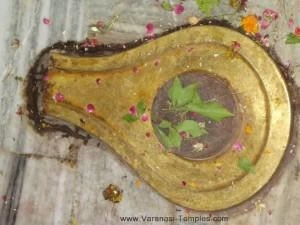
In the sacred geography of Kashi (Varanasi), the Kacheshwar Temple stands as a testament to the profound relationship between cosmic planets and divine energy. Dedicated to Lord Shiva in the form of Kacheshwar, this ancient shrine holds a unique spiritual significance rooted in the Kashi Khand of the Skanda Purana. The primary deity is a Swayambhu (self-manifested) Shiv Ling, revered for its direct connection to planetary influences.
The spiritual essence of this temple revolves around Shukra (Venus), one of the nine celestial planets (Navagrahas). According to ancient texts, Goddess Parvati once inquired about the various manifestations of Shiva in Kashi, and Lord Shiva revealed the location of the Kacheshwar Ling. The temple derives its name from Kach (meaning Venus or Mercury in various contexts, but here specifically tied to the Shukra Graha) and Ishwar (Shiva).
Phalaśruti (Spiritual Benefits):
Why do devotees flock to this sanctuary? The temple records and oral traditions state that those who worship Kacheshwar will find happiness and prosperity flowing into their lives. Furthermore, the temple houses the Shukra Koop (Shukra Well) right in front of the deity. It is believed that merely touching the water of this well bestows the religious merit (Punya) equivalent to performing an Aswamedha Yagya (Horse Sacrifice), one of the most potent Vedic rituals. Devotees visit specifically to mitigate the malefic effects of Venus in their astrological charts and to cleanse ancestral karma.
Historical Origins & Scriptural Legend
The history of Kacheshwar Temple is deeply intertwined with the textual traditions of Varanasi. While specific inscriptions regarding the exact century of construction are sparse—a common trait for many ancient shrines in Kashi that have undergone centuries of renovation—the theological foundation is robustly documented in the Kashi Khand, Chapter 97.
Scriptural Reference:
According to the Kashi Khand, the sacred geography of the city is mapped as a cosmic lotus, with Shiva Lingas placed strategically to absorb negative energies and radiate positivity. The legend narrates that the Kacheshwar Ling was established to balance the planetary energy of Venus (Shukra). Tradition holds that the temple has been a center of Vedic rituals since the pre-medieval era, rebuilt over time by local devotees and dynastic patrons to preserve its sanctity.
The Shukra Koop adds a layer of historical depth to the site. It is believed that this well is not merely a source of water but a Tirtha (pilgrimage site) with astrological remedial powers, a concept prevalent in Vedic times that continues to draw spiritual seekers today.
Architectural Marvels
The Kacheshwar Temple is a classic example of the Nagara style of Hindu temple architecture, adapted to the compact urban landscape of Varanasi’s narrow galis (lanes). While the exterior may appear modest compared to monumental temples, the interior geometry follows strict Vastu Shastra principles.
- Garbhagriha (Sanctum Sanctorum): The inner sanctum houses the Swayambhu Shiv Ling, oriented towards the north to align with the flow of cosmic energy. The Ling is bathed in natural light filtered through a small aperture in the ceiling, symbolizing the connection between the earth and the divine.
- Mandapas (Halls): The temple features a compact Mandapa that allows for circumambulation (Pradakshina). The pillars, though simple, bear the traditional Indian architectural motifs found in Gupta and medieval-era structures prevalent in Kashi.
- Notable Sculptures: Inside the sanctum, alongside the main deity, smaller niches often house idols of Lord Ganesha and the Navagrahas, emphasizing the astrological focus of the temple.
Although the temple does not possess a towering Shikhara (spire) like the grand Kashi Vishwanath Temple, its architectural beauty lies in its symmetry and the ancient stone masonry that resonates with the vibrations of centuries of chanting.
Darshan & Ritual Logistics
To ensure a smooth pilgrimage experience in 2026, devotees should note the daily schedules and ritual options. The temple follows the standard Varanasi temple timings, opening early in the morning and closing after the evening Aarti.
Daily Timings
| Session | Timing | Activity |
|---|---|---|
| Morning | 5:00 AM – 12:00 PM | Mangala Aarti, Abhishekam, Darshan |
| Afternoon | 12:00 PM – 4:00 PM | Rest Period (Sanctum closed) |
| Evening | 4:00 PM – 9:00 PM | Sandhya Aarti, Darshan |
Key Sevas & Online Booking
Devotees can participate in specific rituals to enhance the astrological benefits of the visit:
- Abhishekam: Ritual bathing of the Shiv Ling with milk, honey, ghee, and sugar. This is highly recommended for removing obstacles.
- Archana (Pooja): Offering of bilva leaves and flowers. The priests chant specific Mantras dedicated to Shukra (Venus).
- Rudra Abhishek: A comprehensive Vedic ritual performed for overall well-being.
Online Booking: While many independent smaller temples in Varanasi handle bookings directly through on-site priests, specific Archana and Abhishekam slots for Kacheshwar Temple can be coordinated through the central Kashi Vishwanath Temple Trust portals or local authorized Pandits in Varanasi. It is advisable to book Pujas 24 hours in advance during festival seasons.
2026 Festival Calendar (Major Dates)
- Maha Shivaratri: February 26, 2026 (Extended hours likely).
- Pradosh Vrat: Monthly; key dates include January 11, February 10, March 12, April 10, May 10 (Check local Hindu Panchang for exact Tithi).
- Makar Sankranti (Ganga Snan): January 14, 2026.
- Nag Panchami: August 2, 2026.
Practical Visitor Guidance
Visiting Kacheshwar Temple requires navigating the heritage lanes of Varanasi. Here is what you need to know:
- Dress Code: Modest attire is mandatory. Traditional Indian clothing (Saree, Kurta-Pajama, Dhoti) is highly recommended. Western attire (shorts, miniskirts) is strictly prohibited inside the sanctum.
- Photography & Mobiles: Photography is generally restricted inside the inner sanctum. Flash photography is prohibited. It is best to keep mobile phones on silent mode.
- Lockers: Due to the temple’s ancient structure and narrow lanes, there are limited high-tech locker facilities inside. Devotees are advised to carry minimal luggage. Small bags can be deposited at the shoe storage counter for a nominal fee.
- Accessibility: The approach lane to the temple is narrow and involves walking. It is not wheelchair accessible. The inner sanctum involves stepping over a stone threshold.
Crowd Management
- Best Hours: The best time for a peaceful Darshan is the early morning session (5:30 AM – 7:00 AM) or the afternoon gap (4:00 PM – 5:30 PM).
- Seasonal Advice: In May and June (peak summer), Varanasi experiences high heat and humidity. Carry a water bottle and a handkerchief (towel) to wipe sweat. Although fans are available, the narrow lanes can get stuffy. Monsoons (July-September) bring slippery stones; wear rubber-soled footwear with good grip.
Pilgrimage Connectivity
How to Reach Kacheshwar Temple
The temple is located at D-8/30, Kalika Galli, Varanasi. It is adjacent to the famous Shukreshwar Temple.
- Nearest Airport: Lal Bahadur Shastri International Airport (LBS) Varanasi (approx. 25 km / 60 mins by taxi). Taxis and auto-rickshaws are available to Godaulia/Lahurabir, from where you can walk to the lane.
- Nearest Railway Station: Varanasi Junction (BSB) (approx. 5 km / 20-30 mins by auto). The station is well-connected to all major Indian cities.
- Road Access: The temple is accessible via the main Lahurabir Road and the Varanasi-Allahabad Highway (NH 19). From the city center (Godaulia), it is a short rickshaw ride or a 15-minute walk through the heritage market lanes.
Nearby Sacred Sites (The Pilgrimage Circuit)
Since Kacheshwar Temple is located in a cluster of ancient shrines, you can easily visit these nearby sites:
- Shukreshwar Temple: Located immediately adjacent to Kacheshwar. Dedicated to Lord Shiva, this temple features a large courtyard and is a major hub for locals.
- Annapurna Temple: Just a short walk away in the Durga Kund area. It is the abode of the Goddess of food and nourishment.
- Durga Temple (Monkey Temple): Famous for its Nagara style architecture and red hue, located within the same complex of lanes.
Frequently Asked Questions (FAQ)
1. Is there a VIP Darshan entry at Kacheshwar Temple?
Unlike mega-temples like Tirupati or the main Kashi Vishwanath Corridor, Kacheshwar is a traditional neighborhood temple. There is no separate VIP entry. Darshan is based on the queue system, which is generally manageable compared to larger shrines.
2. What is the significance of the Shukra Koop (Well)?
The Shukra Koop is the astrological highlight of this temple. According to the Kashi Khand, touching the water of this well grants the devotee the spiritual merit equal to performing an Aswamedha Yagya. It is specifically worshipped to pacify the planet Venus (Shukra) in one’s horoscope.
3. Can we perform personal puja with our own priest?
Generally, the temple management appoints priests who are well-versed in the specific rituals of the temple. However, if you have a specific family priest in Varanasi, you may request permission to have them assist with the puja at the counter. It is subject to availability and the temple’s regulations.
4. What is the entry fee for the temple?
Entry to the Kacheshwar Temple is free for all devotees. Charges for specific Sevas (Abhishekam, Archana) vary depending on the materials used and the duration of the ritual. Cash is preferred for on-site donations.
5. Is non-vegetarian food allowed near the temple?
Kashi Vishwanath Temple and all associated shrines in Varanasi are strictly vegetarian zones. Alcohol and non-vegetarian food (including onion and garlic in some strict traditions) are prohibited in and around the temple precincts. Visitors should respect the sanctity of the area.
Photo Gallery

(Click to view images of Kacheshwar Temple, Shukra Koop, and the Kalika Galli complex)
Location & Map
Kacheshwar Temple, D-8/30, Kalika Galli, Varanasi, Uttar Pradesh 221001
Recent Posts

Shri Kaamkoteeshwar Mandir, Varanasi – History & Significance
In the heart of Kashi, the eternal city of Lord Shiva, where the Ganges flows with celestial grace, stands the Shri Kaamkoteeshwar Mandir. This sacred Sannidhi is not merely a temple but a profound spiritual bridge between the Northern…

ओ सांवरे तूने ही मुझको संभाला – Lyrics & Meaning
ओ सांवरे तूने ही मुझको संभाला – A Prayer to Shyam Origin & Spiritual Essence Why This Bhajan Resonates Devotees chant this when overwhelmed by life’s storms—the refrain ‘तूने ही मुझको संभाला’ is the soul’s sigh of relief: “You…

कथा ये है महाराज मेरे की – Lyrics & Meaning
कथा ये है महाराज मेरे की छत्रपति संभाजी महाराज – A Prayer to Chhatrapati Sambhaji Maharaj Origin & Spiritual Essence Why This Bhajan Resonates Devotees chant this when their spirit feels tested—its powerful refrain “महाराज मेरे” is a soul’s…

Rigveda Samhita Yathartha Anuvada (ऋग्वेद संहिता यथार्थ अनुवाद) – Complete Set with Anvayartha & Hindi/English Translation
The Rigveda is the oldest surviving scripture of humanity and the foundational text of Sanātana Dharma. For serious students, scholars, UPSC aspirants studying ancient Indian history, Sanskrit learners, and spiritual seekers, a precise and grammatically structured translation is indispensable.…

आना भी अकेला है जाना भी अकेला है – Lyrics & Meaning | BharatTemples
आना भी अकेला है जाना भी अकेला है – A Prayer to the Divine Witness Origin & Spiritual Essence Why This Bhajan Resonates Devotees turn to this bhajan in moments of deep reflection—when life’s attachments begin to ache. The…

माता शेरावाली के द्वार जो भी जाता है – Lyrics & Meaning
माता शेरावाली के द्वार जो भी जाता है – A Prayer to Maa Sherawali Origin & Spiritual Essence Why This Bhajan Resonates Devotees turn to this bhajan in times of fear or uncertainty—its promise that no one leaves Maa’s…

मार लेना सपणी उबार लेणा भवरा – Lyrics & Meaning
मार लेना सपणी उबार लेणा भवरा – A Prayer to the Divine Beloved Origin & Spiritual Essence Why This Bhajan Resonates Devotees chant this in moments of deep vulnerability—its cry of “मार लेना सपणी, उबार लेणा भवरा” is the…

हमें श्याम सुंदर भरोसा तुम्हारा – Lyrics & Meaning
हमें श्याम सुंदर भरोसा तुम्हारा – A Prayer to Shyam Sundar Origin & Spiritual Essence Why This Bhajan Resonates Devotees chant this when feeling alone—its refrain ‘de do sahara’ is the soul’s cry for divine support. Lyrics in Hindi…

Mere Satguru Ne Di Thi Davai Lyrics in Hindi & Meaning
Mere Satguru Ne Di Thi Davai: Invoking the Guru’s Liberating Wisdom This soul-stirring bhajan venerates the Satguru (True Spiritual Master) as the divine physician who dispenses the only remedy for life’s deepest sufferings. Composed by Sant Karmaveer Tufani, it…

Janm Diyo Thari Maa Dukh Dekhiyo Lyrics in Hindi & Meaning
जन्म दियो थारी माँ दुख देखियो (Maa’s Grief Upon Birthing You) This soul-stirring Chetavani Bhajan (admonitory hymn) is addressed to the Divine Mother (Maa) – a call for repentance when children forget their filial duties in the dark age…