
Contents
Introduction & Spiritual Essence
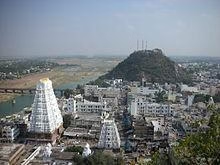
Srikalahasteeswara Temple, located in the town of Srikalahasti, Chittoor district, Andhra Pradesh, stands as a monumental beacon of Shaivism. It is one of the five most sacred Pancha Bhoota Sthalam temples in South India, representing the Vayu Sthalam (Element of Air). Unlike other temples where the form is static, here the deity is revered as Swayambhu (self-manifested).
The presiding deity, Lord Srikalahasteeswara, is an incarnation of Lord Shiva. The temple is uniquely dedicated to Vayu (the Wind God), who is considered an integral aspect of Shiva’s energy. Alongside the Shiva Lingam, the goddess Gnanaprasunambika (Parvati) is worshipped, completing the divine union (Ardhanarishvara concept).
Phalaśruti: Spiritual Benefits
The primary spiritual significance of this temple lies in its planetary influence. It is widely regarded as the most potent shrine for alleviating Rahu-Ketu Dosha (Kala Sarpa Yoga) and malefic planetary afflictions. Devotees visit seeking relief from chronic diseases, obstacles in career, and ancestral karma issues. It is believed that performing Rahu-Ketu Sarpa Dosha Nivarana Puja here cleanses the devotee’s lineage of past sins.
Historical Origins & Scriptural Legend
The Legend of Vayu and the Karpoora Lingam
According to the Sthala Purana, the Wind God, Vayu, performed an arduous penance here for thousands of years. He worshipped a Karpoora Lingam (a lingam made of camphor). Pleased by this devotion, Lord Shiva manifested and granted Vayu three boons:
- Ubiquity: Vayu would be present everywhere in the world.
- Vitality: He would become an inseparable part of every living being (Jiva).
- Nomenclature: The Lingam worshipped by Vayu would bear his name eternally.
Thus, the Lingam is known as Kalahasteeswara, and the temple is considered the earthly body of Lord Shiva, with the Gopuram (tower) representing the forehead and the Vimana representing the head.
Builders and Renovations
While the origins are ancient, the current temple structure is primarily attributed to the Pallava dynasty (9th century CE) and later the Chola kings, notably Rajendra Chola I. Significant renovations and additions, including the main Raja Gopuram, were undertaken during the Vijayanagara period (late 15th to early 16th century).
Architectural Marvels
The temple showcases a majestic blend of Dravidian architecture with influences from various dynasties that contributed to its construction. The complex is designed according to Vastu Shastra, aligning with the cardinal points to harness cosmic energies.
Structural Highlights:
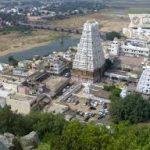
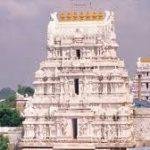
- Three Gopurams: The temple features three towering gopurams (gateways). The Raja Gopuram on the eastern side is the largest, while the Western Gopuram leads directly to the riverbed (Suvarnamukhi). The Northern Gopuram is intricately carved.
- Mandapas: The Maha Mandapa (Hall of Columns) contains exquisitely sculpted pillars depicting deities, celestial nymphs, and scenes from mythology. The ceiling is adorned with vibrant frescoes.
- The Sanctum: The Garbhagriha (sanctum) houses the Swayambhu Lingam. Uniquely, this is a narrow cave-like structure where devotees enter to offer prayers, symbolizing a journey inward.
- Sculptures: Notable is the sculpture of Nandi (the bull mount of Shiva), which is unusually large and positioned to face the Lingam.
While the temple is not a UNESCO heritage site, it is protected and maintained by the Archaeological Survey of India (ASI) and the Tirumala Tirupati Devasthanams (TTD), owing to its structural and spiritual importance.
Darshan & Ritual Logistics
Visiting Srikalahasteeswara Temple requires an understanding of the daily rituals and festivals. Below are the standard timings as of 2026. Note that timings may vary slightly during festivals.
Daily Timings
| Session | Timings | Details |
|---|---|---|
| Morning Darshan | 05:00 AM – 12:30 PM | Opens at 05:00 AM; Morning Puja till 12:30 PM. |
| Afternoon Break | 12:30 PM – 03:00 PM | Sanctum closed for restoration. |
| Evening Darshan | 03:00 PM – 08:00 PM | Reopens at 03:00 PM; Closing depends on events. |
| Night Darshan | 08:00 PM – 09:00 PM | Specific to Ekadashi and Pradosha days. |
Key Sevas & Online Booking
Bookings for special Sevas can be made via the official TTD website or the temple counter. Advance booking is recommended for the following:
- Rahu-Ketu Sarpa Dosha Nivarana Puja: Performed between 06:00 AM and 6:00 PM. Requires one day prior registration.
- Abhishekam: Daily morning ritual offering sacred baths to the deity.
- Laksharchana: Recitation of one lakh names of Shiva.
- Pradosha Vrata: Performed on the 13th day of the lunar fortnight.
2026 Major Festivals
- Maha Shivaratri (Feb 26, 2026): The temple remains open 24 hours for darshan. Special Jagaranam (vigil) and cultural programs are held.
- Sri Kalahasti Brahmotsavam (Mar 26 – Apr 5, 2026): The annual festival spanning 10 days. The last day marks the Rathotsavam (Chariot procession).
- Karthikai Deepam (Nov 8, 2026): Lighting of lamps to signify the eternal flame.
Practical Visitor Guidance
Dress Code & Etiquette
Devotees are required to wear traditional attire. Men should wear Dhotis or trousers with a shirt (no shorts). Women should wear sarees, half-sarees, or Salwar Kameez. Modesty is strictly enforced.
Photography & Electronics
Photography is strictly prohibited inside the inner sanctum. Mobile phones and electronic devices must be deposited at the free locker facilities provided at the temple entrance.
Crowd Management & Best Time to Visit
The temple witnesses heavy crowds during weekends and festivals.
- Best Hours: 9:00 AM to 11:00 AM on weekdays.
- Seasonal Advice: Srikalahasti can get extremely hot in May and June. Carry a water bottle and an umbrella. The monsoon season (July-Sept) offers pleasant weather but requires rain gear.
Pilgrimage Connectivity
How to Reach
Srikalahasti is strategically located, making it a vital stop on the Tirupati pilgrimage circuit.
- By Air: The nearest airport is Tirupati Airport (TIR), located approximately 29 km away. International connectivity is available via Chennai International Airport (MAA), roughly 96 km away.
- By Rail: Srikalahasti Railway Station is a major stop on the Tirupati–Renigunta section. It is well-connected to Chennai, Bangalore, and Hyderabad.
- By Road: The town is connected via National Highway (NH) 65 (Vijayawada-Nellore route) and State Highways. Regular buses are available from Tirupati (approx. 36 km) and Chittoor.
Nearby Sacred Sites
- Kundanakaveri (Kashi Kshetram): Located just 1 km away, it is believed that taking a dip in the Suvarnamukhi river here washes away sins equivalent to those of Kashi.
- Vayu Lingam (Veyilingalakona): A rugged hill trek about 12 km from Srikalahasti, where Vayu is said to have worshipped.
- Tirupati (Venkateswara Swamy Temple): 36 km away. Often combined as a single pilgrimage trip.
Photo Gallery
Frequently Asked Questions (FAQs)
1. Is there a VIP darshan entry available?
Yes, Srikalahasteeswara Temple offers a Divya Darshanam (Special Entry Darshan) ticket costing a nominal fee (typically ₹50-100). This allows devotees to bypass the general queue. VIP tickets are usually available through recommendation letters from local MLAs/MPs.
2. Can we perform Rahu-Ketu Dosha Puja without prior booking?
It is highly recommended to book online via the official TTD portal at least 15 days in advance. However, limited offline tickets are released daily based on availability.
3. Is the temple accessible for senior citizens and differently-abled devotees?
Yes, the temple authorities provide a free wheelchair service at the entrance. Additionally, battery-operated vehicles are available to transport devotees from the main road to the temple gate.
4. Are non-Hindus allowed inside the temple?
As per the temple tradition maintained by TTD, entry into the inner sanctum is restricted to followers of Hinduism. However, the outer courtyards and architecture are often visible from the entrance gates.
5. What are the accommodation facilities available?
TTD has established two guest houses: Sri Kalahasteeswara Guest House and Varaha Guest House. Private hotels and lodges are also abundant in the town center, catering to various budgets.
Contact Details
Official Address:
Srikalahasti Temple, Srikalahasti, Chittoor District, Andhra Pradesh 517644
Phone: 08578-222240
Location Map
Recent Posts

Shri Kaamkoteeshwar Mandir, Varanasi – History & Significance
In the heart of Kashi, the eternal city of Lord Shiva, where the Ganges flows with celestial grace, stands the Shri Kaamkoteeshwar Mandir. This sacred Sannidhi is not merely a temple but a profound spiritual bridge between the Northern…

ओ सांवरे तूने ही मुझको संभाला – Lyrics & Meaning
ओ सांवरे तूने ही मुझको संभाला – A Prayer to Shyam Origin & Spiritual Essence Why This Bhajan Resonates Devotees chant this when overwhelmed by life’s storms—the refrain ‘तूने ही मुझको संभाला’ is the soul’s sigh of relief: “You…

कथा ये है महाराज मेरे की – Lyrics & Meaning
कथा ये है महाराज मेरे की छत्रपति संभाजी महाराज – A Prayer to Chhatrapati Sambhaji Maharaj Origin & Spiritual Essence Why This Bhajan Resonates Devotees chant this when their spirit feels tested—its powerful refrain “महाराज मेरे” is a soul’s…

Rigveda Samhita Yathartha Anuvada (ऋग्वेद संहिता यथार्थ अनुवाद) – Complete Set with Anvayartha & Hindi/English Translation
The Rigveda is the oldest surviving scripture of humanity and the foundational text of Sanātana Dharma. For serious students, scholars, UPSC aspirants studying ancient Indian history, Sanskrit learners, and spiritual seekers, a precise and grammatically structured translation is indispensable.…

आना भी अकेला है जाना भी अकेला है – Lyrics & Meaning | BharatTemples
आना भी अकेला है जाना भी अकेला है – A Prayer to the Divine Witness Origin & Spiritual Essence Why This Bhajan Resonates Devotees turn to this bhajan in moments of deep reflection—when life’s attachments begin to ache. The…

माता शेरावाली के द्वार जो भी जाता है – Lyrics & Meaning
माता शेरावाली के द्वार जो भी जाता है – A Prayer to Maa Sherawali Origin & Spiritual Essence Why This Bhajan Resonates Devotees turn to this bhajan in times of fear or uncertainty—its promise that no one leaves Maa’s…

मार लेना सपणी उबार लेणा भवरा – Lyrics & Meaning
मार लेना सपणी उबार लेणा भवरा – A Prayer to the Divine Beloved Origin & Spiritual Essence Why This Bhajan Resonates Devotees chant this in moments of deep vulnerability—its cry of “मार लेना सपणी, उबार लेणा भवरा” is the…

हमें श्याम सुंदर भरोसा तुम्हारा – Lyrics & Meaning
हमें श्याम सुंदर भरोसा तुम्हारा – A Prayer to Shyam Sundar Origin & Spiritual Essence Why This Bhajan Resonates Devotees chant this when feeling alone—its refrain ‘de do sahara’ is the soul’s cry for divine support. Lyrics in Hindi…

Mere Satguru Ne Di Thi Davai Lyrics in Hindi & Meaning
Mere Satguru Ne Di Thi Davai: Invoking the Guru’s Liberating Wisdom This soul-stirring bhajan venerates the Satguru (True Spiritual Master) as the divine physician who dispenses the only remedy for life’s deepest sufferings. Composed by Sant Karmaveer Tufani, it…

Janm Diyo Thari Maa Dukh Dekhiyo Lyrics in Hindi & Meaning
जन्म दियो थारी माँ दुख देखियो (Maa’s Grief Upon Birthing You) This soul-stirring Chetavani Bhajan (admonitory hymn) is addressed to the Divine Mother (Maa) – a call for repentance when children forget their filial duties in the dark age…