
Contents
1. Introduction & Spiritual Essence
The Sri Govindaraja Swamy Temple, located in the heart of Tirupati, is a monumental gateway to the spirituality of Andhra Pradesh. Constructed in 1130 AD and consecrated by the revered Saint Ramanujacharya, this temple serves as the spiritual anchor for the hill town of Tirupati. While Lord Venkateswara resides atop the seven hills, his elder brother, Govindaraja, awaits devotees at the foothills, offering blessings and solace to the weary pilgrim.
The primary deity, Sri Govindaraja Swamy, is depicted in a majestic reclining posture (Veerasayana), serving as the guardian of the first level of the spiritual ascent towards Tirumala.
Phalaśruti (Spiritual Benefits):
Devotees visit the Govindaraja Temple primarily to seek blessings for prosperity and the removal of financial obstacles. According to local legends, Govindaraja managed the wealth of King Kubera to finance the celestial wedding of Lord Srinivasa (Venkateswara) and Padmavathi. Consequently, worshipping him is believed to:
- Wealth Accumulation: Enhance financial stability and attract prosperity.
- Karmic Cleansing: Specific rituals here are believed to cleanse ancestral karma, particularly those stemming from financial mismanagement or dishonesty.
- Marital Harmony: As he organized the divine wedding, prayers for a harmonious union are often offered here.
2. Historical Origins & Scriptural Legend
Architectural Timeline
According to temple records, the complex was built during the 12th Century, circa 1130 AD. However, archaeological evidence suggests that parts of the structure predate the main consecration, with elements dating back to the 9th and 10th centuries, likely belonging to an earlier shrine dedicated to Parthasarathy Swamy. The temple complex is one of the earliest and largest in the Chittoor district, serving as the nucleus around which the city of Tirupati developed.
Scriptural & Oral Legends
The Sthala Purana (local legend) revolves around the divine wealth management capabilities of Lord Govindaraja. Tradition holds that the city of Tirupati was originally a village named Kotturu at the foot of the Tirumala hills. When Lord Srinivasa decided to marry Goddess Padmavathi, he borrowed immense wealth from King Kubera to finance the grand event.
Lord Govindaraja (also known as Sri Raja Govindaraja or Tiruvenkatam) was assigned the task of managing this wealth and organizing the wedding. It is said that he possessed a unique blessing line on his left palm, signifying the return of four times the wealth borrowed. The temple stands today as a testament to this grand event, and devotees believe he retains the power to unlock abundance for his followers.
3. Architectural Marvels
Dravidian Style & Vastu Shastra
The temple is a masterpiece of the Dravidian architectural style. The structure is designed according to Vastu Shastra principles, ensuring a flow of positive energy. The temple is oriented to align with the natural geography of the Tirupati region, facilitating a spiritual progression from the bustling town to the serene sanctum.
The Raja Gopuram
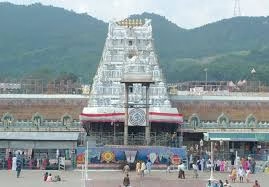
The most striking feature is the towering Raja Gopuram (main gateway tower). This multi-tiered structure is adorned with intricate carvings depicting scenes from Hindu mythology and the life of the Vaishnava saints. The gopuram acts as a threshold between the mundane and the divine, towering over the streets of Tirupati.
Sanctum & Mandapas
The inner sanctum houses the Veerasayana (reclining) form of Lord Govindaraja, facing east. The complex includes a large Mandapa (hall) supported by stone pillars featuring detailed sculptures. While the temple does not currently hold a UNESCO status, it is protected and maintained by the Tirumala Tirupati Devasthanams (TTD), ensuring the preservation of its historical integrity.
4. Darshan & Ritual Logistics
Daily Timings (2026 Schedule)
The temple follows a rigorous Vedic schedule to facilitate both early morning and evening prayers.
| Session | Timings | Description |
|---|---|---|
| Morning | 05:00 AM – 12:00 PM | Suprabhatam, Thomala, Archana |
| Afternoon | 12:00 PM – 05:00 PM | Rest Interval / Cleaning |
| Evening | 05:00 PM – 09:00 PM | Draws of Aaradhana, Ekantha Seva |
Key Sevas & Online Booking
Devotees can participate in several rituals. The most prominent is the Nitya Kalyanam (daily wedding ritual) of Govindaraja and his consorts.
- Abhishekam: Performed on Thursdays and Saturdays.
- Archana: Can be performed daily by offering flowers and prasadam.
- Seva Booking: All sevas can be booked via the official TTD website (ttdevasthanams.ap.gov.in). Tickets for Nitya Kalyanam are limited and released monthly.
Major Festivals 2026
The temple comes alive during the annual Brahmotsavam. In 2026, the key festival dates are:
- Brahmotsavam: (Dates vary by the Hindu calendar; typically March/April) – A 9-day festival featuring a grand procession of Sri Govindaraja Swamy in different Vahanas.
- Vaikuntha Ekadasi: December 29, 2026. This is a high-traffic event; the temple remains open for 24 hours.
- Ramanujacharya Jayanti: Celebrated with special homams and spiritual discourses.
5. Practical Visitor Guidance
Dress Code & Etiquette
As a major Vaishnavite shrine maintained by TTD, traditional attire is mandatory.
- Men: Dhoti or Panchakacham (lungi not allowed) and shirt is optional but recommended.
- Women: Saree, Half-Saree, or Chudidhar with Dupatta.
- Prohibited: T-shirts, jeans, shorts, and skirts are strictly prohibited.
Photography & Electronics
Photography is strictly prohibited inside the sanctum sanctorum. Mobile phones and cameras are allowed in the outer corridors but must be silenced during rituals.
Crowd Management & Best Time to Visit
As this is the entry point for many Tirumala pilgrims, it can get crowded.
- Best Hours: 6:00 AM – 8:00 AM (least crowded) or 7:00 PM – 9:00 PM (peaceful atmosphere).
- Seasonal Advice: During the summer (April–June), Tirupati experiences high temperatures (up to 40°C). Carry a water bottle and an umbrella. Monsoons (July–September) are lush but may cause travel delays.
- Accessibility: The temple is on level ground, making it wheelchair accessible via the side entrances, though the main hall is crowded.
6. Pilgrimage Connectivity
How to Reach
- By Rail: Tirupati Railway Station is the nearest hub, located just 500 meters (approx. 10-minute walk) from the temple.
- By Air: Tirupati International Airport (TIR) is located in Renigunta, approximately 15 km away. Taxis and APSRTC buses are available.
- By Road: The city is well-connected via NH 71. The Tirupati RTC Bus Stand is 1.5 km from the temple.
Nearby Sacred Sites (Pilgrimage Circuit)
A visit to Govindaraja Temple is incomplete without exploring these nearby shrines, all within walking or auto-rickshaw distance:
- Kapila Theertham: A famous Shiva temple located at the foothills of Tirumala, just 1 km away.
- ISKCON Temple: A modern yet spiritual architectural gem located 2 km away.
- Sri Kodanda Rama Swamy Temple: Located near the railway station, this temple holds significant history regarding the presiding deities.
7. Frequently Asked Questions (FAQ)
1. Is there a VIP darshan entry available?
No, the Govindaraja Temple does not have a specific VIP entry like Tirumala. However, TTD employees and those with special recommendations from TTD officials may have priority access during peak hours. General darshan is open to all.
2. Can I perform the Nitya Kalyanam seva online?
Yes, the Nitya Kalyanam (daily wedding ritual) tickets are available for booking online via the TTD official portal. These tickets are released on specific dates every month and sell out quickly.
3. Is there accommodation near the temple?
TTD operates several guest houses (choultries) in Tirupati, such as the Sri Srinivasa Guest House and Sri Venkateswara Guest House, which are within walking distance. Private hotels are also available in the adjacent streets.
4. What is the entry fee?
Entry to the temple is free for all devotees. However, special darshan tickets (approx. Rs. 50) are available to skip the general queue, depending on the time of day.
5. What is the historical significance of the architecture before 1130 AD?
Structural excavations reveal that the core structure likely dates back to the 9th or 10th century, originally dedicated to Lord Parthasarathy. Ramanujacharya consecrated the current deity of Govindaraja in the 12th century, repurposing the existing Dravidian masonry.
Recent Posts

Shri Kaamkoteeshwar Mandir, Varanasi – History & Significance
In the heart of Kashi, the eternal city of Lord Shiva, where the Ganges flows with celestial grace, stands the Shri Kaamkoteeshwar Mandir. This sacred Sannidhi is not merely a temple but a profound spiritual bridge between the Northern…

ओ सांवरे तूने ही मुझको संभाला – Lyrics & Meaning
ओ सांवरे तूने ही मुझको संभाला – A Prayer to Shyam Origin & Spiritual Essence Why This Bhajan Resonates Devotees chant this when overwhelmed by life’s storms—the refrain ‘तूने ही मुझको संभाला’ is the soul’s sigh of relief: “You…

कथा ये है महाराज मेरे की – Lyrics & Meaning
कथा ये है महाराज मेरे की छत्रपति संभाजी महाराज – A Prayer to Chhatrapati Sambhaji Maharaj Origin & Spiritual Essence Why This Bhajan Resonates Devotees chant this when their spirit feels tested—its powerful refrain “महाराज मेरे” is a soul’s…

Rigveda Samhita Yathartha Anuvada (ऋग्वेद संहिता यथार्थ अनुवाद) – Complete Set with Anvayartha & Hindi/English Translation
The Rigveda is the oldest surviving scripture of humanity and the foundational text of Sanātana Dharma. For serious students, scholars, UPSC aspirants studying ancient Indian history, Sanskrit learners, and spiritual seekers, a precise and grammatically structured translation is indispensable.…

आना भी अकेला है जाना भी अकेला है – Lyrics & Meaning | BharatTemples
आना भी अकेला है जाना भी अकेला है – A Prayer to the Divine Witness Origin & Spiritual Essence Why This Bhajan Resonates Devotees turn to this bhajan in moments of deep reflection—when life’s attachments begin to ache. The…

माता शेरावाली के द्वार जो भी जाता है – Lyrics & Meaning
माता शेरावाली के द्वार जो भी जाता है – A Prayer to Maa Sherawali Origin & Spiritual Essence Why This Bhajan Resonates Devotees turn to this bhajan in times of fear or uncertainty—its promise that no one leaves Maa’s…

मार लेना सपणी उबार लेणा भवरा – Lyrics & Meaning
मार लेना सपणी उबार लेणा भवरा – A Prayer to the Divine Beloved Origin & Spiritual Essence Why This Bhajan Resonates Devotees chant this in moments of deep vulnerability—its cry of “मार लेना सपणी, उबार लेणा भवरा” is the…

हमें श्याम सुंदर भरोसा तुम्हारा – Lyrics & Meaning
हमें श्याम सुंदर भरोसा तुम्हारा – A Prayer to Shyam Sundar Origin & Spiritual Essence Why This Bhajan Resonates Devotees chant this when feeling alone—its refrain ‘de do sahara’ is the soul’s cry for divine support. Lyrics in Hindi…

Mere Satguru Ne Di Thi Davai Lyrics in Hindi & Meaning
Mere Satguru Ne Di Thi Davai: Invoking the Guru’s Liberating Wisdom This soul-stirring bhajan venerates the Satguru (True Spiritual Master) as the divine physician who dispenses the only remedy for life’s deepest sufferings. Composed by Sant Karmaveer Tufani, it…

Janm Diyo Thari Maa Dukh Dekhiyo Lyrics in Hindi & Meaning
जन्म दियो थारी माँ दुख देखियो (Maa’s Grief Upon Birthing You) This soul-stirring Chetavani Bhajan (admonitory hymn) is addressed to the Divine Mother (Maa) – a call for repentance when children forget their filial duties in the dark age…