
Contents
Introduction & Spiritual Essence of Yaganti
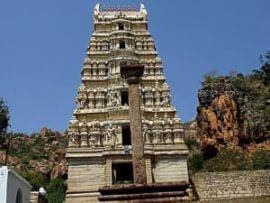
Located in the rugged red sandstone terrain of the Kurnool district in Andhra Pradesh, the Sri Yaganti Uma Maheswara Temple stands as a testament to unwavering devotion and miraculous legends. Dedicated primarily to Lord Shiva (as Maheswara) and Goddess Parvathi (as Uma), this temple offers a unique spiritual atmosphere distinct from other Shiva temples in South India. The temple is renowned for its Swayambhu (self-manifested) idol of Lord Shiva, which is carved from a single stone.
Phalaśruti: The Spiritual Benefits
Devotees believe that a visit to Yaganti Temple brings profound spiritual merit and specific blessings:
- Ancestral Cleansing: Performing rituals here is believed to help cleanse Pitru Dosha (ancestral karma), bringing peace to departed souls.
- Fulfillment of Desires: The temple is known as a Sakthi Peetham where intense prayers are answered.
- Removal of Fear: The presence of Lord Shiva in a benevolent form removes fear (Bhaya) and obstacles from the lives of devotees.
Historical Origins & Scriptural Legend
The history of Yaganti Temple is a blend of royal patronage and divine intervention. It is one of the few temples in India that has not experienced a decline in worship over centuries.
Construction and Patronage
According to historical records, the temple was constructed in the 15th century (approximately 1400–1500 AD) by King Harihara Bukka Raya of the Sangama Dynasty, one of the ruling dynasties of the Vijayanagara Empire. Notably, the construction was carried out according to Vaishnavaite traditions, despite the temple being dedicated to Lord Shiva, showcasing the syncretic harmony of the era.
The Sthala Purana (Legend of Agastya Rishi)
Tradition holds that the great sage Agastya wished to construct a temple for Lord Venkateswara (Lord Vishnu) at this site. However, during the carving process, the toe nail of the idol broke. Distraught by this omen, Agastya performed a severe penance to please Lord Shiva. Shiva appeared and revealed that the site naturally resembled Mount Kailash and was more suited for him. He manifested as the Uma Maheswara murti (a single stone idol of Shiva and Parvathi).
The Legend of Chitteppa
Another popular local story revolves around Chitteppa, a devotee of Shiva. While offering worship, Shiva appeared to him in the form of a tiger (Narasimha avatar connection). Unafraid, Chitteppa realized it was the Lord and shouted, “Neganti Shivanu ne kanti” (I saw Shiva, I saw Shiva). He danced in ecstasy. A cave near the temple, where he reportedly meditated, is still visited by pilgrims.
Architectural Marvels
The Yaganti Temple is a masterpiece of Dravidian architecture executed in local red sandstone (squarish sandstone blocks). The architecture adheres strictly to Shilpa Shastra and Vastu Shastra.
Structure and Sculpture
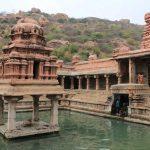
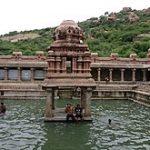
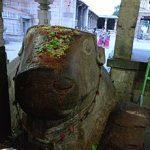
The temple complex features a monumental Raja Gopuram (gateway tower) and a spacious Mandapa (hall) with intricately carved pillars. These pillars depict various deities and mythological scenes from the Puranas. The central shrine (Garbhagriha) houses the Swayambhu idol. A striking feature is the Nandi (the bull vehicle of Shiva) statue, which faces the main deity. Uniquely, the Nandi is not made of a single stone but is a composite of bricks and mortar, adhering to specific religious constraints believed to have been established by sage Agastya.
Conservation Status
The temple is maintained by the Tirumala Tirupati Devasthanams (TTD), ensuring the preservation of its structural integrity. While not a UNESCO site, it is a state-protected monument of immense archaeological value.
Darshan & Ritual Logistics (2026 Guide)
To facilitate a smooth pilgrimage, we have outlined the daily schedule and key rituals below. Note that timings may vary slightly during festival seasons.
Daily Temple Timings
| Session | Timing |
|---|---|
| Morning Opening | 6:00 AM (Suprabhatam) |
| Morning Darshan | 6:30 AM – 1:00 PM |
| Evening Opening | 3:00 PM |
| Evening Darshan | 3:00 PM – 8:00 PM |
Key Sevas & Online Booking
Devotees can book specific Sevas in advance. The temple administration encourages online bookings to manage crowd flow.
- Abhishekam: Performed to the Swayambhu murti with water, milk, and honey. Best time: 9:00 AM – 10:00 AM.
- Archana: Recitation of hymns in the name of the devotee.
- Kumkumarchana: A special ritual dedicated to Goddess Parvathi.
Booking Note: Visit the official TTD website or the dedicated Yaganti portal to reserve slots for 2026. ‘Special Entry Darshan’ tickets are available at the counter for same-day visits.
Festivals in 2026
- Maha Shivaratri (Feb 26, 2026): The most significant festival; the temple remains open 24 hours with special rituals and cultural programs.
- Karthika Masam (Nov 2026): Daily Deepam (lamp) lighting rituals.
- Ugadi (Mar 29, 2026): Telugu New Year celebrations with special Pujas.
Practical Visitor Guidance
Ensuring a comfortable visit is essential for focusing on the spiritual experience.
Dress Code & Etiquette
- Attire: Traditional Indian clothing (Dhoti/Saree) is preferred. However, modest western attire (covered shoulders and knees) is allowed.
- Photography: Strictly prohibited inside the Garbhagriha (Sanctum Sanctorum). Photography is permitted in the outer courtyards.
- Electronic Items: Mobile phones and cameras should be kept on silent. Lockers are available near the entrance for bags and footwear.
Crowd Management & Seasonal Advice
- Best Hours: Visit between 6:00 AM – 8:00 AM or after 5:00 PM to avoid peak crowds.
- Seasonal Tips:
- Summer (April–June): The region gets very hot. Carry a water bottle and wear protective headgear.
- Monsoon (July–Sept): The red soil becomes slippery; wear shoes with good grip.
- Accessibility: The temple has ramps for wheelchairs in the outer areas, but the inner sanctum involves steps.
Pilgrimage Connectivity
How to Reach Yaganti Temple
The temple is located approximately 14 km from Banaganapalle and 100 km from Kurnool.
- By Air: The nearest airport is KTJ (Kurnool Airport) (approx. 90 km). Alternatively, Hyderabad Rajiv Gandhi International Airport is 250 km away.
- By Rail: The nearest major railway junction is Kurnool Town (KRNT). From there, taxis and buses are readily available.
- By Road: The temple is accessible via the Pennar River Road and connects to the Kurnool-Pennai Anantapur Highway. APSRTC runs buses from Kurnool and Banaganapalle directly to Yaganti.
Nearby Sacred Sites
Extend your pilgrimage by visiting these nearby spiritual centers:
- Belum Caves: Located about 50 km away, these are the largest caves in India, housing a Buddhist monastery (founded in the 2nd century AD).
- Srisailam (Mallikarjuna Jyotirlinga): One of the 12 Jyotirlingas, located roughly 150 km from Yaganti.
- Mantralayam: The samadhi of Guru Raghavendra, approximately 100 km away.
Photo Gallery



Frequently Asked Questions (FAQs)
1. Is there a VIP Darshan entry at Yaganti Temple?
Yes, the temple administration offers a Special Entry Darshan for a nominal fee (usually around ₹100-₹200 depending on availability). This allows pilgrims to bypass the general queue during non-peak hours.
2. Can we perform Abhishekam personally?
Generally, only authorized priests perform the Abhishekam inside the sanctum. However, devotees can request the priest to perform specific rituals on their behalf while they are present.
3. Is Yaganti Temple open throughout the year?
Yes, the temple is open 365 days a year, except for temporary closures due to specific local festivals or maintenance, which are announced in advance.
4. What is the significance of the Nandi statue here?
The Nandi statue at Yaganti is made of bricks and lime mortar, unlike the usual stone carvings. Legend says that if a stone Nandi were made, the temple’s energy would become too intense for the devotees to bear, based on the instructions of Sage Agastya.
5. Are there accommodation facilities near the temple?
TTD has established guest houses and choultries in Yaganti, Banaganapalle, and Kurnool. It is advisable to book accommodation in advance via the TTD website, especially during Maha Shivaratri.
Contact Details
Official Address:
Sri Yaganti Uma Maheswara Temple,
Yaganti, Banaganapalle Mandal,
Kurnool District, Andhra Pradesh – 518124
Recent Posts

Shri Kaamkoteeshwar Mandir, Varanasi – History & Significance
In the heart of Kashi, the eternal city of Lord Shiva, where the Ganges flows with celestial grace, stands the Shri Kaamkoteeshwar Mandir. This sacred Sannidhi is not merely a temple but a profound spiritual bridge between the Northern…

ओ सांवरे तूने ही मुझको संभाला – Lyrics & Meaning
ओ सांवरे तूने ही मुझको संभाला – A Prayer to Shyam Origin & Spiritual Essence Why This Bhajan Resonates Devotees chant this when overwhelmed by life’s storms—the refrain ‘तूने ही मुझको संभाला’ is the soul’s sigh of relief: “You…

कथा ये है महाराज मेरे की – Lyrics & Meaning
कथा ये है महाराज मेरे की छत्रपति संभाजी महाराज – A Prayer to Chhatrapati Sambhaji Maharaj Origin & Spiritual Essence Why This Bhajan Resonates Devotees chant this when their spirit feels tested—its powerful refrain “महाराज मेरे” is a soul’s…

Rigveda Samhita Yathartha Anuvada (ऋग्वेद संहिता यथार्थ अनुवाद) – Complete Set with Anvayartha & Hindi/English Translation
The Rigveda is the oldest surviving scripture of humanity and the foundational text of Sanātana Dharma. For serious students, scholars, UPSC aspirants studying ancient Indian history, Sanskrit learners, and spiritual seekers, a precise and grammatically structured translation is indispensable.…

आना भी अकेला है जाना भी अकेला है – Lyrics & Meaning | BharatTemples
आना भी अकेला है जाना भी अकेला है – A Prayer to the Divine Witness Origin & Spiritual Essence Why This Bhajan Resonates Devotees turn to this bhajan in moments of deep reflection—when life’s attachments begin to ache. The…

माता शेरावाली के द्वार जो भी जाता है – Lyrics & Meaning
माता शेरावाली के द्वार जो भी जाता है – A Prayer to Maa Sherawali Origin & Spiritual Essence Why This Bhajan Resonates Devotees turn to this bhajan in times of fear or uncertainty—its promise that no one leaves Maa’s…

मार लेना सपणी उबार लेणा भवरा – Lyrics & Meaning
मार लेना सपणी उबार लेणा भवरा – A Prayer to the Divine Beloved Origin & Spiritual Essence Why This Bhajan Resonates Devotees chant this in moments of deep vulnerability—its cry of “मार लेना सपणी, उबार लेणा भवरा” is the…

हमें श्याम सुंदर भरोसा तुम्हारा – Lyrics & Meaning
हमें श्याम सुंदर भरोसा तुम्हारा – A Prayer to Shyam Sundar Origin & Spiritual Essence Why This Bhajan Resonates Devotees chant this when feeling alone—its refrain ‘de do sahara’ is the soul’s cry for divine support. Lyrics in Hindi…

Mere Satguru Ne Di Thi Davai Lyrics in Hindi & Meaning
Mere Satguru Ne Di Thi Davai: Invoking the Guru’s Liberating Wisdom This soul-stirring bhajan venerates the Satguru (True Spiritual Master) as the divine physician who dispenses the only remedy for life’s deepest sufferings. Composed by Sant Karmaveer Tufani, it…

Janm Diyo Thari Maa Dukh Dekhiyo Lyrics in Hindi & Meaning
जन्म दियो थारी माँ दुख देखियो (Maa’s Grief Upon Birthing You) This soul-stirring Chetavani Bhajan (admonitory hymn) is addressed to the Divine Mother (Maa) – a call for repentance when children forget their filial duties in the dark age…