
Contents
Introduction & Spiritual Essence
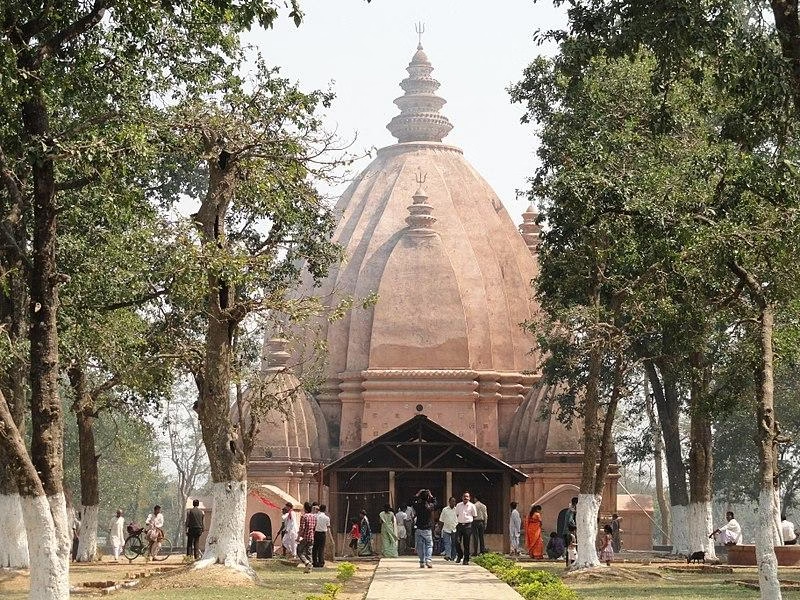
The Negheriting Shiva Doul, situated in the lush landscapes of Golaghat, Assam, stands as a profound testament to the enduring spiritual heritage of the Brahmaputra Valley. Dedicated to Lord Shiva, this ancient shrine is classified as a Swayambhu (self-manifested) Linga, a form where the divine energy is believed to have emerged naturally rather than being carved by human hands. Known locally among devotees as the Dergaon Shiva Doul, it serves as a vital spiritual anchor for the region.
Phalaśruti (Spiritual Benefits): According to local tradition and scriptural hearsay, worshipping the Negheriting Shiva Linga is believed to bestow specific spiritual benefits. Devotees visit specifically to perform Śrāddha (ancestral rites), believing that the sanctity of this Swayambhu Linga has the power to cleanse ancestral karma and grant Moksha (liberation) to departed souls. Regular pilgrims also visit to seek blessings for familial harmony and the removal of planetary afflictions, particularly those governed by Lord Shani (Saturn).
Historical Origins & Scriptural Legend
The history of the Negheriting Shiva Doul is a chronicle of resilience and divine will, spanning over a millennium. The temple’s origins trace back to the 8th – 9th century AD, a period when the Kachari dynasty held sway over significant parts of upper Assam. It is believed the original temple was constructed to enshrine the self-manifested Linga discovered in the region.
The Saga of Destruction and Reconstruction:
Tradition holds that the temple faced ruin due to natural calamities and the shifting course of the nearby river Dihing. The original Linga and stones were washed away and submerged in the riverbed. It wasn’t until the late 17th century, during the reign of the Ahom King Swargadeo Rajeswar Singha (1751–1769 AD), that the temple was revived. Historical records indicate that the King assigned the renowned architect Ghanashyam Khonikar to lead the reconstruction. The stones and the original Linga were miraculously recovered from the riverbed—a site now revered as Sheetal Negheri—and the temple was rebuilt with grandeur, blending Ahom aesthetics with traditional Hindu architectural styles.
Architectural Marvels
The Negheriting Shiva Doul is a classic example of the transition in Assamese temple architecture, showcasing a synthesis of indigenous styles. While the core sanctum (Garbhagriha) retains a distinct Koch and Kachari influence, the towering Shikhara (spire) reflects the later Ahom renovation.
- Garbhagriha and Mandapa: The temple is built on a raised plinth, featuring a rectangular Garbhagriha housing the Linga and a Granary-like structure typical of indigenous Assamese designs. The Mandapa (hall) is designed for congregational prayers and rituals.
- Sculptural Details: Unlike the intricate carvings of South Indian temples, this shrine features heavy, sturdy pillars and minimal exterior carvings, focusing on geometric patterns and lotus motifs. The massive stones used were believed to be transported from the banks of the Dihing river.
- Status: While it is a protected monument, the temple is revered more for its living devotional history than its UNESCO or ASI status. It represents the unique “Charaideo” style of temple architecture adapted for Shiva worship.
Darshan & Ritual Logistics
The spiritual atmosphere of the Negheriting Shiva Doul is most vibrant during the early morning and evening rituals. Below are the standard operational timings. Note that timings may vary slightly during major festivals.
| Session | Timing | Activity |
|---|---|---|
| Morning Darshan | 06:00 AM – 12:00 PM | Mangala Arati, Abhishekam, Pushpanjali |
| Mid-Day Break | 12:00 PM – 03:00 PM | Temple Cleaning / Sanctum Closed |
| Evening Darshan | 03:00 PM – 07:00 PM | Evening Arati, Bhog Offering |
Key Sevas & Online Booking
To facilitate devotees, the temple management committee (under the supervision of the Golaghat district administration) has streamlined several rituals. While direct online booking for this specific regional temple is limited compared to national shrines, notifications for Puja Samagri (materials) and donation receipts are often managed digitally.
- Abhishekam: Performed with water, milk, honey, and ghee. Special timing: 7:00 AM to 10:00 AM.
- Rudra Archana: Chanting of the Rudri mantra. Available between 10:00 AM and 11:30 AM.
- Maha Shivaratri 2026: February 26, 2026. This is the most significant festival here, celebrated with night-long chanting and a massive community feast (Prasad distribution).
- Kartik Puja: November 4, 2026. Observed with special lamp offerings.
Practical Visitor Guidance
Visiting the Negheriting Shiva Doul requires preparation due to its semi-rural location. The atmosphere is serene but strictly devotional.
- Dress Code: Traditional attire is recommended. Men should wear dhoti or pants with a shirt; women should wear saree or modest ethnic wear. Western clothing is discouraged within the inner sanctum.
- Photography Rules: Photography is permitted in the outer courtyard and temple complex. However, it is strictly prohibited inside the Garbhagriha (main sanctum).
- Mobile & Lockers: There are no automated lockers, but a dedicated counter is available to deposit mobile phones and electronics before entering the sanctum. This is mandatory to maintain spiritual silence.
- Crowd Management: The temple is relatively uncrowded on weekdays. The best hours for a peaceful darshan are 9:00 AM to 11:00 AM. During Maha Shivaratri and Sravan Maas, the temple sees heavy footfall; arriving at opening time (6:00 AM) is advised.
- Accessibility: The temple is situated on a hillock. There are steps leading to the entrance. While the path is maintained, it can be steep for elderly visitors. Wheelchair access is currently limited to the lower courtyard.
- Seasonal Advice: Golaghat can be humid in May and June. Carry a water bottle and umbrella. The monsoon season (July–September) brings lush greenery but also slippery steps; please exercise caution.
Pilgrimage Connectivity
The Negheriting Shiva Doul is well-connected to the main transport hubs of Assam, making it accessible for pilgrims from across the state and beyond.
How to Reach
- By Air: The nearest airport is Jorhat Airport (JRH), located approximately 55 km away. The nearest international airport is Lokpriya Gopinath Bordoloi International Airport (GAU) in Guwahati, roughly 220 km away.
- By Rail: The closest railway station is Mariani Junction (MXN) (approx. 25 km). Golaghat Railway Station (GOGH) is also nearby (approx. 18 km).
- By Road: The temple is situated just 1.5 km off National Highway 37 (NH 37). It is approximately 18 km from the district headquarters of Golaghat town. Auto-rickshaws and cabs are available from Dergaon and Golaghat.
Nearby Sacred Sites
To enrich your pilgrimage, consider visiting these nearby spiritual destinations:
- Kohora Namghar (Kaziranga): Located about 30 km away, this is a significant center of the Ekasarana Dharma movement and a gateway to the spiritual practices of the region.
- Bhuvan Ahom Palace (Jorhat): Located 45 km away, this historical site preserves the legacy of the Ahom kings, including Rajeswar Singha, who rebuilt the Negheriting temple.
- Gupteswar Temple (Numaligarh): A cave temple dedicated to Lord Shiva, located about 60 km away, offering a more rugged and meditative environment.
Frequently Asked Questions (FAQ)
1. What is the history of Negheriting Shiva Doul?
The temple was originally built by the Kachari dynasty in the 8th–9th century AD. It was destroyed by natural calamities and later reconstructed in the 18th century by the Ahom King Rajeswar Singha, who installed the present Swayambhu Linga recovered from the river Dihing.
2. Is there a VIP darshan entry available?
No, the Negheriting Shiva Doul does not have a formal VIP darshan entry system. It follows a traditional approach where all devotees wait their turn for the inner sanctum darshan. However, the waiting time is generally short compared to larger shrines.
3. How can I perform online seva booking for this temple?
Currently, the temple does not have a dedicated app for online seva booking. Devotees can contact the managing committee via the District Administration Office in Golaghat for advanced bookings of special pujas like Abhishekam. General donations can often be processed through bank transfers linked to the temple committee.
4. What is the significance of the stone pillars in the temple complex?
The stone pillars are remnants of the original 8th-century construction and the 17th-century reconstruction. They feature minimalistic designs typical of early Assamese architecture, emphasizing structural strength over intricate decoration.
5. Are non-Hindus allowed inside the temple?
While the temple is primarily a Hindu place of worship, the management committee generally allows all visitors to enter the outer courtyard to appreciate the architecture and history. However, entry into the inner sanctum (Garbhagriha) is traditionally reserved for practicing Hindus.



Recent Posts

Shri Kaamkoteeshwar Mandir, Varanasi – History & Significance
In the heart of Kashi, the eternal city of Lord Shiva, where the Ganges flows with celestial grace, stands the Shri Kaamkoteeshwar Mandir. This sacred Sannidhi is not merely a temple but a profound spiritual bridge between the Northern…

ओ सांवरे तूने ही मुझको संभाला – Lyrics & Meaning
ओ सांवरे तूने ही मुझको संभाला – A Prayer to Shyam Origin & Spiritual Essence Why This Bhajan Resonates Devotees chant this when overwhelmed by life’s storms—the refrain ‘तूने ही मुझको संभाला’ is the soul’s sigh of relief: “You…

कथा ये है महाराज मेरे की – Lyrics & Meaning
कथा ये है महाराज मेरे की छत्रपति संभाजी महाराज – A Prayer to Chhatrapati Sambhaji Maharaj Origin & Spiritual Essence Why This Bhajan Resonates Devotees chant this when their spirit feels tested—its powerful refrain “महाराज मेरे” is a soul’s…

Rigveda Samhita Yathartha Anuvada (ऋग्वेद संहिता यथार्थ अनुवाद) – Complete Set with Anvayartha & Hindi/English Translation
The Rigveda is the oldest surviving scripture of humanity and the foundational text of Sanātana Dharma. For serious students, scholars, UPSC aspirants studying ancient Indian history, Sanskrit learners, and spiritual seekers, a precise and grammatically structured translation is indispensable.…

आना भी अकेला है जाना भी अकेला है – Lyrics & Meaning | BharatTemples
आना भी अकेला है जाना भी अकेला है – A Prayer to the Divine Witness Origin & Spiritual Essence Why This Bhajan Resonates Devotees turn to this bhajan in moments of deep reflection—when life’s attachments begin to ache. The…

माता शेरावाली के द्वार जो भी जाता है – Lyrics & Meaning
माता शेरावाली के द्वार जो भी जाता है – A Prayer to Maa Sherawali Origin & Spiritual Essence Why This Bhajan Resonates Devotees turn to this bhajan in times of fear or uncertainty—its promise that no one leaves Maa’s…

मार लेना सपणी उबार लेणा भवरा – Lyrics & Meaning
मार लेना सपणी उबार लेणा भवरा – A Prayer to the Divine Beloved Origin & Spiritual Essence Why This Bhajan Resonates Devotees chant this in moments of deep vulnerability—its cry of “मार लेना सपणी, उबार लेणा भवरा” is the…

हमें श्याम सुंदर भरोसा तुम्हारा – Lyrics & Meaning
हमें श्याम सुंदर भरोसा तुम्हारा – A Prayer to Shyam Sundar Origin & Spiritual Essence Why This Bhajan Resonates Devotees chant this when feeling alone—its refrain ‘de do sahara’ is the soul’s cry for divine support. Lyrics in Hindi…

Mere Satguru Ne Di Thi Davai Lyrics in Hindi & Meaning
Mere Satguru Ne Di Thi Davai: Invoking the Guru’s Liberating Wisdom This soul-stirring bhajan venerates the Satguru (True Spiritual Master) as the divine physician who dispenses the only remedy for life’s deepest sufferings. Composed by Sant Karmaveer Tufani, it…

Janm Diyo Thari Maa Dukh Dekhiyo Lyrics in Hindi & Meaning
जन्म दियो थारी माँ दुख देखियो (Maa’s Grief Upon Birthing You) This soul-stirring Chetavani Bhajan (admonitory hymn) is addressed to the Divine Mother (Maa) – a call for repentance when children forget their filial duties in the dark age…