
Contents
- 1 The Definitive Pilgrimage Guide to Vishnupad Mandir, Gaya
- 1.1 Introduction & Spiritual Essence
- 1.2 Historical Origins & Scriptural Legend
- 1.3 Architectural Marvels
- 1.4 Darshan & Ritual Logistics (2026 Update)
- 1.5 Practical Visitor Guidance
- 1.6 Pilgrimage Connectivity
- 1.7 Architecture
- 1.8 Legend / Local stories
- 1.9 Photo Gallery
- 1.10 How to Reach:
- 1.11 Contact Details
The Definitive Pilgrimage Guide to Vishnupad Mandir, Gaya
An Eternal Abode of Lord Vishnu on the Banks of the Falgu
In the heart of Bihar lies Gaya, a city pulsating with spiritual energy, revered as the gateway to Moksha (liberation). At the center of this sanctity stands the Vishnupad Mandir, a monument of immense faith and architectural grandeur. For the devout Hindu, a visit here is not merely a journey to a temple but a crucial step in the spiritual evolution of the soul.
Introduction & Spiritual Essence
The Vishnupad Mandir is dedicated to Lord Vishnu, the Preserver in the Holy Trinity of Hinduism. Unlike typical idols, the focal point of worship here is a footprint (Pada) etched into basalt rock, known as Dharmasila.
Phalaśruti: The Fruit of Devotion
Why do millions undertake this pilgrimage? The scriptures attest to profound spiritual benefits:
- Ancestral Liberation (Pind Daan): Gaya is globally recognized as the most potent site for Pind Daan, the ritual offering to ancestors. It is believed that performing rites here liberates the soul from the cycle of rebirth.
- Destruction of Sins: As Lord Vishnu trampled the demon Gayasura at this very spot, the soil of Gaya is considered Punya Bhumi (Land of Merit). Bathing in the Falgu River and darshan of the footprint washes away accumulated karmic debts.
- Blessings of Longevity: It is a prevailing belief among devotees that circumambulating the temple and offering prayers ensures a long, prosperous life for the family.
Historical Origins & Scriptural Legend
The history of Vishnupad Mandir is a tapestry woven from mythological lore and historical reconstruction.
The Legend of Gayasura
According to the Skanda Purana and local Sthala Purana, the demon King Gayasura performed severe penance to Lord Vishnu. Pleased, Vishnu granted him a boon. Gayasura requested that the entire earth become a temple where he could reside eternally. Vishnu agreed but placed a condition: wherever Gayasura stood, he must be motionless. However, the demon’s immense size caused the earth to tilt, disrupting cosmic balance. Lord Vishnu, in his Trivikrama (dwarf) avatar, pressed the demon down with his foot. The footprint left on the rock at the spot where Gayasura was subdued is the one enshrined today. The rock itself is termed Dharmasila, symbolizing the victory of Dharma.
Architectural History
While legends date the original site to the Treta Yuga (Rama and Sita allegedly visited), the current structural history is documented. The temple was largely destroyed by invaders in the 16th century. The granite structure seen today was rebuilt in 1787 by Devi Ahilya Bai Holkar, the revered queen of Indore. A flight of 1000 stone steps leads to the nearby Brahmajuni Hill, offering a panoramic view of the temple and the Falgu River.
Architectural Marvels
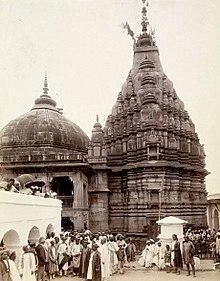
The Vishnupad Mandir is a stunning example of the Nagara style of temple architecture, characterized by a towering shikhara (spire) and intricate carvings.
Key Architectural Features
- The Vimana and Shikhara: The temple rises 100 feet high, featuring a curvilinear spire typical of North Indian temple architecture. The Shikhara is adorned with amalaka discs and kalasha finials, symbolizing the cosmic mountain.
- The Mandapas: The temple complex includes spacious pillared mandapas (halls) used for devotional singing and prayers. The pillars are carved with scenes from the Ramayana and Mahabharata, as well as geometric Vastu motifs.
- Notable Sculptures: Inside the sanctum, alongside the footprint, are images of Goddess Lakshmi and Lord Vishnu. The exterior walls feature niches housing deities of the Hindu pantheon, though the main focus remains the Dharmasila.
Note on Conservation: The Archaeological Survey of India (ASI) recognizes the historical significance of the structure. While not a UNESCO World Heritage site, it is a protected monument of national importance.
Darshan & Ritual Logistics (2026 Update)
Planning your visit requires attention to the ritualistic schedule, especially for those seeking to perform Pind Daan.
Daily Darshan Timings
| Session | Timing | Activity |
|---|---|---|
| Morning | 05:30 AM – 09:00 AM | Mangala Aarti & General Darshan |
| Mid-Day | 09:00 AM – 11:30 AM | Bhoga Offering & Ritual Pind Daan |
| Afternoon | 12:00 PM – 03:30 PM | Temple Closed (Rest Period) |
| Evening | 04:00 PM – 07:30 PM | Sandhya Aarti & General Darshan |
| Night | 09:00 PM – 09:30 PM | Shayan Aarti (Closing) |
Important: During Pitripaksha (Sept/Oct 2026) and other major festivals, the temple remains open throughout the day. Always verify timings at the temple office upon arrival.
Seva & Online Booking
- Abhishekam: Ritual bathing of the Dharmasila with milk, honey, and ghee. Available during morning hours.
- Archana: Recitation of holy names. Can be performed for personal intentions.
- Pind Daan Booking: Due to high demand, especially for the Pitripaksha Mela 2026 (Sept 7 – Sept 21), it is highly recommended to book rituals in advance. This can be done via the official website of the Gaya Temple Committee or at the Gayawal Purohit offices located around the temple complex.
Practical Visitor Guidance
To ensure a smooth spiritual experience, adhere to the following guidelines:
- Dress Code: Traditional Indian attire is preferred (Dhoti/Kurta for men, Saree/Salwar Kameez for women). Modesty is essential.
- Photography & Electronics: Mobile phones and cameras are strictly prohibited inside the inner sanctum. Locker facilities are available near the temple entrance.
- Accessibility: The temple has stone steps. While the main street is flat, the inner sanctum involves stairs. Wheelchair access is limited to the outer courtyard.
- Crowd Management: The busiest times are Sunday mornings and the months of July to October. Best time to visit: January to March (Winter) offers pleasant weather. If visiting in May/June (peak summer), carry water and a head covering, as Gaya can experience temperatures exceeding 40°C.
Pilgrimage Connectivity
How to Reach Vishnupad Mandir
- By Air: Gaya International Airport (GAY) is well-connected with major cities like Delhi, Mumbai, and Kolkata. It is approximately 12 km from the temple (30 mins by taxi).
- By Rail: Gaya Junction (GAYA) is a major railway hub in Eastern India. It is 4 km from the temple (15 mins by auto/taxi).
- By Road: Gaya is connected via National Highway 22 and National Highway 83. Regular buses run from Patna (100 km), Ranchi, and Varanasi.
Nearby Sacred Sites
Complete your pilgrimage circuit by visiting these nearby tirthas:
- Mangla Gauri Temple: Located less than a kilometer away, this is a Shakti Peetha where the breast of Goddess Sati fell. It is essential for completing the Gaya Shraddha rituals.
- Brahmajuni Hill: A steep 1000-step climb offers a breathtaking view of the temple and the Falgu River. At the top is a cave temple dedicated to Siddhanath Shiva.
- Mahabodhi Temple (Bodh Gaya):: Located 12 km away, this UNESCO World Heritage site is where Prince Siddhartha attained enlightenment. It is a vital stop for any visitor to the region.
Frequently Asked Questions (FAQ)
1. Is there a VIP or Special Darshan entry?
Yes, the temple committee provides a “Special Entry” pass for a nominal fee (subject to current rates) to bypass the general queue during peak hours. This can be purchased at the counter outside the temple.
2. Are non-Hindus allowed inside the temple?
Vishnupad Mandir is a traditional Hindu temple. Entry is generally restricted to Hindus only. Non-Hindu visitors may admire the architecture from the outside and visit the nearby Falgu River banks.
3. Where can I stay near the temple?
Gaya offers various accommodation options ranging from budget lodges to luxury hotels. The Bihar State Tourism Development Corporation (BSTDC) runs the “Gaya Hotel” near the temple, which is recommended for its proximity and hygiene.
4. What is the significance of the Falgu River?
The Falgu River (also known as Phalgu) is considered a sacred tributary of the Ganges. Ritual bathing in its waters is believed to purify sins before entering the Vishnupad Mandir.
5. Is online Pind Daan booking available for 2026?
Yes, the Gaya District Administration facilitates online registration for Pind Daan, particularly during the Pitripaksha Mela. However, the actual ritual requires the physical presence of the devotee and a Gayawal Purohit.
Disclaimer: Ritual details and timings are subject to change based on local temple committee announcements and astronomical calculations (Panchang).
Architecture
The temple features a classic Shikhara style, rebuilt in 1787 by Maharani Ahilya Bai Holkar. The structure is built of granite, and the sanctum houses the sacred Dharmasila (footprint).
Legend / Local stories
The present-day structure was rebuilt by Devi Ahilya Bai Holkar, the ruler of Indore, in 1787, on the banks of the Falgu river. A flight of 1000 stone steps leads to the top of the Brahmajuni hill, 1 km southwest of the Vishnupad mandir. Visitors prefer to go to the top of Brahmajuni hill to see the view of the temple from above. There are many small temples near this temple.
Photo Gallery
How to Reach:
The construction date of the original temple is unknown; it is believed that Rama along with Sita had visited this place. The nearest major railway station is Gaya Junction (4 km), and the airport is Gaya International (12 km).
Contact Details
Official Address: Vishnupad Temple, Gaya, Bihar, India
Phone: Contact local temple authorities for specific inquiries.
Recent Posts

Shri Kaamkoteeshwar Mandir, Varanasi – History & Significance
In the heart of Kashi, the eternal city of Lord Shiva, where the Ganges flows with celestial grace, stands the Shri Kaamkoteeshwar Mandir. This sacred Sannidhi is not merely a temple but a profound spiritual bridge between the Northern…

ओ सांवरे तूने ही मुझको संभाला – Lyrics & Meaning
ओ सांवरे तूने ही मुझको संभाला – A Prayer to Shyam Origin & Spiritual Essence Why This Bhajan Resonates Devotees chant this when overwhelmed by life’s storms—the refrain ‘तूने ही मुझको संभाला’ is the soul’s sigh of relief: “You…

कथा ये है महाराज मेरे की – Lyrics & Meaning
कथा ये है महाराज मेरे की छत्रपति संभाजी महाराज – A Prayer to Chhatrapati Sambhaji Maharaj Origin & Spiritual Essence Why This Bhajan Resonates Devotees chant this when their spirit feels tested—its powerful refrain “महाराज मेरे” is a soul’s…

Rigveda Samhita Yathartha Anuvada (ऋग्वेद संहिता यथार्थ अनुवाद) – Complete Set with Anvayartha & Hindi/English Translation
The Rigveda is the oldest surviving scripture of humanity and the foundational text of Sanātana Dharma. For serious students, scholars, UPSC aspirants studying ancient Indian history, Sanskrit learners, and spiritual seekers, a precise and grammatically structured translation is indispensable.…

आना भी अकेला है जाना भी अकेला है – Lyrics & Meaning | BharatTemples
आना भी अकेला है जाना भी अकेला है – A Prayer to the Divine Witness Origin & Spiritual Essence Why This Bhajan Resonates Devotees turn to this bhajan in moments of deep reflection—when life’s attachments begin to ache. The…

माता शेरावाली के द्वार जो भी जाता है – Lyrics & Meaning
माता शेरावाली के द्वार जो भी जाता है – A Prayer to Maa Sherawali Origin & Spiritual Essence Why This Bhajan Resonates Devotees turn to this bhajan in times of fear or uncertainty—its promise that no one leaves Maa’s…

मार लेना सपणी उबार लेणा भवरा – Lyrics & Meaning
मार लेना सपणी उबार लेणा भवरा – A Prayer to the Divine Beloved Origin & Spiritual Essence Why This Bhajan Resonates Devotees chant this in moments of deep vulnerability—its cry of “मार लेना सपणी, उबार लेणा भवरा” is the…

हमें श्याम सुंदर भरोसा तुम्हारा – Lyrics & Meaning
हमें श्याम सुंदर भरोसा तुम्हारा – A Prayer to Shyam Sundar Origin & Spiritual Essence Why This Bhajan Resonates Devotees chant this when feeling alone—its refrain ‘de do sahara’ is the soul’s cry for divine support. Lyrics in Hindi…

Mere Satguru Ne Di Thi Davai Lyrics in Hindi & Meaning
Mere Satguru Ne Di Thi Davai: Invoking the Guru’s Liberating Wisdom This soul-stirring bhajan venerates the Satguru (True Spiritual Master) as the divine physician who dispenses the only remedy for life’s deepest sufferings. Composed by Sant Karmaveer Tufani, it…

Janm Diyo Thari Maa Dukh Dekhiyo Lyrics in Hindi & Meaning
जन्म दियो थारी माँ दुख देखियो (Maa’s Grief Upon Birthing You) This soul-stirring Chetavani Bhajan (admonitory hymn) is addressed to the Divine Mother (Maa) – a call for repentance when children forget their filial duties in the dark age…