
Contents
Introduction & Spiritual Essence
Nestled within the ancient, winding lanes of Kashi (Varanasi), the Sthool Dant Vinayak Temple stands as a formidable guardian of spiritual consciousness. While Varanasi is famous for its Kashi Vishwanath, the Sthool Dant Vinayak holds a unique and colossal presence among the “Manokamna Siddha Vinayaks”. The deity is revered as Sthool Dant, meaning “Lord with large/elephantine teeth.” In this form, Lord Ganesha is believed to destroy all obstacles with immense power while protecting the devotee’s spiritual journey.
Phalaśruti: The Fruit of Worship
According to popular belief, offering prayers at Sthool Dant Vinayak facilitates the granting of Siddhi (supernatural accomplishments) and wisdom. It is specifically worshipped for:
- Ancestral Cleansing: Devotees believe that visiting this temple aids in cleansing ancestral karma (Pitra Dosh).
- Wisdom and Willpower: As the remover of obstacles, the “large teeth” symbolize the ability to chew through life’s toughest challenges.
- Spiritual Grounding: Located near the ghats, it offers a spiritual anchor for those taking the holy dip in the Ganges.
Historical Origins & Scriptural Legend
Antiquity of Kashi:
The history of Sthool Dant Vinayak is woven into the fabric of Kashi’s legend. While specific dynastic records regarding the construction date are sparse—a common occurrence with ancient Kashi shrines—the temple architecture and oral traditions suggest a lineage stretching back to the Maratha or Bhonsle era of the late 18th century, similar to the nearby Man Mandir Ghat.
The Sthala Purana (Local Legend):
According to temple records and priestly lineages, Lord Ganesha manifested as Sthool Dant to protect the Manokamna (wishes) of devotees visiting Kashi. Tradition holds that this specific Vinayak is one of the primary eight Manokamna Ganeshas in Varanasi. The name “Sthool Dant” refers to a divine form where the Lord possesses the strength of an elephant, symbolizing immense mental and spiritual fortitude.
Architectural Marvels
The Sthool Dant Vinayak Temple reflects the traditional Nagara style of temple architecture, albeit adapted to the compact urban fabric of Varanasi’s old city.
Key Architectural Elements
- The Shikhara (Spire): Though not towering, the shikhara is distinct, crowned with the traditional Amalaka (disk-like stone). The stonework exhibits wear consistent with centuries of ritual exposure to the Ganges’ humidity.
- The Mandapa (Hall): The inner sanctum is approached through a modest mandapa. The pillars are carved with motifs of Yalis and Lotus borders, typical of the region’s craft.
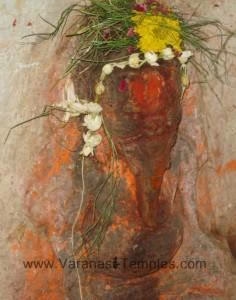
- The Murti (Idol): The central deity is a swayambhu (self-manifested) stone murti. The eyes of the deity are crafted in the traditional Dravidian style, with heavy lids symbolizing deep meditation, yet the mouth features prominent teeth, justifying the name.
Note: While not a UNESCO site, it falls under the heritage zone of the Varanasi district and is maintained by local trusts adhering to ASI conservation guidelines.
Darshan & Ritual Logistics
Visiting this temple requires adherence to the daily cycles of Kashi. Below are the standard timings; however, during festivals, these hours may extend.
| Session | Timing | Details |
|---|---|---|
| Morning Darshan | 5:00 AM – 1:00 PM | Starts with Mangala Aarti. Best time is 7:00 AM. |
| Mid-Day Break | 1:00 PM – 4:00 PM | Temple remains closed for rest and cleaning. |
| Evening Darshan | 4:00 PM – 11:00 PM | Includes Sandhya Aarti. Peak crowd: 6:00 PM – 8:00 PM. |
Sevas and Bookings
For the year 2026, the temple administration encourages digital offerings to manage crowds:
- Abhishekam: Performed daily at 7:00 AM. (Booking via temple office or local priests).
- Archana: Can be performed by name, available throughout open hours.
- Online Seva: While there is no dedicated standalone portal for this specific shrine, offerings are integrated into the broader Kashi Vishwanath offerings platforms and UPI QR codes available at the temple entrance.
2026 Major Festivals at Sthool Dant Vinayak
- Varanasi Teej (Hartalika): August 24-25, 2026 (Special night-long darshan).
- Ganesh Chaturthi: August 26, 2026 (Grand Maha Aarti and distribution of Modak).
- Diwali: November 7, 2026 (Temple is illuminated with thousands of diyas).
- Kashi Mahashivratri: February 26, 2026 (Focus on Ganesha as the gatekeeper of Shiva).
Practical Visitor Guidance
The area surrounding Sthool Dant Vinayak is in the heart of the old city, requiring careful planning.
- Dress Code: Modest attire is mandatory. Traditional Indian wear is preferred. Men should remove shirts (topless) before entering the sanctum, as is customary in Varanasi, though a scarf is acceptable.
- Photography: Strictly prohibited inside the inner sanctum (Garbhagriha). General courtyard photography is allowed, but respect the privacy of other devotees.
- Mobile Lockers: There are no official digital lockers. Visitors are advised to carry minimal bags. Small luggage can be deposited at the counters near Dasaswamedh Ghat before walking in.
- Accessibility: The temple is located on uneven ancient stone streets. It is not wheelchair accessible. Footwear must be removed outside the temple complex.
- Crowd Management:
- Best Time: Early morning (6:00 AM – 8:00 AM) or late evening (after 9:00 PM).
- Seasonal Advice: Summer (May-June) is intense; carry a water bottle and cover your head. The Ganges humidity makes winter (Nov-Feb) the most pleasant time to visit.
Pilgrimage Connectivity
How to Reach
Sthool Dant Vinayak is located at D-16/34, Man Mandir, near Someshwar Ghats in Varanasi.
- By Air: Lal Bahadur Shastri International Airport (VNS) is approximately 15 km away. A taxi to Dashashwamedh Ghat takes about 45-60 minutes.
- By Train: Varanasi Junction (BSB) is the main railway station (approx. 8 km). Auto-rickshaws are available directly to Dashashwamedh.
- Local Transit:
- Rickshaw/Walk: Take an auto-rickshaw to Dashashwamedh Ghat. From there, it is a 10-15 minute walk through crowded market lanes.
- Boat Access: Hire a boat to Man Mandir Ghat. The temple is located immediately adjacent to the ghat, requiring a short ascent of steps.
Nearby Sacred Sites
Enhance your pilgrimage by visiting these adjacent shrines:
- Someshwar Nath Mahadev Temple: Located literally next to Sthool Dant Vinayak. A Jyotirlinga site of high antiquity.
- Man Mandir Ghat: A 16th-century ghat known for its exquisite Rajput architecture and the grand window facades.
- Kashi Vishwanath Temple: Accessible via a short walk or rickshaw ride. While crowded, it is the spiritual anchor of the area.
Frequently Asked Questions (FAQ)
1. Is there a VIP darshan entry at Sthool Dant Vinayak?
As a smaller, ancient shrine, there is no formal VIP entry system like in larger commercial temples. However, visiting during the 5:00 AM opening or avoiding weekends usually provides a quick, unobstructed darshan.
2. Can I carry my mobile phone and bag inside?
Yes, but photography is strictly prohibited inside the sanctum. Large bags are discouraged due to the narrow lanes and crowded inner courtyard. It is best to travel light.
3. What is the significance of the name “Sthool Dant”?
Sthool translates to “gross” or “large,” and Dant means “tooth.” This form of Ganesha represents the ability to crush obstacles through immense strength and earthly grounding, contrasting with the more subtle forms of divine energy.
4. Are food offerings allowed?
Prasad (blessed food) in the form of sweets like Laddu or Modak is available for purchase at the temple counter. Devotees may also distribute bananas, but outside vendors can be distracting; it is recommended to accept the official temple Prasad.
5. Is the temple open during monsoon rains?
Yes. Varanasi remains fully operational during the monsoon (July-September). However, the steps leading to Man Mandir Ghat can become slippery; caution is advised.
This guide was curated by the Lead Heritage Architect at bharattemples.com. We dedicate our efforts to the preservation of India’s sacred geography. Jai Ganesha.
Recent Posts

Shri Kaamkoteeshwar Mandir, Varanasi – History & Significance
In the heart of Kashi, the eternal city of Lord Shiva, where the Ganges flows with celestial grace, stands the Shri Kaamkoteeshwar Mandir. This sacred Sannidhi is not merely a temple but a profound spiritual bridge between the Northern…

ओ सांवरे तूने ही मुझको संभाला – Lyrics & Meaning
ओ सांवरे तूने ही मुझको संभाला – A Prayer to Shyam Origin & Spiritual Essence Why This Bhajan Resonates Devotees chant this when overwhelmed by life’s storms—the refrain ‘तूने ही मुझको संभाला’ is the soul’s sigh of relief: “You…

कथा ये है महाराज मेरे की – Lyrics & Meaning
कथा ये है महाराज मेरे की छत्रपति संभाजी महाराज – A Prayer to Chhatrapati Sambhaji Maharaj Origin & Spiritual Essence Why This Bhajan Resonates Devotees chant this when their spirit feels tested—its powerful refrain “महाराज मेरे” is a soul’s…

Rigveda Samhita Yathartha Anuvada (ऋग्वेद संहिता यथार्थ अनुवाद) – Complete Set with Anvayartha & Hindi/English Translation
The Rigveda is the oldest surviving scripture of humanity and the foundational text of Sanātana Dharma. For serious students, scholars, UPSC aspirants studying ancient Indian history, Sanskrit learners, and spiritual seekers, a precise and grammatically structured translation is indispensable.…

आना भी अकेला है जाना भी अकेला है – Lyrics & Meaning | BharatTemples
आना भी अकेला है जाना भी अकेला है – A Prayer to the Divine Witness Origin & Spiritual Essence Why This Bhajan Resonates Devotees turn to this bhajan in moments of deep reflection—when life’s attachments begin to ache. The…

माता शेरावाली के द्वार जो भी जाता है – Lyrics & Meaning
माता शेरावाली के द्वार जो भी जाता है – A Prayer to Maa Sherawali Origin & Spiritual Essence Why This Bhajan Resonates Devotees turn to this bhajan in times of fear or uncertainty—its promise that no one leaves Maa’s…

मार लेना सपणी उबार लेणा भवरा – Lyrics & Meaning
मार लेना सपणी उबार लेणा भवरा – A Prayer to the Divine Beloved Origin & Spiritual Essence Why This Bhajan Resonates Devotees chant this in moments of deep vulnerability—its cry of “मार लेना सपणी, उबार लेणा भवरा” is the…

हमें श्याम सुंदर भरोसा तुम्हारा – Lyrics & Meaning
हमें श्याम सुंदर भरोसा तुम्हारा – A Prayer to Shyam Sundar Origin & Spiritual Essence Why This Bhajan Resonates Devotees chant this when feeling alone—its refrain ‘de do sahara’ is the soul’s cry for divine support. Lyrics in Hindi…

Mere Satguru Ne Di Thi Davai Lyrics in Hindi & Meaning
Mere Satguru Ne Di Thi Davai: Invoking the Guru’s Liberating Wisdom This soul-stirring bhajan venerates the Satguru (True Spiritual Master) as the divine physician who dispenses the only remedy for life’s deepest sufferings. Composed by Sant Karmaveer Tufani, it…

Janm Diyo Thari Maa Dukh Dekhiyo Lyrics in Hindi & Meaning
जन्म दियो थारी माँ दुख देखियो (Maa’s Grief Upon Birthing You) This soul-stirring Chetavani Bhajan (admonitory hymn) is addressed to the Divine Mother (Maa) – a call for repentance when children forget their filial duties in the dark age…