

Contents
- 1 Naina Devi Temple, Bilaspur: A Complete Pilgrimage Guide (2026)
Naina Devi Temple, Bilaspur: A Complete Pilgrimage Guide (2026)
Welcome to the definitive architectural and spiritual guide for Naina Devi Temple, a revered Shakti Peeth nestled in the Sivalik Hills of Himachal Pradesh. As the Lead Architect for BharatTemples.com, I present this guide not just as a travel log, but as an exploration of the divine geometry, ancient legends, and logistical precision required for a seamless pilgrimage.
Introduction & Spiritual Essence
The temple is dedicated to Goddess Naina Devi, a manifestation of Mata Sati. The name “Naina” (meaning eyes) refers to the specific origin myth of this shrine. It is one of the 51 Shakti Peeths, marking the location where the eyes of Sati fell from the dismembered body of Shiva.
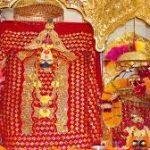
Form of the Deity: The sanctum houses a Trinity of deities. The central idol is Mata Naina Devi, flanked by Goddess Kali (representing time/destruction) and Goddess Lakshmi (representing wealth/prosperity). The idols are depicted as three eyes, symbolizing the third eye of spiritual insight.
Phalaśruti: Why Devotees Visit
According to Hindu scriptures, a visit to this Shakti Peeth grants specific spiritual boons (Phalaśruti):
- Cleansing of Ancestral Karma: Performing Shradh and Pinda Daan here is believed to liberate ancestors from the cycle of rebirth.
- Removal of “Nazar” (Evil Eye): Being the “Eye” of the Goddess, devotees visit specifically to remove malefic planetary influences.
- Resolution of Childlessness: Childless couples offer cradles (Palna) to the Goddess, praying for offspring.
| Date built: | 8th Century CE (Reconstructed) |
|---|---|
| Deity: | Mata Naina Devi (Shakti), Kali, Lakshmi |
| Architectural style: | Himachali Pahari Style |
| Major festivals | Chaitra & Ashwin Navratras, Ashtami |
| Locale: | Naina Hill, Anandpur Sahib Plateau |
| District:: | Bilaspur |
| Address: | Naina Devi Temple, Bilaspur, Himachal Pradesh 174011 |
| Phone | +91-1978-288233 (Temple Office) |
Historical Origins & Scriptural Legend
The history of Naina Devi Temple is a blend of royal patronage and mythological profundity.
Architectural Patronage (8th Century CE)
According to temple records and local chronicles, the original structure was commissioned by Raja Bir Chand of the Bilaspur Kingdom in the 8th century CE. The temple was built atop the Naina Hill (formerly known as Chandigarh). While the original structure faced wear over centuries, the current facade is a result of renovations that preserved the sanctity of the original Garbhagriha (Sanctum Sanctorum).
The Sthala Purana: Legends of the Goddess
The temple derives its name from the Sanskrit word for “eyes,” rooted in the cosmic mythology of the Shakti Peeths.
1. The Fall of the Eyes:
Tradition holds that after Goddess Sati immolated herself at Daksha Yagna, Lord Shiva wandered the universe carrying her body in a state of grief. To stop the impending cosmic imbalance, Lord Vishnu used his Sudarshana Chakra to dismember the body. The 51 body parts fell across the Indian subcontinent. The eyes (Naina) of Sati fell here, establishing the site as a potent energy center.
2. The Gujjar Boy and Raja Bir Chand:
A local legend narrates the discovery of the site by a Gujjar herdsman named Naina. While grazing cattle, he observed a white cow showering milk from her udders onto a specific stone. Intrigued, he observed this for days. One night, the Goddess appeared in his dream, revealing the stone to be her Pindi (symbolic manifestation). When Naina reported this to Raja Bir Chand, the king witnessed the miracle firsthand and constructed the temple, naming it in honor of the boy who discovered it.
3. The Defeat of Mahishasur:
The temple is also venerated as Mahishapeeth. It is believed that this is the battleground where the Goddess vanquished the demon Mahishasur. After blinding him with her divine power, she granted the boon of “Jai Naina” (Victory to the Eyes), cementing the temple’s association with the Shakti that conquers ignorance.
4. The Sikh Connection:
In 1756 CE, Guru Gobind Singh Ji performed a Yagna (sacrificial ritual) at this temple to seek the Goddess’s blessings before his military campaign against the Mughals. Upon his victory, he donated a golden Chhari (holy stick) to the temple, which is still preserved in the sanctum.
Architectural Marvels & Vastu Elements
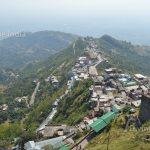
The temple stands at an altitude of 1,177 meters, offering a panoramic view of the Gobind Sagar reservoir on the Sutlej River and the town of Anandpur Sahib.
Style and Geometry
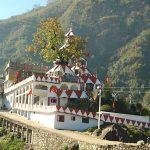
The architecture is a classic example of Himachali Pahari style, blending elements of Nagara architecture. The Shikhara (spire) is multi-tiered and curvilinear, constructed using locally sourced stone and lime mortar. Unlike the ornate southern temples, the structure is relatively compact, designed to withstand the seismic activity of the Himalayan foothills.
Key Features
- The Sanctum (Garbhagriha): Houses the Trinity idols. The inner sanctum is circular, aligning with the Vastu principle of the Bindu (center point of energy).
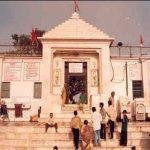
- Mandapas: The temple features a closed Artha (waiting hall) and an open Mandapa (pillared hall) where devotees sit for Kirtan. The pillars are carved with motifs of the sun and moon, representing the balance of Masculine (Shiva) and Feminine (Shakti) energies.
- Recent Renovations: In the late 20th century, the temple committee added gold plating to the roof of the main sanctum, enhancing the visual divinity against the green backdrop of the Sivaliks.
Darshan & Ritual Logistics (2026)
To ensure a spiritually fulfilling experience, devotees should plan their visit around the temple’s schedule. Note that timings may vary slightly during major festivals like Navratri.
Daily Darshan Timings
| Session | Activity | Timings |
|---|---|---|
| Morning | Morning Mangala Aarti | 05:00 AM – 06:00 AM |
| General Darshan | 06:00 AM – 12:00 PM | |
| Mid-Day Break (Sanctum Cleaning) | ||
| Evening | General Darshan | 03:00 PM – 06:00 PM |
| Shayan Aarti (Closing) | 06:30 PM – 07:30 PM | |
Key Sevas & Booking
Devotees can book specific rituals online through the official Shri Naina Devi Ji Temple Board website.
- Chandika Havan: Performed on Ashtami (8th lunar day) for wish fulfillment.
- Shringar Darshan: Exclusive viewing during the decoration of the deity (usually Sunday mornings).
- Kanya Pujan: High demand during Navratri; requires prior registration.
- Online Prashad: The temple board offers delivery of the famous Mahashringar Prashad (a dry mixture of fruits and nuts) nationwide.
2026 Festival Calendar Highlights
- Chaitra Navratri: April 6 – April 14, 2026
- Sharad Navratri: September 21 – September 29, 2026
- Maha Ashtami Havan: October 28, 2026 (Shubh Muhurat: Morning)
- Shri Guru Gobind Singh Ji Parkash Utsav: January 5, 2026
Practical Visitor Guidance
As an architect, I advise pilgrims to respect the structure and the environment. The temple is located at a moderate altitude; acclimatization is rarely an issue, but comfort is key.
Dress Code & Etiquette
- Attire: Traditional Indian clothing (Kurta-Pajama, Saree, Salwar Kameez) is recommended. Western attire like shorts or sleeveless tops is discouraged and may be denied entry in the inner sanctum.
- Footwear: Removal is mandatory before ascending the stairs to the main temple. Use the designated shoe-keeping counters (often run by local volunteers).
Crowd Management & Best Hours
- Early Morning: The best time for a peaceful Darshan is between 6:00 AM and 8:00 AM.
- Afternoon: Least crowded between 1:00 PM and 3:00 PM.
- Navratri Season: Avoid weekends during Navratri if you seek silence. The temple remains open 24 hours during these 9 days, with peak crowds on Maha Ashtami and Maha Navami.
Facilities
- Mobile Lockers: Available near the entrance. Electronic items (cameras, mobile phones) are prohibited inside the sanctum. It is advised to carry minimal belongings.
- Drinking Water: BISNOI water stations are available. Carry your own reusable bottle; the plastic waste around the hill is a concern.
- Accessibility: The temple is accessible via stairs (approx. 200 steps). For differently abled devotees and senior citizens, a Ropeway (Cable Car) is operational, connecting the base to the hilltop temple directly.
Pilgrimage Connectivity
The temple is strategically located in the Shivalik foothills, making it accessible via a network of national highways.
How to Reach
- By Road: The temple is on the Anandpur Sahib – Bilaspur road. It is approximately 80km from Kiratpur Sahib via National Highway 305. Regular buses ply from Bilaspur, Anandpur Sahib, and Nangal.
- By Rail: The nearest broad gauge railway station is Kiratpur Sahib (approx. 34 km). From there, one can hire a taxi or take a local bus (1 hour drive).
- By Air: The nearest airport is Chandigarh International Airport (approx. 100 km – 2.5 hours drive). The other option is Gaggal Airport (Dharamshala), which is further away (approx. 180 km).
Nearby Sacred Sites
- Shri Guru Gobind Singh Ji Sarovar (Anandpur Sahib): Located just 15 km away. This historic Gurudwara is closely linked to the temple’s history via the Yagna performed by the Guru.
- Bhakra Nangal Dam (Gobind Sagar): A marvel of modern engineering creating the artificial lake visible from the temple. A visit to the dam head offers a spiritual connection to the Sutlej River.
- Nangal Wetlands: A paradise for birdwatchers located near the foothills, ideal for a serene nature walk after the temple visit.
Frequently Asked Questions (FAQ)
1. Is there a VIP Darshan entry available?
Yes, the Temple Board offers a “Priority Darshan” pass for a nominal fee (typically ₹100-₹200) which allows devotees to bypass the general queue during non-peak hours. This can be booked at the office counter at the base or online.
2. What is the best time of year to visit Naina Devi?
The best months are March to June and September to November. The weather is pleasant (15°C to 25°C). Winters (December-February) are cold but manageable, while July-August (Monsoon) can see occasional road blockages due to landslides.
3. Can I carry my own food for offering?
Outside food is generally restricted in the inner sanctum. However, cooked food (including Karah and Puri) is available as Prashad at the temple canteen. Dry fruits and sweets purchased from authorized stalls can be carried.
4. Is the Ropeway safe for senior citizens?
Yes, the Naina Devi Ropeway is modern, certified, and highly safe. It is the most recommended mode of transport for senior citizens, pregnant women, and children to avoid the physical exertion of the stairs.
5. Are there accommodation facilities at the temple?
While the temple itself does not have hotel rooms, the Shri Naina Devi Ji Temple Board maintains a Guest House and Dharamshala at the foothills. Several private hotels and lodges are available in the town of Bilaspur (20 mins drive).
Recent Posts

Shri Kaamkoteeshwar Mandir, Varanasi – History & Significance
In the heart of Kashi, the eternal city of Lord Shiva, where the Ganges flows with celestial grace, stands the Shri Kaamkoteeshwar Mandir. This sacred Sannidhi is not merely a temple but a profound spiritual bridge between the Northern…

ओ सांवरे तूने ही मुझको संभाला – Lyrics & Meaning
ओ सांवरे तूने ही मुझको संभाला – A Prayer to Shyam Origin & Spiritual Essence Why This Bhajan Resonates Devotees chant this when overwhelmed by life’s storms—the refrain ‘तूने ही मुझको संभाला’ is the soul’s sigh of relief: “You…

कथा ये है महाराज मेरे की – Lyrics & Meaning
कथा ये है महाराज मेरे की छत्रपति संभाजी महाराज – A Prayer to Chhatrapati Sambhaji Maharaj Origin & Spiritual Essence Why This Bhajan Resonates Devotees chant this when their spirit feels tested—its powerful refrain “महाराज मेरे” is a soul’s…

Rigveda Samhita Yathartha Anuvada (ऋग्वेद संहिता यथार्थ अनुवाद) – Complete Set with Anvayartha & Hindi/English Translation
The Rigveda is the oldest surviving scripture of humanity and the foundational text of Sanātana Dharma. For serious students, scholars, UPSC aspirants studying ancient Indian history, Sanskrit learners, and spiritual seekers, a precise and grammatically structured translation is indispensable.…

आना भी अकेला है जाना भी अकेला है – Lyrics & Meaning | BharatTemples
आना भी अकेला है जाना भी अकेला है – A Prayer to the Divine Witness Origin & Spiritual Essence Why This Bhajan Resonates Devotees turn to this bhajan in moments of deep reflection—when life’s attachments begin to ache. The…

माता शेरावाली के द्वार जो भी जाता है – Lyrics & Meaning
माता शेरावाली के द्वार जो भी जाता है – A Prayer to Maa Sherawali Origin & Spiritual Essence Why This Bhajan Resonates Devotees turn to this bhajan in times of fear or uncertainty—its promise that no one leaves Maa’s…

मार लेना सपणी उबार लेणा भवरा – Lyrics & Meaning
मार लेना सपणी उबार लेणा भवरा – A Prayer to the Divine Beloved Origin & Spiritual Essence Why This Bhajan Resonates Devotees chant this in moments of deep vulnerability—its cry of “मार लेना सपणी, उबार लेणा भवरा” is the…

हमें श्याम सुंदर भरोसा तुम्हारा – Lyrics & Meaning
हमें श्याम सुंदर भरोसा तुम्हारा – A Prayer to Shyam Sundar Origin & Spiritual Essence Why This Bhajan Resonates Devotees chant this when feeling alone—its refrain ‘de do sahara’ is the soul’s cry for divine support. Lyrics in Hindi…

Mere Satguru Ne Di Thi Davai Lyrics in Hindi & Meaning
Mere Satguru Ne Di Thi Davai: Invoking the Guru’s Liberating Wisdom This soul-stirring bhajan venerates the Satguru (True Spiritual Master) as the divine physician who dispenses the only remedy for life’s deepest sufferings. Composed by Sant Karmaveer Tufani, it…

Janm Diyo Thari Maa Dukh Dekhiyo Lyrics in Hindi & Meaning
जन्म दियो थारी माँ दुख देखियो (Maa’s Grief Upon Birthing You) This soul-stirring Chetavani Bhajan (admonitory hymn) is addressed to the Divine Mother (Maa) – a call for repentance when children forget their filial duties in the dark age…