

Contents
- 1 Badami Cave Temples: A Journey Through Time, Stone, and Spirit
Badami Cave Temples: A Journey Through Time, Stone, and Spirit
Nestled in the rugged sandstone cliffs of Bagalkot district in Karnataka, the Badami Cave Temples stand as a testament to the artistic and spiritual zenith of the Early Chalukya dynasty. As the Lead Heritage Architect for BharatTemples.com, I invite you to explore this UNESCO World Heritage Site contender, a cradle of temple architecture that bridged the northern Nagara and southern Dravida styles. This definitive guide is crafted for the devoted pilgrim and the curious traveler alike, seeking to understand the spiritual resonance etched into every stone of Vatapi (ancient Badami).
1. Introduction & Spiritual Essence
The Divine Resonance of Vatapi
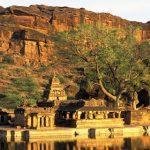
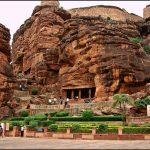
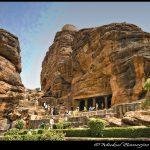
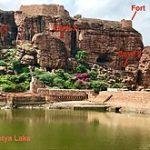
The Badami Cave Temples are not a single shrine but a complex of four monumental rock-cut caves carved into a sheer cliff face overlooking the serene Agastya Teertha. While traditionally housing Hindu deities in the first three caves, the complex represents a harmonious confluence of faiths, with Jain traditions prominent in Cave 4.
Primary Deities and Forms:
- Cave 1 (Shiva): Features a dominant carving of Shiva as Nataraja (cosmic dancer) and Harihara (half-Shiva, half-Vishnu).
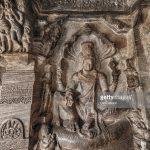
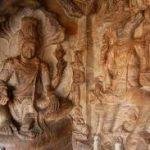
- Cave 2 & 3 (Vishnu): These caves are dedicated to Vishnu, depicting avatars like Varaha (Boar) and Narasimha (Man-Lion). Cave 3 specifically honors Vishnu in his Trivikrama (Vamana) form, spanning the universe.
- Cave 4 (Jainism): Dedicated to the Tirthankaras, showcasing Parsvanatha and Mahavira.
Phalaśruti: The Spiritual Benefits
Devotees visit the Badami caves not merely to witness history, but to engage with the living energy of the Chalukya era. According to local tradition, circumambulating the Agastya Teertha after a darshan (holy viewing) at these caves is believed to:
- Cleanse Ancestral Karma: The rock-cut nature, rooted deep into the earth, is said to stabilize planetary afflictions (Graha Dosha) for seven generations.
- Bestow Creative Wisdom: Standing before the Nataraja in Cave 1 is believed to unlock artistic potential and mental agility, dissolving the inertia of the material world.
- Grant Protection: The fierce forms in Cave 2 and 3 act as spiritual shields for devotees facing legal or territorial disputes.
2. Historical Origins & Scriptural Legend
The Rise of the Chalukyas
According to temple records and epigraphy, these caves were constructed during the reign of the Early Chalukya dynasty. Badami, then known as Vatapi, served as the regal capital.
The foundational year is historically pinpointed by the inscription found in Cave 3, dedicated by King Mangalesha in the Saka 500 era (578–579 CE). This makes Cave 3 the oldest firmly-dated Hindu cave temple in India.
Scriptural References & The Sthala Purana
Tradition holds that the town derives its name from the mythical demon Vatapi and his brother Agni, who were defeated by the sage Agastya. The Agastya Teertha (lake) below the caves is named after this sage, who is said to have performed austerities here, turning the land into a sacred tirtha (crossing point between worlds).
While the caves are rock-cut, they embody the scriptural ideals of the Puranas, bringing the celestial abodes of Vaikuntha (Vishnu’s abode) and Kailash (Shiva’s abode) to the terrestrial plane.
3. Architectural Marvels
Fusion of Nagara and Dravida Styles
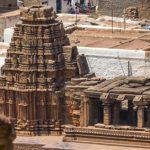
The Badami Cave Temples are the textbook definition of the Vesara style, a unique synthesis of the northern Nagara (curvilinear tower) and southern Dravida (pyramidal roof) traditions.
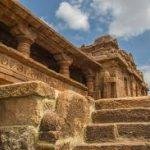
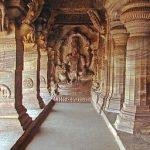
- Structural Layout: Each cave follows a uniform plan: an open verandah (mukha mandapa) with massive stone pillars, a columned pillared hall (maha mandapa), and a small, square sanctum (garbhagriha) cut deep into the cliff.
- The Pillars: The brackets and pillars are intricately carved, featuring dwarfish gatekeepers, amorous couples (mithunas), and aniconic motifs. They demonstrate the transition from wooden structural architecture to stone.
- Notable Sculptures:
- Cave 1: The 18-armed Shiva performing the Tandava (cosmic dance) is a masterpiece of dynamic energy.
- Cave 2: The massive relief of Vishnu as Trivikrama (Vamana) dominates the wall, illustrating the deity measuring the three worlds.
- Cave 3: Features the largest hall and the most vivid murals. The ceiling retains traces of ancient frescoes, a rarity in rock-cut architecture.
While these caves are not yet UNESCO World Heritage Sites individually, they are part of the tentative list under the criteria: “The Evolution of Temple Architecture – Aihole-Badami-Pattadakal.”
4. Darshan & Ritual Logistics
Daily Timings and Sevas
The caves are managed by the Archaeological Survey of India (ASI) and open to visitors daily. Unlike active agama-based temples, there are no hourly pujas, but morning rituals (cleaning and lamp lighting) are performed.
| Session | Timing |
|---|---|
| Morning Darshan | 06:00 AM – 12:00 PM |
| Afternoon Closure | 12:00 PM – 03:00 PM |
| Evening Darshan | 03:00 PM – 06:00 PM |
*Note: Timings may vary slightly during government holidays or special events.
Sevas and Offerings
As these are protected monuments, traditional Abhishekam (ritual bathing of the deity) is not performed on the rock-cut idols. However, visitors may offer Archana (silent prayers) or light a ghee lamp at the designated areas outside the caves.
2026 Key Festival Dates
While Badami celebrates most Hindu festivals with fervor, the following dates are significant for planning a visit:
- Mahashivratri: February 26, 2026 (Special night-long vigil near the Shiva Cave).
- Narasimha Jayanti: May 11, 2026 (Celebrated in Cave 2).
- Basant Panchami: February 2, 2026 (Celebrated near the Agastya Lake).
5. Practical Visitor Guidance
Rules and Etiquette
Preserving the soft sandstone is paramount. Adherence to the following is mandatory:
- Dress Code: Modest attire is required. Shoulders and knees must be covered (light scarves or stoles are recommended).
- Photography: Photography is allowed, but flash is prohibited to prevent pigment degradation.
- Luggage: Large bags and cameras (other than mobile phones) must be deposited in the mobile locker facilities provided at the entrance.
- Accessibility: The caves involve steep staircases. They are not wheelchair accessible. Senior citizens are advised to visit early morning.
Crowd Management & Seasonal Advice
- Best Hours: 06:30 AM to 08:30 AM. The morning sun illuminates the eastern façades perfectly, and crowds are minimal.
- Monsoon (June–September): The sandstone becomes slippery. Exercise extreme caution on the steps.
- Summer (May): Temperatures soar. Carry ample water; the steps can be scorching.
6. Pilgrimage Connectivity
How to Reach Badami
By Air: The nearest airport is Belgaum (IXE), approximately 150 km away. Alternatively, Hubli (132 km) and Goa (190 km) are viable international options.
By Rail: Badami has its own railway station (BDK), well-connected to Bangalore and Hubli. The station is a short auto-rickshaw ride from the town center.
By Road: Badami is on NH50 (Pune–Bangalore route). It is a 5-hour drive from Bangalore (approx. 450 km) and 6 hours from Pune.
The Pilgrimage Circuit
Badami is the anchor of the “Chalukya Triangle.” To complete the spiritual journey, devotees should visit:
- Pattadakal (20 km): A UNESCO World Heritage Site featuring 8th-century temples.
- Aihole (35 km): Known as the “Cradle of Temple Architecture” with over 125 temples.
- Hubli-Dharwad (120 km): Home to the ancient Chandramoulishwara Temple.
7. Frequently Asked Questions (FAQs)
Is there a VIP Darshan entry at Badami Caves?
Since the caves are a protected archaeological site managed by the ASI, there is no traditional VIP darshan system. However, purchasing a composite ticket for all caves allows faster entry. Security checks are mandatory for all.
Can I offer food (Prasad) inside the caves?
No. Eating inside the caves is strictly prohibited to maintain hygiene and protect the ancient sculptures from rodents and insects. There are designated picnic spots near the lake where food can be consumed.
What is the entry fee for Badami Caves?
As of 2026, the entry fee for Indian nationals is typically ₹40, and ₹600 for SAARC/BIMSTEC nationals. There is no entry fee for children under 15. These fees are subject to change by the Archaeological Survey of India.
Are the caves open on all days?
Badami caves are open from Tuesday to Sunday. They are closed on Fridays. Please check the ASI website before planning your trip, especially around national holidays.
Is photography allowed inside Cave 3?
Yes, photography is allowed inside all caves, but flash photography is prohibited. Use of tripods or drones requires prior permission from the ASI office in Bangalore or Badami.
Photo Gallery
Contact Details
Official Address: Archaeological Survey of India, Badami Caves, Badami, Karnataka 587201
Phone: (Refer to local ASI office directory for the most current contact number, as direct lines for specific caves are not maintained).
Recent Posts

Shri Kaamkoteeshwar Mandir, Varanasi – History & Significance
In the heart of Kashi, the eternal city of Lord Shiva, where the Ganges flows with celestial grace, stands the Shri Kaamkoteeshwar Mandir. This sacred Sannidhi is not merely a temple but a profound spiritual bridge between the Northern…

ओ सांवरे तूने ही मुझको संभाला – Lyrics & Meaning
ओ सांवरे तूने ही मुझको संभाला – A Prayer to Shyam Origin & Spiritual Essence Why This Bhajan Resonates Devotees chant this when overwhelmed by life’s storms—the refrain ‘तूने ही मुझको संभाला’ is the soul’s sigh of relief: “You…

कथा ये है महाराज मेरे की – Lyrics & Meaning
कथा ये है महाराज मेरे की छत्रपति संभाजी महाराज – A Prayer to Chhatrapati Sambhaji Maharaj Origin & Spiritual Essence Why This Bhajan Resonates Devotees chant this when their spirit feels tested—its powerful refrain “महाराज मेरे” is a soul’s…

Rigveda Samhita Yathartha Anuvada (ऋग्वेद संहिता यथार्थ अनुवाद) – Complete Set with Anvayartha & Hindi/English Translation
The Rigveda is the oldest surviving scripture of humanity and the foundational text of Sanātana Dharma. For serious students, scholars, UPSC aspirants studying ancient Indian history, Sanskrit learners, and spiritual seekers, a precise and grammatically structured translation is indispensable.…

आना भी अकेला है जाना भी अकेला है – Lyrics & Meaning | BharatTemples
आना भी अकेला है जाना भी अकेला है – A Prayer to the Divine Witness Origin & Spiritual Essence Why This Bhajan Resonates Devotees turn to this bhajan in moments of deep reflection—when life’s attachments begin to ache. The…

माता शेरावाली के द्वार जो भी जाता है – Lyrics & Meaning
माता शेरावाली के द्वार जो भी जाता है – A Prayer to Maa Sherawali Origin & Spiritual Essence Why This Bhajan Resonates Devotees turn to this bhajan in times of fear or uncertainty—its promise that no one leaves Maa’s…

मार लेना सपणी उबार लेणा भवरा – Lyrics & Meaning
मार लेना सपणी उबार लेणा भवरा – A Prayer to the Divine Beloved Origin & Spiritual Essence Why This Bhajan Resonates Devotees chant this in moments of deep vulnerability—its cry of “मार लेना सपणी, उबार लेणा भवरा” is the…

हमें श्याम सुंदर भरोसा तुम्हारा – Lyrics & Meaning
हमें श्याम सुंदर भरोसा तुम्हारा – A Prayer to Shyam Sundar Origin & Spiritual Essence Why This Bhajan Resonates Devotees chant this when feeling alone—its refrain ‘de do sahara’ is the soul’s cry for divine support. Lyrics in Hindi…

Mere Satguru Ne Di Thi Davai Lyrics in Hindi & Meaning
Mere Satguru Ne Di Thi Davai: Invoking the Guru’s Liberating Wisdom This soul-stirring bhajan venerates the Satguru (True Spiritual Master) as the divine physician who dispenses the only remedy for life’s deepest sufferings. Composed by Sant Karmaveer Tufani, it…

Janm Diyo Thari Maa Dukh Dekhiyo Lyrics in Hindi & Meaning
जन्म दियो थारी माँ दुख देखियो (Maa’s Grief Upon Birthing You) This soul-stirring Chetavani Bhajan (admonitory hymn) is addressed to the Divine Mother (Maa) – a call for repentance when children forget their filial duties in the dark age…