
Contents
- 1 Ghati Subramanya, Bangalore, Karnataka: The Definitive Pilgrimage Guide
Ghati Subramanya, Bangalore, Karnataka: The Definitive Pilgrimage Guide
Introduction & Spiritual Essence
Nestled in the tranquil foothills of Doddaballapura, approximately 60 km from Bangalore, lies the ancient Ghati Subramanya Temple. This sacred sanctuary is one of Karnataka’s most revered pilgrimage sites, uniquely housing two potent manifestations of divinity under a single roof. For the devotee, this temple represents a convergence of cosmic energies where Lord Karthikeya (Subramanya) and Lord Narasimha reside together.
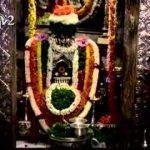
The temple is a Swayambhu (self-manifested) site, where the primary deities are believed to have emerged naturally from the earth. This specific murti (idol) configuration is rare: Lord Subramanya faces East, while Lord Narasimha is positioned behind him, facing West. A unique mirror installation allows devotees to view both deities simultaneously during darshan.
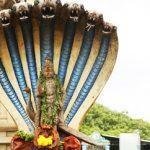
Phalaśruti (Spiritual Benefits): Why do devotees flock here? The temple is renowned as a powerful remedy for Sarpa Dosha (planetary afflictions related to serpents) and Kuja Dosha (Mangal-related issues). It is a beacon of hope for childless couples (Santan Prapti), with the belief that worshipping the seven-hooded serpent form of Lord Subramanya grants progeny blessings and protection from Garuda (the vehicle of Vishnu).
Historical Origins & Scriptural Legend
Chronology and Builders: Recorded history indicates the temple has existed for over 600 years. While the original architects are not fully documented, the temple saw significant patronage under the Ghorpade rulers of Sandur, who governed parts of the Bellary region. Tradition holds that the deity appeared in the dreams of a local king or chieftain, revealing the location of the self-emerged idols. The structure was subsequently built around these divine manifestations.
Scriptural & Oral Legends:
According to the Sthala Purana (local legend), Lord Subramanya performed intense penance here in the form of a serpent to protect the Naga Kula (serpent lineage) from the wrath of Garuda. He prayed to Lord Narasimha, an avatar of Vishnu and the master of Garuda, to grant safety to his devotees. In response to his devotion, Lord Narasimha appeared here. Consequently, the region is associated with the vanquishing of the demon Ghatikasura.
The temple is also a premier center for Naga Aradhana (Snake Worship). A notable feature is the Valmiki (anthill) located opposite the sanctum, where devotees traditionally pour milk as a ritual offering.
Architectural Marvels
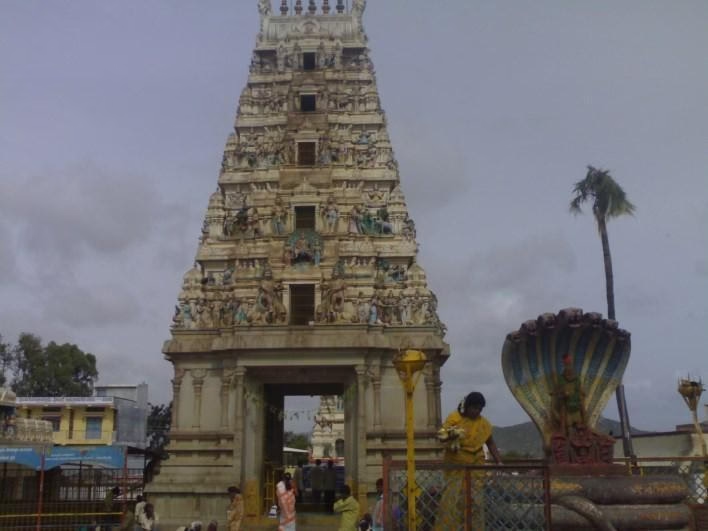
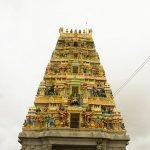
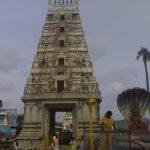
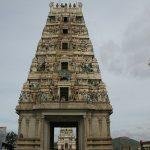
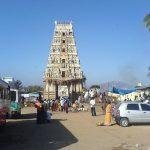
The Ghati Subramanya Temple is a masterpiece of Dravidian architecture. The most distinctive feature is the towering gateway tower (Gopuram), which soars toward the sky, adorned with intricate sculptures depicting various deities and events from Hindu mythology.
Sanctum Layout:
The inner sanctum (Garbhagriha) is designed to accommodate the twin deities. The idol of Lord Subramanya is carved from a single stone and faces East, while Lord Narasimha resides at the rear, facing West. A strategically placed mirror on the rear wall reflects the image of Lord Narasimha, allowing the devotee to offer prayers to both deities simultaneously without breaking the ritual sequence.
Vastu Shastra Elements:
The temple complex adheres to traditional Vastu principles, with the entrance aligned to the East to welcome the first rays of the sun. The outer prakaram (corridor) is lined with thousands of small Naga Pratimas (snake idols) installed by devotees, creating a unique visual landscape of faith.
Darshan & Ritual Logistics
The temple administration facilitates a structured darshan experience. Below are the standard daily timings. Please verify with the temple office for any seasonal changes.
Daily Timings (2026 Schedule)
| Slot | Timing | Activity |
|---|---|---|
| Morning | 06:00 AM – 08:00 AM | Morning Arathi & Abhishekam |
| Morning | 08:30 AM – 12:00 PM | General Darshan |
| Lunch Break | 12:00 PM – 03:00 PM | Sanctum Closed |
| Evening | 03:30 PM – 06:00 PM | General Darshan |
| Night | 06:30 PM – 08:00 PM | Pradosha Pooja & Close |
Key Sevas & Online Booking
Devotees can perform several important rituals to invoke blessings. Booking can be done at the temple counter or typically through the official temple trust website or the Karnataka Tourism portal.
- Abhishekam: Ritual bathing of the deity with milk, honey, and turmeric. Best performed on Tuesdays.
- Naga Pratistha: Installation of a snake idol (donated by the temple or brought by devotee) for Sarpa Dosha Nivarana.
- Kuja Dosha Pooja: Specifically performed on Tuesdays to mitigate the ill effects of Mars.
- Archana: Reciting the names of the Lord with offerings of flowers and betel leaves.
Upcoming 2026 Festivals:
- Brahmarathotsava: Pushya Shuddha Shashti (January 2026). The major annual chariot festival.
- Narasimha Jayanti: Vaishakha Shukla Chaturdashi (April/May 2026).
- Special Cattle Fair: Held in December 2026, attracting traders from Tamil Nadu, Andhra Pradesh, and Kerala.
Practical Visitor Guidance
To ensure a smooth spiritual experience, please adhere to the following guidelines:
- Dress Code: Traditional attire is mandatory. Men should wear Dhoti/Panche and shirts, while women should wear Saree/Salwar Kameez. Strict dress codes are enforced for entry into the inner sanctum.
- Photography: Strictly prohibited inside the sanctum and the inner prakaram. Mobile phones are allowed but must be silenced.
- Mobile Lockers: Free and paid locker facilities are available at the entrance for cameras, belts, and mobile devices not permitted inside.
- Crowd Management:
- Best Time to Visit: Tuesday is considered highly auspicious. If avoiding crowds, visit on weekdays (Wednesday to Friday).
- Seasonal Advice: May is the peak summer season; carry sufficient water and a head covering. The Cattle Fair in December draws massive crowds; plan accommodation in advance.
Pilgrimage Connectivity
How to Reach Ghati Subramanya
The temple is well-connected by road via NH 648 (formerly known as Bellary Road).
By Air:
The nearest airport is Kempegowda International Airport (BLR), approximately 48 km away. Taxis and cabs are readily available at the airport. The drive via NH 648 takes about 1 hour to 1 hour 15 minutes.
By Train:
The nearest major railway station is Bengaluru City Junction (SBC) (approx. 60 km). Alternatively, Yelahanka Junction (approx. 35 km) is closer and well-connected to the city. From the station, hire a taxi to Doddaballapura.
By Road:
From Bangalore, take the airport road (NH 648) towards Doddaballapura. Continue past the town toward Ghati Subramanya. Regular buses ply from the Kempegowda Bus Station (Majestic) to Doddaballapura; from there, local transport or auto-rickshaws can take you the remaining distance (approx. 10 km).
Nearby Sacred Sites
Extend your pilgrimage by visiting these nearby spiritual hubs:
- Muddenahalli (10 km): Visit the Sri Sathya Sai Grama and the Muddenahalli Vishnu Temple.
- Bhoga Nandeeshwara Temple (15 km): Located at the foot of Nandi Hills, this is one of the oldest temples in Karnataka, dedicated to Lord Shiva.
- Chandragiri Betta (12 km): A historical hill fort near Savandurga, offering a blend of trekking and spiritual exploration.
Frequently Asked Questions (FAQ)
Is there a VIP Darshan entry available?
Yes, the temple administration offers special entry darshan tickets (paid) to bypass regular queues, especially during weekends and festivals. Tickets can be purchased at the counter near the entrance.
Can we perform Puja for Sarpa Dosha?
Absolutely. Ghati Subramanya is one of the most potent places for Sarpa Dosha Nivarana. You can purchase a ticket for the specific Sarpa Dosha Pooja or Abhishekam at the temple office. It is advisable to carry your horoscope or birth details.
Are there accommodation facilities near the temple?
While the temple complex itself has limited rest houses (Dharmashalas), Doddaballapura town (10 km away) offers various guest houses and budget hotels. For better amenities, staying in Bangalore or near Yelahanka is recommended for a day trip.
Is the temple accessible for the elderly and physically challenged?
The outer complex is flat and easy to navigate. However, the sanctum requires climbing a few steps. Wheelchair access is available for the outer courtyard, but entry to the inner sanctum might be difficult for wheelchair users.
What is the significance of pouring milk on the anthill?
Tradition holds that the anthill (Valmiki) contains the residing energy of the Serpent Gods. Offering milk is considered an act of appeasement and gratitude, seeking protection from snake bites and relief from astrological afflictions.
Contact Details
Address: S Ghati, Bramhana Beedi, Doddaballapur Taluk, Ghati Subramanya, Karnataka 561203
Phone: 080-2765-7131 (Temple Office)
Recent Posts

Shri Kaamkoteeshwar Mandir, Varanasi – History & Significance
In the heart of Kashi, the eternal city of Lord Shiva, where the Ganges flows with celestial grace, stands the Shri Kaamkoteeshwar Mandir. This sacred Sannidhi is not merely a temple but a profound spiritual bridge between the Northern…

ओ सांवरे तूने ही मुझको संभाला – Lyrics & Meaning
ओ सांवरे तूने ही मुझको संभाला – A Prayer to Shyam Origin & Spiritual Essence Why This Bhajan Resonates Devotees chant this when overwhelmed by life’s storms—the refrain ‘तूने ही मुझको संभाला’ is the soul’s sigh of relief: “You…

कथा ये है महाराज मेरे की – Lyrics & Meaning
कथा ये है महाराज मेरे की छत्रपति संभाजी महाराज – A Prayer to Chhatrapati Sambhaji Maharaj Origin & Spiritual Essence Why This Bhajan Resonates Devotees chant this when their spirit feels tested—its powerful refrain “महाराज मेरे” is a soul’s…

Rigveda Samhita Yathartha Anuvada (ऋग्वेद संहिता यथार्थ अनुवाद) – Complete Set with Anvayartha & Hindi/English Translation
The Rigveda is the oldest surviving scripture of humanity and the foundational text of Sanātana Dharma. For serious students, scholars, UPSC aspirants studying ancient Indian history, Sanskrit learners, and spiritual seekers, a precise and grammatically structured translation is indispensable.…

आना भी अकेला है जाना भी अकेला है – Lyrics & Meaning | BharatTemples
आना भी अकेला है जाना भी अकेला है – A Prayer to the Divine Witness Origin & Spiritual Essence Why This Bhajan Resonates Devotees turn to this bhajan in moments of deep reflection—when life’s attachments begin to ache. The…

माता शेरावाली के द्वार जो भी जाता है – Lyrics & Meaning
माता शेरावाली के द्वार जो भी जाता है – A Prayer to Maa Sherawali Origin & Spiritual Essence Why This Bhajan Resonates Devotees turn to this bhajan in times of fear or uncertainty—its promise that no one leaves Maa’s…

मार लेना सपणी उबार लेणा भवरा – Lyrics & Meaning
मार लेना सपणी उबार लेणा भवरा – A Prayer to the Divine Beloved Origin & Spiritual Essence Why This Bhajan Resonates Devotees chant this in moments of deep vulnerability—its cry of “मार लेना सपणी, उबार लेणा भवरा” is the…

हमें श्याम सुंदर भरोसा तुम्हारा – Lyrics & Meaning
हमें श्याम सुंदर भरोसा तुम्हारा – A Prayer to Shyam Sundar Origin & Spiritual Essence Why This Bhajan Resonates Devotees chant this when feeling alone—its refrain ‘de do sahara’ is the soul’s cry for divine support. Lyrics in Hindi…

Mere Satguru Ne Di Thi Davai Lyrics in Hindi & Meaning
Mere Satguru Ne Di Thi Davai: Invoking the Guru’s Liberating Wisdom This soul-stirring bhajan venerates the Satguru (True Spiritual Master) as the divine physician who dispenses the only remedy for life’s deepest sufferings. Composed by Sant Karmaveer Tufani, it…

Janm Diyo Thari Maa Dukh Dekhiyo Lyrics in Hindi & Meaning
जन्म दियो थारी माँ दुख देखियो (Maa’s Grief Upon Birthing You) This soul-stirring Chetavani Bhajan (admonitory hymn) is addressed to the Divine Mother (Maa) – a call for repentance when children forget their filial duties in the dark age…