
Contents
Introduction & Spiritual Essence
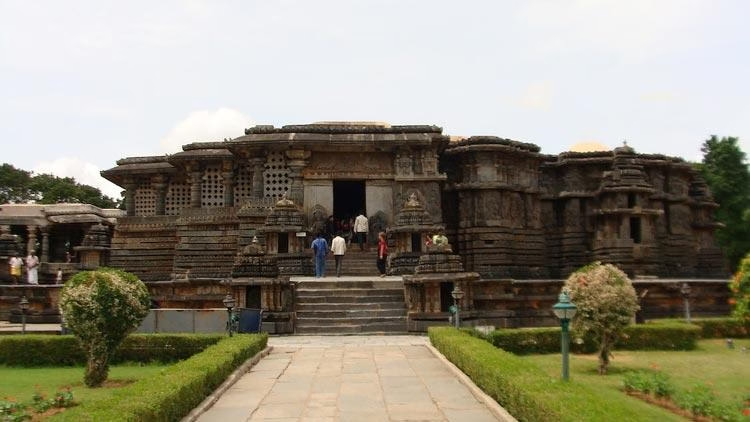
The Hoysaleswara Temple in Halebidu, Karnataka, stands as a silent testament to the architectural zenith of the Hoysala Empire. Located in the heart of Hassan district, this temple is not merely a stone structure but a spiritual energy center dedicated to Lord Shiva. Unlike many ancient temples that have suffered the ravages of time, the Hoysaleswara Temple remains a masterpiece of stone carving, drawing devotees and art lovers alike to its raised platform.
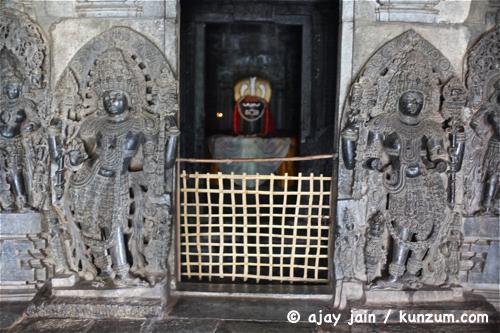
The primary deity here is the Swayambhu (self-manifested) Shiva Linga, worshipped as Hoysaleswara. Interestingly, the temple houses two distinct shrines: one for King Vishnuvardhana (Hoysaleswara) and another for his queen, Shantala Devi (Shantaleswara). While the temple does not strictly follow a typical Agamic structure due to its unique Hoysala design, the spiritual energy is palpable.
Phalaśruti (Spiritual Benefits): Devotees visit this ancient shrine to cleanse ancestral karma and seek blessings for marital harmony. It is believed that offering prayers at the feet of Hoysaleswara, especially during Pradosha Kalam, helps dissolve the malefic effects of planetary alignments. The temple is also renowned for granting Moksha (liberation) to those who circumambulate the temple with a pure heart.
Historical Origins & Scriptural Legend
The history of Halebidu is a saga of grandeur and resilience. According to temple records, the Hoysaleswara Temple was commissioned by Ketumalla, a general and minister in the court of King Vishnuvardhana, around 1121 CE. Dedicated to the King and his beloved Queen Shantala, the construction spanned 105 years, engaging over 20,000 laborers to complete the intricate friezes.
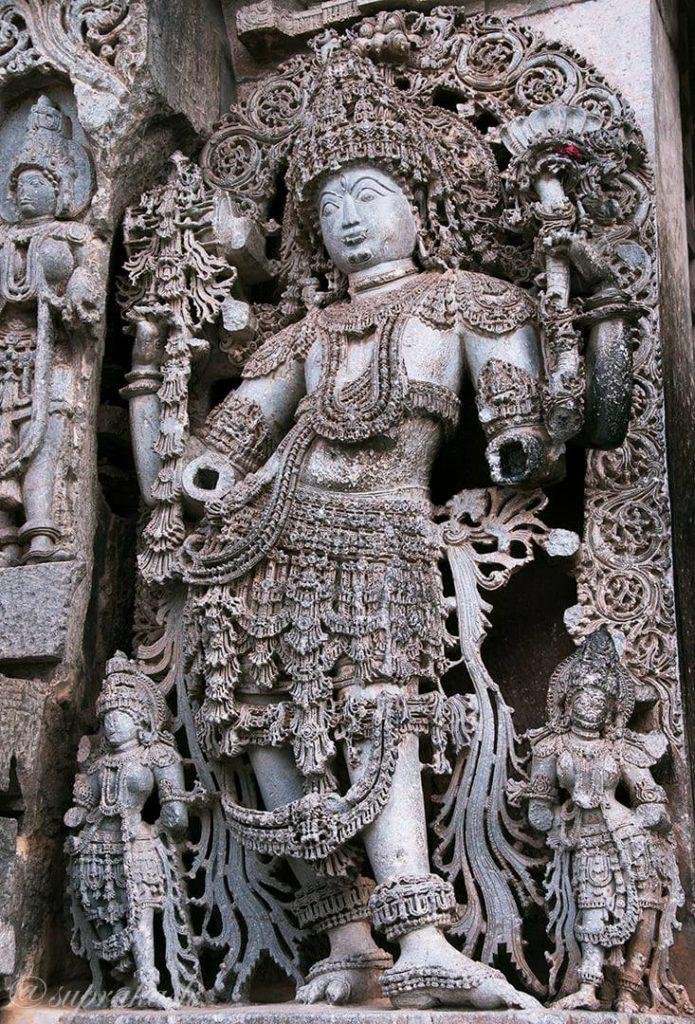
Tradition holds that Queen Shantala Devi, a follower of Jainism who remained deeply spiritual towards Shaivism, was the muse for the temple’s sculptures. Her legendary beauty and grace as a Bharatanatyam dancer are immortalized in the Shilabalikas (bracket figures) carved on the temple walls.
The temple’s tragic history begins in the 14th century when the Delhi Sultanate forces, led by Malik Kafur, invaded the Deccan. Halebidu (then called Dorasamudra) was ransacked twice, in 1311 and 1327 CE. The plunder left the temple in ruins, earning the town its name—Old Capital—and causing the roof to vanish, though the walls remained miraculously intact.
Architectural Marvels
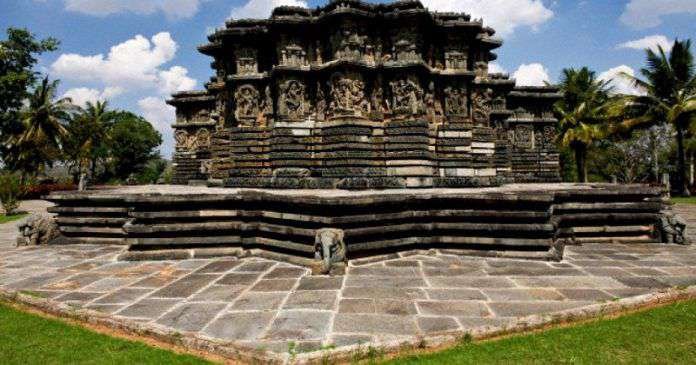
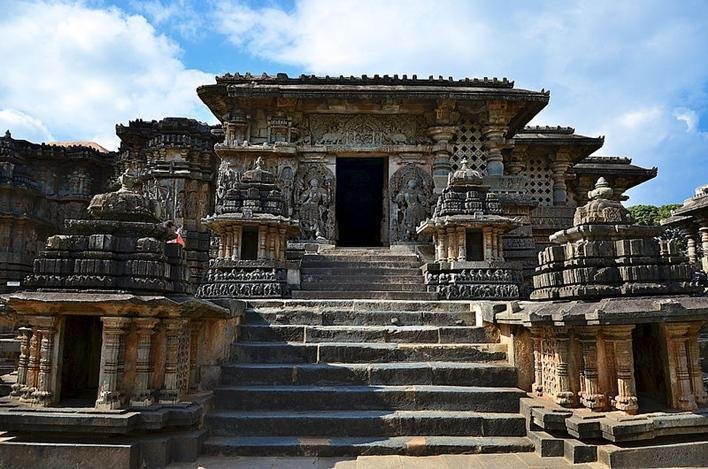
Hoysaleswara Temple is the crowning glory of Hoysala architecture. The temple is built on a raised star-shaped platform (Adhisthana) using chloritic schist (soft soapstone), a material that allows for exquisite detailing.
Style and Vastu: Unlike the towering Shikharas of Nagara style or the pyramid towers of Dravida, Hoysala temples feature a unique Sarvatobhadra design—a complex star-shaped floor plan. The layout is designed so that the sun’s rays never fall directly on the sanctum, maintaining a cool inner sanctum.
Key Features:
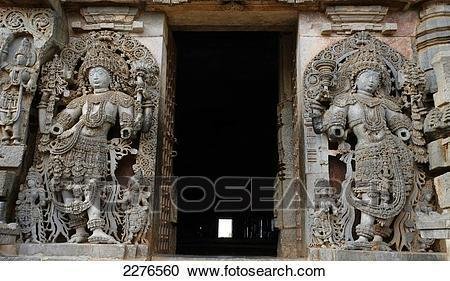
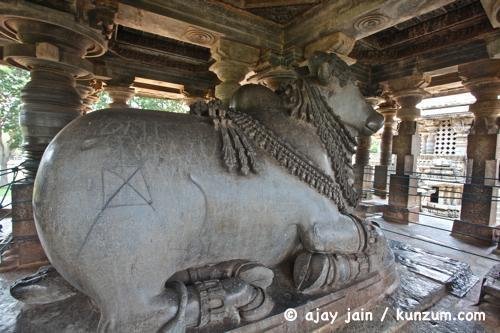
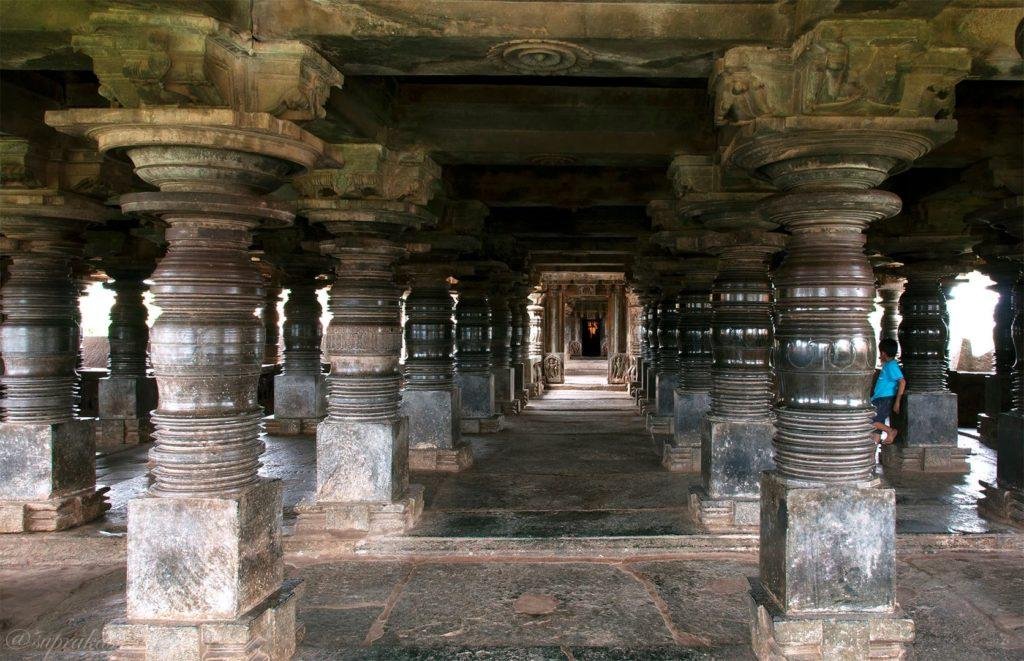
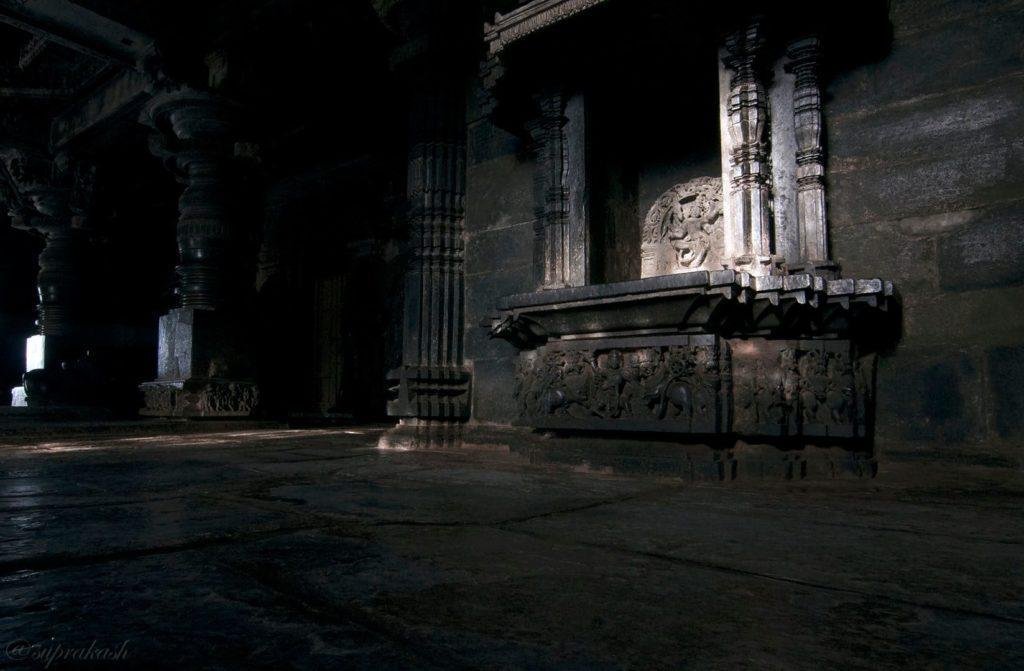
- The Mantapa: The temple features a massive, open Mandapa (hall) with intricately carved pillars. The lathe-turned pillars are a signature Hoysala element.
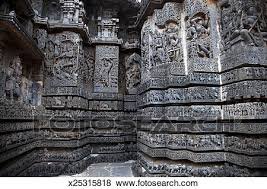
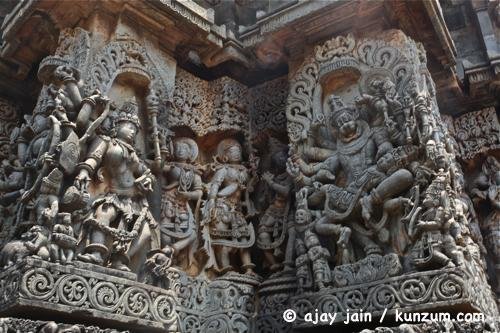
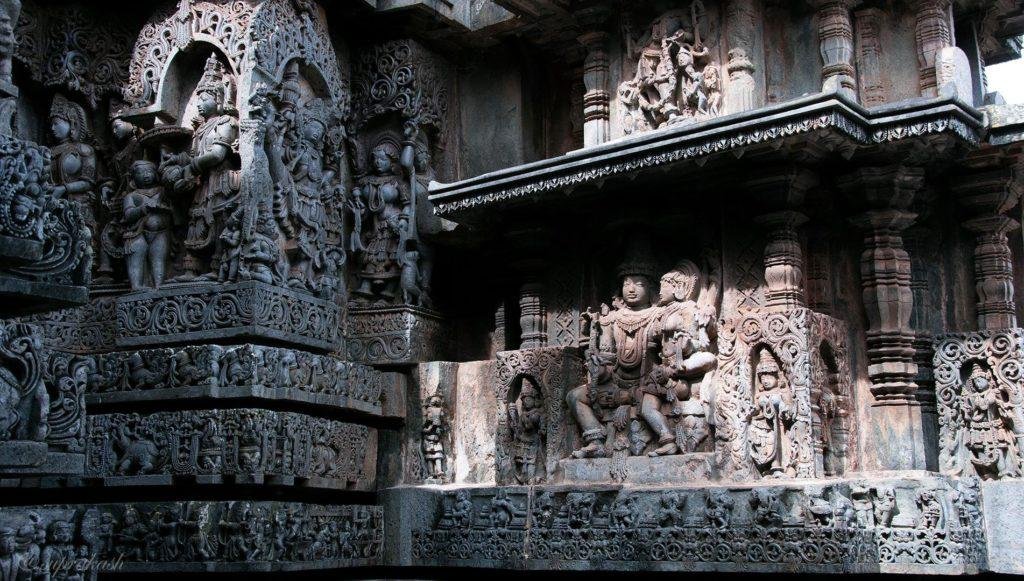
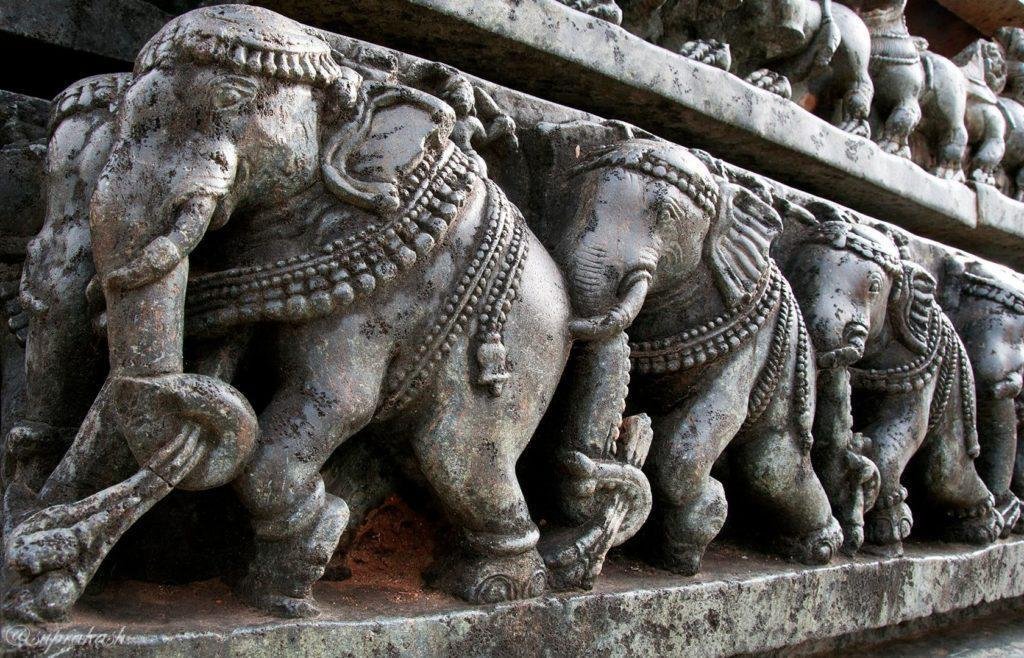
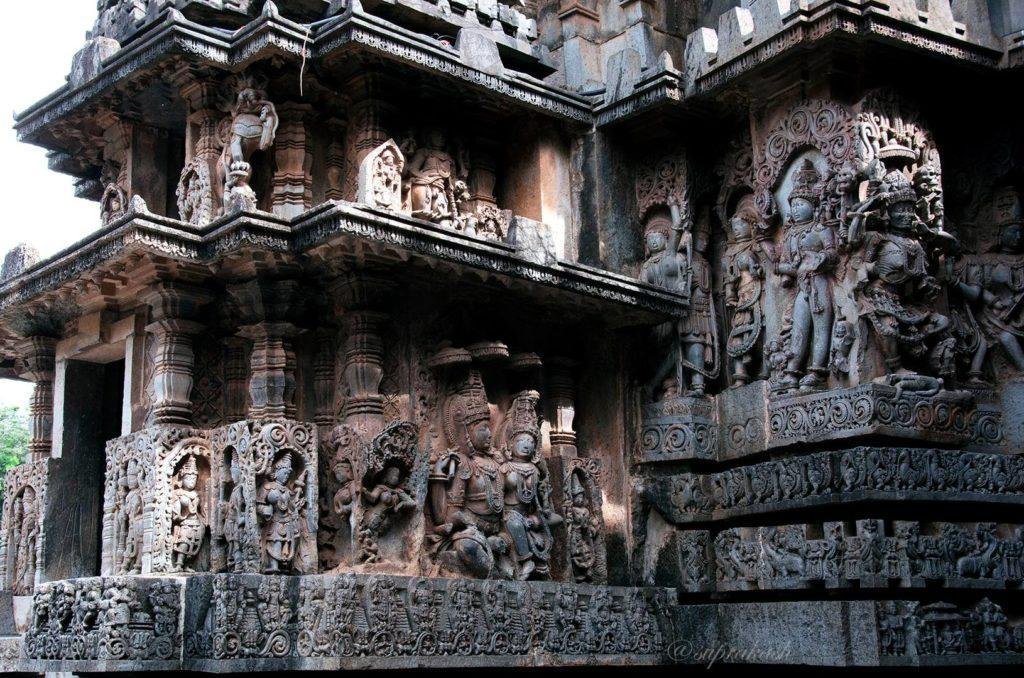
- Friezes: The outer walls are covered with an endless procession of gods, goddesses, animals, birds, and dancers. The Purana friezes narrate episodes from the Ramayana and Mahabharata.
- Shilabalikas: The bracket figures of dancing damsels are carved with such precision that their jewelry and expressions remain sharp after eight centuries.
The temple was an early attempt at a Ekakuta vimana (single shrine), though today it is often studied as a Dvikuta (twin shrines) complex due to the adjoining Shantaleswara shrine. Unfortunately, the temple does not hold an ASI protected monument status logo, but it is maintained by the Archaeological Survey of India.
Darshan & Ritual Logistics
Visiting Halebidu requires planning, as the temple is a protected site. The atmosphere is one of quiet devotion, contrasting with the bustling crowds of larger shrines.
Daily Timings
Timings may vary slightly on festival days. The temple generally remains closed for a brief afternoon recess.
| Session | Timings |
|---|---|
| Morning Darshan | 6:00 AM – 11:00 AM |
| Afternoon Closure | 11:00 AM – 4:00 PM |
| Evening Darshan | 4:00 PM – 8:30 PM |
Sevas and Online Booking
While physical booking is available at the temple counter, online seva booking is facilitated through the Karnataka Tourism portal for convenience.
- Abhishekam: Performed with milk, honey, and ghee. Timing: 7:00 AM – 8:00 AM.
- Archana: Recitation of Shiva Sahasranama. Available throughout open hours.
- Rudrabhishekam: A specialized Vedic ritual for peace and prosperity (requires prior notice).
2026 Festival Calendar
Plan your visit around these auspicious dates for a heightened spiritual experience:
- Maha Shivaratri: February 26, 2026 (Special night-long darshan).
- Karthika Deepam: November 5, 2026 (Lighting of lamps).
- Hoysala Mahotsav: December 10–15, 2026 (Cultural performances of classical dance and music).
Practical Visitor Guidance
To ensure a respectful visit, adhere to the following guidelines which preserve the sanctity and the structure of the temple.
- Dress Code: Traditional attire is recommended. Men should wear dhotis or trousers, and women should wear sarees or salwar kameez. Avoid shorts and sleeveless tops.
- Footwear: Shoes must be removed at the designated entrance. A small fee is charged for safekeeping.
- Photography: Photography is allowed within the complex, but strictly prohibited inside the inner sanctum (garbhagriha).
- Mobile Lockers: Mobile phones are allowed, but it is respectful to keep them silent. Note that the temple complex has restricted lighting for the preservation of carvings; carrying a small flashlight is not permitted.
Crowd Management & Seasonal Advice
Unlike Belur, Halebidu sees a more spread-out crowd. However, December to February sees peak tourism.
- Best Hours: Visit immediately after opening (6:00 AM) to experience the morning rituals and avoid the midday sun.
- Seasonal Tip: During May (peak summer), temperatures in Hassan district can soar. Carry a water bottle and a head covering. The stone floors reflect heat intensely.
- Monsoon: The star-shaped platform can become slippery during heavy rains (July–August). Exercise caution on the steps.
Pilgrimage Connectivity
Halebidu is strategically located on the tourist circuit of Hassan, making it highly accessible.
How to Reach
- By Road: Halebidu is well connected via NH 73 and NH 75.
- From Bangalore: 220 km via NH 75 (approx. 4.5 hours).
- From Mysore: 149 km (approx. 3 hours).
- From Hassan: 32 km (the nearest major town).
- Nearest Railway Station: Hassan Railway Station (approx. 45 mins drive). Trains from Bangalore and Mysore are frequent.
- Nearest Airport: Kempegowda International Airport (BLR), Bangalore (approx. 4 hours by road).
Nearby Sacred Sites
To complete your pilgrimage circuit, visit these nearby sites (within 6-10 km radius):
- Belur Chennakeshava Temple: Dedicated to Lord Vishnu, featuring the iconic Darja Mantapa. Distance: 16 km.
- Jain Bastis (Basti Hills): Located 1 km from Halebidu, these Jain temples feature gleaming black stone pillars and a 14-foot statue of Lord Parshwanatha.
- Kedareswara Temple: Another Hoysala era temple in Halebidu itself, dedicated to Lord Shiva, though smaller than Hoysaleswara.
Photo Gallery
Frequently Asked Questions (FAQ)
1. Is there a VIP darshan entry at Hoysaleswara Temple?
No, unlike Tirupati or Shirdi, Hoysaleswara Temple does not have a paid VIP darshan system. Entry is free and open to all. However, it is recommended to visit early in the morning to avoid crowds and have a peaceful darshan.
2. Are there accommodation facilities in Halebidu?
While there are a few lodges and homestays in Halebidu, the majority of hotels are located in Hassan (32 km away), which offers a wider range of options from budget to luxury. It is advisable to book in advance during the Hoysala Mahotsav.
3. Can I hire a guide at the temple complex?
Yes, government-approved guides are available at the temple entrance. Hiring a guide is highly recommended to understand the intricate symbolism carved into the walls. The fee is nominal, usually ranging from ₹300 to ₹500.
4. Is the temple wheelchair accessible?
The main sanctum is accessible via ramps, but the flooring is uneven due to the age of the structure. The outer corridors are manageable with assistance, but navigating the entire complex might be challenging for those with severe mobility issues.
5. What is the best time to visit Halebidu?
The ideal time is from October to March when the weather is cool and pleasant. Summers (March to June) can be extremely hot, making outdoor exploration difficult.
Recent Posts

Shri Kaamkoteeshwar Mandir, Varanasi – History & Significance
In the heart of Kashi, the eternal city of Lord Shiva, where the Ganges flows with celestial grace, stands the Shri Kaamkoteeshwar Mandir. This sacred Sannidhi is not merely a temple but a profound spiritual bridge between the Northern…

ओ सांवरे तूने ही मुझको संभाला – Lyrics & Meaning
ओ सांवरे तूने ही मुझको संभाला – A Prayer to Shyam Origin & Spiritual Essence Why This Bhajan Resonates Devotees chant this when overwhelmed by life’s storms—the refrain ‘तूने ही मुझको संभाला’ is the soul’s sigh of relief: “You…

कथा ये है महाराज मेरे की – Lyrics & Meaning
कथा ये है महाराज मेरे की छत्रपति संभाजी महाराज – A Prayer to Chhatrapati Sambhaji Maharaj Origin & Spiritual Essence Why This Bhajan Resonates Devotees chant this when their spirit feels tested—its powerful refrain “महाराज मेरे” is a soul’s…

Rigveda Samhita Yathartha Anuvada (ऋग्वेद संहिता यथार्थ अनुवाद) – Complete Set with Anvayartha & Hindi/English Translation
The Rigveda is the oldest surviving scripture of humanity and the foundational text of Sanātana Dharma. For serious students, scholars, UPSC aspirants studying ancient Indian history, Sanskrit learners, and spiritual seekers, a precise and grammatically structured translation is indispensable.…

आना भी अकेला है जाना भी अकेला है – Lyrics & Meaning | BharatTemples
आना भी अकेला है जाना भी अकेला है – A Prayer to the Divine Witness Origin & Spiritual Essence Why This Bhajan Resonates Devotees turn to this bhajan in moments of deep reflection—when life’s attachments begin to ache. The…

माता शेरावाली के द्वार जो भी जाता है – Lyrics & Meaning
माता शेरावाली के द्वार जो भी जाता है – A Prayer to Maa Sherawali Origin & Spiritual Essence Why This Bhajan Resonates Devotees turn to this bhajan in times of fear or uncertainty—its promise that no one leaves Maa’s…

मार लेना सपणी उबार लेणा भवरा – Lyrics & Meaning
मार लेना सपणी उबार लेणा भवरा – A Prayer to the Divine Beloved Origin & Spiritual Essence Why This Bhajan Resonates Devotees chant this in moments of deep vulnerability—its cry of “मार लेना सपणी, उबार लेणा भवरा” is the…

हमें श्याम सुंदर भरोसा तुम्हारा – Lyrics & Meaning
हमें श्याम सुंदर भरोसा तुम्हारा – A Prayer to Shyam Sundar Origin & Spiritual Essence Why This Bhajan Resonates Devotees chant this when feeling alone—its refrain ‘de do sahara’ is the soul’s cry for divine support. Lyrics in Hindi…

Mere Satguru Ne Di Thi Davai Lyrics in Hindi & Meaning
Mere Satguru Ne Di Thi Davai: Invoking the Guru’s Liberating Wisdom This soul-stirring bhajan venerates the Satguru (True Spiritual Master) as the divine physician who dispenses the only remedy for life’s deepest sufferings. Composed by Sant Karmaveer Tufani, it…

Janm Diyo Thari Maa Dukh Dekhiyo Lyrics in Hindi & Meaning
जन्म दियो थारी माँ दुख देखियो (Maa’s Grief Upon Birthing You) This soul-stirring Chetavani Bhajan (admonitory hymn) is addressed to the Divine Mother (Maa) – a call for repentance when children forget their filial duties in the dark age…