
Contents
- 1 Definitive Pilgrimage Guide: Vitank Narsimha Temple, Varanasi
- 1.1 Introduction & Spiritual Essence: The Ferocious Protector of Kashi
- 1.2 Historical Origins & Scriptural Legend
- 1.3 Architectural Marvels
- 1.4 Photo Gallery
- 1.5 Darshan & Ritual Logistics
- 1.6 Practical Visitor Guidance
- 1.7 Pilgrimage Connectivity
- 1.8 Frequently Asked Questions (FAQ)
- 1.9 Contact Details
- 1.10 Conclusion
Definitive Pilgrimage Guide: Vitank Narsimha Temple, Varanasi
Introduction & Spiritual Essence: The Ferocious Protector of Kashi
Deep within the spiritual heart of Varanasi (Kashi), hidden in the labyrinthine alleys near the sacred Kedar Ghat, stands a profound manifestation of Lord Vishnu. The Vitank Narsimha Temple is not merely a structure of stone; it is a living testament to the Kashi Khand of the Skanda Purana, where Lord Shiva declares that Vishnu dwells eternally here to protect the city’s devotees.
Primary Deity and Form
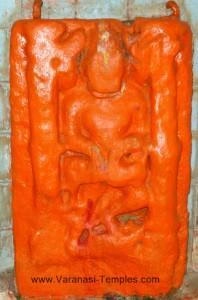
The presiding deity is Vitank Narsimha, a specific form of Lord Narasimha (the avatar of Vishnu with a lion’s head and human body). Unlike the widely known Ugra Narsimha (who represents destructive fury), Vitank Narsimha is often depicted in a controlled, seated posture (Yoga Asana), symbolizing the channeling of immense power into courage and mental fortitude. As a Swayambhu (self-manifested) deity or an ancient Murti (idol) revered since the Puranic ages, it represents the fierce yet benevolent aspect of the divine protector.
Phalaśruti: The Spiritual Benefits
Why do devotees make this specific pilgrimage? The Phalaśruti (scriptural promise of merit) found in the Kashi Khand of the Skanda Purana is explicit. It is recorded in Chapter 61 of the Kashi Khand that among the various forms of Lord Vishnu residing in Kashi, Vitank Narsimha holds a unique significance.
According to tradition, devotees who worship this deity with sincerity are blessed with:
- Unyielding Courage: The ability to overcome fear and anxiety in worldly affairs.
- Mental Strength: Vital for critical decision-making in personal and professional life.
- Protection from Negative Energies: As a fierce protector, he guards the devotee from internal and external malevolent forces.
Historical Origins & Scriptural Legend
While many temples in Varanasi date back to specific medieval dynasties, the Vitank Narsimha Temple derives its authority from divine geography rather than royal patronage. The temple records and oral traditions root its existence in the Puranic era.
The Kashi Khand Legend
According to the Kashi Khand, Varanasi is a city of liberation, but it is also under the constant protection of Vishnu. In the 61st chapter, the text describes the presence of Lord Vishnu in various forms. The legend holds that Lord Vishnu took the form of Vitank Narsimha to subdue the arrogance of Brahma and to protect the sages (Rishis) meditating along the banks of the Ganges.
Tradition holds that this specific location near Kedar Ghat is spiritually significant because it marks a point where the divine energy of Vishnu intersects with the ascetic energy of Shiva (represented by the nearby Kedareshwar Temple).
Architectural Marvels
The Vitank Narsimha Temple is a classic example of the Kashi Nagara style of architecture, designed to fit seamlessly into the dense urban fabric of the old city. While the complex is compact compared to sprawling modern temples, its architectural elements are deeply symbolic.
Vastu Shastra and Placement
The temple is situated facing the East, specifically towards the river Ganga. According to Vastu Shastra, the placement of the Narsimha idol in the inner sanctum (Garbhagriha) is calculated to absorb the first rays of the sun reflecting off the river water.
Notable Sculptures
The sanctum houses the idol of Vitank Narsimha, typically depicted with four arms holding the Shankha (conch), Chakra (discus), and gestures of blessing. The surrounding stone walls often feature intricate carvings of floral motifs and other Vaishnavite symbols. Although not designated as a UNESCO site, the temple is part of the heritage cluster of Varanasi that the Archaeological Survey of India (ASI) monitors for its historical value.
Photo Gallery
Darshan & Ritual Logistics
Visiting Vitank Narsimha requires an understanding of the rhythms of Kashi. Unlike large temples, this shrine follows the traditional temple timings common in Varanasi, adjusted for the seasons.
Daily Timings
Assuming the current year is 2026, the following schedule is standard. However, timings may vary slightly during festival seasons.
| Session | Opening Time | Closing Time |
|---|---|---|
| Morning | 5:30 AM (Brahma Muhurta) | 12:00 PM |
| Evening | 4:30 PM (Sandhya) | 11:00 PM |
Key Sevas and Online Booking
Devotees can participate in daily rituals. While grand elaborate Abhishekams are typically reserved for larger temples, the Vitank Narsimha temple facilitates personal offerings.
- Abhishekam: Performed with water, milk, and honey. Timing: 7:00 AM daily.
- Archana: Recitation of 108 names of Narsimha. Timing: 9:00 AM and 6:00 PM.
Online Booking: For specific rituals in Varanasi, the Varanasi Mathura Corridor initiatives have digitized many bookings. Devotees are advised to check the official Kashi Vishwanath website or the Varanasi Panchkoshi Parikrama portals for updated links. However, for this specific shrine, on-site offerings are the norm.
Festival Dates 2026
The most significant festival here is Narasimha Jayanti, celebrated on the Shukla Paksha Chaturdashi of the Vaishakh month.
- Narasimha Jayanti 2026: Sunday, May 17, 2026.
During this period, special Maha Abhishek and Shringar Darshan are performed from 5:00 AM to 10:00 PM.
Practical Visitor Guidance
As the temple is located in the crowded Varanasi old city near Kedar Ghat, preparation is key for a comfortable visit.
Dress Code and Etiquette
Traditional attire is recommended. Men should wear dhotis or long trousers and shirts; women should wear sarees or full-length skirts. Avoid shorts and tank tops to respect the sanctity of the shrine. Footwear must be removed before entering the temple premises; plastic slippers are often easier to manage.
Crowd Management and Accessibility
- Best Hours: The most peaceful time for Darshan is early morning (5:30 AM to 7:00 AM) or late evening (after 9:00 PM).
- Photography: Strictly prohibited inside the inner sanctum. Discretion is advised in the outer courtyard as it is a narrow lane.
- Accessibility: The lane leading to the temple is narrow and uneven. It is not wheelchair accessible. Mobile lockers are not available on-site, so travel light.
- Seasonal Advice: In May and June (peak summer), temperatures exceed 40°C. Carry a water bottle and a handkerchief. During the monsoon (July-August), the lanes near Kedar Ghat can be slippery; wear rubber-soled shoes.
- Kedareshwar Temple: Located immediately adjacent to the Vitank Narsimha Temple. This Shiva temple is one of the five Pancha Kedaras in Varanasi.
- Kedar Ghat: One of the oldest ghats in Varanasi, known for its spiritual potency. It is believed that bathing here cleanses sins of a past life.
- Lalita Ghat: Just a short walk downstream, featuring a unique fusion of Nepalese and Hindu architecture.
| Date built: | – |
|---|---|
| Deity: | Vitank Narsimha |
| Architectural style: | Hindu Temple architecture |
| Major festivals | – |
| Locale: | Varanasi |
| District:: | Varanasi |
| Address: | – |
| Phone | – |
Pilgrimage Connectivity
Reaching the Vitank Narsimha Temple requires navigating the heritage lane of B.6/102. Here is the logistical breakdown for 2026 travel.
How to Reach
Nearest Airport: Lal Bahadur Shastri International Airport (VNS) is approximately 25 km away. A taxi to Kedar Ghat takes 50-70 minutes depending on traffic.
Nearest Railway Station: Varanasi Junction (BSB) is about 6 km away. From the station, take an auto-rickshaw to Assi Ghat or Kedar Ghat. Auto-rickshaws generally stop at the major ghats; from there, you must walk.
By Road: The temple is accessible via the Varanasi-Ranchi Highway (NH 19) and Varanasi-Lucknow Highway (NH 31). However, vehicles cannot enter the narrow lane. You must get down at the Kedar Ghat parking area or the main road and walk approximately 10 minutes.
Nearby Sacred Sites
Make the most of your visit by exploring the sacred circuit around Kedar Ghat:
Frequently Asked Questions (FAQ)
1. Is there a VIP darshan entry at Vitank Narsimha Temple?
No, the Vitank Narsimha Temple is a traditional, community-style shrine. It does not offer paid VIP darshan tickets like larger commercial temples. Entry is based on the queue system.
2. What is the significance of the name “Vitank”?
“Vitank” refers to the Lord who possesses immense energy and supremacy. In the context of Narsimha, it signifies the form that is both fierce (to destroy evil) and protective (to shield the devotee), symbolizing the totality of power.
3. Can I visit the temple during the winter months?
Yes, October to March is the ideal time to visit Varanasi. The weather is cool and pleasant, making the walk to Kedar Ghat comfortable. However, avoid peak fog months (late December to January) if you have early morning travel plans.
4. Is there a dress code for non-Hindu visitors?
While non-Hindus are generally permitted entry in many temples in Varanasi (unlike some strictly Vaishnavite temples in South India), it is respectful to dress modestly. Footwear must always be removed outside the temple premises.
5. What is the contact number for the temple?
As this is an ancient shrine managed by local trusts, there is no centralized official contact number. For general inquiries regarding Varanasi temples, you may contact the Varanasi District Administration at the District Collector’s office or the Kashi Vishwanath Corridor administration.
Kashi Khand, in Chapter 61, mentions among other forms of Lord Vishnu, one Vitank Narsimha. Devotees who worship this deity will always be courageous and gain mental strength which is vital for important decision making.
Contact Details
Official Address: B.6/102, Kedar Ghat, Varanasi, Uttar Pradesh 221001
Conclusion
The Vitank Narsimha Temple is more than a destination; it is a spiritual anchor in the turbulent sea of life. Whether you are seeking the courage to make difficult decisions or simply looking to absorb the ancient energies of Varanasi, a visit to this hidden shrine at Kedar Ghat will leave an indelible mark on your soul.
Recent Posts

Shri Kaamkoteeshwar Mandir, Varanasi – History & Significance
In the heart of Kashi, the eternal city of Lord Shiva, where the Ganges flows with celestial grace, stands the Shri Kaamkoteeshwar Mandir. This sacred Sannidhi is not merely a temple but a profound spiritual bridge between the Northern…

ओ सांवरे तूने ही मुझको संभाला – Lyrics & Meaning
ओ सांवरे तूने ही मुझको संभाला – A Prayer to Shyam Origin & Spiritual Essence Why This Bhajan Resonates Devotees chant this when overwhelmed by life’s storms—the refrain ‘तूने ही मुझको संभाला’ is the soul’s sigh of relief: “You…

कथा ये है महाराज मेरे की – Lyrics & Meaning
कथा ये है महाराज मेरे की छत्रपति संभाजी महाराज – A Prayer to Chhatrapati Sambhaji Maharaj Origin & Spiritual Essence Why This Bhajan Resonates Devotees chant this when their spirit feels tested—its powerful refrain “महाराज मेरे” is a soul’s…

Rigveda Samhita Yathartha Anuvada (ऋग्वेद संहिता यथार्थ अनुवाद) – Complete Set with Anvayartha & Hindi/English Translation
The Rigveda is the oldest surviving scripture of humanity and the foundational text of Sanātana Dharma. For serious students, scholars, UPSC aspirants studying ancient Indian history, Sanskrit learners, and spiritual seekers, a precise and grammatically structured translation is indispensable.…

आना भी अकेला है जाना भी अकेला है – Lyrics & Meaning | BharatTemples
आना भी अकेला है जाना भी अकेला है – A Prayer to the Divine Witness Origin & Spiritual Essence Why This Bhajan Resonates Devotees turn to this bhajan in moments of deep reflection—when life’s attachments begin to ache. The…

माता शेरावाली के द्वार जो भी जाता है – Lyrics & Meaning
माता शेरावाली के द्वार जो भी जाता है – A Prayer to Maa Sherawali Origin & Spiritual Essence Why This Bhajan Resonates Devotees turn to this bhajan in times of fear or uncertainty—its promise that no one leaves Maa’s…

मार लेना सपणी उबार लेणा भवरा – Lyrics & Meaning
मार लेना सपणी उबार लेणा भवरा – A Prayer to the Divine Beloved Origin & Spiritual Essence Why This Bhajan Resonates Devotees chant this in moments of deep vulnerability—its cry of “मार लेना सपणी, उबार लेणा भवरा” is the…

हमें श्याम सुंदर भरोसा तुम्हारा – Lyrics & Meaning
हमें श्याम सुंदर भरोसा तुम्हारा – A Prayer to Shyam Sundar Origin & Spiritual Essence Why This Bhajan Resonates Devotees chant this when feeling alone—its refrain ‘de do sahara’ is the soul’s cry for divine support. Lyrics in Hindi…

Mere Satguru Ne Di Thi Davai Lyrics in Hindi & Meaning
Mere Satguru Ne Di Thi Davai: Invoking the Guru’s Liberating Wisdom This soul-stirring bhajan venerates the Satguru (True Spiritual Master) as the divine physician who dispenses the only remedy for life’s deepest sufferings. Composed by Sant Karmaveer Tufani, it…

Janm Diyo Thari Maa Dukh Dekhiyo Lyrics in Hindi & Meaning
जन्म दियो थारी माँ दुख देखियो (Maa’s Grief Upon Birthing You) This soul-stirring Chetavani Bhajan (admonitory hymn) is addressed to the Divine Mother (Maa) – a call for repentance when children forget their filial duties in the dark age…