
Contents
- 1 Definitive Pilgrimage Guide: Shri Pitambara Peetha, Datia
Definitive Pilgrimage Guide: Shri Pitambara Peetha, Datia
Introduction & Spiritual Essence
Established in the 1920s by the revered Shree Swami Ji Maharaj, Shri Pitambara Peetha is one of the most profound Shakta (Goddess-centric) spiritual complexes in Madhya Pradesh. Located in Datia, the Peetha serves as a dedicated Tapasthali (place of meditation) for devotees seeking divine protection and spiritual upliftment.
The primary deities worshipped here are the fierce and protective forms of the Mahavidyas:
- Devi Bagalamukhi: The Goddess who possesses the power to stun, paralyze, and destroy enemies and negativity.
- Devi Dhumavati: The Goddess of smoke and dissolution, revered for granting wisdom in times of loss and bestowing the boon of longevity (Dirghayu).
Phalaśruti: Why Devotees Visit
According to the legends and the tradition of the Peetha, devotees visit for specific spiritual benefits:
- Removal of Obstacles: Worship of Bagalamukhi is believed to nullify legal disputes, financial crises, and black magic.
- Cleansing Ancestral Karma: Rituals performed here, particularly at the Vankhandeswar Shiva temple, are believed to liberate ancestors from the cycle of birth and death.
- Attainment of Siddhi: The ashram provides a unique environment for Tantra Sadhana, attracting practitioners seeking spiritual powers.
Historical Origins & Scriptural Legend
Archaeological Significance: A central pillar of the Peetha’s history is the ancient Vankhandeswar Shiva Temple. The shivling here is not merely a symbol of faith but a historical artifact. The Archaeological Survey of India (ASI) has tested and approved the dating of this shivling, confirming its origins trace back to the era of the Mahabharata.
The Legend of Shree Swami Ji Maharaj
Tradition holds that the founder, a Parivrajakachrya Dandi Swami, arrived in Datia and remained there for the rest of his life. His identity remained a mystery; devotees referred to him affectionately as “Swamiji” or “Maharaj.” He was a polymath with profound knowledge of Sanskrit, Urdu, Persian, Arabic, English, Pali, and Prakrit. He established the Peetha to spread the light of Sanskrit learning and spiritual sadhana.
The ashram has hosted legendary classical musicians, including Pandit Gundecha Maharaj, Siyaram Tiwari, Rajan and Sajan Mishra, and the Dagar Bandhu, all drawn to the spiritual aura cultivated by the Peetha.
Architectural Marvels
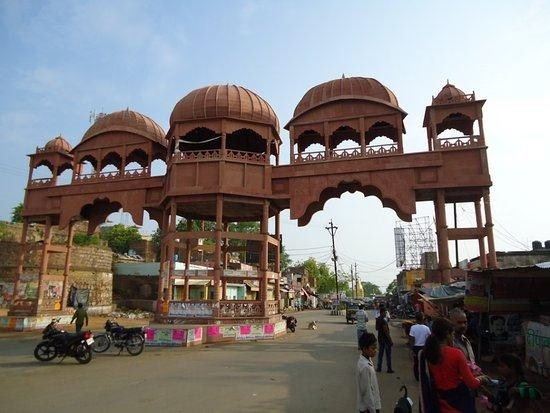
While the complex functions as an ashram, its architecture seamlessly blends traditional Hindu temple styles with the open, airy layouts of a meditation center.
Design and Layout
- Sanctum Sanctorum (Garbhagriha): The main temple houses the idols of Bagalamukhi and Dhumavati. The idols are crafted with intricate detailing, featuring the traditional Shringara (ornamentation) specific to Tantric iconography.
- Vastu Shastra: The complex is laid out to facilitate energy flow, with the main shrines aligned to facilitate meditation and long-duration Yagnas (fire rituals).
- The Sanskrit Library: A notable architectural feature is the ashram’s library, built to preserve ancient manuscripts and texts on mantras and sadhanas. It serves as a hub for academic and spiritual study.
Sculpture and Statuary
Spread across the large area of the ashram are temples dedicated to Parshuram, Hanuman, and Kal Bhairav. The sculptures reflect a blend of Nagara and North Indian styles, characterized by curved shikharas and detailed carvings depicting mythological narratives.

Darshan & Ritual Logistics
The Peetha maintains a strict schedule of Vedic rituals and Tantric pujas. Below are the standard timings.
Daily Timings
| Session | Timings |
|---|---|
| Morning Darshan | 5:00 AM – 12:00 PM |
| Afternoon Break | 12:00 PM – 4:00 PM |
| Evening Darshan | 4:00 PM – 9:00 PM |
Key Sevas and Online Booking
To ensure safety and manage crowd volume, the trust has digitized the booking process for major sevas.
- Bagalamukhi Abhishekam: A ritual performed for the removal of fear and illness. Best performed on Tuesdays.
- Dhumavati Archana: Dedicated to longevity and removal of poverty. Best performed on Saturdays.
- Rudrabhishek: Performed at the Vankhandeswar Shiva temple for ancestors.
Online Seva Booking: Devotees can book these rituals via the official Peetha website or theMadhya Pradesh Tourism Portal (integration for religious circuits is often linked here).
Festival Dates for 2026
Planning a visit during these times offers a glimpse into the peak spiritual atmosphere of the Peetha.
- Navratri (Vasanta): April 3 – April 11, 2026 (Special Yagnas performed daily).
- Bagalamukhi Jayanti: May 13, 2026 (Major Mela expected).
- Navratri (Sharad): September 21 – September 29, 2026.
- Maha Shivaratri: February 26, 2026 (Night-long vigil at Vankhandeswar Temple).
Practical Visitor Guidance
Rules & Etiquette
- Dress Code: Modest, traditional attire is recommended (Kurta-Pajama for men, Saree/Salwar Kameez for women).
- Photography: Strictly prohibited inside the sanctum sanctorum. Photography in the outer courtyard requires permission from the trust office.
- Mobile Lockers: Available near the entrance for phones and electronic devices, as these are not permitted during the Darshan.
Crowd Management & Seasonal Advice
- Best Hours: The best time for a peaceful Darshan is between 5:00 AM and 7:00 AM, or after 8:00 PM.
- Summer (April-June): Datia can be very hot. Carry water bottles and a cap/umbrella.
- Monsoon (July-Sept): The ashram premises can become slippery; wear rubber-soled sandals.
Pilgrimage Connectivity
How to Reach Pitambara Peeth
The ashram is located on Station Road, Datia, making it highly accessible.
- By Air: The nearest airport is Gwalior (GWJ), approximately 75 km away (approx. 1.5-hour drive via NH44).
- By Rail: Datia Railway Station is the nearest railhead, located roughly 3 km from the ashram. It lies on the main Delhi-Mumbai rail route. Major trains stopping here include the Malwa Express, Dakshin Express, and Punjab Mail.
- By Road: Datia is well-connected via NH44 (North-South Corridor). It is 29 km from Jhansi (Uttar Pradesh) and 75 km from Gwalior.
Nearby Sacred Sites (Pilgrimage Circuit)
- Vankhandeswar Shiva Temple: Located within the Peetha complex, this is a must-visit for history buffs due to its ASI-certified Mahabharata-era origins.
- Gopachal Parvat (Gwalior): Located 75 km away, featuring massive rock-cut Jain sculptures.
- Siteshwar Temple (Datia): An ancient Shiva temple located near the banks of the Sindh River in Datia.
Frequently Asked Questions (FAQ)
Is there a VIP darshan entry available?
Yes, the Peetha trust offers a special pass system for urgent health conditions or elderly devotees. These can be requested at the administrative office upon arrival.
Is there a facility for night stay (Dharamshala)?
The Peetha operates a Dharamshala and guest house for devotees. It is advisable to book in advance during festival seasons (Navratri) by contacting the temple office at 07522234960.
Are non-Hindus allowed inside?
While the Peetha is a Shakta center, the outer complex and gardens are generally open to all seekers for spiritual study. However, entry into the main sanctum for Darshan and participation in Vedic rituals is restricted to Hindus.
What is the significance of the library?
The library houses rare texts on Tantra, Sanskrit grammar, and Vedic philosophy. It is a unique feature where one can purchase books on secret mantras and sadhanas not commonly found elsewhere.
Is the temple accessible for wheelchair users?
The outer pathways are paved, but the inner sanctum involves stairs. Staff assistance is available for devotees with mobility issues to facilitate a view from the entrance of the sanctum.
Is there a dress code for children?
While there is no strict code for children, it is respectful to dress them in traditional Indian attire during the darshan.
Contact Details
Shri Pitambara Peetha Trust
Station Road, Datia, Madhya Pradesh 475661
Phone: 07522234960
Recent Posts

Shri Kaamkoteeshwar Mandir, Varanasi – History & Significance
In the heart of Kashi, the eternal city of Lord Shiva, where the Ganges flows with celestial grace, stands the Shri Kaamkoteeshwar Mandir. This sacred Sannidhi is not merely a temple but a profound spiritual bridge between the Northern…

ओ सांवरे तूने ही मुझको संभाला – Lyrics & Meaning
ओ सांवरे तूने ही मुझको संभाला – A Prayer to Shyam Origin & Spiritual Essence Why This Bhajan Resonates Devotees chant this when overwhelmed by life’s storms—the refrain ‘तूने ही मुझको संभाला’ is the soul’s sigh of relief: “You…

कथा ये है महाराज मेरे की – Lyrics & Meaning
कथा ये है महाराज मेरे की छत्रपति संभाजी महाराज – A Prayer to Chhatrapati Sambhaji Maharaj Origin & Spiritual Essence Why This Bhajan Resonates Devotees chant this when their spirit feels tested—its powerful refrain “महाराज मेरे” is a soul’s…

Rigveda Samhita Yathartha Anuvada (ऋग्वेद संहिता यथार्थ अनुवाद) – Complete Set with Anvayartha & Hindi/English Translation
The Rigveda is the oldest surviving scripture of humanity and the foundational text of Sanātana Dharma. For serious students, scholars, UPSC aspirants studying ancient Indian history, Sanskrit learners, and spiritual seekers, a precise and grammatically structured translation is indispensable.…

आना भी अकेला है जाना भी अकेला है – Lyrics & Meaning | BharatTemples
आना भी अकेला है जाना भी अकेला है – A Prayer to the Divine Witness Origin & Spiritual Essence Why This Bhajan Resonates Devotees turn to this bhajan in moments of deep reflection—when life’s attachments begin to ache. The…

माता शेरावाली के द्वार जो भी जाता है – Lyrics & Meaning
माता शेरावाली के द्वार जो भी जाता है – A Prayer to Maa Sherawali Origin & Spiritual Essence Why This Bhajan Resonates Devotees turn to this bhajan in times of fear or uncertainty—its promise that no one leaves Maa’s…

मार लेना सपणी उबार लेणा भवरा – Lyrics & Meaning
मार लेना सपणी उबार लेणा भवरा – A Prayer to the Divine Beloved Origin & Spiritual Essence Why This Bhajan Resonates Devotees chant this in moments of deep vulnerability—its cry of “मार लेना सपणी, उबार लेणा भवरा” is the…

हमें श्याम सुंदर भरोसा तुम्हारा – Lyrics & Meaning
हमें श्याम सुंदर भरोसा तुम्हारा – A Prayer to Shyam Sundar Origin & Spiritual Essence Why This Bhajan Resonates Devotees chant this when feeling alone—its refrain ‘de do sahara’ is the soul’s cry for divine support. Lyrics in Hindi…

Mere Satguru Ne Di Thi Davai Lyrics in Hindi & Meaning
Mere Satguru Ne Di Thi Davai: Invoking the Guru’s Liberating Wisdom This soul-stirring bhajan venerates the Satguru (True Spiritual Master) as the divine physician who dispenses the only remedy for life’s deepest sufferings. Composed by Sant Karmaveer Tufani, it…

Janm Diyo Thari Maa Dukh Dekhiyo Lyrics in Hindi & Meaning
जन्म दियो थारी माँ दुख देखियो (Maa’s Grief Upon Birthing You) This soul-stirring Chetavani Bhajan (admonitory hymn) is addressed to the Divine Mother (Maa) – a call for repentance when children forget their filial duties in the dark age…