
Contents
Introduction & Spiritual Essence
In the heart of Mayurbhanj district of Odisha lies the ancient village of Khiching, a site of immense archaeological and spiritual significance. Here, amidst the rugged beauty of the Eastern Ghats, stands the Kichakeshwari Temple. This temple is not merely a place of worship; it is the ancestral seat (Kuladevi) and the Ishtadevata (cherished deity) of the legendary Bhanj dynasty, who ruled the region for centuries.
The primary deity is Maa Kichakeshwari, a localized form of Goddess Durga or Mahishasuramardini. The name is derived from a historical association with King Kichaka, a legendary figure from the Mahabharata era, linking the site to epic history. Unlike conventional images of the Goddess, the idol here is often depicted in a serene, benevolent form, symbolizing both power and protection.
Phalaśruti (Spiritual Benefits): Devotees believe that visiting this temple cleanses ancestral karma and removes obstacles in life. As the State Deity of the Princely State of Mayurbhanj, she is considered the guardian of the land. Pilgrims travel here specifically to seek blessings for stability, prosperity, and the removal of negativity.
Historical Origins & Scriptural Legend
The Bhanj Dynasty Connection: According to historical records and temple inscriptions, the original temple was constructed between 920 and 925 AD. While the exact founder is debated in colonial records, oral tradition strongly attributes its foundation to the Bhanj kings, who revered Maa Kichakeshwari as their lineage deity. The temple served as the spiritual anchor for their reign.
Destruction and Reconstruction: The temple suffered significant damage due to invasions and the passage of time. Vandals reportedly damaged the original structure in the medieval period. However, the resilience of the faith was restored by Maharaja Pratap Chandra Bhanjdeo. In 1934, he spearheaded a massive reconstruction project, spending approximately ₹85,000 (a colossal sum at the time) to restore the temple to its former glory, adhering to the original architectural vision.
The Stala Purana: Local legends weave a fascinating narrative connecting the geography to the Mahabharata. The village name “Khiching” is believed to be derived from “Kichaka,” the notorious commander-in-chief of the Virata Kingdom. Folklore suggests that the site was a battleground where the Pandavas vanquished Kichaka, and the temple stands as a penance or a marker of this divine intervention.
Architectural Marvels
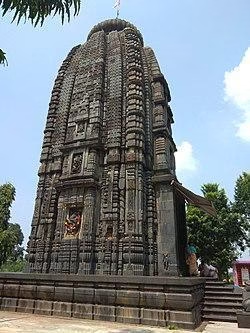
The Kichakeshwari Temple is a masterpiece of Kalinga Architecture, a distinct style of the Nagara order prevalent in Odisha. It strikes a perfect balance between the massive and the elegant.
- The Rekha Deul Style: The temple follows the classic Rekha Deul plan, characterized by a towering spire (Shikhara) that curves inward to a point. The temple stands at an impressive height of 100 feet (30 meters).
- Materials: Constructed predominantly from black chlorite stone, the intricate carvings have withstood the test of time. The dark hue of the stone adds to the mystical aura of the Goddess.
- Sculptures: The exterior walls are adorned with intricate carvings of deities, floral motifs, and mythological scenes. The Jagamohana (porch) is particularly notable for its structural stability and decorative elements.
- Museum: Adjacent to the temple complex stands a museum built by Maharaja Purna Chandra Bhanjdeo in 1922. It houses a rare collection of archaeological artifacts, sculptures, and weapons from the Bhanj dynasty era, providing a context to the temple’s history.
Darshan & Ritual Logistics
The temple follows a strict daily schedule. Note that the main temple remains closed between 12:00 PM and 3:00 PM daily.
Daily Timings
| Session | Timing | Activity |
|---|---|---|
| Morning | 06:00 AM – 12:00 PM | Mangala Alati, Abhishekam, Ghat Puja |
| Closed | 12:00 PM – 03:00 PM | Sandhya Alati Preparation |
| Evening | 03:00 PM – 09:00 PM | Puja, Darshan, Bhog, Prahara Alati |
Sevas and Offerings
Devotees can partake in various sevas to seek the grace of Maa Kichakeshwari:
- Abhishekam: Ritual bathing of the deity with water, milk, and honey (usually performed in the morning).
- Archana: Offering of flowers and recitation of the Goddess’s names.
- Chandrika Homam: A sacred fire ritual performed for specific wishes.
Online Seva Booking: While traditional booking is available at the temple counter, the temple administration is increasingly digitizing services. For the most up-to-date online booking links, pilgrims are advised to check the official Odisha Temple Management portal or the temple’s information desk upon arrival.
2026 Major Festival Dates
The temple celebrates several festivals with great pomp, but the most significant is Sivarathri.
- Sivarathri: Celebrated over seven days (likely falling in February/March 2026). The temple is illuminated, and special Yagnas are performed.
- Chandana Yatra: During the summer months (Vaisakha), the deity is smeared with cooling sandalwood paste.
- Navaratri: Grand celebrations during Ashwin and Chaitra months, featuring special alankarams (decorations).
Practical Visitor Guidance
To ensure a serene darshan experience, please adhere to the following guidelines:
- Dress Code: Traditional Indian attire is preferred. Men should wear dhotis or formal pants with shirts; women should wear sarees, salwar kameez, or similar modest clothing.
- Photography: Photography is generally restricted inside the inner sanctum (Garbhagriha). Mobile photography is allowed in the outer precincts, but flash should be avoided.
- Mobile Lockers: Shoe deposit and mobile lockers are available at the entrance for a nominal fee. It is highly recommended to leave electronic devices in lockers to maintain the sanctity of the temple.
- Accessibility: The temple complex has stone steps. A ramp is available near the museum entrance, but the inner sanctum may require climbing stairs. Wheelchair assistance can be requested from the temple administration.
Crowd Management & Seasonal Advice
Best Time to Visit:
- Time of Day: Early morning (6:00 AM – 8:00 AM) offers the most peaceful darshan. Evenings (after 4:00 PM) are also pleasant but slightly more crowded.
- Seasonal: October to February is the ideal season due to pleasant weather. Summers (April-May) are hot and humid; carry ample water and an umbrella if visiting during this period.
Pilgrimage Connectivity
Khiching is a remote heritage village, but it is well-connected via road to major hubs in Mayurbhanj.
How to Reach
- By Air: The nearest airport is Biju Patnaik International Airport (BBI) in Bhubaneswar, approximately 250 km away. From there, hire a taxi or take a train to Keonjhar.
- By Rail: The nearest major railway station is Kendujhargarh (Keonjhar) Railway Station, about 50 km from Khiching. Another nearby option is Balasore (approx. 100 km).
- By Road: Khiching is located about 27 km west of Karanjia and 50 km east of Keonjhargarh. It is accessible via State Highway 49. Buses and taxis are available from Keonjhar and Karanjia.
Nearby Sacred Sites
A pilgrimage to Khiching can be extended to nearby spiritual destinations:
- Gupteshwar Temple (Karanjia): A cave temple dedicated to Lord Shiva, located roughly 30 km away.
- Devkund Waterfall: While primarily a natural attraction, the area is considered a sacred Tirtha (pilgrimage spot) where the water falls from a height of 100 feet into a natural amphitheater.
- Maa Barunei Temple (Karlapal): Located near Karanjia, this ancient Shakti temple is another significant site in the region, dedicated to Goddess Barunei.
Frequently Asked Questions (FAQ)
Is there a VIP darshan entry available at Khiching Kichakeshwari Temple?
Yes, the temple administration facilitates a priority darshan queue for senior citizens, differently-abled devotees, and sometimes for VIP passes issued by the district administration. It is advisable to inquire at the temple office upon arrival.
What are the exact addresses and contact numbers?
The official address is: Kichakeshwari Temple, Khiching, Sukruli Block, Mayurbhanj, Odisha 757036. For inquiries, pilgrims can contact the temple office at the local number: +91-6797-234222. (Note: It is recommended to verify this number via the official Odisha government tourism website before travel).
Where can I stay in Khiching?
Accommodation options in Khiching are limited. The primary option is the OTDC (Odisha Tourism Development Corporation) Guest House, which is located very close to the temple. It offers clean, budget-friendly rooms. There are also a few private lodges in nearby Karanjia.
Is photography allowed inside the temple?
Photography is strictly prohibited inside the Garbhagriha (inner shrine) to maintain the sanctity of the deity. However, visitors are free to take photographs of the exterior architecture and the museum.
What is the significance of the museum within the complex?
The museum, built in 1922 by Maharaja Purna Chandra Bhanjdeo, is a repository of history. It displays rare artifacts, ancient sculptures, inscriptions, and royal relics that narrate the story of the Bhanj dynasty and the cultural heritage of Mayurbhanj.
Recent Posts

Shri Kaamkoteeshwar Mandir, Varanasi – History & Significance
In the heart of Kashi, the eternal city of Lord Shiva, where the Ganges flows with celestial grace, stands the Shri Kaamkoteeshwar Mandir. This sacred Sannidhi is not merely a temple but a profound spiritual bridge between the Northern…

ओ सांवरे तूने ही मुझको संभाला – Lyrics & Meaning
ओ सांवरे तूने ही मुझको संभाला – A Prayer to Shyam Origin & Spiritual Essence Why This Bhajan Resonates Devotees chant this when overwhelmed by life’s storms—the refrain ‘तूने ही मुझको संभाला’ is the soul’s sigh of relief: “You…

कथा ये है महाराज मेरे की – Lyrics & Meaning
कथा ये है महाराज मेरे की छत्रपति संभाजी महाराज – A Prayer to Chhatrapati Sambhaji Maharaj Origin & Spiritual Essence Why This Bhajan Resonates Devotees chant this when their spirit feels tested—its powerful refrain “महाराज मेरे” is a soul’s…

Rigveda Samhita Yathartha Anuvada (ऋग्वेद संहिता यथार्थ अनुवाद) – Complete Set with Anvayartha & Hindi/English Translation
The Rigveda is the oldest surviving scripture of humanity and the foundational text of Sanātana Dharma. For serious students, scholars, UPSC aspirants studying ancient Indian history, Sanskrit learners, and spiritual seekers, a precise and grammatically structured translation is indispensable.…

आना भी अकेला है जाना भी अकेला है – Lyrics & Meaning | BharatTemples
आना भी अकेला है जाना भी अकेला है – A Prayer to the Divine Witness Origin & Spiritual Essence Why This Bhajan Resonates Devotees turn to this bhajan in moments of deep reflection—when life’s attachments begin to ache. The…

माता शेरावाली के द्वार जो भी जाता है – Lyrics & Meaning
माता शेरावाली के द्वार जो भी जाता है – A Prayer to Maa Sherawali Origin & Spiritual Essence Why This Bhajan Resonates Devotees turn to this bhajan in times of fear or uncertainty—its promise that no one leaves Maa’s…

मार लेना सपणी उबार लेणा भवरा – Lyrics & Meaning
मार लेना सपणी उबार लेणा भवरा – A Prayer to the Divine Beloved Origin & Spiritual Essence Why This Bhajan Resonates Devotees chant this in moments of deep vulnerability—its cry of “मार लेना सपणी, उबार लेणा भवरा” is the…

हमें श्याम सुंदर भरोसा तुम्हारा – Lyrics & Meaning
हमें श्याम सुंदर भरोसा तुम्हारा – A Prayer to Shyam Sundar Origin & Spiritual Essence Why This Bhajan Resonates Devotees chant this when feeling alone—its refrain ‘de do sahara’ is the soul’s cry for divine support. Lyrics in Hindi…

Mere Satguru Ne Di Thi Davai Lyrics in Hindi & Meaning
Mere Satguru Ne Di Thi Davai: Invoking the Guru’s Liberating Wisdom This soul-stirring bhajan venerates the Satguru (True Spiritual Master) as the divine physician who dispenses the only remedy for life’s deepest sufferings. Composed by Sant Karmaveer Tufani, it…

Janm Diyo Thari Maa Dukh Dekhiyo Lyrics in Hindi & Meaning
जन्म दियो थारी माँ दुख देखियो (Maa’s Grief Upon Birthing You) This soul-stirring Chetavani Bhajan (admonitory hymn) is addressed to the Divine Mother (Maa) – a call for repentance when children forget their filial duties in the dark age…