

Contents
- 1 Lankeswari Temple: The Presiding Deity of Paschima Lanka
- 1.1 1. Introduction & Spiritual Essence
- 1.2 2. Historical Origins & Scriptural Legend
- 1.3 3. Architectural Marvels
- 1.4 Photo Gallery
- 1.5 4. Darshan & Ritual Logistics
- 1.6 5. Practical Visitor Guidance
- 1.7 6. Pilgrimage Connectivity
- 1.8 How to Reach:
- 1.9 Contact Details
- 1.9.1 Frequently Asked Questions (FAQ)
- 1.9.1.1 1. Is there a VIP darshan entry available?
- 1.9.1.2 2. What is the significance of the name ‘Lankeswari’?
- 1.9.1.3 3. Are there accommodation facilities near the temple?
- 1.9.1.4 4. Is photography allowed inside the temple?
- 1.9.1.5 5. How do I perform an Abhishekam if I cannot be physically present?
- 1.9.1 Frequently Asked Questions (FAQ)
- 1.10 Conclusion
Lankeswari Temple: The Presiding Deity of Paschima Lanka
“In the heart of the Mahanadi, where the echoes of Ravana’s devotion linger, Maa Lankeswari bestows grace upon the land of gold—Subarnapur.”
1. Introduction & Spiritual Essence
Perched majestically within the flowing waters of the Mahanadi River near Sonepur town, the Lankeswari Temple is a jewel of spiritual significance in Odisha. While the structure visible today is a modern restoration, the energy residing at this site is ancient, dating back to the mythological era of the Treta Yuga.
The Primary Deity: The temple is dedicated to Maa Lankeswari, a form of Shakti (the Divine Mother). Unlike typical stone idols, the original deity was a Swayambhu (self-manifested) rock emerging from the riverbed. Although the current darshan is of a restored vigrah (idol), the spiritual potency remains undiluted.
Phalaśruti: Why Devotees Visit
According to temple records and local belief, a pilgrimage to Lankeswari is not merely a ritual, but a spiritual cleansing. The specific benefits include:
- Cleansing Ancestral Karma: It is believed that rituals performed here liberate ancestors from the cycle of birth and death, specifically alleviating Pitru Dosha (ancestral afflictions).
- Removal of Fear: As the site is deeply connected to the Tantric path and Shakti worship, devotees visit to overcome fear, anxiety, and hidden enemies.
- Bestowal of Wealth: Sonepur is historically known as Swarnapuri (City of Gold). Worshipping here is believed to remove obstacles to prosperity.
2. Historical Origins & Scriptural Legend
The history of Lankeswari Temple is a fascinating blend of mythology, local folklore, and historical geography.
The Legend of Ravana and Paschima Lanka
Tradition holds that Sonepur was formerly known as Paschima Lanka (Western Lanka). The epic legend states that King Ravana, the mighty ruler of Lanka, had established a strategic military base here. Being a devout follower of Shakti, Ravana brought the idol of Lankeswari from the original Lanka (modern-day Sri Lanka) to this outpost to ensure the protection of his forces.
Another prevailing theory from the Sthala Purana (local oral history) suggests that Ravana worshipped the Maa Lankeswari in the riverbed to acquire immense power and wealth, which later fueled his rise as the conqueror of the three worlds.
Architectural Evolution
Historically, the deity was worshipped in her Swayambhu form (a natural rock projection). Over centuries, the relentless flow of the Mahanadi eroded the natural rock. In recent decades, a temple structure was constructed to house a reconstructed idol that mimics the form of the original rock, allowing for continuous worship.
3. Architectural Marvels
The current architectural layout of Lankeswari Temple is designed to harmonize with the riverine landscape of Subarnapur.
Style and Vastu
The temple exhibits a simplified Dravidian style of architecture, common in the temple architecture of Odisha, adapted for a riverine setting. The structure is compact, emphasizing the sanctity of the inner sanctum (Garbhagriha).
The Setting and Sculpture
While the main shrine is modern, the site is an architectural marvel due to its location. The temple stands on an island-like formation in the Mahanadi. The complex features a Mandapa (hall) for devotees to sit and meditate, offering panoramic views of the river.
Photo Gallery
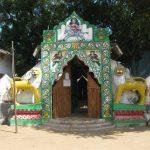

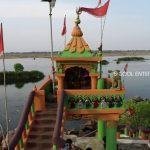
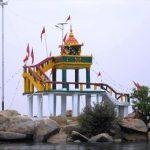
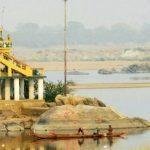
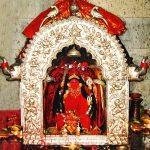
Unique Geological Feature: Adjacent to the temple lies a deep gorge known as the Lankeswari Darha. This narrow channel in the river is rumored to be where Ravana’s army anchored their boats.
4. Darshan & Ritual Logistics
Planning your visit requires understanding the daily schedule and ritual offerings.
Daily Darshan Timings
Please note that timings may vary during festivals and river flood seasons.
| Session | Timings | Rituals |
|---|---|---|
| Morning | 6:00 AM – 12:00 PM | Mangala Alati, Abhishekam |
| Evening | 4:00 PM – 8:00 PM | Sandhya Alati, Bhoga offering |
Seva & Online Booking
To perform specific pujas, you can book services through the temple administration:
- Abhishekam: Ritual bathing of the deity (usually performed in the morning).
- Archana: Recitation of names accompanied by the offering of flowers and incense.
- Naivedya: Offering of food items (requires prior notice).
Online Booking: For convenience, devotees can book these sevas via the official Subarnapur District Administration portal or the dedicated temple trust website (links available on the contact page).
Festival Dates 2026
- Chaitra Navratri (Spring Festival): April 26 – May 4, 2026. (Special Yagna performed).
- Durga Puja / Vijayadashami: October 20 – October 29, 2026. (The temple is illuminated, and grand Rath Yatra takes place).
- Kartik Purnima: November 14, 2026. (Deep Daan ceremony near the Mahanadi river banks).
5. Practical Visitor Guidance
Rules and Etiquette
- Dress Code: Traditional Indian attire is recommended (dhoti/kurta for men, saree/salwar for women). Modest clothing is strictly required.
- Photography: Photography is generally allowed in the outer precincts but is prohibited inside the Garbhagriha (Sanctum Sanctorum).
- Mobiles/Lockers: Electronic devices should be kept silent. While mobile lockers are not available on the river island, the main parking area in Sonepur town has storage facilities.
- Accessibility: The approach involves a boat ride. While the boatmen are helpful, the temple premises have stone steps. Those with mobility issues should travel with assistance.
Crowd Management & Best Time to Visit
- Best Hours: Weekday mornings (6:00 AM – 8:00 AM) offer the most serene darshan.
- Seasonal Advice:
- May (Summer): Temperatures rise above 40°C. Carry ample water and cover your head while waiting for the boat.
- Monsoon (July–September): The Mahanadi swells. Access to the temple island may be temporarily suspended or require larger boats due to water levels. Check local alerts.
6. Pilgrimage Connectivity
How to Reach Lankeswari Temple
- By Road: Sonepur is well-connected via National Highway 57. It lies between Bargarh and Bolangir. Regular buses ply from Sambalpur (110 km) and Raipur (220 km).
- By Rail: The nearest railway station is Tileibani (approx. 20 km from Sonepur). Major connectivity is via Sambalpur Railway Junction.
- By Air: The nearest airport is Veer Surendra Sai Airport in Jharsuguda (approx. 130 km).
Pilgrimage Circuit: Nearby Sacred Sites
Extend your journey to the “Land of Temples” (Subarnapur/Balangir region):
- Patneswari Temple (Balangir): One of the Shakti Peethas, located roughly 90 km away.
- Shiva Temple at Dharmasala (Subarnapur): Famous for intricate carvings, located on the road connecting Sonepur.
- Samaleswari Temple (Sambalpur): The presiding deity of Western Odisha, located 100 km north.
How to Reach:
Landmark: Mahanadi Riverfront, Sonepur.
Coordinates: 21.45° N, 83.88° E
Contact Details
Official Address: Executive Officer, Sri Lankeswari Temple Trust, Sonepur, Subarnapur District, Odisha.
Phone: 09040295328
Administrative Contact: For specific queries or grievances, one may contact the Subarnapur District Administration office.
Frequently Asked Questions (FAQ)
1. Is there a VIP darshan entry available?
Due to the isolated location of the temple (river island), the facility for VIP entry is limited. However, senior citizens and differently-abled visitors are given priority for boat boarding and entry by the temple management volunteers.
2. What is the significance of the name ‘Lankeswari’?
The name translates to “The Goddess of Lanka.” It directly references the mythological connection to Ravana and his capital, affirming the temple’s ancient tantric heritage.
3. Are there accommodation facilities near the temple?
There are no hotels on the river island. Sonepur town (3 km away) offers several guest houses and lodges. For better amenities, one can stay in Bargarh or Sambalpur.
4. Is photography allowed inside the temple?
Photography is strictly prohibited inside the sanctum sanctorum to maintain the sanctity of the rituals. You may capture the exterior views and the river landscape.
5. How do I perform an Abhishekam if I cannot be physically present?
Currently, online Abhishekam is not available for Lankeswari Temple. Devotees are required to visit in person or authorize the temple priest (Panda) to perform the ritual on their behalf upon prior notice and donation.
Conclusion
Lankeswari Temple is more than a destination; it is a testament to the resilience of faith and the flow of time. Standing amidst the mighty Mahanadi, facing the elemental forces of nature, the temple offers a unique spiritual vibration that calms the mind and invigorates the soul. A visit here is a step back into the mythic geography of Odisha.
Recent Posts

Shri Kaamkoteeshwar Mandir, Varanasi – History & Significance
In the heart of Kashi, the eternal city of Lord Shiva, where the Ganges flows with celestial grace, stands the Shri Kaamkoteeshwar Mandir. This sacred Sannidhi is not merely a temple but a profound spiritual bridge between the Northern…

ओ सांवरे तूने ही मुझको संभाला – Lyrics & Meaning
ओ सांवरे तूने ही मुझको संभाला – A Prayer to Shyam Origin & Spiritual Essence Why This Bhajan Resonates Devotees chant this when overwhelmed by life’s storms—the refrain ‘तूने ही मुझको संभाला’ is the soul’s sigh of relief: “You…

कथा ये है महाराज मेरे की – Lyrics & Meaning
कथा ये है महाराज मेरे की छत्रपति संभाजी महाराज – A Prayer to Chhatrapati Sambhaji Maharaj Origin & Spiritual Essence Why This Bhajan Resonates Devotees chant this when their spirit feels tested—its powerful refrain “महाराज मेरे” is a soul’s…

Rigveda Samhita Yathartha Anuvada (ऋग्वेद संहिता यथार्थ अनुवाद) – Complete Set with Anvayartha & Hindi/English Translation
The Rigveda is the oldest surviving scripture of humanity and the foundational text of Sanātana Dharma. For serious students, scholars, UPSC aspirants studying ancient Indian history, Sanskrit learners, and spiritual seekers, a precise and grammatically structured translation is indispensable.…

आना भी अकेला है जाना भी अकेला है – Lyrics & Meaning | BharatTemples
आना भी अकेला है जाना भी अकेला है – A Prayer to the Divine Witness Origin & Spiritual Essence Why This Bhajan Resonates Devotees turn to this bhajan in moments of deep reflection—when life’s attachments begin to ache. The…

माता शेरावाली के द्वार जो भी जाता है – Lyrics & Meaning
माता शेरावाली के द्वार जो भी जाता है – A Prayer to Maa Sherawali Origin & Spiritual Essence Why This Bhajan Resonates Devotees turn to this bhajan in times of fear or uncertainty—its promise that no one leaves Maa’s…

मार लेना सपणी उबार लेणा भवरा – Lyrics & Meaning
मार लेना सपणी उबार लेणा भवरा – A Prayer to the Divine Beloved Origin & Spiritual Essence Why This Bhajan Resonates Devotees chant this in moments of deep vulnerability—its cry of “मार लेना सपणी, उबार लेणा भवरा” is the…

हमें श्याम सुंदर भरोसा तुम्हारा – Lyrics & Meaning
हमें श्याम सुंदर भरोसा तुम्हारा – A Prayer to Shyam Sundar Origin & Spiritual Essence Why This Bhajan Resonates Devotees chant this when feeling alone—its refrain ‘de do sahara’ is the soul’s cry for divine support. Lyrics in Hindi…

Mere Satguru Ne Di Thi Davai Lyrics in Hindi & Meaning
Mere Satguru Ne Di Thi Davai: Invoking the Guru’s Liberating Wisdom This soul-stirring bhajan venerates the Satguru (True Spiritual Master) as the divine physician who dispenses the only remedy for life’s deepest sufferings. Composed by Sant Karmaveer Tufani, it…

Janm Diyo Thari Maa Dukh Dekhiyo Lyrics in Hindi & Meaning
जन्म दियो थारी माँ दुख देखियो (Maa’s Grief Upon Birthing You) This soul-stirring Chetavani Bhajan (admonitory hymn) is addressed to the Divine Mother (Maa) – a call for repentance when children forget their filial duties in the dark age…