
Contents
- 1 Introduction & Spiritual Essence
- 2 Historical Origins & Scriptural Legend
- 3 Architectural Marvels
- 4 Darshan & Ritual Logistics
- 5 Practical Visitor Guidance
- 6 Pilgrimage Connectivity
- 7 Frequently Asked Questions (FAQ)
- 7.1 1. Is there a VIP darshan entry available at Swarnadhisvara Temple?
- 7.2 2. What is the historical significance of the laterite stone used in construction?
- 7.3 3. Can we perform Rudrabhishekam or other Shiva rituals here?
- 7.4 4. Is photography allowed inside the sanctum sanctorum?
- 7.5 5. What is the best time to visit Bhubaneswar to avoid crowds?
Introduction & Spiritual Essence
Nestled in the sacred city of Bhubaneswar, often called the “Temple City of India,” the Swarnadhisvara Siva Temple stands as a silent testament to the region’s rich spiritual heritage. While the towering Lingaraj Temple dominates the skyline, Swarnadhisvara offers a more intimate, contemplative darshan of Lord Shiva.
Deity & Form: The enshrined deity is a Swayambhu (self-manifested) Shiva Lingam. The term “Swarnadhisvara” translates to “Lord of the Golden Ocean,” a name steeped in local lore and devotion. The Lingam rests within a circular Yoni Pitha, symbolizing the cosmic creative energy. Unlike the grandeur of neighboring temples, this sanctum is located approximately 2 meters below the present ground level, giving it a subterranean, mysterious, and deeply grounding aura.
Phalaśruti (Benefits of Visit): Devotees believe that worshipping at this ancient shrine helps cleanse ancestral karma (Pitru Dosha). As it is situated along the pilgrimage route between Lingaraj and Kedar Gouri, it is considered a vital stop for attaining spiritual merit (Punya). The quiet atmosphere allows for uninterrupted meditation, making it ideal for seekers of inner peace.
Historical Origins & Scriptural Legend
Chronology: According to the Archaeological Survey of India (ASI) and historical records, the temple dates back to the 13th Century CE. It was constructed during the Late Ganga Dynasty period, a time when the Kalinga region was a hub of architectural innovation.
Location & Context: The temple is situated on the road leading from the Lingaraj Temple to Kedar Gouri, facing east towards the rising sun. It is an abandoned and non-living temple, meaning regular ritual worship is not performed with the same intensity as the living temples of Bhubaneswar. However, it remains a revered archaeological and spiritual site.
Scriptural Legend: While the specific Sthala Purana for Swarnadhisvara is less documented than major pilgrimage sites, local tradition holds that the area was once part of a dense forest (Ekamra Kshetra). The name “Swarnadhisvara” suggests a legend connected to a golden treasury or a divine blessing of prosperity, possibly linked to King Prataprudra Deva or earlier Gangas who patronized the arts. Oral history suggests that the temple was built to mark a specific celestial alignment of Shiva, bringing the energy of the “Golden Ocean” (prosperity) to Bhubaneswar.
Architectural Marvels
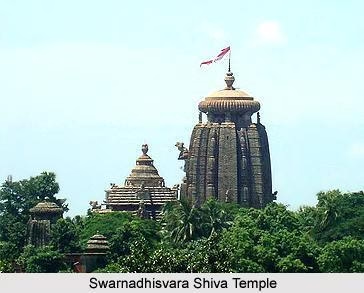
The Swarnadhisvara Temple is a classic example of the Kalingan Style of architecture, distinct for its focus on verticality and intricate carvings.
Structure & Layout:
- Plan: The temple follows a Pancharatha plan (five chariots/rathas), distinguished by a central Raha and a pair of Anuratha and Kanika Pagas on either side.
- Elevation: The Bada (vertical podium) is partially buried, measuring 2.3 meters in height. It is a Panchanga Bada (five distinct mouldings). The Baranda (base mouldings) measures 0.55 m.
- Superstructure: The Gandi (spire) rises to 3 meters. The Mastaka (crowning structure) measures 1 meter and consists of the Beki, Amlaka, Khapuri, and Kalasa.
Material: The temple is constructed primarily of laterite stone, a porous, reddish rock common in Odisha, which gives the structure its distinctive earthy hue and rugged texture.
Sculptural Details:
- Gandi (Wall): The eastern wall features three miniature Rekha Deula (resembling small temple spires), with the central one taller than the flanking two. Above these is a Gajakranta motif (elephant frieze), though only the elephants remain visible today.
- North Wall: Features a Vajra Mastaka (thunderbolt head) and a broken Udyota Simha (stylized lion).
- South Wall: Also adorned with a Vajra Mastaka. The rest of the gandi is relatively plain, emphasizing the focus on the deity within.
Darshan & Ritual Logistics
As a non-living temple, the routine is less rigid than active shrines, but accessibility is maintained for pilgrims. Visitors are encouraged to check local listings for specific ceremonial events.
Daily Timings
| Session | Timing | Status |
|---|---|---|
| Morning Darshan | 06:00 AM – 12:00 PM | Open |
| Mid-day Closure | 12:00 PM – 02:00 PM | Closed |
| Evening Darshan | 04:00 PM – 08:00 PM | Open |
*Note: Timings may vary slightly during festivals or specific local rituals.
Seva & Booking
While the temple is non-living, priests from the Lingaraj temple complex occasionally perform Abhishekam (ritual bathing) and Archana (offering of names) on auspicious days like Mondays and Maha Shivaratri.
- Abhishekam: Performed with milk, honey, and water.
- Archana: Chanting of Shiva Sahasranama.
- Online Booking: Currently, dedicated online booking for this specific minor temple is not available through the Odisha government portal. However, for major festivals, devotees can utilize the Odisha Temple Administration Council (OTAC) portal for the broader Bhubaneswar circuit (Lingaraj Temple).
2026 Major Festivals
- Maha Shivaratri: February 26, 2026 (Expected peak crowd; special night-long opening).
- Shravan Mondays: July 13, 20, 27; August 3, 10, 17, 24, 31 (Seasonal influx of devotees).
- Deepavali (Diwali): November 1, 2026.
- Nuakhai: September 8, 2026 (Regional harvest festival).
Practical Visitor Guidance
Preserving the sanctity and structural integrity of the 13th-century site is paramount. Please adhere to the following guidelines:
- Dress Code: Traditional or modest attire is recommended. Men should wear dhotis or trousers with shirts; women should wear sarees, salwar kameez, or skirts. Avoid shorts and sleeveless tops.
- Photography: Photography is generally permitted in the outer precincts. However, it is strictly prohibited inside the sanctum (Garbhagriha) or near the main deity.
- Mobile Lockers: As this is a smaller shrine, dedicated locker facilities are limited. It is advisable to carry minimal belongings. Larger bags or electronic items may need to be left in vehicles or at the security post near the main road.
- Accessibility: The temple is below ground level (approx. 2 meters descent). There are steps leading to the sanctum, which may be steep. Senior citizens and those with mobility issues should proceed with caution. There is no wheelchair access.
Crowd Management & Seasonal Advice
- Best Hours to Visit: Early mornings (6:00 AM – 8:00 AM) offer the most peaceful darshan. Evenings (6:00 PM – 7:00 PM) are also quiet.
- Peak Seasons: Avoid visiting during Shravan Mela (July-August) and Maha Shivaratri if you prefer a quiet experience, as crowds spill over from the nearby Lingaraj Temple.
- Weather: Bhubaneswar is humid year-round. In May, temperatures can exceed 40°C. Carry a water bottle and an umbrella for shade.
Pilgrimage Connectivity
How to Reach
The temple is centrally located in Bhubaneswar, making it easily accessible.
- Nearest Airport: Biju Patnaik International Airport (BBI), Bhubaneswar. Distance: Approx. 10 km (30-40 minutes by taxi).
- Nearest Railway Station: Bhubaneswar Railway Station (BBS). Distance: Approx. 5 km (15-20 minutes by taxi/auto).
- By Road: The temple is located on the main road connecting Lingaraj Temple and Kedar Gouri. It is easily accessible via NH-16 (formerly NH-5) connecting Bhubaneswar to Kolkata/Chennai. Local city buses (Mo Bus) stop near the Pipili/Baramunda intersection.
Nearby Sacred Sites (Pilgrimage Circuit)
Swarnadhisvara Siva Temple is part of the “Bhubaneswar Pilgrimage Circuit.” While there, explore these nearby spiritual sites:
- Lingaraj Temple (0.5 km away): The largest and most famous temple in Bhubaneswar, dedicated to Lord Harihara.
- Mukteswar Temple (1.5 km away): Known for its ornate archway and gem-shaped spire.
- Kedar Gouri Temple (1.0 km away): A twin temple dedicated to Lord Shiva and Goddess Gouri (Parvati), located just opposite.
Frequently Asked Questions (FAQ)
1. Is there a VIP darshan entry available at Swarnadhisvara Temple?
Since this is a smaller, non-living temple, there is no formal VIP darshan system like at major temples (e.g., Tirupati or Puri). However, due to the low footfall, the darshan is typically swift and accessible.
2. What is the historical significance of the laterite stone used in construction?
Laterite was a primary building material in Eastern India between the 10th and 15th centuries. It is reddish, porous, and durable in tropical climates. Its use here dates the temple to the Late Ganga period and gives it an aesthetic blend with the red soil of Odisha.
3. Can we perform Rudrabhishekam or other Shiva rituals here?
While the temple is non-living, priests from the Lingaraj temple complex can be requested for special ceremonies (like Rudrabhishekam) during major festivals or by prior arrangement. Daily individual pujas are not strictly enforced by the temple administration.
4. Is photography allowed inside the sanctum sanctorum?
No. Strictly no photography is allowed inside the inner sanctum where the Shiva Lingam is enshrined. However, you may take photos of the outer walls, architecture, and the compound.
5. What is the best time to visit Bhubaneswar to avoid crowds?
The best time to visit is between October and February. The weather is pleasant (15°C – 28°C), and crowds are manageable outside of major festivals. Summers (April-June) are scorching hot, while monsoons (July-September) are humid with heavy rainfall.
Recent Posts

Shri Kaamkoteeshwar Mandir, Varanasi – History & Significance
In the heart of Kashi, the eternal city of Lord Shiva, where the Ganges flows with celestial grace, stands the Shri Kaamkoteeshwar Mandir. This sacred Sannidhi is not merely a temple but a profound spiritual bridge between the Northern…

ओ सांवरे तूने ही मुझको संभाला – Lyrics & Meaning
ओ सांवरे तूने ही मुझको संभाला – A Prayer to Shyam Origin & Spiritual Essence Why This Bhajan Resonates Devotees chant this when overwhelmed by life’s storms—the refrain ‘तूने ही मुझको संभाला’ is the soul’s sigh of relief: “You…

कथा ये है महाराज मेरे की – Lyrics & Meaning
कथा ये है महाराज मेरे की छत्रपति संभाजी महाराज – A Prayer to Chhatrapati Sambhaji Maharaj Origin & Spiritual Essence Why This Bhajan Resonates Devotees chant this when their spirit feels tested—its powerful refrain “महाराज मेरे” is a soul’s…

Rigveda Samhita Yathartha Anuvada (ऋग्वेद संहिता यथार्थ अनुवाद) – Complete Set with Anvayartha & Hindi/English Translation
The Rigveda is the oldest surviving scripture of humanity and the foundational text of Sanātana Dharma. For serious students, scholars, UPSC aspirants studying ancient Indian history, Sanskrit learners, and spiritual seekers, a precise and grammatically structured translation is indispensable.…

आना भी अकेला है जाना भी अकेला है – Lyrics & Meaning | BharatTemples
आना भी अकेला है जाना भी अकेला है – A Prayer to the Divine Witness Origin & Spiritual Essence Why This Bhajan Resonates Devotees turn to this bhajan in moments of deep reflection—when life’s attachments begin to ache. The…

माता शेरावाली के द्वार जो भी जाता है – Lyrics & Meaning
माता शेरावाली के द्वार जो भी जाता है – A Prayer to Maa Sherawali Origin & Spiritual Essence Why This Bhajan Resonates Devotees turn to this bhajan in times of fear or uncertainty—its promise that no one leaves Maa’s…

मार लेना सपणी उबार लेणा भवरा – Lyrics & Meaning
मार लेना सपणी उबार लेणा भवरा – A Prayer to the Divine Beloved Origin & Spiritual Essence Why This Bhajan Resonates Devotees chant this in moments of deep vulnerability—its cry of “मार लेना सपणी, उबार लेणा भवरा” is the…

हमें श्याम सुंदर भरोसा तुम्हारा – Lyrics & Meaning
हमें श्याम सुंदर भरोसा तुम्हारा – A Prayer to Shyam Sundar Origin & Spiritual Essence Why This Bhajan Resonates Devotees chant this when feeling alone—its refrain ‘de do sahara’ is the soul’s cry for divine support. Lyrics in Hindi…

Mere Satguru Ne Di Thi Davai Lyrics in Hindi & Meaning
Mere Satguru Ne Di Thi Davai: Invoking the Guru’s Liberating Wisdom This soul-stirring bhajan venerates the Satguru (True Spiritual Master) as the divine physician who dispenses the only remedy for life’s deepest sufferings. Composed by Sant Karmaveer Tufani, it…

Janm Diyo Thari Maa Dukh Dekhiyo Lyrics in Hindi & Meaning
जन्म दियो थारी माँ दुख देखियो (Maa’s Grief Upon Birthing You) This soul-stirring Chetavani Bhajan (admonitory hymn) is addressed to the Divine Mother (Maa) – a call for repentance when children forget their filial duties in the dark age…