
Contents
- 1 The Definitive Pilgrimage Guide: Yajna Nrisimha Temple, Puri
- 1.1 1. Introduction & Spiritual Essence
- 1.2 2. Historical Origins & Scriptural Legend
- 1.3 3. Architectural Marvels
- 1.4 4. Darshan & Ritual Logistics (2026 Guide)
- 1.5 5. Practical Visitor Guidance
- 1.6 6. Pilgrimage Connectivity
- 1.7 7. Frequently Asked Questions (FAQ)
- 1.8 Photo Gallery
- 1.9 How to Reach:
- 1.10 Contact Details
The Definitive Pilgrimage Guide: Yajna Nrisimha Temple, Puri
| Date built: | – |
|---|---|
| Deity: | Lord Narasimha |
| Architectural style: | – |
| Major festivals | – |
| Locale: | – |
| District:: | puri |
| Address: | – |
| Phone | – |
1. Introduction & Spiritual Essence
Nestled within the holy district of Puri, Odisha, stands the magnificent Yajna Nrisimha Temple, a sanctuary dedicated to Lord Narasimha, the fierce yet benevolent avatar of Lord Vishnu. Also revered locally as Nrusingha or Nrusimha, this temple is a pivotal stop on the spiritual circuit of Puri, located just west of the renowned Gundicha Temple and east of the Indradyumna Pokhari.
Phalaśruti: The Spiritual Benefit
Devotees visit this sacred site to appease the internal moods of Lord Vishnu’s avatar. The temple houses two distinct idols of Lord Narasimha placed one behind the other:
- Shanta Narasimha (The Peaceful Form): Facing the devotee, this front idol represents calmness and sobriety. It is believed that Darshan of Shanta Narasimha instantly washes away anger, frustration, and anxiety, granting mental peace and clarity.
- Ugra Narasimha (The Fierce Form): Located behind the peaceful deity, Ugra Narasimha represents the internal, intense mood of the Lord, destroying evil and ignorance.
The Phalaśruti (spiritual benefit) of visiting this temple is profound. It is said that bathing in the adjacent Indradyumna Tank and taking Darshan of Sri Nilakantheswar, Yagna Narasimha, and the Panchamuki Hanuman (five-faced Hanuman) consecutively grants immense Punya (merit) and cleanses ancestral karma.
2. Historical Origins & Scriptural Legend
The history of the Yajna Nrisimha Temple is rooted deeply in the Skanda Purana and local Odia tradition. While specific architectural dating is challenging due to ancient renovations, the legend holds that the temple’s origins trace back to the legendary King Indradyumna.
The Tale of the Ashwamedha Yajna
According to temple records and scriptural tradition, King Indradyumna resided near the Nilakantheswar temple to perform the Ashwamedha Yajna (Horse Sacrifice), a grand ritual that lasted for one thousand years. Guided by the sage Narada, the King crafted an image of Lord Narasimha using black stone. This idol was placed under a black sandalwood tree (Krishna Chandan) and worshipped.
It is believed that the actual site of the Yajna was directly in front of the current temple structure, hence the deity became known as Yajna Narasimha. Tradition holds that the temple serves as a spiritual shield for the town. A notable historical anecdote recounts the invasion by Kalapahad in the 16th century, who was known for destroying Hindu idols. When Kalapahad entered the sanctum, he intended to smash the deity, but upon seeing the Shanta Narasimha (peaceful) image, his rage subsided. He could not bring himself to destroy the idol, sparing the temple from desecration.
3. Architectural Marvels
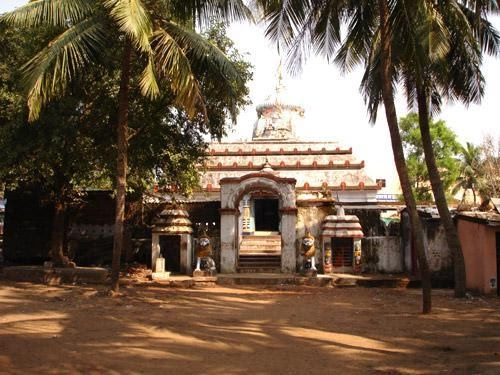
The temple architecture is a classic example of the Kalinga style of temple architecture, closely resembling the structural principles of the Shri Jagannath Temple.
Structure and Layout
- Orientation: The temple faces west, spanning an approximate height of 60 feet. The Deul (sanctum tower) and the Jagamohana (assembly hall) follow the traditional Vastu Shastra alignment.
- The Deity Configuration: Following the Pancharatra and Vaikhanasa agamas, the central idol of Vishnu (Narasimha) is surrounded by four side icons (Vasudeva, Sankarshana, Pradyumna, and Aniruddha).
- Sculptural Details: The Shanta Narasimha idol is unique for its human-like features—a sharp nose, curly mustache, and an outstretched tongue—distinct from the typical leonine avatar depictions found elsewhere.
While the temple is not a UNESCO heritage site, it is protected under the Archaeological Survey of India (ASI) and the Shri Jagannath Temple Administration (SJTA) due to its historical significance.
4. Darshan & Ritual Logistics (2026 Guide)
For devotees planning a visit in 2026, it is essential to note that temple timings may vary slightly during festivals. Below is the standard schedule.
Daily Darshan Timings
| Session | Timing |
|---|---|
| Morning Darshan | 05:00 AM – 12:00 PM |
| Evening Darshan | 05:00 PM – 09:00 PM |
| Mangala Alati | 06:00 AM |
Key Sevas & Online Booking
Devotees can book specific sevas through the official SJTA online portal. Key rituals include:
- Abhishekam: Performed on Ekadashi and special occasions.
- Archana: Daily offering of flowers and mantras.
- Chandan Jatra: A major festival where the deity is smeared with sandalwood paste.
Online Booking: Visit jagannathsales.in (official SJTA portal) to reserve seva slots at least 24 hours in advance.
Major Festivals in 2026
Plan your visit around these significant dates:
- Narasimha Janma (Narasimha Jayanti): Friday, May 9, 2026. This is the most auspicious day to visit.
- Satapuri Amavasya: A monthly new moon day observed with special rituals.
- Chandan Jatra: Begins on Akshaya Tritiya (April/May 2026).
5. Practical Visitor Guidance
Ensuring a smooth pilgrimage experience requires preparation, especially given the crowded nature of Puri during festivals.
Rules and Etiquette
- Dress Code: Traditional Indian attire is mandatory. Men should wear Dhoti or formal pants with a shirt; women should wear Saree, Salwar Kameez, or Churidar. Shorts and modern clothing are strictly prohibited.
- Restrictions: As per temple tradition, non-Hindus are not permitted inside the sanctum. However, Darshan of the deities is possible from the entrance doorway.
- Photography: Prohibited inside the inner sanctum. Mobile phones and electronic devices must be kept in silent mode. Lockers are available near the temple entrance.
Crowd Management & Seasonal Advice
- Best Hours: The ideal time for peaceful Darshan is between 8:00 AM and 10:00 AM, or late evening after 7:30 PM.
- Seasonal Tips:
- May-June (Summer): Puri experiences high humidity. Carry a water bottle, umbrella, and cotton clothing.
- July-September (Monsoon): Heavy rains are common. Check local alerts before travel.
- December-January (Winter): Ideal weather for travel. Carry light woolens for the evenings.
6. Pilgrimage Connectivity
The Yajna Nrisimha Temple is accessible via Puri, which serves as a major religious hub in Odisha.
How to Reach
- By Air: The nearest airport is Biju Patnaik International Airport in Bhubaneswar (approx. 60 km away). Direct flights are available from Delhi, Kolkata, Hyderabad, and Bangalore.
- By Rail: Puri Railway Station is located in the heart of the town and is well-connected to major cities like Delhi, Kolkata, and Ahmedabad via express trains.
- By Road: Puri is connected via National Highway 316 (formerly part of NH 5 and NH 16). Regular bus services are available from Bhubaneswar (State Highway 8) and other Odisha cities.
Nearby Sacred Sites (Pilgrimage Circuit)
- Gundicha Temple (200m away): The abode of Lord Jagannath during the famous Rath Yatra.
- Indradyumna Tank (Adjacent): A historic reservoir where devotees perform ritual bathing before Darshan.
- Maa Mangala Temple (Kakatpur): Located about 40 km from Puri, this is a powerful Shakti Peetha on the banks of the Prachi River.
7. Frequently Asked Questions (FAQ)
Is there a VIP Darshan entry?
Yes, the SJTA offers special entry Darshan tickets for devotees wishing to avoid long queues. These can be purchased at the administrative office near the temple or booked online via the official portal.
What is the history of the two Narasimha idols?
The temple houses two idols: Shanta Narasimha (front) represents peace and was instrumental in stopping the invader Kalapahad. Ugra Narasimha (back) represents the fierce aspect. They are placed one behind the other to signify the dual nature of the avatar—ferocity in action but peace in the soul.
Can I carry food inside the temple?
Strictly no. Only water bottles (sealed or transparent) are allowed. Prasad is available for purchase at the temple counter outside.
What is the significance of the Indradyumna Pokhari?
It is a large temple tank associated with King Indradyumna. Bathing in this tank before Darshan of Yajna Narasimha and Nilakantheswar is believed to grant the Punya of performing an Ashwamedha Yajna.
Is the temple open during the Rath Yatra?
Yes, but the crowd is immense. During the Rath Yatra period (June/July 2026), Darshan timings may be adjusted. It is advisable to check the SJTA website for specific circulars.
Photo Gallery
How to Reach:
The temple is located at a distance of 60 km from Bhubaneswar, on the coast of Bay of Bengal.There are many ways of getting to India and then to Puri. There are regular bus service from other main cities of the country to Puri. Puri is linked with Bhubaneswar by state highway no.8 and Bhubanaswar is situated along the National Highway no.5 connecting Chennai and Kolkata. The best way to go from Bhubaneswar to Puri is on one of the State Govt. buses, mini buses and tourist buses. For reaching around puri – cycle rickshaws are available all over town and also available auto rickshaws. Puri is well connected by Railways. The Railway Station of Puri is in The heart of the town and near to all hotels. The nearest airport is located in Bhubaneswar the capital city of Odisha. Bhubaneswar is connected by air to cities like Delhi, Kolkata, Hyderabad.
Contact Details
Official Address
Recent Posts

Shri Kaamkoteeshwar Mandir, Varanasi – History & Significance
In the heart of Kashi, the eternal city of Lord Shiva, where the Ganges flows with celestial grace, stands the Shri Kaamkoteeshwar Mandir. This sacred Sannidhi is not merely a temple but a profound spiritual bridge between the Northern…

ओ सांवरे तूने ही मुझको संभाला – Lyrics & Meaning
ओ सांवरे तूने ही मुझको संभाला – A Prayer to Shyam Origin & Spiritual Essence Why This Bhajan Resonates Devotees chant this when overwhelmed by life’s storms—the refrain ‘तूने ही मुझको संभाला’ is the soul’s sigh of relief: “You…

कथा ये है महाराज मेरे की – Lyrics & Meaning
कथा ये है महाराज मेरे की छत्रपति संभाजी महाराज – A Prayer to Chhatrapati Sambhaji Maharaj Origin & Spiritual Essence Why This Bhajan Resonates Devotees chant this when their spirit feels tested—its powerful refrain “महाराज मेरे” is a soul’s…

Rigveda Samhita Yathartha Anuvada (ऋग्वेद संहिता यथार्थ अनुवाद) – Complete Set with Anvayartha & Hindi/English Translation
The Rigveda is the oldest surviving scripture of humanity and the foundational text of Sanātana Dharma. For serious students, scholars, UPSC aspirants studying ancient Indian history, Sanskrit learners, and spiritual seekers, a precise and grammatically structured translation is indispensable.…

आना भी अकेला है जाना भी अकेला है – Lyrics & Meaning | BharatTemples
आना भी अकेला है जाना भी अकेला है – A Prayer to the Divine Witness Origin & Spiritual Essence Why This Bhajan Resonates Devotees turn to this bhajan in moments of deep reflection—when life’s attachments begin to ache. The…

माता शेरावाली के द्वार जो भी जाता है – Lyrics & Meaning
माता शेरावाली के द्वार जो भी जाता है – A Prayer to Maa Sherawali Origin & Spiritual Essence Why This Bhajan Resonates Devotees turn to this bhajan in times of fear or uncertainty—its promise that no one leaves Maa’s…

मार लेना सपणी उबार लेणा भवरा – Lyrics & Meaning
मार लेना सपणी उबार लेणा भवरा – A Prayer to the Divine Beloved Origin & Spiritual Essence Why This Bhajan Resonates Devotees chant this in moments of deep vulnerability—its cry of “मार लेना सपणी, उबार लेणा भवरा” is the…

हमें श्याम सुंदर भरोसा तुम्हारा – Lyrics & Meaning
हमें श्याम सुंदर भरोसा तुम्हारा – A Prayer to Shyam Sundar Origin & Spiritual Essence Why This Bhajan Resonates Devotees chant this when feeling alone—its refrain ‘de do sahara’ is the soul’s cry for divine support. Lyrics in Hindi…

Mere Satguru Ne Di Thi Davai Lyrics in Hindi & Meaning
Mere Satguru Ne Di Thi Davai: Invoking the Guru’s Liberating Wisdom This soul-stirring bhajan venerates the Satguru (True Spiritual Master) as the divine physician who dispenses the only remedy for life’s deepest sufferings. Composed by Sant Karmaveer Tufani, it…

Janm Diyo Thari Maa Dukh Dekhiyo Lyrics in Hindi & Meaning
जन्म दियो थारी माँ दुख देखियो (Maa’s Grief Upon Birthing You) This soul-stirring Chetavani Bhajan (admonitory hymn) is addressed to the Divine Mother (Maa) – a call for repentance when children forget their filial duties in the dark age…