
Contents
- 1 Introduction & Spiritual Essence: The Temple of Earth
- 2 Historical Origins & Scriptural Legend
- 3 Architectural Marvels: Dravidian Grandeur
- 4 Darshan & Ritual Logistics
- 5 Practical Visitor Guidance
- 6 Pilgrimage Connectivity
- 7 Frequently Asked Questions (FAQ)
- 8 Architecture
- 9 Legend / Local stories
- 10 Photo Gallery
- 11 How to Reach:
- 12 Contact Details
Introduction & Spiritual Essence: The Temple of Earth
In the ancient city of Kanchipuram, often hailed as the “Kashi of the South,” stands the majestic Ekambareswarar Temple (also known as Ekambaranathar Temple). This sacred shrine is one of the most revered sites in Shaivism, forming a critical part of the Pancha Bhoota Stalas—the five elemental abodes of Lord Shiva. Here, the formless divinity is venerated as the Prithvi Lingam, representing the element of Earth.
The spiritual essence of this temple lies in its association with divine feminine devotion and the grounding nature of the earth. The primary deity is Ekambareswarar (Lord of the Mango Tree), and his consort is worshipped as Gowridevi Amman. While the Kamakshi Amman temple is located nearby, the Parvati shrine is spiritually linked to this complex, symbolizing the inseparable union of Purusha (consciousness) and Prakriti (nature).
Phalaśruti: The Fruits of Pilgrimage
Devotees flock to Ekambareswarar Temple to attain stability, prosperity, and spiritual grounding. According to Saivite traditions and the Tevaram hymns sung by the Nayanars, visiting this temple yields specific benefits:
- Removal of Earthly Burdens: As the abode of the Earth element, sincere prayers here are believed to alleviate karmic debts and provide a stable foundation for one’s life endeavors.
- Harmony in Marriage: The legend of Parvati’s penance and Shiva’s eventual union with her makes this a potent site for those seeking marital bliss or reunion with a partner.
- Prosperity: Worshipping the Prithvi Lingam is traditionally associated with removing obstacles to wealth and agricultural abundance.
Historical Origins & Scriptural Legend
The Legend of the Mango Tree and Divine Love
According to the Sthala Purana, a profound legend narrates the divine penance of Goddess Parvati. Once, Parvati was cursed to become dark-complexioned. To purify herself, she performed intense penance under an ancient mango tree near the banks of the Vegavathi River.
Lord Shiva decided to test her devotion. He manifested a raging fire (representing the Agni element). Unwavering, Parvati embraced the stone lingam she had fashioned from sand to protect it from the heat. Touched by her devotion, Shiva appeared as Tazhuva kuzhainthaar (“He who melted in Her embrace”) and accepted her as his consort. The mango tree under which she performed penance is still believed to be present in the temple complex, yielding fruits of four distinct tastes—a symbol of the four Vedas.
Architectural Evolution
While the temple has existed since at least 600 AD, the current structural grandeur is a testament to centuries of royal patronage. The foundational stones were laid by the Pallavas, but the massive masonry structure seen today was constructed during the Chola dynasty in the 9th century.
Further expansions were added by the Vijayanagar rulers in the 15th century. Historical inscriptions dating to 1532 CE detail land grants by King Achutaraya. A notable historical figure, Pachiyappa Mudaliar, a wealthy merchant from Chennai, spent a significant portion of his wealth renovating the temple during the British era. His horse-back silhouette is carved into one of the temple pillars, immortalizing his contribution.
Architectural Marvels: Dravidian Grandeur
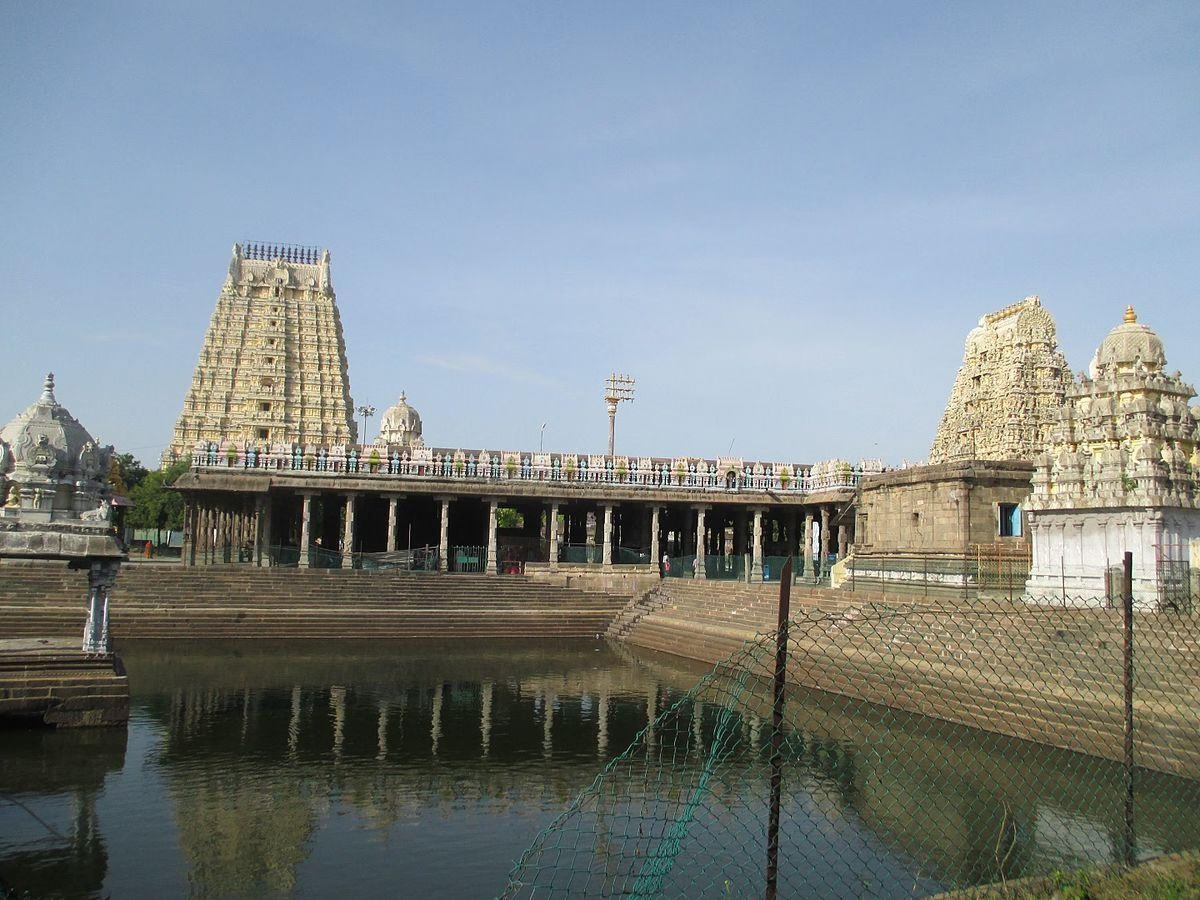
The temple complex is a sprawling 25 acres, making it one of the largest temples in South India. It is a quintessential example of Dravidian architecture, characterized by towering gateways and intricate sculptural work.
The Gopurams and Mandapas
- The Southern Tower (Raja Gopuram): This is the tallest of the four gateway towers, soaring to a height of 59 meters (194 feet) with 11 stories. It dominates the Kanchipuram skyline.
- Aayiram Kaal Mandapam: The “Thousand-Pillared Hall” is an architectural highlight built during the Vijayanagar period. The pillars are sculpted with exquisite figures depicting various legends and avatars of Shiva.
- Sanctum Sanctorum: The inner shrine houses the Prithvi Lingam, which is a massive, earth-colored lingam. Uniquely, there is no separate shrine for Parvati within the main complex, as she is believed to reside in the Kamakshi Amman Temple nearby.
Unique Features
A notable inclusion is the Nilathingal Thundam Perumal temple, a Divyadesam (Vaishnavite shrine) located within the Ekambareswarar complex. This represents the harmony between Shaivism and Vaishnavism, where Vishnu is worshipped here as Vamana Murthy.
Darshan & Ritual Logistics
The temple observes six daily rituals starting from 5:30 AM to 10:00 PM. The priests perform these ceremonies with great precision, adhering to the Agamic scriptures.
Daily Timings (Standard Schedule)
Note: Timings may vary slightly during festivals or special occasions.
| Session | Timing | Description |
|---|---|---|
| Morning | 5:30 AM – 7:00 AM | Thiruvananthal (Opening) & Abhishekam |
| 7:00 AM – 9:00 AM | Darshan for Devotees | |
| 9:00 AM – 11:00 AM | Uchikala Pooja (Noon Ritual) | |
| Afternoon | 11:00 AM – 5:00 PM | Temple Open (Darshan) |
| Evening | 5:30 PM – 7:00 PM | Arthajama Pooja (Evening Ritual) |
| 7:00 PM – 9:00 PM | General Darshan | |
| Night | 9:00 PM – 10:00 PM | Palliyarai Pooja (Closing) |
Key Sevas and Booking
- Abhishekam (Ritual Bathing): Performed with milk, honey, ghee, and sandalwood paste. It is best to book this for the morning slot (6:00 AM).
- Archana: Recitation of hymns in the name of the devotee. Available throughout the day.
- Online Seva Booking: The temple administration (HRCE) offers online booking for special darshans and abhishekams. Visit the official Tamil Nadu Hindu Charitable Endowments website to secure slots in advance, especially for weekends.
2026 Festival Dates (Panchanga Highlights)
- Pradosham: Every 13th and 28th day of the lunar month (approx. monthly).
- Shivaratri: February 26, 2026 (Grand all-night rituals).
- Panguni Uthiram: March 18 – March 30, 2026 (The most prominent annual festival, spanning 13 days, concluding with the temple car procession).
- Kartikai Deepam: November 4, 2026.
Practical Visitor Guidance
Dress Code and Etiquette
As with all major Hindu temples in South India, traditional attire is encouraged. Men should wear dhotis or pants with shirts (vests are not permitted inside the sanctum). Women are advised to wear sarees, salwar kameez, or long skirts. Western attire such as shorts, tees, and sleeveless tops are generally restricted in the inner sanctum.
Crowd Management and Best Hours
Kanchipuram is a bustling temple town. To experience the sanctity of the temple without the crush of crowds:
- Best Time: Weekday mornings (Tuesday to Thursday) between 7:00 AM and 9:00 AM.
- Seasonal Advice: The summer months (April–June) in Tamil Nadu are hot and dry. Carry a water bottle and an umbrella. Visiting during the winter months (November–February) offers pleasant weather for walking the 25-acre complex.
Facilities
- Mobile Lockers: Storage facilities are available near the entrance for electronics and valuables.
- Photography: Strictly prohibited inside the sanctum sanctorum and inner prakarams. Mobile photography is generally allowed in the outer areas but check with guards.
- Accessibility: The temple is wheelchair accessible in the outer corridors, though the inner sanctum has ancient stone steps.
Pilgrimage Connectivity
How to Reach Ekambareswarar Temple
By Air: The nearest airport is Chennai International Airport (MAA), approximately 70 km away. From there, taxis and buses are available to Kanchipuram.
By Rail: Kanchipuram Railway Station is well-connected to Chennai and Chengalpattu. The temple is located roughly 2 km from the station (auto-rickshaws are easily available).
By Road: Kanchipuram is situated on the Chennai-Bangalore Highway (NH 48). It is a 2-hour drive from Chennai.
Nearby Sacred Sites (The Kanchipuram Circuit)
After visiting the Earth element, devotees often complete the Pancha Bhoota circuit by visiting the other elemental temples:
- Kamakshi Amman Temple: Located just 1 km away, this is the seat of the Goddess (Shakti) and the spiritual center of Kanchipuram.
- Varadaraja Perumal Temple: Dedicated to Vishnu, this temple is a stunning example of Vijayanagar architecture and is roughly 3 km away.
- Kailasanathar Temple: The oldest structural temple in Kanchipuram (built by Pallavas), dedicated to Shiva in the form of Mount Kailash.
Frequently Asked Questions (FAQ)
1. Is there a VIP darshan entry available?
Yes, the temple offers a special entry darshan (Rs. 100) for devotees who wish to bypass the general queue, especially during non-peak hours. This can be booked at the counter or online.
2. What is the significance of the four-tasted mango tree?
The mango tree in the fourth prakaram (courtyard) is believed to be centuries old. Its branches represent the four Vedas (Rig, Yajur, Sama, Atharva), and the fruits from the same tree reportedly have four different tastes, symbolizing the unity of knowledge.
3. Are there accommodation facilities near the temple?
While the temple complex itself does not have a guesthouse, Kanchipuram has numerous guest houses run by the HRCE department and private hotels ranging from budget to heritage categories.
4. Is Non-Veg allowed inside the temple premises?
No. Being a Hindu temple, the premises are strictly vegetarian. Alcohol and non-vegetarian food are prohibited within the complex and the immediate vicinity.
5. Can we perform ceremonies like Annaprasana or Namakaranam?
Yes, the temple administration allows specific rituals for devotees. Prior booking through the RDO office in Kanchipuram is required to arrange for the priests and the hall space.
| Date built: | – |
|---|---|
| Deity: | Shiva |
| Architectural style: | Dravidian architecture |
| Major festivals | – |
| Locale: | – |
| District:: | Kanchipuram |
| Address: | – |
| Phone | – |
Ekambareswarar Temple (Ekambaranathar Temple) is a Hindu temple dedicated to the deity Shiva, located in the town of Kanchipuram in Tamil Nadu, India.It is significant to the Hindu sect of Saivism as one of the temples associated with the five elements, the Pancha Bhoota Stalas, and specifically the element of earth, or Prithvi. Shiva is worshiped as Ekambareswarar or Ekambaranathar, and is represented by the lingam, with his idol referred to as Prithvi lingam. His consort Parvati is depicted as Gowridevi Amman. The presiding deity is revered in the 7th century Tamil Saiva canonical work, the Tevaram, written by Tamil saint poets known as the nayanars and classified as Paadal Petra Sthalam. The temple also houses Nilathingal Thundam Perumal temple, a Divyadesam, the 108 temples revered in the Vaishnava canon Nalayira Divya Prabhandam.
The temple complex covers 25 acres, and is one of the largest in India. It houses four gateway towers known as gopurams. The tallest is the southern tower, with 11 stories and a height of 55 metres (180 ft), making it one of the tallest temple towers in India. The temple has numerous shrines, with those of Ekambareswarar and Nilathingal Thundam Perumal being the most prominent. The temple complex houses many halls; the most notable is the thousand-pillared hall built during the Vijayanagar period.
The temple has six daily rituals at various times from 5:30 a.m. to 10 p.m., and twelve yearly festivals on its calendar. Panguni Uthiram festival celebrated for thirteen days during the Tamil month of Panguni (March – April) is the most prominent festival of the temple and the town.
The present masonry structure was built during the Chola dynasty in the 9th century, while later expansions are attributed to Vijayanagar rulers. The temple is maintained and administered by the Hindu Religious and Charitable Endowments Department of the Government of Tamil Nadu. The temple is the largest and one of the most prominent tourist attractions in the city.
Architecture
The temple covers an area of over 23 acres (93,000 m2).Reaching a height of 59 m (194 ft), the temple’s Raja gopuram (the entrance tower to the temple) is one of the tallest in South India.The bottom half of the gateway tower has the shrines of Vinayaka and Murugan on either sides. From the entrance, there are two halls namely Vahana Mandapam (vehicle hall) and Sarabesa Mandapam (also called Navaratri hall).The Aayiram Kaal Mandapam, or the “hallway with a thousand pillars”, which was built by the Vijayanagar Kings, is found on precinct after the gateway tower.yo yove been an underground holy river. The fourth courtyard contains a small Ganesha temple and a pond. The third courtyard contains lot of smaller shrines. The flag staff of the temple is axial to the sanctum and diagonally located to the main entrance and the temple tank on either directions. There is a shrine called Thirukachi Mayanam and Kalayana Mandapa, named after Pachayappa Mudaliar, both of which are located close to the flag staff. Thirukachi Mayanam, Valeesam, Rishabesam and Satyanadeesam are located in four corners of the temple. The hall of the flagstaff has pillars sculpted with intricate figures indicating various legends and avatars of Shiva.
The sanctum sanctorum contains the lingam along with the image of Shiva. There are granite image of the 63 Nayanmars around the first precinct.[14] The temple’s inner most precinct are decorated with an array of Shivalingam, one of which is a Sahasra Lingam with 1,008 Siva lingams sculpted on it.[15]There is no separate shrine for Parvati within the complex as with all other Shiva temples in Kanchipuram. A local belief is that Kamakshi Amman Temple is the consort for Ekambaranathar.
There is a small shrine for Vishnu named Nilathingal Thundam Perumal temple inside the temple complex. Vishnu is prayed as Vamana Murthy and the shrine is hailed by the Alvar saints as one of the 108 Divya Desams.
Legend / Local stories
Legend has it that once Parvati, the consort of Shiva was cursed to become dark like Kali. She wanted to expatiate herself from the sin by doing penance under the temple’s ancient Mango tree near Vegavathi river. In order to test her devotion Shiva sent fire on her. Goddess Parvati prayed to her brother, Vishnu, for help. In order to save her, he took the Moon from Shiva’s head and showed the rays which then cooled down the tree as well as Parvati. Shiva again sent the river Ganga (Ganges) to disrupt Parvati’s penance. Parvati prayed to Ganga and convinced her that both of them were sisters and so should not harm her. Subsequently, Ganga did not disturb her penance and Parvati made a Shiva Linga out of sand to get united with Shiva. The God here came to be known as Ekambareswarar or “Lord of Mango Tree”.
According to another legend, it is believed that Parvati worshipped Shiva in the form of a Prithivi Lingam (or a Lingam improvised out of sand), under a mango tree. Legend has it that the neighboring Vegavati river overflowed and threatened to engulf the Shiva Lingam and that Parvati or Kamakshi embraced the Lingam. Shiva touched by the gesture materialized in person and married her. In this context he is referred to as Tazhuva kuzhainthaar (“He who melted in Her embrace”) in Tamil.
Tiurkuripputhonda Nayanar, one of the 63 saivite saints, called nayanars was a washerman near the temple and he washed the clothes of all the Saivities. He was divinely tricked by God Shiva appearing as an aged brahmin and asked him to wash before dawn. At the same time Shiva made a cloudly evening. On observing the approach of the evening, the washerman banged his head in a stone in disappointment. God appeared in his true form and graced his devotee.
This vast temple is one of the most ancient in India having been in existence since at least 600 AD. Second century AD Tamil poetry speaks of Kama kottam, and the Kumara kottam (currently the Kamakashi Amman temple and the Subramanya temple).Initially temple was built by Pallavas. The Vedantist Kachiyapper served as a priest at the temple. The existing structure then, was pulled down and rebuilt by the later Chola Kings. Adi Sankara, the 10th-century saint got Kanchipuram remodelled along with expansion of this temple along with Kamakshi Amman temple and Varadaraja Perumal Temple with the help of local rulers.
There are inscriptions dated 1532 CE (record 544 of 1919) indicating the gift of number of villages made by Achutaraya. Vira Narasingaraya Saluva Nayaka who was directed by Achutaraya broke the royal order by giving more lands to Ekambaranathar temple than the Varadaraja Swamy temple against the instruction of an equal gift to either of the temples. Achutaraya on hearing this equally distributed the lands to both the temples.
The Vijayanagar kings, during the 15th century, also made lot of contributions to the temple and later developed by Vallal Pachiyappa Mudaliar used to go regularly from Chennai to Kanchipuram to worship in this temple, he spent significant money he amazed during British rule on the temple renovation, Pachiyappa Mudaliar seated at horse back can be seen in the temple pillar. At the later stage a similar temple with same name Ekambareswarar was constructed in Chennai by Pachiappa Mudaliar in order to avoid travelling time to Kanchipuram. The Archaeological Survey of India report of 1905–06 indicates widespread renovation activities carried out in the temple by Nattukottai Chettiar-Lakshmanan chettiar of MLRMLN family of MLRMLN family of Mena house devakottai in 1905-06 along with 16pillar Mandapam located outside the southern gate.
Photo Gallery
How to Reach:
Contact Details
Official Address
Recent Posts

Shri Kaamkoteeshwar Mandir, Varanasi – History & Significance
In the heart of Kashi, the eternal city of Lord Shiva, where the Ganges flows with celestial grace, stands the Shri Kaamkoteeshwar Mandir. This sacred Sannidhi is not merely a temple but a profound spiritual bridge between the Northern…

ओ सांवरे तूने ही मुझको संभाला – Lyrics & Meaning
ओ सांवरे तूने ही मुझको संभाला – A Prayer to Shyam Origin & Spiritual Essence Why This Bhajan Resonates Devotees chant this when overwhelmed by life’s storms—the refrain ‘तूने ही मुझको संभाला’ is the soul’s sigh of relief: “You…

कथा ये है महाराज मेरे की – Lyrics & Meaning
कथा ये है महाराज मेरे की छत्रपति संभाजी महाराज – A Prayer to Chhatrapati Sambhaji Maharaj Origin & Spiritual Essence Why This Bhajan Resonates Devotees chant this when their spirit feels tested—its powerful refrain “महाराज मेरे” is a soul’s…

Rigveda Samhita Yathartha Anuvada (ऋग्वेद संहिता यथार्थ अनुवाद) – Complete Set with Anvayartha & Hindi/English Translation
The Rigveda is the oldest surviving scripture of humanity and the foundational text of Sanātana Dharma. For serious students, scholars, UPSC aspirants studying ancient Indian history, Sanskrit learners, and spiritual seekers, a precise and grammatically structured translation is indispensable.…

आना भी अकेला है जाना भी अकेला है – Lyrics & Meaning | BharatTemples
आना भी अकेला है जाना भी अकेला है – A Prayer to the Divine Witness Origin & Spiritual Essence Why This Bhajan Resonates Devotees turn to this bhajan in moments of deep reflection—when life’s attachments begin to ache. The…

माता शेरावाली के द्वार जो भी जाता है – Lyrics & Meaning
माता शेरावाली के द्वार जो भी जाता है – A Prayer to Maa Sherawali Origin & Spiritual Essence Why This Bhajan Resonates Devotees turn to this bhajan in times of fear or uncertainty—its promise that no one leaves Maa’s…

मार लेना सपणी उबार लेणा भवरा – Lyrics & Meaning
मार लेना सपणी उबार लेणा भवरा – A Prayer to the Divine Beloved Origin & Spiritual Essence Why This Bhajan Resonates Devotees chant this in moments of deep vulnerability—its cry of “मार लेना सपणी, उबार लेणा भवरा” is the…

हमें श्याम सुंदर भरोसा तुम्हारा – Lyrics & Meaning
हमें श्याम सुंदर भरोसा तुम्हारा – A Prayer to Shyam Sundar Origin & Spiritual Essence Why This Bhajan Resonates Devotees chant this when feeling alone—its refrain ‘de do sahara’ is the soul’s cry for divine support. Lyrics in Hindi…

Mere Satguru Ne Di Thi Davai Lyrics in Hindi & Meaning
Mere Satguru Ne Di Thi Davai: Invoking the Guru’s Liberating Wisdom This soul-stirring bhajan venerates the Satguru (True Spiritual Master) as the divine physician who dispenses the only remedy for life’s deepest sufferings. Composed by Sant Karmaveer Tufani, it…

Janm Diyo Thari Maa Dukh Dekhiyo Lyrics in Hindi & Meaning
जन्म दियो थारी माँ दुख देखियो (Maa’s Grief Upon Birthing You) This soul-stirring Chetavani Bhajan (admonitory hymn) is addressed to the Divine Mother (Maa) – a call for repentance when children forget their filial duties in the dark age…