
Contents
- 1 The Definitive Pilgrimage Guide to Uppiliappan Temple, Thanjavur
- 1.1 1. Introduction & Spiritual Essence: The Bestower of Unsalted Offerings
- 1.2 2. Historical Origins & Scriptural Legend
- 1.3 3. Architectural Marvels
- 1.4 4. Darshan & Ritual Logistics (2026 Update)
- 1.5 5. Practical Visitor Guidance
- 1.6 6. Pilgrimage Connectivity
- 1.7 Architecture
- 1.8 Legend / Local stories
- 1.9 Photo Gallery
- 1.10 How to Reach:
- 1.11 Contact Details
The Definitive Pilgrimage Guide to Uppiliappan Temple, Thanjavur
By Lead Heritage Architect & SEO Strategist, bharattemples.com
Nestled in the spiritual heart of the Cauvery Delta, the Uppiliappan Temple (also known as Thiruvinnagar Venkatachalapathy Temple) stands as a serene beacon of devotion in Thirunageswaram, near Kumbakonam. As a distinguished entry among the 108 Divya Desams, this temple offers a unique spiritual experience, deeply rooted in the legends of Sage Markandeya and the sanctity of Tulsi. For devotees seeking a connection with Lord Vishnu in his manifestation as Uppiliappan, this guide provides a comprehensive look into the history, architecture, and practical logistics for your 2026 pilgrimage.
| Date built: | – |
|---|---|
| Deity: | Vishnu |
| Architectural style: | – |
| Major festivals | Rama Navami |
| Locale: | Thirunageswaram |
| District:: | Thanjavur |
| Address: | Oppiliyappan Koil N Street, Thirunageswaram, Tamil Nadu 612204 |
| Phone | 04352463385 |
1. Introduction & Spiritual Essence: The Bestower of Unsalted Offerings
The Deity: Uppiliappan (Oppiliappan)
The temple is dedicated to Lord Vishnu, worshipped here as Uppiliappan (meaning “The Elder Brother of Salt” or “Incomparable Lord”) and Thiruvinnagar Venkatachalapathy. Unlike the presiding deity at Tirumala, where Sridevi and Bhudevi are present, here Lord Uppiliappan is flanked by his consort, Bhumi Devi (Earth Goddess). The primary idol is a Swayambhu (self-manifested) murthi in a standing posture facing East.
Phalaśruti: Why Devotees Visit
The spiritual significance of Uppiliappan Temple is unique and profound. According to scriptural legends, the Neyvethiyam (food offering) prepared for the deity here is strictly without salt. This tradition stems from the legend of Sage Markandeya, where the Lord (in the guise of an old man) promised to accept food prepared without salt if he were to marry the sage’s daughter (Bhumi Devi).
Devotees visit this temple to:
- Cleanse Ancestral Karma: It is believed that performing rituals here helps alleviate Pithru Dosham (ancestral afflictions).
- Seek Marital Bliss: Couples visit to invoke blessings for a harmonious married life, modeled after the divine union of Vishnu and Bhumi.
- Overcome Salt-Related Ailments: Given the legend, those suffering from health issues related to sodium or blood pressure offer prayers here.
2. Historical Origins & Scriptural Legend
The Legend of Markandeya and Tulsi
According to the Brahmanda Purana and local oral traditions (Sthala Purana), the temple’s history is rooted in a divine play involving Sage Markandeya. The sage performed severe penance for a thousand years to have Vishnu as his son-in-law. At the same time, Tulsi (the Holy Basil plant) performed austerities to have Vishnu reside on her leaf.
Vishnu granted both wishes. He appeared as a baby on a Tulsi plant in the soil of Thiruvinnagar, found by Markandeya. Raised as his daughter, the child (Bhumi Devi) eventually married Vishnu, who appeared as an old man (Vishnu’s Vatapatra Sai form). The Lord agreed to consume food without salt, hence the name Uppiliappan (Oppiliappan implies “one without a sibling” or “matchless,” but culturally linked to the “salt” legend).
Timeline and Builders
While the temple is believed to be of great antiquity, the initial structures are attributed to the Medieval Cholas (late 8th century AD). Significant expansions occurred under the Thanjavur Nayaks (16th–17th centuries).
- Chola Inscriptions: Two inscriptions dating to the reign of Rajendra Chola I (1012–44 CE) and Rajaraja Chola I mention gifts of land and gold jewels to the temple.
- Nayak Contributions: Govinda Dikshitar, a minister under the Nayak rulers (Achuthappa Nayak and Raghunatha Nayak), was instrumental in adding many structures, including the temple tank and marriage halls.
3. Architectural Marvels
Dravidian Style & Layout
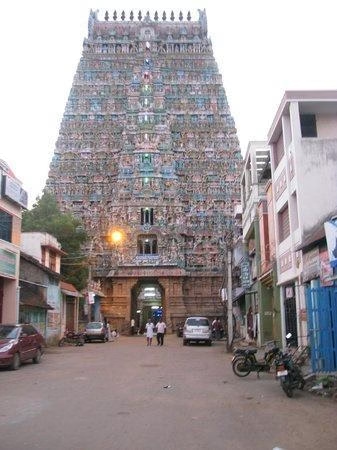
The Uppiliappan Temple is a masterpiece of Dravidian architecture. The temple complex is enclosed by a granite wall, with a magnificent five-tiered Rajagopuram (gateway tower) facing East. The presiding deity’s Vimana is known as the Suddhananda (Pure Happiness) Vimana.
Notable Shrines and Features
Inside the complex, the layout is designed according to Vastu Shastra principles to ensure the free flow of positive energy:
- Main Sanctum: Houses Uppiliappan in a standing posture, flanked by Bhumi Devi and Sage Markandeya.
- Anjaneya Shrine: Located on the southern side of the first precinct.
- Desika Shrine: A dedicated space for the Vaishnava saint Vedanta Desika near the sanctum.
- Tiruppalliarai: The sacred bed chamber, uniquely covered with mirrors, where the processional deities rest.
- The Sacred Tank (Ahoraathra Pushkarani): Located outside the main complex, this tank is famous for being the only theertham (sacred water body) where taking a dip is permitted even at night.
The temple also features a Yaga Sala (ritual hall), a library, and a Kodimandapa (pillared hall) with eight carved pillars used for daily rituals.
4. Darshan & Ritual Logistics (2026 Update)
The temple is administered by the Hindu Religious and Endowment Board of the Government of Tamil Nadu. Below are the expected timings for 2026.
Daily Timings
| Session | Timing |
|---|---|
| Morning Opening | 6:00 AM |
| Ushathkalam (Early Morning Pooja) | 7:00 AM |
| Kalasanthi (Mid-Morning Pooja) | 8:00 AM |
| Saandrakalam (Afternoon Pooja) | 12:00 PM |
| Evening Opening | 4:00 PM |
| Sayarakshai (Evening Pooja) | 6:00 PM |
| Closure | 9:00 PM |
Key Sevas & Online Booking
Devotees can book specific Sevas in advance. Given the temple’s fame for unsalted offerings, Archana performed with uncooked rice and pepper is highly recommended.
- Abhishekam: Performed on Ekadashi days and special occasions. Note: The Sahasradhari plate used here is gold-plated.
- Thirumanjanam: The sacred ablution ceremony.
- Kalyana Utsavam: The celestial marriage ceremony reenactment.
Booking: Visit the Tamil Nadu HR&CE official website (temple.tamilnadutourism.gov.in) to book Pooja, Havan, and Archana tickets online for Uppiliappan Temple. Carry the digital receipt for entry.
2026 Festival Calendar
- Panguni Uthiram (Chariot Festival): March/April 2026. This is the most grandeur event where the processional deities are taken around the temple in a chariot.
- Vasantotsavam: Celebrated for six days in May–June 2026. The deities are taken to the garden located 0.5 km south of the temple.
- Rama Navami: March/April 2026. A major festival dedicated to Lord Rama.
- Brahmotsavam: Typically held in the month of Panguni (April).
5. Practical Visitor Guidance
Rules & Regulations
- Dress Code: Traditional attire is mandatory. Men should wear Veshti (dhoti) or trousers with a shirt; women should wear saree, salwar kameez, or churidar.
- Photography: Strictly prohibited inside the inner sanctum (Garbhagriha) and during processions. Photography is permitted in the outer precincts.
- Mobile Lockers: The temple provides deposit facilities for electronic items, as mobile phones are not allowed inside the inner praharam (circumambulation path).
- Accessibility: The temple has ramps for wheelchairs in the outer corridors, but the inner sanctum involves a few steps.
Crowd Management
- Best Time to Visit: Early morning (6:00 AM – 8:00 AM) or late evening (after 6:30 PM) to avoid heavy crowds. Weekdays are generally quieter than weekends.
- Seasonal Advice:
- Summer (April–June): Temperatures in Thanjavur can exceed 38°C. Carry a water bottle (filled from the temple tank is allowed) and an umbrella.
- Monsoon (October–December): The Cauvery delta region receives heavy rainfall. Wear non-slip footwear.
6. Pilgrimage Connectivity
How to Reach Uppiliappan Temple
The temple is located in Thirunageswaram, approximately 6 km from Kumbakonam.
- By Air: The nearest airport is Tiruchirappalli International Airport (TRZ), located approximately 95 km away. From there, you can hire a taxi or take a bus to Kumbakonam.
- By Rail: Kumbakonam Railway Station (Code: KUMB) is the nearest major railhead. It is well-connected to Chennai, Egmore, and Trichy. Auto-rickshaws and local buses are readily available from the station to Thirunageswaram.
- By Road:
- Directly accessible via NH 383 (connecting Kumbakonam to Mayiladuthurai).
- Bus services are frequent from Kumbakonam New Bus Stand (Route 25, 26, 64).
Nearby Sacred Sites (Pilgrimage Circuit)
Thirunageswaram is a hub of spiritual activity. Combine your visit with these nearby temples:
- Naganathaswamy Temple (Thirunageswaram): Located just 1 km away, this is one of the 9 Navagraha temples dedicated to Rahu (Serpent God).
- Sarangapani Temple (Kumbakonam): A major Divya Desam (number 61) located about 8 km away, renowned for its towering Rajagopuram.
- Adhi Kumbeswarar Temple (Kumbakonam): A historic Shiva temple dedicated to Lord Shiva as the pot-bearer, located 7 km away.
Uppiliappan Temple, also known as Thiruvinnagar of Venkatachalapathy Temple is a temple dedicated to Hindu god Vishnu, located near Thirunageswaram, a village in the outskirts of the Kumbakonam in the South Indian state of Tamil Nadu. Constructed in the Dravidian style of architecture, the temple is glorified in the Divya Prabandha, the early medieval Tamil canon of the Azhwarsaints from the 6th–9th centuries AD. It is counted as the 60th of the 108 Divya Desams dedicated to Vishnu. Vishnu is worshiped as Uppiliappan and his consort Lakshmi as Bhumi Devi.
The temple is believed to be of significant antiquity and to have been initiated by the Medieval Cholas of the late 8th century AD, with later contributions at different times from Thanjavur Nayaks. The temple has two inscriptions dating from the Chola period, a five-tiered rajagopuram (gateway tower), and a granite wall. The complex contains all the shrines and water bodies associated with it.
Uppiliappan is believed to have appeared for sage Markandeya and Hindu gods Bhoomadevi, Brahma and Shiva. The temple observes six daily rituals and three yearly festivals. The chariot festival, celebrated during the Tamil month of “Panguni” (March–April), is the most prominent. The temple is maintained and administered by the Hindu Religious and Endowment Board of the Government of Tamil Nadu.
Architecture
The temple has a five-tiered rajagopuram (the gateway tower) and enshrined within a granite wall. The complex contains all the shrines and water bodies associated with it. The Sahasradhari plate and pot (kudam) are made of gold for performing Thirumanjanam (ablution) to the presiding deity. The temple also maintains golden sword, diamond crown and gold arm guard for the image of Hanuman. The shrine over the sanctum is plated with gold.The main shrine of the temple houses the image of Oppiliappan in standing posture and it also houses the images of Bhoomidevi and sage Markendeya. The vimana is called Suddhananda, meaning “pure happiness”. The Desika shrine is located near the sancturn sanctorum. On the sides of the first precinct, the shrine of Anjaneya is located on the southern, and Alwars’ and Sri Rama’s on the northern and Ramanuja’s on the eastern sides.The shrine for Maniappan is located in the second precinct in the southern side, while the shrines of Ennappan and the holy birth spot of Bhoomidevi are located in the northern side. Garuda’s shrine is located right opposite the sanctum and right behind the temple mast. The shrine of dancing Krishna is located on the southern side of the main entrance.
A marble hall is located on the western side in the inner precinct acts as the resting hall for the festival deities during festivals. Dolotsavam festival is celebrated in Another marble hall in the northern side of the temple. Adjoining the hall, there is a shrine where the images of Rama, Lakshmana, Sita and Hanuman are housed. The sacred bed chamber called Tiruppalliarai, covered full of mirrors is located next to it.A Yaga sala for performing religious rituals is present in the temple. The temple has a hall for housing festival vehicles, a library, and a hall with edight carved pillars on the banks of the temple tank, where the annual float-festival is celebrated. The Kodimandapa, located to the south of the Garuda shrine, is used for several day-to-day religious practises. The annual Kalyana Utsavam festival is performed in the hall amidst music and dance programmes.
Outside the main complex, the temple maintains two marriage halls, a rest house containing five rooms, two other halls, a housing each for the small chariot and the big chariot. There is a garden around the third precinct of the temple and a much bigger garden about 0.5 km (0.31 mi) to the south of the temple, where Tulasi and flowers are grown. A hall in the garden is used for resting deities during the Vasantotsavam festival celebrated for six days in May–June every year.
Legend / Local stories
The history of the temple is mentioned in the Brahmanda Purana, one of the eighteen famed Hindu scriptures. Per Hindu legend, Tulasi once did penance to attain closeness to Vishnu. Vishnu responded that his consort Lakshmi would appear under Tulasi’s lap in Tiruvinnagaram. Tulasi appeared in the place where the temple is located. This is mentioned in the 53rd verse of Nammazhwaar in Thiruviruththam. Markandeya Maharishi worshipped Vishnu and desired that Lakshmi should appear as his daughter and Vishnu should become his son-in-law. Once Markandeya was on a holy trip and after reaching Thiruvinnagaram, he felt it was the right place to get his desire fulfilled. Markandeya started a severe penance for thousand years, seeking Lakshmi’s blessings. Lakshmi appeared as a baby under the already incarnated tulasi plant. Markandeya felt Lakshmi’s presence in the form of the baby and realised that part of his desire had been fulfilled. He took possession of the baby and raised her. When the young girl reached adolescence, on the panguni month of Shravana, Vishnu appeared as an old man and asked for the hand of Markandeya’s daughter in marriage. Markandeya replied, “You are very ripe and old, my daughter is too young and she does not even know how to cook with proper salt contents”, to which the old man replied, “If your daughter must cook without salt, then I will still take it as my best food, but I will not leave from here without marrying her”. Markandeya sought Vishnu’s help and then realised using his penance that the old man was Vishnu himself. When he opened his eyes, Vishnu appeared in front of him with conch and chakram as in Vaikundam. Markandeya offered his daughter’s hand in marriage. Per the legend, the temple’s Neyvethiyam (food offering) is always prepared without salt.[1]
The name Oppiliappan is a result of this legend. There is also a story behind the tank in this temple. Once a King had consummated with a daughter of a saint and hence the saint cursed him to become a bird. The king lived as a bird and one night when there was a storm, the branch of the tree the bird was sleeping on broke and fell into the water of this tank. The bird regained its original form as the King and since then this is known as the only theerththam that one can do theerth thaadanam even in the night. Since this tank has such healing power in the day as well as night, it is called “Ahoraathra Pushkarani”.The place is called by various names, including “Agasa Nagaram”, “Vaikunda Nagaram”, “Thiruvinnagar”, “Oppiliappan Sannithi” and “Uppiliappan Sannithi”. The presiding deity is also called by various names, including Venkatachalapathy, Thiruvinnagarappan, Oppilaappan, Thanoppillaappan, Uppiliappan and Srinivasan.
It is not clear from the inscriptions and records when the temple was initiated, but there are inscriptions from the Medieval Cholas period indicating generous gifts to the temple. There are two inscriptions recorded from the Naganathar Temple in Tirunageswaram. The epigraph numbered 211 of 1911 on the northern wall of the central shrine indicates gift of gold jewel worked in gems and pearls to the temple from the Chola king Parakesarivarman, alias Rajendra Chola I (1012–44 CE). The second inscription numbered 218 of 1911 on the shrine’s southern wall indicates a gift of land to the temple in the 14th year of the Chola king Rajaraja Rajakkesarivarman I.
The tradition in many ancient temples in Tamil Nadu including this one is that the original image of the presiding deity is made of wood and replaced later with stone.[11] There were a lot of additions made to the temple by Govinda Dikshitar, the minister of successive Nayak rulers, Achuthappa Nayak (1560–1614) and Raghunatha Nayak (1600–34).[12] The temple is maintained and administered by the Hindu Religious and Endowment Board of the Government of Tamil Nadu.
Photo Gallery
How to Reach:
Contact Details
Official Address: Oppiliyappan Koil N Street, Thirunageswaram, Tamil Nadu 612204
Recent Posts

Shri Kaamkoteeshwar Mandir, Varanasi – History & Significance
In the heart of Kashi, the eternal city of Lord Shiva, where the Ganges flows with celestial grace, stands the Shri Kaamkoteeshwar Mandir. This sacred Sannidhi is not merely a temple but a profound spiritual bridge between the Northern…

ओ सांवरे तूने ही मुझको संभाला – Lyrics & Meaning
ओ सांवरे तूने ही मुझको संभाला – A Prayer to Shyam Origin & Spiritual Essence Why This Bhajan Resonates Devotees chant this when overwhelmed by life’s storms—the refrain ‘तूने ही मुझको संभाला’ is the soul’s sigh of relief: “You…

कथा ये है महाराज मेरे की – Lyrics & Meaning
कथा ये है महाराज मेरे की छत्रपति संभाजी महाराज – A Prayer to Chhatrapati Sambhaji Maharaj Origin & Spiritual Essence Why This Bhajan Resonates Devotees chant this when their spirit feels tested—its powerful refrain “महाराज मेरे” is a soul’s…

Rigveda Samhita Yathartha Anuvada (ऋग्वेद संहिता यथार्थ अनुवाद) – Complete Set with Anvayartha & Hindi/English Translation
The Rigveda is the oldest surviving scripture of humanity and the foundational text of Sanātana Dharma. For serious students, scholars, UPSC aspirants studying ancient Indian history, Sanskrit learners, and spiritual seekers, a precise and grammatically structured translation is indispensable.…

आना भी अकेला है जाना भी अकेला है – Lyrics & Meaning | BharatTemples
आना भी अकेला है जाना भी अकेला है – A Prayer to the Divine Witness Origin & Spiritual Essence Why This Bhajan Resonates Devotees turn to this bhajan in moments of deep reflection—when life’s attachments begin to ache. The…

माता शेरावाली के द्वार जो भी जाता है – Lyrics & Meaning
माता शेरावाली के द्वार जो भी जाता है – A Prayer to Maa Sherawali Origin & Spiritual Essence Why This Bhajan Resonates Devotees turn to this bhajan in times of fear or uncertainty—its promise that no one leaves Maa’s…

मार लेना सपणी उबार लेणा भवरा – Lyrics & Meaning
मार लेना सपणी उबार लेणा भवरा – A Prayer to the Divine Beloved Origin & Spiritual Essence Why This Bhajan Resonates Devotees chant this in moments of deep vulnerability—its cry of “मार लेना सपणी, उबार लेणा भवरा” is the…

हमें श्याम सुंदर भरोसा तुम्हारा – Lyrics & Meaning
हमें श्याम सुंदर भरोसा तुम्हारा – A Prayer to Shyam Sundar Origin & Spiritual Essence Why This Bhajan Resonates Devotees chant this when feeling alone—its refrain ‘de do sahara’ is the soul’s cry for divine support. Lyrics in Hindi…

Mere Satguru Ne Di Thi Davai Lyrics in Hindi & Meaning
Mere Satguru Ne Di Thi Davai: Invoking the Guru’s Liberating Wisdom This soul-stirring bhajan venerates the Satguru (True Spiritual Master) as the divine physician who dispenses the only remedy for life’s deepest sufferings. Composed by Sant Karmaveer Tufani, it…

Janm Diyo Thari Maa Dukh Dekhiyo Lyrics in Hindi & Meaning
जन्म दियो थारी माँ दुख देखियो (Maa’s Grief Upon Birthing You) This soul-stirring Chetavani Bhajan (admonitory hymn) is addressed to the Divine Mother (Maa) – a call for repentance when children forget their filial duties in the dark age…