
Contents
Introduction & Spiritual Essence
Nestled in the serene Kedar-khanda of the Garhwal Himalayas, Guptakashi stands as a testament to divine concealment and spiritual revelation. This ancient town, perched at an elevation of 1,319 meters, is revered as the “Hidden Kashi”—a place where the cosmic lord Shiva sought refuge from the Pandavas. The primary deity here is Vishwanath (Lord of the World), enshrined in a form that echoes the sanctity of Varanasi.
The spiritual heart of Guptakashi also beats within the shrine of Ardhanareshvara, the androgynous form representing the union of Shiva and Parvati. Devotees flock to this sacred geography not merely for sightseeing, but for profound Phalaśruti (spiritual benefits). It is believed that offering prayers here cleanses the sins of Brāhmanahatya (killing of a Brahmin) and fratricide—karmic burdens carried from past lives. As one of the six sacred “Kashis” prescribed in the Puranas, a visit to Guptakashi grants the same spiritual merit as a pilgrimage to Varanasi itself, making it an essential stop for those seeking moksha (liberation).
Historical Origins & Scriptural Legend
The history of Guptakashi is etched in the annals of the Mahabharata. According to temple records and oral traditions, after the bloody Kurukshetra war, the Pandavas sought to atone for their sins. Desiring the forgiveness of Lord Shiva, they pursued him from Kashi. Annoyed by the war’s brutality, Shiva disguised himself as a bull (Nandi) and fled into the Himalayas.
Tradition holds that the Pandavas tracked him to this valley. When Bhima attempted to seize the bull by its tail and hind legs, Shiva vanished into the ground—hence the name Guptakashi (Hidden Kashi). He later reappeared in five distinct forms across the region, establishing the Panch Kedar circuit. The Vishwanath Temple here is architecturally dated back to the era of the Katyuri Kings (approx. 7th–11th century CE), though it has undergone several renovations, notably by the Chand Kings of Kumaon. The temple complex is also linked to the Winter Kedarnath; during the harsh winter months when Kedarnath is snowbound, the symbolic deity of Kedarnath is shifted via Guptakashi to Ukhimath, where the priests reside and continue worship.
Architectural Marvels
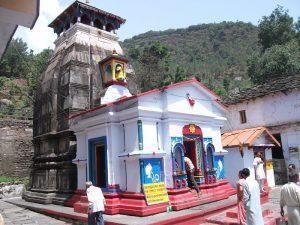
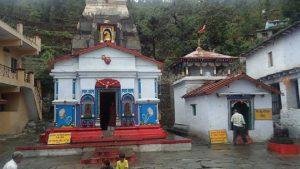
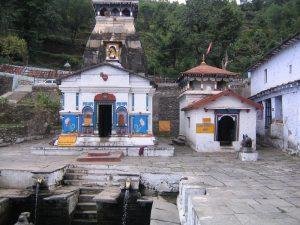
The temple showcases the classic Nagara style of architecture, adapted to the Himalayan terrain. Constructed primarily from massive stone slabs, the structure features a tall, pyramidal Shikhara (tower) rising above the sanctum sanctorum. The roof is topped with a sloping wooden frame, a distinctive feature of Garhwal architecture designed to withstand heavy snowfall.
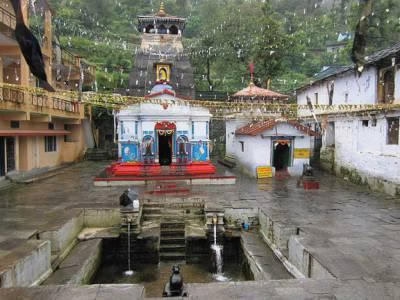
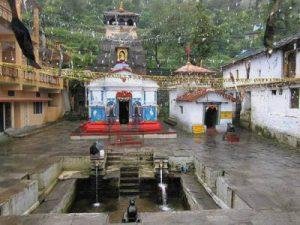
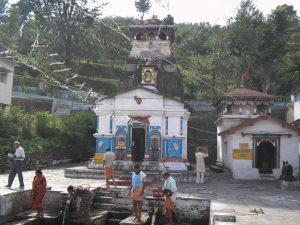
At the entrance, two stone Dwarpalakas (guardians) stand guard. The exterior façade is adorned with painted lotus motifs, while the lintel features an image of Bhairava, the fierce aspect of Shiva. To the left of the main shrine lies the Ardhanareshvara shrine, facing a metallic statue of Nandi, the divine bull. A notable feature is the Manikarnika Kund situated in front of the temple. Two natural springs—one representing the Ganges (Bhagirathi) and the other the Yamuna—feed the kund. The water flows through a Goumukh (spout resembling a cow’s mouth) and an elephant’s trunk, bathing the Shiva-linga within. The abundance of stone lingas throughout the town leads to the local saying: “Jitne pathar, utne Shankar” (As many stones, so many Shivas).
Darshan & Ritual Logistics
Visitors are encouraged to dress modestly, adhering to traditional Indian attire. The atmosphere is one of deep devotion, particularly during the morning and evening Aarti. While specific online booking portals are regional, sevas can often be arranged through the temple committee office on-site.
Daily Darshan Timings (Standard Schedule)
| Session | Timing | Activity |
|---|---|---|
| Morning | 6:00 AM – 1:00 PM | Opening, Abhishekam, Shringar Darshan |
| Afternoon | 1:00 PM – 4:00 PM | Temple Cleaning (Restricted Entry) |
| Evening | 4:00 PM – 8:00 PM | Sandhya Aarti, Darshan |
Key Sevas & 2026 Festivals
- Abhishekam: Ritual bathing of the linga with milk, honey, and water. Best performed in the morning.
- Rudrabhishek: A potent Vedic ritual for peace and prosperity.
- Archana: Individual prayers; devotees can book this at the temple counter.
Major 2026 Festival Dates:
- Maha Shivaratri: February 26, 2026 (Grand celebrations with night-long vigil).
- Amarnath Yatra Start: July 2026 (Provisional dates; significant footfall in Guptakashi en route to Kedarnath).
- Diwali: November 1, 2026.
- Makar Sankranti: January 14, 2026.
Practical Visitor Guidance
Guptakashi is a high-altitude town with cold weather year-round. Even in summer (May–June), evenings are chilly.
- Dress Code: Traditional Indian wear (Saree, Kurta-Pajama) is recommended. Avoid shorts or sleeveless tops.
- Photography: Strictly prohibited inside the sanctum sanctorum. Photography of the outer architecture is generally permitted.
- Footwear & Lockers: Shoes must be removed at designated stands outside the temple. Small mobile lockers are often available near the entrance, but it is best to carry minimal valuables.
- Crowd Management: The temple sees heavy crowds during the Char Dham Yatra season (May–June). Best Time to Visit: October to November for clear skies and pleasant weather. Monsoon months (July–August) should be avoided due to landslide risks on the NH.
- Accessibility: The temple has stone steps; assistance may be required for elderly pilgrims.
Pilgrimage Connectivity
Guptakashi serves as a vital junction for the Kedarnath pilgrimage.
How to Reach
- By Air: The nearest airport is Jolly Grant Airport, Dehradun (approx. 180 km / 7 hours drive).
- By Rail: The nearest railway head is Rishikesh (approx. 150 km / 6 hours drive) or Haridwar.
- By Road: Guptakashi is well-connected via NH 109 (formerly NH 58). Buses and taxis are available from Rishikesh and Rudraprayag. The drive offers scenic views of the Mandakini river valley.
Nearby Sacred Sites (Pilgrimage Circuit)
- Ukhimath (19 km): The winter seat of Lord Kedarnath and Madhyamaheshwar. It features the ancient Omkareshwar Temple.
- Triyuginarayan (23 km): Known as the “Kashi of the Mountains,” this is the legendary site where Lord Shiva and Parvati were married. The eternal fire (Akhand Dhuni) burns in the courtyard.
- Kedarnath (22 km by trek start): One of the 12 Jyotirlingas and a Char Dham site, accessible via Gaurikund.
Frequently Asked Questions (FAQ)
1. Is there a VIP darshan entry at Guptakashi Temple?
While there is no formal “VIP” ticketing system like in Tirupati, devotees carrying donation receipts for specific Sevas (like Rudrabhishek) are often granted priority entry during non-peak hours. Elders and differently-abled pilgrims are assisted by temple volunteers.
2. What is the significance of the Manikarnika Kund here?
The Manikarnika Kund is a sacred water tank located in front of the Vishwanath temple. It is fed by two natural springs representing the Ganges and Yamuna rivers. Bathing the Shiva-linga here with waters from these springs is considered highly purifying for the soul.
3. How far is Guptakashi from Kedarnath?
Guptakashi is located approximately 45 km by road from Gaurikund (the motorable head). From Gaurikund, pilgrims must trek approximately 16 km to reach Kedarnath. However, in terms of straight-line distance and religious significance, it is considered the spiritual precursor to the Kedarnath shrine.
4. Can I stay overnight at the temple?
There are no accommodations inside the temple complex, but Guptakashi town offers numerous hotels, guest houses, and Dharamshalas. It is advisable to book in advance during the peak Yatra season (May–June).
5. Why is it called “Gupta” Kashi?
According to the Sthala Purana, Lord Shiva hid (Gupt) from the Pandavas at this location before revealing himself at Kedarnath. The name literally translates to “Hidden Kashi,” signifying its hidden spiritual potency.
Visual Journey: Guptakashi
Explore the divine architecture and serene landscapes of this ancient temple town.

Contact & Administrative Details
Guptakashi Temple Committee
District: Rudraprayag, Uttarakhand
Pin Code: 246401
For general inquiries and specific Puja bookings, it is recommended to contact the Kedarnath Gaurikund Temple Committee or the Garhwal Mandal Vikas Nigam (GMVN) guest house in Guptakashi.
Note: Direct phone numbers for the specific shrine are often managed locally. Visitors are advised to check with their accommodation providers for the latest contact information.
Recent Posts

Shri Kaamkoteeshwar Mandir, Varanasi – History & Significance
In the heart of Kashi, the eternal city of Lord Shiva, where the Ganges flows with celestial grace, stands the Shri Kaamkoteeshwar Mandir. This sacred Sannidhi is not merely a temple but a profound spiritual bridge between the Northern…

ओ सांवरे तूने ही मुझको संभाला – Lyrics & Meaning
ओ सांवरे तूने ही मुझको संभाला – A Prayer to Shyam Origin & Spiritual Essence Why This Bhajan Resonates Devotees chant this when overwhelmed by life’s storms—the refrain ‘तूने ही मुझको संभाला’ is the soul’s sigh of relief: “You…

कथा ये है महाराज मेरे की – Lyrics & Meaning
कथा ये है महाराज मेरे की छत्रपति संभाजी महाराज – A Prayer to Chhatrapati Sambhaji Maharaj Origin & Spiritual Essence Why This Bhajan Resonates Devotees chant this when their spirit feels tested—its powerful refrain “महाराज मेरे” is a soul’s…

Rigveda Samhita Yathartha Anuvada (ऋग्वेद संहिता यथार्थ अनुवाद) – Complete Set with Anvayartha & Hindi/English Translation
The Rigveda is the oldest surviving scripture of humanity and the foundational text of Sanātana Dharma. For serious students, scholars, UPSC aspirants studying ancient Indian history, Sanskrit learners, and spiritual seekers, a precise and grammatically structured translation is indispensable.…

आना भी अकेला है जाना भी अकेला है – Lyrics & Meaning | BharatTemples
आना भी अकेला है जाना भी अकेला है – A Prayer to the Divine Witness Origin & Spiritual Essence Why This Bhajan Resonates Devotees turn to this bhajan in moments of deep reflection—when life’s attachments begin to ache. The…

माता शेरावाली के द्वार जो भी जाता है – Lyrics & Meaning
माता शेरावाली के द्वार जो भी जाता है – A Prayer to Maa Sherawali Origin & Spiritual Essence Why This Bhajan Resonates Devotees turn to this bhajan in times of fear or uncertainty—its promise that no one leaves Maa’s…

मार लेना सपणी उबार लेणा भवरा – Lyrics & Meaning
मार लेना सपणी उबार लेणा भवरा – A Prayer to the Divine Beloved Origin & Spiritual Essence Why This Bhajan Resonates Devotees chant this in moments of deep vulnerability—its cry of “मार लेना सपणी, उबार लेणा भवरा” is the…

हमें श्याम सुंदर भरोसा तुम्हारा – Lyrics & Meaning
हमें श्याम सुंदर भरोसा तुम्हारा – A Prayer to Shyam Sundar Origin & Spiritual Essence Why This Bhajan Resonates Devotees chant this when feeling alone—its refrain ‘de do sahara’ is the soul’s cry for divine support. Lyrics in Hindi…

Mere Satguru Ne Di Thi Davai Lyrics in Hindi & Meaning
Mere Satguru Ne Di Thi Davai: Invoking the Guru’s Liberating Wisdom This soul-stirring bhajan venerates the Satguru (True Spiritual Master) as the divine physician who dispenses the only remedy for life’s deepest sufferings. Composed by Sant Karmaveer Tufani, it…

Janm Diyo Thari Maa Dukh Dekhiyo Lyrics in Hindi & Meaning
जन्म दियो थारी माँ दुख देखियो (Maa’s Grief Upon Birthing You) This soul-stirring Chetavani Bhajan (admonitory hymn) is addressed to the Divine Mother (Maa) – a call for repentance when children forget their filial duties in the dark age…