
Contents
Introduction & Spiritual Essence: The Belly of the Divine Bull
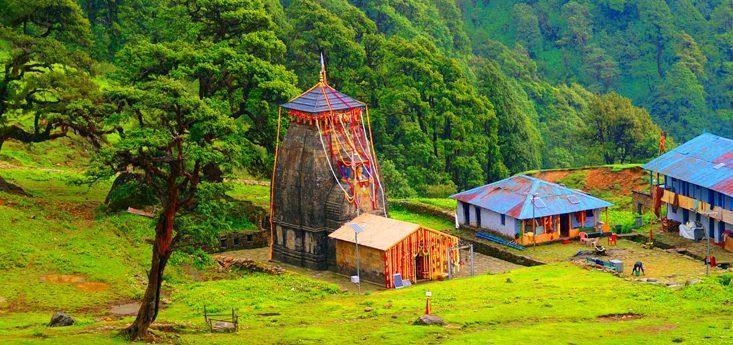
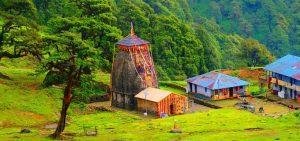
Nestled in the pristine solitude of the Garhwal Himalayas, Madhyamaheshwar (also known as Madmaheshwar) stands as the fourth sacred stop in the revered Panch Kedar pilgrimage circuit. At an altitude of 3,497 meters (11,473 ft), this remote temple is not merely a stone structure but a living testament to divine presence. The primary deity here is Lord Shiva, worshipped specifically as the “Navel” (Nabhi) of the divine bull (Nandi).
Phalaśruti (Spiritual Benefit): Devotees believe that visiting Madhyamaheshwar cleanses the sins of “Brāhmanahatya” (killing of Brahmins) and “Gotra-hatya” (fratricide)—sins associated with the epic Mahabharata. By offering prayers here, devotees seek liberation (Moksha) and blessings for spiritual awakening. The temple represents the Madhya (middle) aspect of Shiva’s cosmic form, balancing the higher consciousness of Kedarnath with the earthly grounding of Kalpeshwar.
Historical Origins & Scriptural Legend
According to ancient scriptures and the Sthala Purana of the region, the origins of Madhyamaheshwar are inextricably linked to the Pandavas, the heroes of the Mahabharata. After the Kurukshetra war, the Pandavas sought forgiveness from Lord Shiva for the heavy cost of victory. Shiva, unwilling to grant immediate absolution, disguised himself as a bull and roamed the Himalayas.
Tradition holds that when the Pandavas spotted Shiva in Guptakashi, he attempted to submerge into the earth. Bhima, the mighty second Pandava, grasped the bull’s tail and hind legs, causing Shiva to manifest in five distinct parts:
- Kedarnath: The hump (back).
- Tungnath: The arms.
- Rudranath: The face.
- Madhyamaheshwar: The belly and navel (Nabhi).
- Kalpeshwar: The hair (Jata).
It is said that the Pandavas built the temple at Madhyamaheshwar to enshrine the Swayambhu (self-manifested) Shiva Lingam in the shape of a navel.
Architectural Marvels
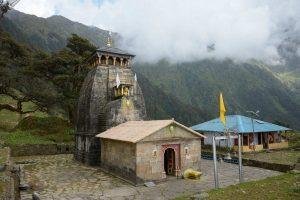
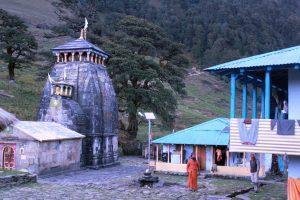
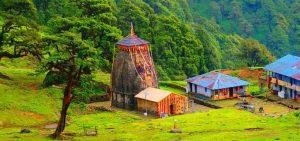
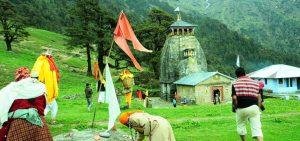
The temple exhibits a classic Nagara style of architecture, though much simpler and more modest compared to the grand temples of the plains. The structure is built of local stone, designed to withstand the harsh alpine climate.
- The Sanctum: The inner sanctum (Garbhagriha) houses a black stone Lingam that is distinctly navel-shaped, encapsulated in a brass covering.
- Auxiliary Shrines: Within the complex, devotees will find smaller shrines dedicated to Ardhanarishwara (half-Shiva, half-Parvati) and a marble idol of Goddess Saraswati. A shrine for Parvati is also present.
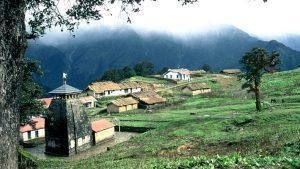
- Setting: The temple sits in a lush meadow below the commanding Chaukhamba peaks. The older temple, known as Vriddh-Madmaheshwar, is a tiny blackened shrine on the ridge, offering a panoramic view of the snow-clad mountains.
- Preservation: While not a UNESCO site, the temple is maintained by local trusts and follows traditional architectural principles that harmonize with the mountain’s Vastu.
Darshan & Ritual Logistics (2026 Update)
The temple opens during the summer months, typically from May to November, as the region is inaccessible due to heavy snowfall in winter. During the winter, the idol is shifted to Ukhimath for worship.
Daily Darshan Timings (General Schedule)
| Session | Timing |
|---|---|
| Morning Darshan | 6:00 AM – 1:00 PM |
| Afternoon Break | 1:00 PM – 4:00 PM (Temple closed) |
| Evening Darshan | 4:00 PM – 8:30 PM |
Note: Timings may vary slightly based on weather conditions and lunar calendar.
Sevas and Online Booking
While physical booking is available at the temple counter in Ukhimath or the temple office, the Madhyamaheshwar Temple Trust encourages digital payments for donations. For major Sevas, it is advisable to consult the official Uttarakhand Tourism portal or contact the temple administration directly.
- Abhishekam: Performed daily in the morning before darshan opens.
- Shiva Rudrabhishek: Available for special requests (requires advance notice).
- Maha Aarti: Takes place at 6:30 PM daily.
2026 Key Festival Dates
- Opening Date: Announced in May 2026 (Akshaya Tritiya)
- Maha Shivaratri: March 8, 2026 (Celebrated with special Yagnas).
- Amarnath Yatra Season: June – August 2026 (Pilgrims often visit Madhyamaheshwar during this window).
- Closing Date: Announced in November 2026 (Kartik Purnima)
Practical Visitor Guidance
Reaching Madhyamaheshwar requires spiritual commitment, as the last leg of the journey is a trek.
- Photography & Electronics: Photography inside the inner sanctum is strictly prohibited. Mobile phones should be kept silent. Plastic bottles are banned; carry a reusable metal flask.
- Accessibility: The trek is moderate (approx. 21 km total). For elderly devotees, Palkis (palanquins) and mules are available from Ransi village.
- Crowd Management: Unlike Kedarnath, this temple is relatively less crowded. The best time for a peaceful darshan is early morning (6 AM) or late evening (6 PM).
- Seasonal Advice: Carry warm layers even in summer (June/July), as sudden snowfall can occur. In May, daylight is strong; carry sunglasses and sunscreen.
Pilgrimage Connectivity
How to Reach
The journey begins from Ukhimath (196 km from Dehradun).
- Nearest Airport: Jolly Grant Airport, Dehradun (approx. 225 km to Ukhimath).
- Nearest Railhead: Haridwar/Rishikesh (approx. 210 km to Ukhimath).
- Road Route: Rishikesh → Devprayag → Srinagar Garhwal → Rudraprayag → Ukhimath → Sari → Ransi → Gondhar → Madhyamaheshwar.
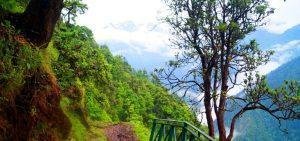
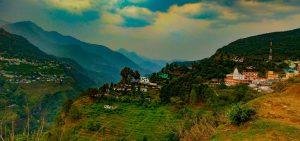
- Trek Route: The motorable road ends at Ransi village (12 km from Ukhimath). From Ransi, a 13 km trek passes through Ransi, Gaundhar, Bantoli, and Khatara to reach the temple.
Nearby Sacred Sites (Pilgrimage Circuit)
- Kedarnath (200 km away): The first and most famous of the Panch Kedar.
- Ukhimath (20 km away): The winter home of Kedarnath and Madhyamaheshwar idols.
- Rudranath (50 km trek away): The third temple in the circuit, dedicated to the face of Shiva.
Frequently Asked Questions (FAQs)
1. Is there a VIP darshan entry at Madhyamaheshwar?
Madhyamaheshwar is a rustic temple, and there is no formal VIP gate. However, devotees with special needs (elderly or disabled) are facilitated by the temple priests and local helpers for a faster darshan. It is recommended to tip the caretakers modestly and respectfully.
2. Can I book accommodation at the temple?
There are no luxury hotels at the temple itself. Basic guesthouses (Dharamshalas) and GMVN (Garhwal Mandal Vikas Nigam) tents are available at Gaundhar and Ransi. It is highly recommended to carry your own sleeping bag for the trek. Booking should be done via the GMVN website.
While Kedarnath represents the back and Tungnath the arms, Madhyamaheshwar represents the Nabhi (navel). In yogic philosophy, the navel is the seat of the body’s energy (Manipura Chakra). Worshipping Shiva here is believed to balance one’s physical and astral bodies.
4. Is the trek difficult for beginners?
The trek is graded as Moderate. The path is clearly defined but steep at certain sections. First-time trekkers should focus on cardiovascular fitness. The presence of ponies makes it accessible for most age groups.
5. Is there an online seva booking facility?
Currently, daily darshan does not require booking. However, for specific rituals like Rudrabhishekam, you can coordinate with the Madhyamaheshwar Temple Trust office in Ukhimath or contact them at the phone number listed on the site.
Recent Posts

Shri Kaamkoteeshwar Mandir, Varanasi – History & Significance
In the heart of Kashi, the eternal city of Lord Shiva, where the Ganges flows with celestial grace, stands the Shri Kaamkoteeshwar Mandir. This sacred Sannidhi is not merely a temple but a profound spiritual bridge between the Northern…

ओ सांवरे तूने ही मुझको संभाला – Lyrics & Meaning
ओ सांवरे तूने ही मुझको संभाला – A Prayer to Shyam Origin & Spiritual Essence Why This Bhajan Resonates Devotees chant this when overwhelmed by life’s storms—the refrain ‘तूने ही मुझको संभाला’ is the soul’s sigh of relief: “You…

कथा ये है महाराज मेरे की – Lyrics & Meaning
कथा ये है महाराज मेरे की छत्रपति संभाजी महाराज – A Prayer to Chhatrapati Sambhaji Maharaj Origin & Spiritual Essence Why This Bhajan Resonates Devotees chant this when their spirit feels tested—its powerful refrain “महाराज मेरे” is a soul’s…

Rigveda Samhita Yathartha Anuvada (ऋग्वेद संहिता यथार्थ अनुवाद) – Complete Set with Anvayartha & Hindi/English Translation
The Rigveda is the oldest surviving scripture of humanity and the foundational text of Sanātana Dharma. For serious students, scholars, UPSC aspirants studying ancient Indian history, Sanskrit learners, and spiritual seekers, a precise and grammatically structured translation is indispensable.…

आना भी अकेला है जाना भी अकेला है – Lyrics & Meaning | BharatTemples
आना भी अकेला है जाना भी अकेला है – A Prayer to the Divine Witness Origin & Spiritual Essence Why This Bhajan Resonates Devotees turn to this bhajan in moments of deep reflection—when life’s attachments begin to ache. The…

माता शेरावाली के द्वार जो भी जाता है – Lyrics & Meaning
माता शेरावाली के द्वार जो भी जाता है – A Prayer to Maa Sherawali Origin & Spiritual Essence Why This Bhajan Resonates Devotees turn to this bhajan in times of fear or uncertainty—its promise that no one leaves Maa’s…

मार लेना सपणी उबार लेणा भवरा – Lyrics & Meaning
मार लेना सपणी उबार लेणा भवरा – A Prayer to the Divine Beloved Origin & Spiritual Essence Why This Bhajan Resonates Devotees chant this in moments of deep vulnerability—its cry of “मार लेना सपणी, उबार लेणा भवरा” is the…

हमें श्याम सुंदर भरोसा तुम्हारा – Lyrics & Meaning
हमें श्याम सुंदर भरोसा तुम्हारा – A Prayer to Shyam Sundar Origin & Spiritual Essence Why This Bhajan Resonates Devotees chant this when feeling alone—its refrain ‘de do sahara’ is the soul’s cry for divine support. Lyrics in Hindi…

Mere Satguru Ne Di Thi Davai Lyrics in Hindi & Meaning
Mere Satguru Ne Di Thi Davai: Invoking the Guru’s Liberating Wisdom This soul-stirring bhajan venerates the Satguru (True Spiritual Master) as the divine physician who dispenses the only remedy for life’s deepest sufferings. Composed by Sant Karmaveer Tufani, it…

Janm Diyo Thari Maa Dukh Dekhiyo Lyrics in Hindi & Meaning
जन्म दियो थारी माँ दुख देखियो (Maa’s Grief Upon Birthing You) This soul-stirring Chetavani Bhajan (admonitory hymn) is addressed to the Divine Mother (Maa) – a call for repentance when children forget their filial duties in the dark age…