
Contents
Banke Bihari Temple: The Definitive Pilgrimage Guide
Nestled in the sacred folds of Vrindavan, Mathura, stands the Shri Bankey Bihari Mandir, a beacon of devotion and architectural splendor. As the Lead Heritage Architect for BharatTemples.com, I invite you to explore this sanctuary where the divine play (Leela) of Lord Krishna is enshrined in a black marble idol, radiating an aura that has captivated devotees for centuries.
| Date built: | 1862 |
|---|---|
| Deity: | Bankey Bihari Ji |
| Architectural style: | Rajasthani architecture |
| Major festivals | – |
| Locale: | Vrindavan |
| District:: | Mathura |
| Address: | – |
| Phone | – |
Introduction & Spiritual Essence
The temple is dedicated to Bankey Bihari Ji, a form of Lord Krishna. The name is a linguistic treasure: Bankey means “bent in three places” (Tribhanga posture), and Bihari means “supreme enjoyer.” The idol stands in the Tribhanga posture, a pose that signifies divine playfulness and eternal grace.
Phalaśruti (Spiritual Benefits): Why do millions undertake the journey to Vrindavan? The Phalaśruti associated with the Bankey Bihari Darshan suggests that a sincere gaze upon the deity’s lotus eyes purifies the soul of accumulated karma. It is believed that here, the boundary between the devotee and the Divine dissolves, offering a glimpse of the celestial couple, Radha and Shyam, merged into a single form. Devotees visit specifically to attain mental peace and to experience the Rasa of Vrindavan.
Historical Origins & Scriptural Legend
The history of this temple is not merely of bricks and mortar but of a divine revelation. Tradition holds that the idol was manifested by the celestial couple themselves.
The Legend of Swami Haridas: Swami Haridas, the guru of the legendary singer Tansen, was a devotee of unparalleled caliber. Born in 1478 A.D. in a village near Aligarh, he later settled in the dense forests of Nidhivan, Vrindavan. He was the reincarnation of Lalita Sakhi (a close friend of Radha in the Dvapara Yuga).
According to temple records and oral history, his disciples once begged to witness the divine form of Radha-Krishna. Swami Haridas sang a hymn, “Mai ri sahaj jori pragat bhai…” (O Mother, the divine couple has appeared). Upon hearing this, the area was flooded with an intense, blinding light. From this radiance emerged Shyama-Shyam (Radha-Krishna).
Overwhelmed by their celestial beauty, which lesser mortals could not bear, Swami Haridas requested them to merge into a single form. Thus, they combined into the dark form of Krishna with the complexion of Radha—like a monsoon cloud adorned with lightning. This black idol, originally installed in Nidhivan, is the one worshipped today.
Construction: While the deity has been worshipped since the 16th century, the current structure of the Banke Bihari Temple was built in 1862 A.D. by the Goswamis of Vrindavan, following the traditional Rajasthani architectural style.
Architectural Marvels
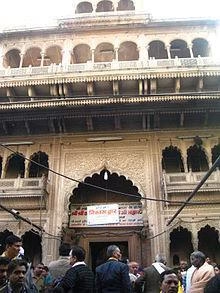
The temple stands as a testament to Rajasthani architecture, characterized by its intricate arches and carvings. Unlike the towering Nagara spires found in other regions, the Banke Bihari temple focuses on the sanctity of the inner chamber.
- The Mandapa: The sanctum is accessed through a series of arches, creating a tunnel-like passage that directs the pilgrim’s focus entirely on the deity.
- The Shikhara: The temple features a modest yet ornate Shikhara (tower) that reflects the architectural patronage of the 19th-century Rajasthani merchants who funded its construction.
- Notable Sculptures: The pillars of the Mandapa are adorned with floral motifs and depictions of Lord Krishna’s pastimes, carved in deep relief.
Darshan & Ritual Logistics
The rhythm of life at Banke Bihari revolves around the Seva (service) of the Lord. Unlike other temples, there is no early morning Mangala darshan, as the Lord is allowed to rest until 7:45 AM.
Daily Timings (2026 Schedule)
| Session | Timings | Details |
|---|---|---|
| Morning Darshan | 7:45 AM – 12:00 PM | Closed between 12:00 PM – 4:30 PM |
| Evening Darshan | 5:30 PM – 9:30 PM | Varies slightly based on seasons |
Note: The temple remains closed between 12:00 PM and 4:30 PM for the Lord’s rest (Shayan).
Key Sevas & Online Booking
The temple offers unique Sevas performed in three parts daily: Shringar (dressing), Rajbhog (mid-day meal), and Shayan (sleep).
- Abhishekam: Performed only on specific days. Booking is highly competitive.
- Archana: Can be performed by submitting devotee names at the office.
- Online Booking: Devotees can book specific sevas or VVIP Darshan passes through the official temple website or authorized portals.
2026 Major Festival Dates
Visiting during festivals offers a unique glimpse into the vibrant culture of Braj.
- Holi (Phagun Purnima): March 13, 2026 (The temple creates a unique atmosphere with flower petals and bhajans).
- Jhulan Yatra: August 2026 (The swing festival of Radha-Krishna).
- Janmashtami: August 14, 2026 (Midnight celebrations).
- Annakut (Govardhan Puja): November 2, 2026 (A mountain of sweets is offered).
Practical Visitor Guidance
As an architect, I advise pilgrims to respect the structural and spiritual integrity of the site.
- Dress Code: Traditional attire is recommended. Men should wear dhoti/kurta or formal pants with a shirt; women should wear saree, salwar kameez, or lehenga.
- Photography: Strictly prohibited inside the inner sanctum. Mobile phones should be kept on silent mode.
- Crowd Management: The temple attracts 50,000+ devotees daily. The best time for a peaceful darshan is early morning (7:45 AM) or late evening (8:00 PM) on weekdays. Tuesdays and Fridays are exceptionally crowded.
- Accessibility: The pathways are narrow due to the historic layout. Wheelchair access is limited. Wear comfortable footwear as you must leave shoes at the paid counter.
Pilgrimage Connectivity
How to Reach
- By Road: Vrindavan is on NH-2 (now NH-19). It is 7 km from the highway. Regular buses operate from Delhi (150 km) and Mathura (12 km). The Yamuna Expressway has improved access from NCR.
- By Train: The nearest major railhead is Mathura Junction (12 km). Vrindavan Railway Station is connected via a rail-bus service to Mathura.
- By Air: The nearest airport is Agra (Kheria Airport), 67 km away. The nearest international hub is Indira Gandhi International Airport, Delhi (approx. 150 km).
Nearby Sacred Sites
Complete your pilgrimage by visiting these nearby temples within Vrindavan:
- Shri Radha Vallabh Temple: Just a short walk away, dedicated to the beloved deity of Lord Krishna.
- ISKCON Temple (Sri Sri Krishna Balaram Mandir): Located in Raman Reti, known for its spiritual atmosphere and kirtans.
- Nidhivan: The sacred grove where Swami Haridas practiced meditation and where the deity was originally worshipped.


Frequently Asked Questions (FAQ)
1. Is there a VIP darshan entry at Banke Bihari Temple?
Yes, the temple administration offers a VVIP Darshan pass for a fee, allowing devotees to bypass the general queue. However, even with this pass, entry is subject to crowd levels and temple rules.
2. Can I perform an Abhishekam of the deity?
Generally, Abhishekam is not performed daily for the main deity to maintain the idol’s sanctity. It is done on specific festival days like Janmashtami. Daily rituals include Shringar and Rajbhog.
3. Are cameras allowed inside the temple?
Cameras and mobile photography are strictly prohibited inside the inner sanctum and the prayer hall. Lockers are available outside the temple to deposit electronic items.
4. Why is the curtain drawn frequently during Darshan?
The Shayan (sleep) ritual involves drawing a curtain between the deity and the devotees. This symbolizes the Lord resting. Additionally, historical legends suggest that the intense gaze of Bankey Bihari Ji can mesmerize devotees to the point of trance; the curtain is drawn to allow devotees a moment of respite.
5. What is the best time to visit to avoid crowds?
The absolute best time is Monday to Thursday mornings (7:45 AM – 9:00 AM). Weekends and festivals see extreme overcrowding.
Recent Posts

Shri Kaamkoteeshwar Mandir, Varanasi – History & Significance
In the heart of Kashi, the eternal city of Lord Shiva, where the Ganges flows with celestial grace, stands the Shri Kaamkoteeshwar Mandir. This sacred Sannidhi is not merely a temple but a profound spiritual bridge between the Northern…

ओ सांवरे तूने ही मुझको संभाला – Lyrics & Meaning
ओ सांवरे तूने ही मुझको संभाला – A Prayer to Shyam Origin & Spiritual Essence Why This Bhajan Resonates Devotees chant this when overwhelmed by life’s storms—the refrain ‘तूने ही मुझको संभाला’ is the soul’s sigh of relief: “You…

कथा ये है महाराज मेरे की – Lyrics & Meaning
कथा ये है महाराज मेरे की छत्रपति संभाजी महाराज – A Prayer to Chhatrapati Sambhaji Maharaj Origin & Spiritual Essence Why This Bhajan Resonates Devotees chant this when their spirit feels tested—its powerful refrain “महाराज मेरे” is a soul’s…

Rigveda Samhita Yathartha Anuvada (ऋग्वेद संहिता यथार्थ अनुवाद) – Complete Set with Anvayartha & Hindi/English Translation
The Rigveda is the oldest surviving scripture of humanity and the foundational text of Sanātana Dharma. For serious students, scholars, UPSC aspirants studying ancient Indian history, Sanskrit learners, and spiritual seekers, a precise and grammatically structured translation is indispensable.…

आना भी अकेला है जाना भी अकेला है – Lyrics & Meaning | BharatTemples
आना भी अकेला है जाना भी अकेला है – A Prayer to the Divine Witness Origin & Spiritual Essence Why This Bhajan Resonates Devotees turn to this bhajan in moments of deep reflection—when life’s attachments begin to ache. The…

माता शेरावाली के द्वार जो भी जाता है – Lyrics & Meaning
माता शेरावाली के द्वार जो भी जाता है – A Prayer to Maa Sherawali Origin & Spiritual Essence Why This Bhajan Resonates Devotees turn to this bhajan in times of fear or uncertainty—its promise that no one leaves Maa’s…

मार लेना सपणी उबार लेणा भवरा – Lyrics & Meaning
मार लेना सपणी उबार लेणा भवरा – A Prayer to the Divine Beloved Origin & Spiritual Essence Why This Bhajan Resonates Devotees chant this in moments of deep vulnerability—its cry of “मार लेना सपणी, उबार लेणा भवरा” is the…

हमें श्याम सुंदर भरोसा तुम्हारा – Lyrics & Meaning
हमें श्याम सुंदर भरोसा तुम्हारा – A Prayer to Shyam Sundar Origin & Spiritual Essence Why This Bhajan Resonates Devotees chant this when feeling alone—its refrain ‘de do sahara’ is the soul’s cry for divine support. Lyrics in Hindi…

Mere Satguru Ne Di Thi Davai Lyrics in Hindi & Meaning
Mere Satguru Ne Di Thi Davai: Invoking the Guru’s Liberating Wisdom This soul-stirring bhajan venerates the Satguru (True Spiritual Master) as the divine physician who dispenses the only remedy for life’s deepest sufferings. Composed by Sant Karmaveer Tufani, it…

Janm Diyo Thari Maa Dukh Dekhiyo Lyrics in Hindi & Meaning
जन्म दियो थारी माँ दुख देखियो (Maa’s Grief Upon Birthing You) This soul-stirring Chetavani Bhajan (admonitory hymn) is addressed to the Divine Mother (Maa) – a call for repentance when children forget their filial duties in the dark age…