

Contents
1. Introduction & Spiritual Essence
Located in the historic neighborhood of Sovabazar, the Shobhabazar Lal Mandir stands as a testament to Kolkata’s deep spiritual roots and colonial-era history. While the city is known as the “City of Joy,” this ancient temple offers a sanctuary of silence and divine grace, drawing devotees from across West Bengal and beyond.
The primary deity worshipped here is Lord Hanuman, also known as Anjaneya. In this particular manifestation, he is revered as Bajrang Bali, the one with a body as hard as a diamond. The term “Lal” (Red) refers to the vermilion (sindoor) coating applied to the idol, which devotees believe is the source of his immense power and vitality.
Phalaśruti: The Benefits of Visiting
According to ancient traditions and the local Sthala Purana, regular darshan of the Shobhabazar Lal Mandir offers specific spiritual benefits:
- Removal of Obstacles: Lord Hanuman is the Vighnaharta (Remover of Obstacles). Devotees visit here before starting new ventures to ensure success.
- Cleansing of Karmic Debt: Applying the temple’s Chola (sacred cloth) is believed to cleanse ancestral karma and protect against negative energies.
- Health and Vitality: The red vermilion offering is associated with longevity and the curing of ailments.
2. Historical Origins & Scriptural Legend
The Patronage of the Shobhabazar Raj
The temple’s history is inextricably linked to the Shobhabazar Raj Family, a prominent aristocratic family of colonial Kolkata. While the exact construction date is often debated in historical records, it is widely accepted that the temple structure was significantly developed and patronized by Raja Nabakrishna Bahadur (the 2nd Raja of Shobhabazar) in the mid-18th century.
Tradition holds that the Raja, a devoted follower of Lord Rama and Hanuman, established the temple to secure divine blessings for the prosperity of his estate and the growing settlement around Sutanuti.
Scriptural and Oral Legends
While the Vedas focus on the cosmic aspects of the divine, the Shobhabazar Lal Mandir is deeply rooted in the Stala Purana (local legend). Folklore suggests that the specific idol is a Swayambhu (self-manifested) manifestation, or at least dates back to a period predating the city’s expansion.
A notable legend associated with the Shobhabazar Raj is the devotion of Raja Rajkrishna Bahadur. It is said that Lord Hanuman appeared in his dreams, directing him to the location where the idol now stands. This divine intervention is why the temple remains the spiritual anchor of the Sovabazar area.
3. Architectural Marvels
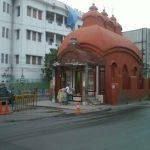
The temple is a fascinating blend of traditional Hindu temple architecture and the distinctive Bengali style that evolved during the British Raj.
Style and Layout
Unlike the towering Nagara or Dravida styles of South India, the Shobhabazar Lal Mandir features a curvilinear Shikhara (tower) that is characteristic of the Bengal region, yet it retains a classical North Indian sensibility. The structure is built using traditional brick and lime mortar, a technique perfected in 18th-century Bengal.
Sculptures and Sanctum
The inner sanctum (Garbhagriha) houses the deity in a standing posture. The walls surrounding the sanctum often feature terracotta reliefs depicting scenes from the Ramayana—a hallmark of the region’s architectural heritage.
4. Darshan & Ritual Logistics
To ensure a seamless spiritual experience, devotees should note the following timings and rituals. Note: Timings are standard; however, special timings apply during festivals.
Daily Temple Timings
| Session | Timings |
|---|---|
| Morning Darshan | 6:00 AM – 12:00 PM |
| Afternoon Break | 12:00 PM – 4:00 PM |
| Evening Darshan | 4:00 PM – 9:00 PM |
| Aarti (Sandhya) | 7:30 PM (Daily) |
Key Sevas & Online Booking
Devotees can participate in various rituals to enhance their connection with the Divine:
- Mangala Aarti: Performed early morning; requires prior arrival.
- Abhishekam:
- Chola Offering: Offering red silk cloth and vermilion (Sindoor) for the Hanuman idol.
Online Seva Booking: As of 2026, the temple management committee has digitized offerings. Devotees can book specific Pujas and Sevas through the official Bharat Temples Portal or the temple’s local office at Girish Park.
Festival Dates for 2026
- Hanuman Jayanti: April 12, 2026 – Special Chhappan Bhog offering.
- Diwali: October 21, 2026 – Night-long kirtan and illumination.
- Chaitra Purnima: April 11, 2026 – Grand Mela (Fair) expected.
5. Practical Visitor Guidance
Visiting a high-traffic temple in central Kolkata requires preparation. Here are essential tips for a comfortable visit.
Dress Code & Etiquette
Visitors must dress modestly. Traditional Indian attire is preferred. Western clothing is permitted but should be conservative (avoid shorts/tank tops). Leather items (belts, wallets) are traditionally discouraged inside the sanctum.
Photography & Mobiles
Photography is strictly prohibited inside the inner sanctum. Mobile phones are allowed but must be kept on silent mode. Locker facilities are available near the entrance for bags and electronic devices, free of charge.
Accessibility & Crowd Management
- Best Time to Visit: Weekday mornings (8:00 AM – 10:00 AM) are least crowded.
- Seasonal Advice: Kolkata summers (May-June) are extremely hot. Carry a water bottle and a hand fan. Winters (Dec-Jan) offer the most pleasant weather for darshan.
- Accessibility: The temple has ramps for wheelchair access, though the inner sanctum may be difficult to navigate during peak hours due to narrow passages.
6. Pilgrimage Connectivity
How to Reach
The Shobhabazar Lal Mandir is centrally located in Kolkata, making it easily accessible.
- Nearest Metro Station: Girish Park (North-South Line), approximately 300 meters walk.
- By Rail: The temple is 5 km from Howrah Junction and 6 km from Sealdah Station. Taxis and Auto-rickshaws are readily available.
- By Road: The temple is located off Jatindra Mohan Avenue, connecting to the EM Bypass and JB Bose Marg.
Nearby Sacred Sites (The Kolkata Pilgrimage Circuit)
Extend your spiritual journey by visiting these nearby landmarks:
- Dakshineswar Kali Temple: Located 8 km north, famous for its association with Sri Ramakrishna Paramahamsa.
- Kalighat Kali Temple: The Shakti Peetha located in South Kolkata, 7 km away.
- Sovabazar Rajbari: The ancestral mansion of the royal family, offering a glimpse into Bengali heritage, located just minutes from the temple.
7. Frequently Asked Questions (FAQ)
1. Is there a VIP darshan entry available?
While the temple management does not officially have a VIP quota, elderly devotees and those with medical conditions can request assistance from the temple guards at the entry gate for priority access during non-peak hours.
2. Can I perform the Abhishekam myself?
Typically, the temple priests (Pujaris) perform the Abhishekam on behalf of the devotee. However, during specific time slots (usually after morning Aarti), devotees may be permitted to pour water/milk over the idol under the guidance of the head priest.
3. What is the significance of the Red Vermilion?
The application of red vermilion (Sindoor) symbolizes the life force (Prana) and immense strength of Lord Hanuman. It is believed that applying it grants the devotee vitality and protection from harm.
4. Is there parking available near the temple?
Limited street parking is available along Jatindra Mohan Avenue. It is highly recommended to use public transport (Metro) due to the heavy traffic in the Girish Park/Sovabazar area.
5. Are foreigners allowed inside?
Yes, the temple welcomes all visitors regardless of faith. However, adherence to the dress code and temple rules is mandatory.
Recent Posts

Shri Kaamkoteeshwar Mandir, Varanasi – History & Significance
In the heart of Kashi, the eternal city of Lord Shiva, where the Ganges flows with celestial grace, stands the Shri Kaamkoteeshwar Mandir. This sacred Sannidhi is not merely a temple but a profound spiritual bridge between the Northern…

ओ सांवरे तूने ही मुझको संभाला – Lyrics & Meaning
ओ सांवरे तूने ही मुझको संभाला – A Prayer to Shyam Origin & Spiritual Essence Why This Bhajan Resonates Devotees chant this when overwhelmed by life’s storms—the refrain ‘तूने ही मुझको संभाला’ is the soul’s sigh of relief: “You…

कथा ये है महाराज मेरे की – Lyrics & Meaning
कथा ये है महाराज मेरे की छत्रपति संभाजी महाराज – A Prayer to Chhatrapati Sambhaji Maharaj Origin & Spiritual Essence Why This Bhajan Resonates Devotees chant this when their spirit feels tested—its powerful refrain “महाराज मेरे” is a soul’s…

Rigveda Samhita Yathartha Anuvada (ऋग्वेद संहिता यथार्थ अनुवाद) – Complete Set with Anvayartha & Hindi/English Translation
The Rigveda is the oldest surviving scripture of humanity and the foundational text of Sanātana Dharma. For serious students, scholars, UPSC aspirants studying ancient Indian history, Sanskrit learners, and spiritual seekers, a precise and grammatically structured translation is indispensable.…

आना भी अकेला है जाना भी अकेला है – Lyrics & Meaning | BharatTemples
आना भी अकेला है जाना भी अकेला है – A Prayer to the Divine Witness Origin & Spiritual Essence Why This Bhajan Resonates Devotees turn to this bhajan in moments of deep reflection—when life’s attachments begin to ache. The…

माता शेरावाली के द्वार जो भी जाता है – Lyrics & Meaning
माता शेरावाली के द्वार जो भी जाता है – A Prayer to Maa Sherawali Origin & Spiritual Essence Why This Bhajan Resonates Devotees turn to this bhajan in times of fear or uncertainty—its promise that no one leaves Maa’s…

मार लेना सपणी उबार लेणा भवरा – Lyrics & Meaning
मार लेना सपणी उबार लेणा भवरा – A Prayer to the Divine Beloved Origin & Spiritual Essence Why This Bhajan Resonates Devotees chant this in moments of deep vulnerability—its cry of “मार लेना सपणी, उबार लेणा भवरा” is the…

हमें श्याम सुंदर भरोसा तुम्हारा – Lyrics & Meaning
हमें श्याम सुंदर भरोसा तुम्हारा – A Prayer to Shyam Sundar Origin & Spiritual Essence Why This Bhajan Resonates Devotees chant this when feeling alone—its refrain ‘de do sahara’ is the soul’s cry for divine support. Lyrics in Hindi…

Mere Satguru Ne Di Thi Davai Lyrics in Hindi & Meaning
Mere Satguru Ne Di Thi Davai: Invoking the Guru’s Liberating Wisdom This soul-stirring bhajan venerates the Satguru (True Spiritual Master) as the divine physician who dispenses the only remedy for life’s deepest sufferings. Composed by Sant Karmaveer Tufani, it…

Janm Diyo Thari Maa Dukh Dekhiyo Lyrics in Hindi & Meaning
जन्म दियो थारी माँ दुख देखियो (Maa’s Grief Upon Birthing You) This soul-stirring Chetavani Bhajan (admonitory hymn) is addressed to the Divine Mother (Maa) – a call for repentance when children forget their filial duties in the dark age…