
Contents
- 1 Adhi Kesava Perumal Temple, Vilangadupakkam: A Definitive Pilgrimage Guide
Adhi Kesava Perumal Temple, Vilangadupakkam: A Definitive Pilgrimage Guide
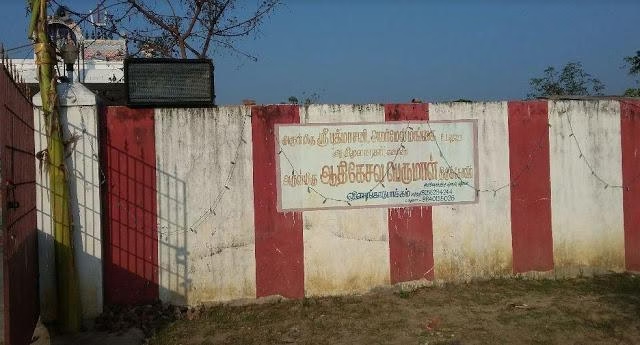
Welcome to the sacred grounds of the Adhi Kesava Perumal Temple, nestled in the quiet village of Vilangadupakkam in Thiruvallur district. As we journey through 2026, this ancient shrine continues to draw devotees seeking the blessings of Lord Vishnu in his form as the Primeval Lord (Adhi Kesava). This comprehensive guide is engineered for the modern pilgrim, blending spiritual wisdom with practical logistics.
| Date built: | – |
|---|---|
| Deity: | Adhi Kesava |
| Architectural style: | Dravidian architecture |
| Major festivals | – |
| Locale: | Vilangadupakkam |
| District:: | Thiruvallur |
| Address: | – |
| Phone | – |
1. Introduction & Spiritual Essence
The Adhi Kesava Perumal Temple is a revered Divya Desam (holy abode of Vishnu) located in Vilangadupakkam, Thiruvallur. The presiding deity is Adhi Kesava Perumal (the Primeval Lord Vishnu), and the consort is Senkomani Thayar.
The Divine Form
In this sanctum, the Lord is enshrined as a Swayambhu (self-manifested) idol. He is depicted in a seated posture, radiating grace and cosmic authority. The term “Adhi Kesava” signifies Lord Vishnu as the primordial cause of the universe, the beginning of all beginnings.
Phalaśruti: The Benefits of Darshan
According to temple lore and local devotion, a visit to this temple offers profound spiritual benefits:
- Ancestral Liberation: It is believed that performing rituals here helps cleanse ancestral karma, offering peace to departed souls (Pitru Tarpanam).
- Removal of Obstacles: Devotees facing prolonged delays in marriage or career milestones pray here for the removal of planetary blocks.
- Mental Peace: The serene atmosphere of Vilangadupakkam aids in meditation and mental clarity.
2. Historical Origins & Scriptural Legend
Builders and Timeline
While specific inscriptions regarding the exact date of construction are under archaeological study, the temple architecture suggests origins during the Later Chola or Vijayanagara period. The Dravidian style indicates significant renovations during the Nayak era, a time when many temples in Tamil Nadu received their current gopurams and mandapas.
The Sthala Purana: The Legend of the Name
Tradition holds that this village was once a dense forest of Vilangu (deodar trees), which eventually gave the village its name: Vilangadupakkam. The legend speaks of a celestial event where Lord Vishnu appeared here to bless the sage Pundarika (or local sages depending on the oral tradition) who performed intense penance to witness the Primeval form of the Lord. This manifestation is why the Lord is revered as the “Adhi” (first/primeval) Kesava.
3. Architectural Marvels
Dravidian Style and Vastu
The temple follows the classical Dravidian style of architecture. The layout is oriented according to Vastu Shastra principles, ensuring the flow of energy from the Rajagopuram (main tower) to the sanctum sanctorum (Garbhagriha).
Key Features
- The Shikhara: The roof over the sanctum displays intricate stonework, typical of the Vijayanagara style.
- Mandapas: The temple features a sturdy Maha Mandapa and a front porch. The pillars are carved with figures of deities and dwarapalas (guardians).
- Inner Prakaram: The inner courtyard houses the shrines for Senkomani Thayar, Yoga Narasimhar, and the main deity.
4. Darshan & Ritual Logistics (2026 Season)
To enhance your spiritual journey, we have compiled the latest timings and seva schedules for 2026.
Daily Temple Timings
| Session | Timing | Status |
|---|---|---|
| Morning Darshan | 07:00 AM – 11:00 AM | Open |
| Mid-Day Closure | 11:00 AM – 05:00 PM | Closed |
| Evening Darshan | 05:30 PM – 08:00 PM | Open |
Key Sevas & Online Booking
- Thirumanjanam (Abhishekam): Performed daily at 9:00 AM. Devotees can sponsor this ritual for health and prosperity.
- Archana: Available throughout darshan hours.
- Online Booking: While specific online portals for this village temple may be managed by the local temple trust, general seva bookings for Tamil Nadu temples can be explored via the official Tamil Nadu Tourism Department portal.
Major 2026 Festivals
- Vaikuntha Ekadashi (January 2026): A grand celebration marking the opening of the heavenly gates.
- Brahmotsavam (May/June 2026): The annual temple chariot festival (Rathotsavam). The deity is taken in a procession around the village.
- Garuda Sevai (June 2026): The Lord mounts the Garuda Vahana.
5. Practical Visitor Guidance
To ensure a hassle-free visit, please adhere to the following guidelines:
- Dress Code: Traditional attire is mandatory. Men should wear dhotis or trousers with shirts; women should wear sarees or salwar kameez. Avoid shorts and sleeveless tops.
- Photography: Photography is strictly prohibited inside the sanctum sanctorum. It may be allowed in the outer prakaram, but please seek permission from the temple staff.
- Mobile Lockers: As this is a village temple, advanced electronic lockers may not be available. It is advisable to carry minimal belongings.
- Accessibility: The temple is accessible for senior citizens up to the vehicle parking area, which is approximately 200 meters from the entrance.
Crowd Management & Seasonal Advice
- Best Hours: For a serene darshan, visit between 7:00 AM and 8:00 AM, or 6:00 PM to 7:00 PM.
- Summer (April – June): Thiruvallur district experiences high temperatures. Carry a water bottle and an umbrella.
- Monsoon (October – December): Roads in Vilangadupakkam can be slippery; wear comfortable, non-slip footwear.
6. Pilgrimage Connectivity
How to Reach Adhi Kesava Perumal Temple
The temple is strategically located near Red Hills, making it accessible from Chennai.
- By Road: Located on the Vilangadupakkam village route. Key access points include Redhills (2.5 km) and the Chennai-Tirupati Highway (NH71). Town bus routes 56K and 38G connect the village to major hubs like Red Hills and Broadway.
- By Rail: The nearest railway station is Chennai Central (approx. 19 km). Minjur Railway Station is about 13 km away.
- By Air: Chennai International Airport is approximately 31 km away.
Nearby Sacred Sites (Pilgrimage Circuit)
Enhance your trip by visiting these nearby holy sites:
- Kapaleeshwarar Temple (Mylapore): One of the most famous Shiva temples in Tamil Nadu, approximately 20 km away.
- Parthasarathy Temple (Triplicane): A historic Krishna temple, part of the 108 Divya Desams, located about 18 km away.
- Sholinghur Narasimhar Temple: For trekking devotees seeking the blessings of Lord Narasimha (approx. 50 km).
7. Frequently Asked Questions (FAQ)
1. Is there a VIP Darshan entry available at the temple?
Since this is a village temple, there is no formal VIP entry system like in Tirupati. However, timings are strictly followed, and during non-peak hours, the queue moves quickly.
2. Are there accommodation facilities in Vilangadupakkam?
Vilangadupakkam is a small village. For comfortable stay options, hotels and guest houses are available in Red Hills (approx. 2.5 km) or Chennai (approx. 15 km).
3. Can I perform Pitru Tarpanam (ancestral rites) here?
Yes, the temple is associated with ancestral blessings. It is recommended to consult the temple priest (Gurukkal) upon arrival to perform specific rituals on auspicious days like Amavasya or Mahalaya.
4. What is the contact number for the temple?
As of current records, the contact number is not widely listed for public inquiries. It is advisable to contact the Executive Officer, HR & CE Department, Tamil Nadu Government, or visit in person.
5. Is the temple wheelchair accessible?
The interior is relatively compact. While the approach roads are motorable, wheelchair access inside the sanctum might be difficult due to traditional architectural steps.
Recent Posts

Shri Kaamkoteeshwar Mandir, Varanasi – History & Significance
In the heart of Kashi, the eternal city of Lord Shiva, where the Ganges flows with celestial grace, stands the Shri Kaamkoteeshwar Mandir. This sacred Sannidhi is not merely a temple but a profound spiritual bridge between the Northern…

ओ सांवरे तूने ही मुझको संभाला – Lyrics & Meaning
ओ सांवरे तूने ही मुझको संभाला – A Prayer to Shyam Origin & Spiritual Essence Why This Bhajan Resonates Devotees chant this when overwhelmed by life’s storms—the refrain ‘तूने ही मुझको संभाला’ is the soul’s sigh of relief: “You…

कथा ये है महाराज मेरे की – Lyrics & Meaning
कथा ये है महाराज मेरे की छत्रपति संभाजी महाराज – A Prayer to Chhatrapati Sambhaji Maharaj Origin & Spiritual Essence Why This Bhajan Resonates Devotees chant this when their spirit feels tested—its powerful refrain “महाराज मेरे” is a soul’s…

Rigveda Samhita Yathartha Anuvada (ऋग्वेद संहिता यथार्थ अनुवाद) – Complete Set with Anvayartha & Hindi/English Translation
The Rigveda is the oldest surviving scripture of humanity and the foundational text of Sanātana Dharma. For serious students, scholars, UPSC aspirants studying ancient Indian history, Sanskrit learners, and spiritual seekers, a precise and grammatically structured translation is indispensable.…

आना भी अकेला है जाना भी अकेला है – Lyrics & Meaning | BharatTemples
आना भी अकेला है जाना भी अकेला है – A Prayer to the Divine Witness Origin & Spiritual Essence Why This Bhajan Resonates Devotees turn to this bhajan in moments of deep reflection—when life’s attachments begin to ache. The…

माता शेरावाली के द्वार जो भी जाता है – Lyrics & Meaning
माता शेरावाली के द्वार जो भी जाता है – A Prayer to Maa Sherawali Origin & Spiritual Essence Why This Bhajan Resonates Devotees turn to this bhajan in times of fear or uncertainty—its promise that no one leaves Maa’s…

मार लेना सपणी उबार लेणा भवरा – Lyrics & Meaning
मार लेना सपणी उबार लेणा भवरा – A Prayer to the Divine Beloved Origin & Spiritual Essence Why This Bhajan Resonates Devotees chant this in moments of deep vulnerability—its cry of “मार लेना सपणी, उबार लेणा भवरा” is the…

हमें श्याम सुंदर भरोसा तुम्हारा – Lyrics & Meaning
हमें श्याम सुंदर भरोसा तुम्हारा – A Prayer to Shyam Sundar Origin & Spiritual Essence Why This Bhajan Resonates Devotees chant this when feeling alone—its refrain ‘de do sahara’ is the soul’s cry for divine support. Lyrics in Hindi…

Mere Satguru Ne Di Thi Davai Lyrics in Hindi & Meaning
Mere Satguru Ne Di Thi Davai: Invoking the Guru’s Liberating Wisdom This soul-stirring bhajan venerates the Satguru (True Spiritual Master) as the divine physician who dispenses the only remedy for life’s deepest sufferings. Composed by Sant Karmaveer Tufani, it…

Janm Diyo Thari Maa Dukh Dekhiyo Lyrics in Hindi & Meaning
जन्म दियो थारी माँ दुख देखियो (Maa’s Grief Upon Birthing You) This soul-stirring Chetavani Bhajan (admonitory hymn) is addressed to the Divine Mother (Maa) – a call for repentance when children forget their filial duties in the dark age…