
Contents
- 1 Sarveshwara Dhyana Nilayam: The Definitive Pilgrimage Guide (2026)
Sarveshwara Dhyana Nilayam: The Definitive Pilgrimage Guide (2026)
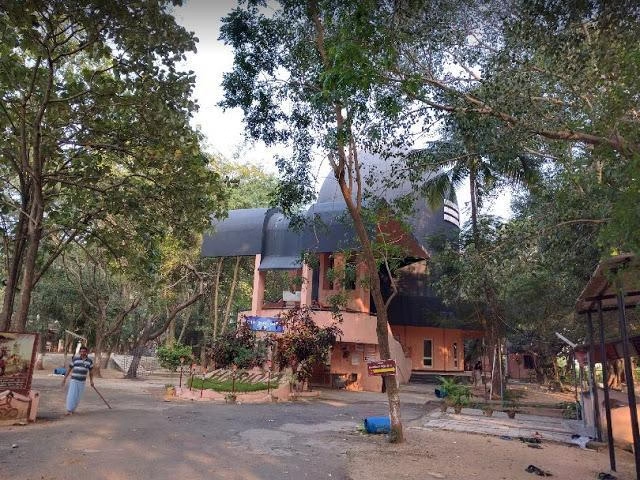
Amidst the spiritual vibrations of Thamaraipakkam stands a monolithic marvel—the Sarveshwara Dhyana Nilayam. Unlike traditional Dravidian temples with towering gopurams, this unique sanctuary is architectural devotion incarnate, shaped entirely as a massive Shiva Linga. For the modern devotee seeking both Bhakti (devotion) and inner peace, this temple, established by the Chinmaya Mission, offers a profound spiritual retreat. This 2026 guide is engineered to assist pilgrims in navigating the sacred precincts, understanding the scriptural significance of Lord Sarveshwara, and experiencing the serenity of this architectural wonder.
1. Introduction & Spiritual Essence
The primary deity of this temple is Sarveshwara, a form of Lord Shiva signifying “The Lord of All.” This temple is distinctively a Swayambhu (self-manifested) representation, not carved from stone but cast and constructed to emulate the form of the eternal Lingam.
Phalaśruti: Why Devotees Visit
Devotees flock to Sarveshwara Dhyana Nilayam for specific spiritual benefits:
- Meditation & Focus: As a dedicated Dhyana Nilayam (Abode of Meditation), the sanctum is designed to enhance concentration and inner stillness.
- Cleansing Ancestral Karma: Offering prayers here is believed to mitigate Pitru Dosha (ancestral imbalances), bringing peace to lineage.
- Relief from Rahu-Ketu: The Spatika Lingam (Crystal Lingam) present here is highly potent for nullifying malefic planetary effects.
Visitors often report a tangible vibration—a “spiritual shock”—during the Abhishekam, attributed to the energy accumulation from the 1989 Kumbabhishekam.
2. Historical Origins & Scriptural Legend
The history of Sarveshwara Dhyana Nilayam is deeply intertwined with the Chinmaya Mission and the vision of Poojya Gurudev Swami Chinmayananda.
Establishment:
Tradition holds that on June 27, 1984, two noble devotees from Chennai donated eight acres of land at Thamaraipakkam for spiritual purposes. Gurudev Swami Chinmayananda meticulously planned the blueprints, envisioning a unique structure that defied conventional temple architecture.
Construction & Consecration:
The foundation was laid on September 29, 1987, with construction executed by M/s ECC of Larsen & Toubro Limited. The Maha Kumbabhishekam (Grand Consecration) took place on October 15, 1989, at 10:30 AM. This event is pivotal in the temple’s oral history, marking the installation of a rare Spatika Lingam (Crystal Lingam) with a diamond-studded crest.
Scriptural Connection:
While the temple does not date back to medieval antiquity, it adheres to the Sthala Purana tradition by serving as a modern Punya Bhoomi (Sacred Land) for the dissemination of Vedanta. The site houses the Anant Medical Centre and Pithamaha Sadan, linking physical service (Seva) with spiritual liberation (Moksha).
3. Architectural Marvels
The temple represents a fusion of Dravidian principles and modern engineering. It is a standout example of non-traditional temple architecture recognized for its imposing scale.
The Monolithic Dome:
The defining feature is the 65-foot high Shiva Linga-shaped dome. Unlike carved stone temples, this is a structural concrete shell designed to resemble a stylized Lingam. The exterior is smooth and curvilinear, symbolizing the formless Brahman taking form.
Vastu Elements:
The complex is aligned with Vastu Shastra principles, oriented to facilitate the flow of positive energy. The ground floor features a spacious, circular Satsang Hall, promoting community gathering, while the upper floor houses the Dhyana Nilayam (Meditation Hall).
Notable Shrines:
- The Spatika Lingam: A precious crystal Lingam that absorbs and radiates energy. The use of holy waters from eight famous rivers during the consecration enhances its sanctity.
- Hari Hara School: Integrated into the complex, symbolizing the balance between education (Hari/Vishnu) and spirituality (Hara/Shiva).
Note: While not a UNESCO site, the architectural uniqueness is a subject of study for modern heritage enthusiasts.
4. Darshan & Ritual Logistics (2026 Update)
The temple operates on a strict schedule conducive to both daily worshippers and meditation seekers. Assuming the current year is 2026, the following timings and festivals apply.
Daily Timings
| Session | Timing |
|---|---|
| Morning | 06:30 AM – 12:00 PM |
| Afternoon Break | 12:00 PM – 04:00 PM (Temple Closed) |
| Evening | 04:00 PM – 08:00 PM |
Key Sevas & Booking
- Abhishekam: Performed during morning hours. The Spatika Lingam Abhishekam is highly sought after.
- Archana: Can be performed by the resident priest. Devotees may request specific Suktas for health or prosperity.
- Online Seva Booking: As of 2026, devotees can book general darshan and specific Sevas via the Chinmaya Mission Tamil Nadu portal or the temple’s official Facebook page (linked from bharattemples.com).
2026 Major Festival Dates
Plan your visit around these auspicious days:
- Maha Shivaratri: February 26, 2026 (Extended night darshan until 2 AM).
- Pradosham: 13th and 28th of every month (Special Abhishekam at twilight).
- Deepavali: October 21, 2026 (Special Sahasranama Archana).
- Pongal: January 14, 2026 (Community offering to Lord Sarveshwara).
5. Practical Visitor Guidance
To ensure a serene experience for all, adherence to the following guidelines is mandatory:
Dress Code: Traditional attire is recommended. Men should wear dhotis or trousers with shirts; women should wear sarees, salwar kameez, or modest western wear. Avoid shorts and sleeveless tops.
Photography: Photography is strictly prohibited inside the sanctum sanctorum and the meditation hall to maintain the sanctity and vibration of the space. Exterior photography is permitted.
Electronic Devices: Mobile phones must be silenced. Lockers are available near the entrance for bags and electronic devices.
Crowd Management:
- Best Hours: Early mornings (6:30 AM – 8:00 AM) on weekdays offer the most peaceful Darshan.
- Weekend Peak: Saturdays and Sundays see higher footfall due to visitors from Chennai.
- Seasonal Advice: In May and June, carry a water bottle, as Tamil Nadu summers can be intense. The meditation hall is air-conditioned.
6. Pilgrimage Connectivity
Thamaraipakkam is a growing spiritual hub, easily accessible from Chennai and its suburbs.
How to Reach
- By Road: Located on the main highway connecting Red Hills to Periyapalayam via Thamaraipakkam. The temple is 100 meters from the Thamaraipakkam Sivan Koil Bus Stop.
NH/Route: Accessible via NH 116 (Red Hills – Kaveripattinam Road). - By Rail: The nearest railway station is Thiruninravur Railway Station (approx. 13 km). Share autos and taxis are readily available from the station.
- By Air: Chennai International Airport (MAA) is approximately 43 km away (approx. 1-hour drive via Outer Ring Road).
Nearby Sacred Sites (Circuit)
Expand your pilgrimage by visiting these nearby temples:
- Thiruporur Murugan Temple: A historic temple dedicated to Lord Murugan, located roughly 25 km away.
- Periyapalayam Mariamman Temple: Famous for its intense energy and animal sacrifice rituals (optional viewing), about 8 km away.
- Sri Venkateswara Temple (Red Hills): A popular Tirupati Balaji replica, roughly 19 km from Thamaraipakkam.
7. Frequently Asked Questions (FAQs)
Is there a VIP darshan entry available?
Unlike some major temples, Sarveshwara Dhyana Nilayam does not have a rigid VIP ticket system. However, devotees who book special Sevas (like Abhishekam) in advance are accorded priority entry during the ritual time. Senior citizens and differently-abled visitors are assisted by volunteers.
Can I meditate for long hours inside the temple?
Yes, the temple is specifically designed for meditation. The upper floor houses a spacious meditation hall where devotees can sit silently for extended periods, provided they do not disturb others.
Is outside food allowed?
Outside food is generally not permitted inside the sanctum. However, the temple premises include the Anant Medical Centre canteen, which serves simple, sattvic vegetarian meals (Annadhanam) to devotees, usually during lunch hours.
Is the temple wheelchair accessible?
While the architecture includes stairs leading to the upper shrine, the ground floor Satsang hall and the shrine entrance are accessible. Wheelchair ramps are available for ground-level access. Please contact the administration (+91 44 2762 6745) for specific assistance to the upper level.
What is the best time to visit for the Spatika Lingam Abhishekam?
The Spatika Lingam is usually worshipped during the morning session (07:30 AM – 09:00 AM). It is advisable to call the temple office a day in advance to confirm the specific timing for the crystal Lingam Abhishekam, as it may vary based on the priest’s schedule.
Recent Posts

Shri Kaamkoteeshwar Mandir, Varanasi – History & Significance
In the heart of Kashi, the eternal city of Lord Shiva, where the Ganges flows with celestial grace, stands the Shri Kaamkoteeshwar Mandir. This sacred Sannidhi is not merely a temple but a profound spiritual bridge between the Northern…

ओ सांवरे तूने ही मुझको संभाला – Lyrics & Meaning
ओ सांवरे तूने ही मुझको संभाला – A Prayer to Shyam Origin & Spiritual Essence Why This Bhajan Resonates Devotees chant this when overwhelmed by life’s storms—the refrain ‘तूने ही मुझको संभाला’ is the soul’s sigh of relief: “You…

कथा ये है महाराज मेरे की – Lyrics & Meaning
कथा ये है महाराज मेरे की छत्रपति संभाजी महाराज – A Prayer to Chhatrapati Sambhaji Maharaj Origin & Spiritual Essence Why This Bhajan Resonates Devotees chant this when their spirit feels tested—its powerful refrain “महाराज मेरे” is a soul’s…

Rigveda Samhita Yathartha Anuvada (ऋग्वेद संहिता यथार्थ अनुवाद) – Complete Set with Anvayartha & Hindi/English Translation
The Rigveda is the oldest surviving scripture of humanity and the foundational text of Sanātana Dharma. For serious students, scholars, UPSC aspirants studying ancient Indian history, Sanskrit learners, and spiritual seekers, a precise and grammatically structured translation is indispensable.…

आना भी अकेला है जाना भी अकेला है – Lyrics & Meaning | BharatTemples
आना भी अकेला है जाना भी अकेला है – A Prayer to the Divine Witness Origin & Spiritual Essence Why This Bhajan Resonates Devotees turn to this bhajan in moments of deep reflection—when life’s attachments begin to ache. The…

माता शेरावाली के द्वार जो भी जाता है – Lyrics & Meaning
माता शेरावाली के द्वार जो भी जाता है – A Prayer to Maa Sherawali Origin & Spiritual Essence Why This Bhajan Resonates Devotees turn to this bhajan in times of fear or uncertainty—its promise that no one leaves Maa’s…

मार लेना सपणी उबार लेणा भवरा – Lyrics & Meaning
मार लेना सपणी उबार लेणा भवरा – A Prayer to the Divine Beloved Origin & Spiritual Essence Why This Bhajan Resonates Devotees chant this in moments of deep vulnerability—its cry of “मार लेना सपणी, उबार लेणा भवरा” is the…

हमें श्याम सुंदर भरोसा तुम्हारा – Lyrics & Meaning
हमें श्याम सुंदर भरोसा तुम्हारा – A Prayer to Shyam Sundar Origin & Spiritual Essence Why This Bhajan Resonates Devotees chant this when feeling alone—its refrain ‘de do sahara’ is the soul’s cry for divine support. Lyrics in Hindi…

Mere Satguru Ne Di Thi Davai Lyrics in Hindi & Meaning
Mere Satguru Ne Di Thi Davai: Invoking the Guru’s Liberating Wisdom This soul-stirring bhajan venerates the Satguru (True Spiritual Master) as the divine physician who dispenses the only remedy for life’s deepest sufferings. Composed by Sant Karmaveer Tufani, it…

Janm Diyo Thari Maa Dukh Dekhiyo Lyrics in Hindi & Meaning
जन्म दियो थारी माँ दुख देखियो (Maa’s Grief Upon Birthing You) This soul-stirring Chetavani Bhajan (admonitory hymn) is addressed to the Divine Mother (Maa) – a call for repentance when children forget their filial duties in the dark age…