
Contents
Introduction & Spiritual Essence
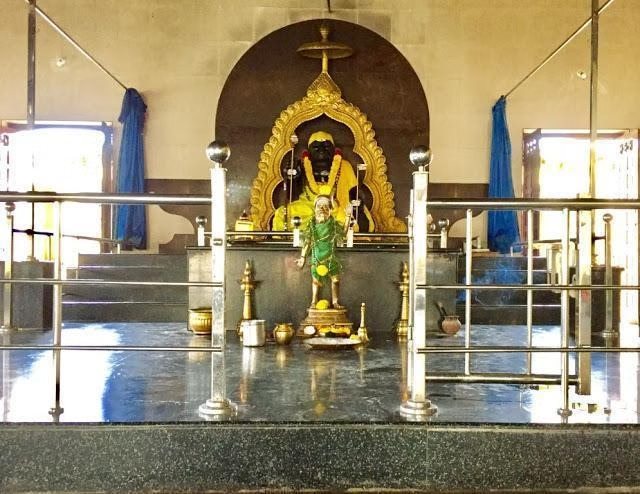
The Kallukatti Siddhar Jeeva Samadhi in Nerkundram, Thiruvallur, stands as a profound testament to the life and enlightenment of a great Tamil Siddhar. Unlike conventional temples built for worship of deities, this site is a Jeeva Samadhi—the final resting place of a realized soul who is believed to have attained physical immortality through yogic powers. The primary deity here is Kallukatti Siddhar, a revered figure in the Siddha tradition of Tamil Nadu.
Alternate names for this spiritual abode include Kallukatti Ayya Samadhi and Nerkundram Siddhar Samadhi. The form of worship is focused on the tomb (Samadhi), often adorned with a Shivalingam or the idol of the Siddhar, representing the union of the individual soul with the universal consciousness.
Phalaśruti: Why Devotees Visit
Devotees flock to this holy site seeking blessings for physical and mental well-being. The Siddhas were masters of medicine and spirituality. It is believed that worshipping at this Samadhi:
- Cleanses Ancestral Karma: Performing rituals here is said to alleviate doshas and bring peace to departed souls.
- Grants Healing: As Siddhas were physicians, the site is potent for those seeking recovery from prolonged illnesses.
- Bestows Spiritual Wisdom: Meditating here aids in inner purification and the acquisition of higher knowledge.
Historical Origins & Scriptural Legend
While specific dynastic records regarding the construction are sparse—a common trait for sites associated with wandering yogis—tradition holds that the Samadhi dates back several centuries, likely during the era of the Vijayanagara influence or the Nayak period, which saw significant patronage of local spiritual sites in Tamil Nadu.
The legend surrounding Kallukatti Siddhar is rooted in oral folklore. The name “Kallu” (stone) and “Katti” (cut/sword) suggests a connection to a sage who possessed the alchemical power to transmute substances or one who meditated upon hard granite stones, symbolizing steadfastness. Local lore suggests he was a wandering healer who settled in Nerkundram to engage in deep tapas (penance) and eventually chose this spot for his Jeeva Samadhi, entering a state of eternal meditation within the earth.
According to temple records and local caretakers, the Samadhi was discovered and later consecrated with a Shiva Lingam by subsequent devotees who felt the powerful vibrations of the site.
Architectural Marvels
The architecture of the Kallukatti Siddhar Samadhi reflects the traditional Dravidian style, seamlessly blending simplicity with sacred geometry. While it may not possess the towering gopurams of major temples, its structural significance lies in its Vastu alignment and the spiritual energy of the sanctum.
Key Architectural Elements:
- The Samadhi Sanctum: The central shrine houses the Samadhi of Kallukatti Siddhar. It is typically a raised platform or a covered tomb, representing the earth element stability.
- Shivalingam: A significant feature is the installation of a Shivalingam atop or adjacent to the Samadhi, symbolizing the formless aspect of the divine (Nirakar) that the Siddha merged with.
- Mandapas: The complex includes pillared halls (Mandapas) for devotees to sit and meditate, featuring carved pillars depicting various yogic postures and symbols.
- Vastu Shastra: The temple is believed to be built according to Vastu principles, with the sanctum sanctorum placed strategically to harness the telluric energies of the location.
The use of local granite and the earthy tones of the structure reflect the ascetic nature of the Siddha tradition, avoiding excessive ornamentation in favor of spiritual potency.
Darshan & Ritual Logistics
Visitors to the Kallukatti Siddhar Samadhi can participate in various rituals and Sevas. The atmosphere is generally meditative, allowing for personal prayer and reflection.
Daily Timings
The timings provided are based on standard temple schedules and local guidelines. As is common with Samadhi shrines, timings may vary slightly based on seasonal festivals or local priest availability.
| Session | Time | Activity |
|---|---|---|
| Morning | 06:00 AM – 12:00 PM | Opening, Cleaning, Pooja |
| Evening | 04:00 PM – 07:00 PM | Closing Aarti, Abhishekam |
Key Sevas & Online Booking
While specific online portals for this local shrine may not be extensive, the following Sevas are traditionally performed:
- Abhishekam: Bathing the Shivalingam with milk, honey, and vibhuthi (sacred ash).
- Archana: Reciting names of the deity or Siddhar strotram.
- Sahastranama Archana: Recitation of 1008 names.
Note: For online booking availability, devotees should check the local administration or inquire directly with the temple trust as some smaller shrines rely on local management rather than centralized portals.
2026 Festival Dates
Key festivals celebrated at Shiva temples and Siddhar shrines in Tamil Nadu for the year 2026:
- Pradosham: Every Monday and Saturday evening.
- Maha Shivaratri: February 26, 2026.
- Navaratri: September 22 – October 1, 2026.
- Kartikai Deepam: November 5, 2026.
Practical Visitor Guidance
To ensure a spiritually fulfilling and hassle-free visit to the Kallukatti Siddhar Samadhi, please adhere to the following guidelines:
- Dress Code: Traditional attire is recommended. Men should wear dhotis or trousers with shirts; women should wear sarees, salwar kameez, or modest dresses. Please cover shoulders and knees.
- Photography Rules: Photography is generally allowed in the outer premises but is strictly prohibited inside the sanctum sanctorum. Please respect the privacy of the shrine.
- Mobile Lockers: Due to the smaller scale of the shrine, large backpacks may not be permitted inside. It is advisable to carry minimal belongings.
- Crowd Management: The Samadhi is a place of peace. Maintain silence in the prayer hall. Peak hours are usually Sunday mornings and festival evenings.
- Seasonal Advice: Tamil Nadu summers (April–June) can be scorching. Carry a water bottle and an umbrella. The post-monsoon season (October–January) offers the most pleasant weather for Darshan.
Pilgrimage Connectivity
Nerkundram is a suburb located in the Thiruvallur district, well-connected to the capital city of Chennai.
How to Reach
- By Air: The nearest airport is Chennai International Airport (MAA), approximately 35 km away.
- By Rail: The closest railway stations are Thiruvallur Railway Station (15 km) or Pattabiram Railway Station (10 km).
- By Road: Nerkundram is accessible via NH 66 (Bangalore Highway). It connects to the Chennai–Bangalore arterial road. Local bus services are frequent from Thiruvallur bus stand.
Nearby Sacred Sites
Extend your pilgrimage circuit to these nearby spiritual centers:
- Veera Raghava Swamy Temple (Thiruvallur): A prominent Divya Desam dedicated to Lord Vishnu, located about 15 km away.
- Kadambathur Thiruvidanthai Temple: A unique temple where Lord Brahma is worshipped alongside Vishnu.
- Ekambareswarar Temple (Kanchipuram): One of the Pancha Bhoota Stalas (representing the Earth element), about 35 km away.
Frequently Asked Questions (FAQ)
1. What is the history of Kallukatti Siddhar Jeeva Samadhi?
The history is rooted in the Tamil Siddha tradition. While exact construction dates are unavailable, it is revered as the resting place of a powerful sage known as Kallukatti Siddhar. The site has been a center for spiritual healing and meditation for centuries, maintaining the Dravidian architectural heritage of the region.
2. What are the darshan timings?
The Samadhi is open daily, typically from 6:00 AM to 12:00 PM and 4:00 PM to 7:00 PM. It is advisable to visit during the morning hours for a quiet, meditative experience.
3. Is there a VIP darshan entry?
No, as a Siddhar Samadhi and local shrine, there is generally no VIP darshan system. All devotees are treated equally, reflecting the egalitarian nature of the Siddha path. However, priority may be given to elderly visitors or those with disabilities upon request.
4. How can I perform an online seva booking?
Currently, specific online booking services for Kallukatti Siddhar Samadhi are not available. Sevas and offerings must be performed in person by contacting the temple priests or the local trust managing the shrine.
5. What is the significance of visiting this Samadhi?
Visiting this site is believed to remove obstacles, heal ailments, and provide mental clarity. The Siddhas are considered guardians of nature and alchemy; their Samadhis are potent spots for manifesting intentions and seeking ancestral blessings.
Legend / Local stories
Local folklore suggests that Kallukatti Siddhar was an expert in herbal formulations and stone-based medicine (hence the name Kallu/Stone). It is said that he used to sit in meditation on a large granite rock near the site. Villagers believed he could cure any disease with his herbal preparations and ash. To this day, devotees apply vibhuthi (sacred ash) from the Samadhi, believing it to carry the healing properties blessed by the Siddhar.
Photo Gallery


How to Reach
Address: Kallukatti Siddhar Jeeva Samadhi, Nerkundram, Thiruvallur District, Tamil Nadu.
Search for “Kallukatti Siddhar Temple” on Google Maps. The location is roughly 4km from the Thiruvallur bus stand towards Nerkundram.
Contact Details
Since this is a local shrine managed by the community, there may not be an official phone number available. For inquiries, it is best to visit the temple office in person or contact the Thiruvallur Temple Trust or local residents in Nerkundram.
Recent Posts

Shri Kaamkoteeshwar Mandir, Varanasi – History & Significance
In the heart of Kashi, the eternal city of Lord Shiva, where the Ganges flows with celestial grace, stands the Shri Kaamkoteeshwar Mandir. This sacred Sannidhi is not merely a temple but a profound spiritual bridge between the Northern…

ओ सांवरे तूने ही मुझको संभाला – Lyrics & Meaning
ओ सांवरे तूने ही मुझको संभाला – A Prayer to Shyam Origin & Spiritual Essence Why This Bhajan Resonates Devotees chant this when overwhelmed by life’s storms—the refrain ‘तूने ही मुझको संभाला’ is the soul’s sigh of relief: “You…

कथा ये है महाराज मेरे की – Lyrics & Meaning
कथा ये है महाराज मेरे की छत्रपति संभाजी महाराज – A Prayer to Chhatrapati Sambhaji Maharaj Origin & Spiritual Essence Why This Bhajan Resonates Devotees chant this when their spirit feels tested—its powerful refrain “महाराज मेरे” is a soul’s…

Rigveda Samhita Yathartha Anuvada (ऋग्वेद संहिता यथार्थ अनुवाद) – Complete Set with Anvayartha & Hindi/English Translation
The Rigveda is the oldest surviving scripture of humanity and the foundational text of Sanātana Dharma. For serious students, scholars, UPSC aspirants studying ancient Indian history, Sanskrit learners, and spiritual seekers, a precise and grammatically structured translation is indispensable.…

आना भी अकेला है जाना भी अकेला है – Lyrics & Meaning | BharatTemples
आना भी अकेला है जाना भी अकेला है – A Prayer to the Divine Witness Origin & Spiritual Essence Why This Bhajan Resonates Devotees turn to this bhajan in moments of deep reflection—when life’s attachments begin to ache. The…

माता शेरावाली के द्वार जो भी जाता है – Lyrics & Meaning
माता शेरावाली के द्वार जो भी जाता है – A Prayer to Maa Sherawali Origin & Spiritual Essence Why This Bhajan Resonates Devotees turn to this bhajan in times of fear or uncertainty—its promise that no one leaves Maa’s…

मार लेना सपणी उबार लेणा भवरा – Lyrics & Meaning
मार लेना सपणी उबार लेणा भवरा – A Prayer to the Divine Beloved Origin & Spiritual Essence Why This Bhajan Resonates Devotees chant this in moments of deep vulnerability—its cry of “मार लेना सपणी, उबार लेणा भवरा” is the…

हमें श्याम सुंदर भरोसा तुम्हारा – Lyrics & Meaning
हमें श्याम सुंदर भरोसा तुम्हारा – A Prayer to Shyam Sundar Origin & Spiritual Essence Why This Bhajan Resonates Devotees chant this when feeling alone—its refrain ‘de do sahara’ is the soul’s cry for divine support. Lyrics in Hindi…

Mere Satguru Ne Di Thi Davai Lyrics in Hindi & Meaning
Mere Satguru Ne Di Thi Davai: Invoking the Guru’s Liberating Wisdom This soul-stirring bhajan venerates the Satguru (True Spiritual Master) as the divine physician who dispenses the only remedy for life’s deepest sufferings. Composed by Sant Karmaveer Tufani, it…

Janm Diyo Thari Maa Dukh Dekhiyo Lyrics in Hindi & Meaning
जन्म दियो थारी माँ दुख देखियो (Maa’s Grief Upon Birthing You) This soul-stirring Chetavani Bhajan (admonitory hymn) is addressed to the Divine Mother (Maa) – a call for repentance when children forget their filial duties in the dark age…