
Contents
- 1 Definitive Pilgrimage Guide: Punya Koteeswarar Temple, Punnappakkam
Definitive Pilgrimage Guide: Punya Koteeswarar Temple, Punnappakkam
By Bharat Temples Editorial Team | Last Updated: January 2026
In the serene landscape of Punnappakkam, Thiruvallur District, stands a sanctuary of profound spiritual energy—the Punya Koteeswarar Temple. This ancient temple, dedicated to Lord Shiva, serves as a beacon for devotees seeking ancestral peace and divine grace.
Introduction & Spiritual Essence
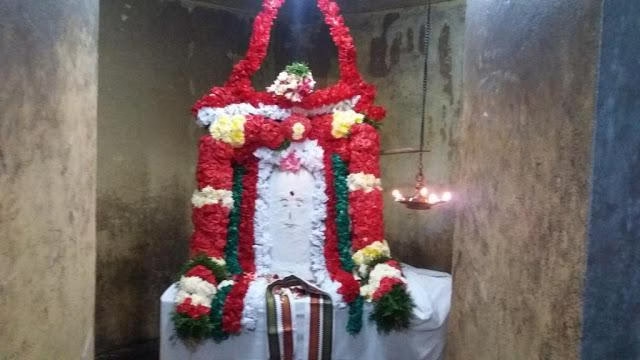
The Punya Koteeswarar Temple is a classic example of a rural temple holding immense mythological weight. The presiding deity, Punya Koteeswarar (a manifestation of Lord Shiva), is the family deity for the surrounding communities.
- Primary Deity: Punya Koteeswarar (Shiva)
- Consort: Goddess Punithavalli Amman (also revered as Balambigai).
- Distinctive Feature: A unique shrine for Adhi Kesava Perumal (Vishnu) with Sridevi and Boodevi, making it a rare Vishnu-Shiva coexistence.
Phalaśruti: Why Visit?
According to temple records and local devotee testimony, visiting this temple offers specific spiritual benefits:
- Cleansing Ancestral Karma: Rituals performed here are believed to remove Pitru Dosha (ancestral afflictions), granting peace to departed souls.
- Removal of Obstacles: Lord Punya Koteeswarar is revered as a granter of success in legal matters and educational pursuits.
- Divine Mother’s Grace: Goddess Punithavalli is known to bestow fertility blessings and family harmony upon child-seeking couples.
Historical Origins & Scriptural Legend
While specific excavation dates are not widely publicized in modern surveys, the architectural style suggests a construction period during the late Chola or early Vijayanagara era (approx. 14th-16th century).
The Sthala Purana
Tradition holds that the temple was established on land blessed by a holy sage (Rishi) who performed intense penance at this location. The name “Punya” indicates the site’s inherent merit as a Punya Kshetra (holy field). Local legend narrates that Lord Vishnu (Adhi Kesava Perumal) and Lord Shiva (Punya Koteeswarar) once exchanged glances here, blessing the land with unity of purpose.
Renovations
The temple has undergone several renovations, primarily funded by local villagers and agricultural families. The Thiruvallur District administration has recently aided in restoring the temple tank (Teppakulam) for the 2026 festival season.
Architectural Marvels
The temple features the traditional Dravidian Architectural Style. Despite its compact size, it encapsulates the essential elements of Agamic temple design.
- Vastu Shastra: The temple is oriented to the east, with the Garbhagriha (sanctum sanctorum) positioned to capture the first rays of the rising sun.
- Shikhara (Vimana): The tower above the sanctum is a modest yet ornate Ashtanga Vimana (eight-part tiered structure), typical of the Vijayanagara influence.
- Mandapas: A pillared Ardha Mandapa (half-hall) connects the sanctum to the Maha Mandapa, which houses several stone inscriptions in Tamil.
- Sculptures: The outer walls feature intricate carvings of deities, dwarapalakas (guardians), and floral motifs.
While it is not a UNESCO site, it is a protected monument under the Archaeological Survey of India (ASI) and the Hindu Religious and Charitable Endowments (HR&CE) Department of Tamil Nadu.
Darshan & Ritual Logistics (2026 Update)
For a peaceful experience, we recommend planning your visit around the daily rituals. Please verify timings before travel, especially during festival seasons.
Daily Timings
| Session | Start Time | End Time |
|---|---|---|
| Morning Darshan | 06:00 AM | 11:00 AM |
| Midday Closure | 11:00 AM | 04:30 PM |
| Evening Darshan | 04:30 PM | 08:30 PM |
Key Sevas & Online Booking
The temple management has digitized several services. Devotees can perform the following Sevas:
- Abhishekam: Ritual bathing of the deity. Best performed on Mondays.
- Archana: Individual prayers (Sankalpam) offered daily.
- Deepa Aradhana: Lamp offering for spiritual enlightenment.
How to Book: Visit the official Tamil Nadu HR&CE Online Portal or use the “Sri Karumariamman Temple Online Seva” app (often used for smaller associate temples in the district). Select “Punya Koteeswarar Temple, Punnappakkam.” Booking opens 7 days in advance.
2026 Major Festival Dates
- Pradosham: Monthly event. Notable dates: Jan 11, Jan 25, Feb 9, Mar 9, Apr 7, May 7, Jun 6, Jul 5, Aug 4, Sep 3, Oct 3, Nov 2, Dec 2.
- Maha Shivaratri: February 26, 2026. Special Note: The temple will remain open 24 hours on this day.
- Aadi Perukku: July/August 2026 (Date determined by Tamil Calendar).
- Arudra Darshan: December 2026 (Exact date TBD).
Practical Visitor Guidance
To ensure a smooth darshan, adhere to the following guidelines:
- Dress Code: Traditional attire is mandatory. Men should wear Dhoti or formal trousers with a shirt; women should wear Saree or Salwar Kameez. Avoid shorts and sleeveless tops.
- Photography: Strictly prohibited inside the sanctum sanctorum. Photography is allowed in the outer quadrangles, provided it does not disturb rituals.
- Mobile Lockers: A shoe-keeping facility is available near the entrance. There are no secure digital lockers for phones; please leave valuables in your vehicle.
- Accessibility: The temple has a few steps at the entrance. A temporary wooden ramp is available for wheelchair access upon request from the temple caretaker.
Crowd Management & Seasonal Advice
Best Hours: 8:00 AM to 9:30 AM or after 6:00 PM to avoid the village morning rush.
Seasonal Tip: In May (peak summer), the granite floors retain heat. Carry a small bottle of water and wear slip-resistant footwear.
Pilgrimage Connectivity
How to Reach
Punnappakkam is easily accessible from Chennai via the Chennai-Bangalore Highway.
- Nearest Airport: Chennai International Airport (MAA) – 49 km (approx. 1 hr 15 mins).
- Nearest Railway Station: Thiruninravur Railway Station – 15 km. Autos are readily available.
- By Road: From Chennai Central, take NH 150 (Chennai-Bangalore Highway). Take the exit toward Thamaraipakkam/Vengal. The temple is 2 km from the Pagalmedu bus stop.
Nearby Sacred Sites (Pilgrimage Circuit)
Extend your spiritual journey by visiting these nearby temples:
- Chengamal Swami Temple (Thamaraipakkam): Located 4 km away, known for its ancient Vishnu idol.
- Sri Sadasiva Brahmendra Temple (Vengal): 4 km away, a rare shrine dedicated to the sage Brahmendra.
- Ekambaranathar Temple (Kanchipuram): Located 45 km south, one of the Pancha Bhoota Stalas (Earth element).
Frequently Asked Questions (FAQ)
1. Is there a VIP Darshan entry?
No. Being a local heritage temple, VIP ticketing is not strictly enforced. However, priority is given to elderly devotees and those booking Sevas (Abhishekam/Archana). Present your receipt at the queue entrance.
2. What is the contact number for urgent queries?
For immediate assistance regarding timings or rituals, you can contact the temple caretaker at +91 90422 88735. Please note that response times may vary during non-peak hours.
3. Are there accommodation facilities near the temple?
Punnappakkam is a small village; there are no luxury hotels on-site. For comfortable stay options, devotees usually travel to Thiruvallur (22 km away) or Chennai (38 km away), where multiple lodges are available.
4. Is outside food allowed inside the temple?
Outside food is not permitted inside the sanctum. However, a small community Prasadam stall operates near the entrance during morning and evening hours, offering Pongal and Puliyodarai.
5. What is the significance of the Adhi Kesava Perumal shrine?
The presence of Lord Vishnu (Adhi Kesava Perumal) within a Shiva temple highlights the unity of Shiva and Vishnu (Hariharamurti concept) and the syncretic nature of Tamil village deities. Devotees visit this shrine for relief from Saturn-related afflictions.
Photo Gallery
Recent Posts

Shri Kaamkoteeshwar Mandir, Varanasi – History & Significance
In the heart of Kashi, the eternal city of Lord Shiva, where the Ganges flows with celestial grace, stands the Shri Kaamkoteeshwar Mandir. This sacred Sannidhi is not merely a temple but a profound spiritual bridge between the Northern…

ओ सांवरे तूने ही मुझको संभाला – Lyrics & Meaning
ओ सांवरे तूने ही मुझको संभाला – A Prayer to Shyam Origin & Spiritual Essence Why This Bhajan Resonates Devotees chant this when overwhelmed by life’s storms—the refrain ‘तूने ही मुझको संभाला’ is the soul’s sigh of relief: “You…

कथा ये है महाराज मेरे की – Lyrics & Meaning
कथा ये है महाराज मेरे की छत्रपति संभाजी महाराज – A Prayer to Chhatrapati Sambhaji Maharaj Origin & Spiritual Essence Why This Bhajan Resonates Devotees chant this when their spirit feels tested—its powerful refrain “महाराज मेरे” is a soul’s…

Rigveda Samhita Yathartha Anuvada (ऋग्वेद संहिता यथार्थ अनुवाद) – Complete Set with Anvayartha & Hindi/English Translation
The Rigveda is the oldest surviving scripture of humanity and the foundational text of Sanātana Dharma. For serious students, scholars, UPSC aspirants studying ancient Indian history, Sanskrit learners, and spiritual seekers, a precise and grammatically structured translation is indispensable.…

आना भी अकेला है जाना भी अकेला है – Lyrics & Meaning | BharatTemples
आना भी अकेला है जाना भी अकेला है – A Prayer to the Divine Witness Origin & Spiritual Essence Why This Bhajan Resonates Devotees turn to this bhajan in moments of deep reflection—when life’s attachments begin to ache. The…

माता शेरावाली के द्वार जो भी जाता है – Lyrics & Meaning
माता शेरावाली के द्वार जो भी जाता है – A Prayer to Maa Sherawali Origin & Spiritual Essence Why This Bhajan Resonates Devotees turn to this bhajan in times of fear or uncertainty—its promise that no one leaves Maa’s…

मार लेना सपणी उबार लेणा भवरा – Lyrics & Meaning
मार लेना सपणी उबार लेणा भवरा – A Prayer to the Divine Beloved Origin & Spiritual Essence Why This Bhajan Resonates Devotees chant this in moments of deep vulnerability—its cry of “मार लेना सपणी, उबार लेणा भवरा” is the…

हमें श्याम सुंदर भरोसा तुम्हारा – Lyrics & Meaning
हमें श्याम सुंदर भरोसा तुम्हारा – A Prayer to Shyam Sundar Origin & Spiritual Essence Why This Bhajan Resonates Devotees chant this when feeling alone—its refrain ‘de do sahara’ is the soul’s cry for divine support. Lyrics in Hindi…

Mere Satguru Ne Di Thi Davai Lyrics in Hindi & Meaning
Mere Satguru Ne Di Thi Davai: Invoking the Guru’s Liberating Wisdom This soul-stirring bhajan venerates the Satguru (True Spiritual Master) as the divine physician who dispenses the only remedy for life’s deepest sufferings. Composed by Sant Karmaveer Tufani, it…

Janm Diyo Thari Maa Dukh Dekhiyo Lyrics in Hindi & Meaning
जन्म दियो थारी माँ दुख देखियो (Maa’s Grief Upon Birthing You) This soul-stirring Chetavani Bhajan (admonitory hymn) is addressed to the Divine Mother (Maa) – a call for repentance when children forget their filial duties in the dark age…