

Contents
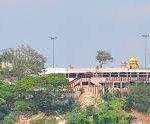
Palani Arulmigu Shri Dhandayuthapani temple is one of the Six Abodes of Murugan. It is located in the town of Palani in Dindigul district, 100 kilometres (62 mi) southeast of Coimbatore and northwest of Madurai in the foot-hills of the Palani hills, Tamil Nadu, India.
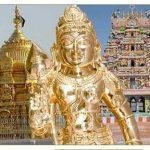
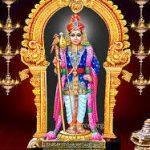
The idol of the Muruga in Palani, was created and consecrated by sage Bogar, one of aaseevaham’s (Ancient Tamil Culture) eighteen great siddhas out of an amalgam of nine poisons or navapashanam. The legend also holds that, the sculptor had to work very rapidly to complete its features, but that he spent so much time in creating the face, he did not have time to bestow but a rough grace upon the rest of the body, thus explaining the contrast between the artistic perfection of the face and the slightly less accomplished work upon the body. A shrine to Bhogar exists in the southwestern corridor of the temple, which, by legend, is said to be connected by a subterranean tunnel to a cave in the heart of the hill, where Bhogar continues to meditate and maintain his vigil, with eight idols of Muruga.
Architecture
The idol of the deity is said to be made of an amalgam of nine poisonous substances which forms an eternal medicine when mixed in a certain ratio. It is placed upon a pedestal of stone, with an archway framing it and represents the god Subrahmanya in the form He assumed at Palani – that of a very young recluse, shorn of his locks and all his finery, dressed in no more than a loincloth and armed only with a staff, the dhandam, as befits a monk.
Legend / Local stories
Sage Narada once visited the celestial court of Shiva at Mount Kailash to present to him a fruit, the gyana-palam (literally, the fruit of knowledge), that held in it the elixir of wisdom. Upon Shiva expressing his intention of dividing the fruit between his two sons, Ganesha and Murugan,the sage counseled against cutting it. He decided to award it to whichever of his two sons first circled the world thrice. Accepting the challenge, Karthikeya started his journey around the globe on his mount peacock. However, Ganesha, who surmised that the world was no more than his parents Shiva and Shakti combined, circumambulated them. Pleased with their son’s discernment, Shiva awarded the fruit to Ganesha. When Kartikeya returned, he was furious to learn that his efforts had been in vain. He left Kailash and took up his abode in Palani hills in South India.
Photo Gallery
How to Reach:
By Air
Nearest Airport is Madurai .
By Train
Nearest Railway Station is Palani.
By Road
Direct buses are available from all the cities of Tamil Nadu.
Address
Giri Veethi, Palani, Tamil Nadu 624601
Contact Details
04545 242 236
Recent Posts

Shri Kaamkoteeshwar Mandir, Varanasi – History & Significance
In the heart of Kashi, the eternal city of Lord Shiva, where the Ganges flows with celestial grace, stands the Shri Kaamkoteeshwar Mandir. This sacred Sannidhi is not merely a temple but a profound spiritual bridge between the Northern…

ओ सांवरे तूने ही मुझको संभाला – Lyrics & Meaning
ओ सांवरे तूने ही मुझको संभाला – A Prayer to Shyam Origin & Spiritual Essence Why This Bhajan Resonates Devotees chant this when overwhelmed by life’s storms—the refrain ‘तूने ही मुझको संभाला’ is the soul’s sigh of relief: “You…

कथा ये है महाराज मेरे की – Lyrics & Meaning
कथा ये है महाराज मेरे की छत्रपति संभाजी महाराज – A Prayer to Chhatrapati Sambhaji Maharaj Origin & Spiritual Essence Why This Bhajan Resonates Devotees chant this when their spirit feels tested—its powerful refrain “महाराज मेरे” is a soul’s…

Rigveda Samhita Yathartha Anuvada (ऋग्वेद संहिता यथार्थ अनुवाद) – Complete Set with Anvayartha & Hindi/English Translation
The Rigveda is the oldest surviving scripture of humanity and the foundational text of Sanātana Dharma. For serious students, scholars, UPSC aspirants studying ancient Indian history, Sanskrit learners, and spiritual seekers, a precise and grammatically structured translation is indispensable.…

आना भी अकेला है जाना भी अकेला है – Lyrics & Meaning | BharatTemples
आना भी अकेला है जाना भी अकेला है – A Prayer to the Divine Witness Origin & Spiritual Essence Why This Bhajan Resonates Devotees turn to this bhajan in moments of deep reflection—when life’s attachments begin to ache. The…

माता शेरावाली के द्वार जो भी जाता है – Lyrics & Meaning
माता शेरावाली के द्वार जो भी जाता है – A Prayer to Maa Sherawali Origin & Spiritual Essence Why This Bhajan Resonates Devotees turn to this bhajan in times of fear or uncertainty—its promise that no one leaves Maa’s…

मार लेना सपणी उबार लेणा भवरा – Lyrics & Meaning
मार लेना सपणी उबार लेणा भवरा – A Prayer to the Divine Beloved Origin & Spiritual Essence Why This Bhajan Resonates Devotees chant this in moments of deep vulnerability—its cry of “मार लेना सपणी, उबार लेणा भवरा” is the…

हमें श्याम सुंदर भरोसा तुम्हारा – Lyrics & Meaning
हमें श्याम सुंदर भरोसा तुम्हारा – A Prayer to Shyam Sundar Origin & Spiritual Essence Why This Bhajan Resonates Devotees chant this when feeling alone—its refrain ‘de do sahara’ is the soul’s cry for divine support. Lyrics in Hindi…

Mere Satguru Ne Di Thi Davai Lyrics in Hindi & Meaning
Mere Satguru Ne Di Thi Davai: Invoking the Guru’s Liberating Wisdom This soul-stirring bhajan venerates the Satguru (True Spiritual Master) as the divine physician who dispenses the only remedy for life’s deepest sufferings. Composed by Sant Karmaveer Tufani, it…

Janm Diyo Thari Maa Dukh Dekhiyo Lyrics in Hindi & Meaning
जन्म दियो थारी माँ दुख देखियो (Maa’s Grief Upon Birthing You) This soul-stirring Chetavani Bhajan (admonitory hymn) is addressed to the Divine Mother (Maa) – a call for repentance when children forget their filial duties in the dark age…