
Contents
- 1 Somanadheeswarar Temple: A Definitive Pilgrimage Guide to Kaniampakkam
- 1.1 1. Introduction & Spiritual Essence
- 1.2 2. Historical Origins & Scriptural Legend
- 1.3 3. Architectural Marvels
- 1.4 4. Darshan & Ritual Logistics (2026 Schedule)
- 1.5 5. Practical Visitor Guidance
- 1.6 6. Pilgrimage Connectivity
- 1.7 7. Frequently Asked Questions (FAQ)
- 1.8 Photo Gallery
- 1.9 How to Reach & Contact
Somanadheeswarar Temple: A Definitive Pilgrimage Guide to Kaniampakkam
Welcome to the spiritual heart of Kaniampakkam, a serene village in Thiruvallur District where the divine presence of Lord Shiva manifests as Somanadheeswarar. As we look toward a spiritual journey in 2026, this guide serves as your comprehensive companion to understanding the history, architectural grandeur, and devotional logistics of this sacred sanctuary.
1. Introduction & Spiritual Essence
The Somanadheeswarar Temple is an ancient Saivite shrine, believed to be over 1,000 years old, standing as a testament to the unwavering faith of the Chola era devotees. Here, the primary deity, Lord Shiva, is worshipped as Somanadheeswarar (The Lord of the Moon), and the consort Goddess Parvathi is revered as Theertheswari (The Lady of the Holy Waters).
The Divine Form (Murti)
The sanctum sanctorum houses a Maha Dhyana Lingam, a unique Lingam representing deep meditation. Legend holds that this Lingam was fashioned not by human hands, but by Goddess Parvathi herself, molded from sacred sand. This Swayambhu (self-manifested) nature enhances the temple’s vibrational energy.
Phalaśruti: The Spiritual Benefits
Devotees flock to Somanadheeswarar Temple for specific spiritual boons:
- Removal of Pitra Dosha: It is believed that worshipping here helps in cleansing ancestral karma, offering peace to forefathers.
- Relief from Moon Afflictions: As the name suggests, the temple is potent for those facing astrological afflictions related to the Moon (Chandra), promoting mental peace and emotional stability.
- Blessings of Sage Agasthya: The temple is associated with the great Sage Agasthya, who is said to have worshipped Shiva here. His presence adds to the temple’s Vedic potency.
2. Historical Origins & Scriptural Legend
The Chola Legacy
While exact inscriptions regarding the specific king remain hidden within the temple walls, the architectural style and the masonry suggest a glorious origin during the Chola Dynasty (circa 10th-11th Century CE). The temple has undergone restorations to preserve its structural integrity, maintaining the sanctity of its original foundations.
The Sthala Purana
According to temple records and local folklore, the name “Somanadheeswarar” holds profound significance. The Chandra (Moon) on Lord Shiva’s matted locks is usually a source of cool, calming energy. However, in this Kshetram (place), the Lord is believed to have absorbed the intense spiritual heat generated by the penance of Sage Agasthya. Hence, the Moon here is not merely an ornament but a symbol of relief and soothing grace.
Tradition holds that Goddess Parvathi, seeking to create a permanent abode for Shiva in this region, molded the Lingam from sand. Since the earth (sand) is the witness to this divine act, the temple is considered a powerful spot for grounding one’s energies.
3. Architectural Marvels
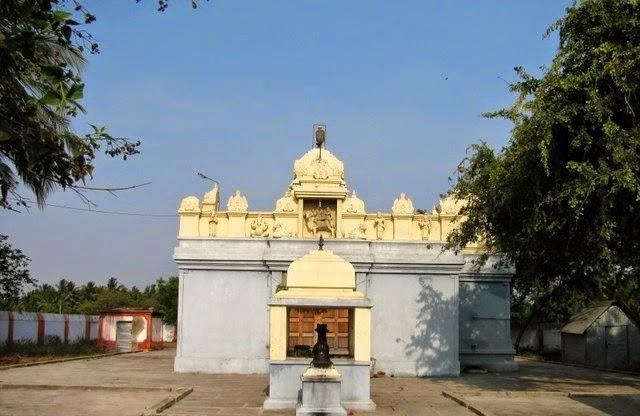
The Somanadheeswarar Temple is a classic example of the Dravidian style of architecture, characterized by its towering gateways and concentric enclosures.
Key Structural Elements
- The Sanctum (Garbhagriha): The innermost shrine is designed to hold the cool energy of the Sand Lingam, distinct in its simplicity and power.
- Mandapas (Pillared Halls): The temple features pillared halls that facilitate circumambulation (Pradakshina) and ritual gatherings. The pillars are often adorned with sculptures depicting mythological narratives.
- Theertheswari Shrine: A dedicated shrine for the Goddess is located adjacent to the main sanctum, following the traditional Agra-Adhi Sthana (front-back) arrangement typical of Shiva-Parvathi temples.
- Preservation Status: While specific ASI (Archaeological Survey of India) tags for this local gem are still being documented, the temple falls under the vigilant care of the Hindu Religious and Charitable Endowments (HR&CE) Department of Tamil Nadu.
4. Darshan & Ritual Logistics (2026 Schedule)
To ensure a smooth pilgrimage experience in 2026, devotees are advised to check the official HR&CE website for real-time updates on festivals and special closures.
Daily Temple Timings
| Session | Timings | Note |
|---|---|---|
| Morning Darshan | 6:00 AM – 11:30 AM | Includes break for Abhishekam |
| Evening Darshan | 4:00 PM – 8:00 PM | Standard hours |
| Ritual Note | Timings may extend during Pournami (Full Moon) and Pradosham. | |
Key Sevas & Online Booking
Most rituals at this temple are managed directly at the counter. However, for larger festivals, the Tamil Nadu HR&CE portal may activate online services.
- Abhishekam (Ritual Bathing): Performed daily for the Sand Lingam. Best time: 8:00 AM.
- Archana (Chanting of Names): Available for individual and family welfare.
- Special Deeparadhana: Post evening lamp lighting.
Major Festivals in 2026
Mark your calendars for these spiritually potent dates:
- Arudra Darshanam: Celebrates the cosmic dance of Shiva. Expected date: January 2026 (Pushya Masam).
- Mahashivratri: The Great Night of Shiva. Expected date: February 26, 2026.
- Pradosham: Occurring twice a month (13th day of lunar fortnight). The most significant for relief from karma.
- Navarathri: Dedicated to Goddess Theertheswari. Expected date: October 2026.
5. Practical Visitor Guidance
To maintain the sanctity of the temple, specific guidelines are followed:
Dress Code & Etiquette
- Traditional attire is highly recommended: Men (Dhoti/Veshti), Women (Saree/Salwar Kameez).
- Avoid shorts, sleeveless tops, or torn clothing.
Photography & Electronics
- Mobile phones are permitted but photography inside the sanctum is strictly prohibited.
- Lockers or safe-keeping facilities may not be available; travel light.
Crowd Management & Seasons
- Best Time to Visit: Early mornings (6:00 AM – 7:30 AM) on weekdays.
- Seasonal Advice: Tamil Nadu summers (April–June) are intense. Carry a water bottle and an umbrella. Monsoons (Oct–Dec) enhance the natural beauty but plan for potential travel delays.
- Accessibility: The temple is accessible for seniors, though the inner sanctum may require stepping over a small threshold.
6. Pilgrimage Connectivity
How to Reach Somanadheeswarar Temple
The temple is conveniently located in the Thiruvallur district, easily accessible from Chennai.
- By Road: The temple is located approximately 32 km from Chennai. Take NH 716 towards Minjur/Ponneri. It is about 500 meters from the Devadanam Ranganathar Temple.
- Nearest Railway Station: Ponneri Railway Station (approx. 8 km) or Minjur Railway Station (approx. 6 km) on the Chennai-Tiruvottiyur section.
- Nearest Airport: Chennai International Airport (MAA) is approximately 51 km away.
- Bus Transport: Buses ply regularly from Chennai (High Road) to Ponneri. From Ponneri Bus Depot, local autos are readily available to Kaniampakkam.
Nearby Sacred Sites
Extend your pilgrimage with these nearby temples:
- Devadanam Ranganathar Temple: An ancient Vishnu temple located just 500 meters away. Ideal for a combined Shiva-Vishnu darshan.
- Keezhkasaram Archaeological Site: For history enthusiasts interested in ancient inscriptions nearby.
- Ponneri Lingeswarar Temple: Another historic Shiva temple in the vicinity of Ponneri.
7. Frequently Asked Questions (FAQ)
Is there a VIP Darshan entry?
Generally, this is a rural heritage temple without commercial VIP protocols. However, donors supporting temple maintenance often receive priority access during rituals. Contact the temple executive officer for specific arrangements.
Can we perform child naming ceremonies?
Yes, the temple is conducive to housewarming ceremonies (Grihapravesam) and naming ceremonies. It is advisable to book the date with the priest (Pandit) in advance.
What is the significance of the Sand Lingam?
Unlike stone or metal Lingams, the sand Lingam is believed to be highly sensitive to energy. It is considered a direct manifestation of the Goddess’s touch, making it particularly potent for wish fulfillment.
Is non-vegetarian food allowed near the temple?
No, the temple precincts and the village of Kaniampakkam strictly adhere to vegetarian customs. Please respect local sentiments and avoid carrying non-vegetarian items into the temple vicinity.
Are there accommodation facilities?
There are no lodges directly attached to the temple. For overnight stays, pilgrims usually return to Chennai or stay at lodges in Minjur/Ponneri.
Photo Gallery

How to Reach & Contact
Official Address:
Somanadheeswarar Temple,
Kaniampakkam Village (via Devadanam),
Tiruvallur District, Tamil Nadu.
The temple is located at about 3 Kms from Devadanam, 500 meters from Devadanam Ranganathar Temple, 9 Kms from Ponneri, 10 Kms from Ponneri Bus Depot, 8 Kms from Ponneri Railway Station, 8 Kms from Minjur, 8 Kms from Minjur Bus Depot, 6 Kms from Minjur Railway Station, 58 Kms from Tiruvallur, 32 Kms from Chennai and 51 Kms from Chennai International Airport.
Recent Posts

Shri Kaamkoteeshwar Mandir, Varanasi – History & Significance
In the heart of Kashi, the eternal city of Lord Shiva, where the Ganges flows with celestial grace, stands the Shri Kaamkoteeshwar Mandir. This sacred Sannidhi is not merely a temple but a profound spiritual bridge between the Northern…

ओ सांवरे तूने ही मुझको संभाला – Lyrics & Meaning
ओ सांवरे तूने ही मुझको संभाला – A Prayer to Shyam Origin & Spiritual Essence Why This Bhajan Resonates Devotees chant this when overwhelmed by life’s storms—the refrain ‘तूने ही मुझको संभाला’ is the soul’s sigh of relief: “You…

कथा ये है महाराज मेरे की – Lyrics & Meaning
कथा ये है महाराज मेरे की छत्रपति संभाजी महाराज – A Prayer to Chhatrapati Sambhaji Maharaj Origin & Spiritual Essence Why This Bhajan Resonates Devotees chant this when their spirit feels tested—its powerful refrain “महाराज मेरे” is a soul’s…

Rigveda Samhita Yathartha Anuvada (ऋग्वेद संहिता यथार्थ अनुवाद) – Complete Set with Anvayartha & Hindi/English Translation
The Rigveda is the oldest surviving scripture of humanity and the foundational text of Sanātana Dharma. For serious students, scholars, UPSC aspirants studying ancient Indian history, Sanskrit learners, and spiritual seekers, a precise and grammatically structured translation is indispensable.…

आना भी अकेला है जाना भी अकेला है – Lyrics & Meaning | BharatTemples
आना भी अकेला है जाना भी अकेला है – A Prayer to the Divine Witness Origin & Spiritual Essence Why This Bhajan Resonates Devotees turn to this bhajan in moments of deep reflection—when life’s attachments begin to ache. The…

माता शेरावाली के द्वार जो भी जाता है – Lyrics & Meaning
माता शेरावाली के द्वार जो भी जाता है – A Prayer to Maa Sherawali Origin & Spiritual Essence Why This Bhajan Resonates Devotees turn to this bhajan in times of fear or uncertainty—its promise that no one leaves Maa’s…

मार लेना सपणी उबार लेणा भवरा – Lyrics & Meaning
मार लेना सपणी उबार लेणा भवरा – A Prayer to the Divine Beloved Origin & Spiritual Essence Why This Bhajan Resonates Devotees chant this in moments of deep vulnerability—its cry of “मार लेना सपणी, उबार लेणा भवरा” is the…

हमें श्याम सुंदर भरोसा तुम्हारा – Lyrics & Meaning
हमें श्याम सुंदर भरोसा तुम्हारा – A Prayer to Shyam Sundar Origin & Spiritual Essence Why This Bhajan Resonates Devotees chant this when feeling alone—its refrain ‘de do sahara’ is the soul’s cry for divine support. Lyrics in Hindi…

Mere Satguru Ne Di Thi Davai Lyrics in Hindi & Meaning
Mere Satguru Ne Di Thi Davai: Invoking the Guru’s Liberating Wisdom This soul-stirring bhajan venerates the Satguru (True Spiritual Master) as the divine physician who dispenses the only remedy for life’s deepest sufferings. Composed by Sant Karmaveer Tufani, it…

Janm Diyo Thari Maa Dukh Dekhiyo Lyrics in Hindi & Meaning
जन्म दियो थारी माँ दुख देखियो (Maa’s Grief Upon Birthing You) This soul-stirring Chetavani Bhajan (admonitory hymn) is addressed to the Divine Mother (Maa) – a call for repentance when children forget their filial duties in the dark age…