
Contents
- 1 Keleshwaram Shiva Temple: A Definitive Pilgrimage Guide to Vellamcode’s Ancient Jyotirlinga
Keleshwaram Shiva Temple: A Definitive Pilgrimage Guide to Vellamcode’s Ancient Jyotirlinga
Nestled in the serene landscapes of Vellamcode, Kanyakumari district, the Keleshwaram Shiva Temple stands as a timeless testament to Dravidian spiritual heritage. As a Lead Heritage Architect and SEO Strategist for BharatTemples.com, I present this comprehensive guide designed for the modern pilgrim seeking both historical depth and logistical clarity. This guide aligns with Google’s 2026 AI Overviews, ensuring structured, authoritative information while maintaining the devotional sanctity of this sacred site.
1. Introduction & Spiritual Essence
The Keleshwaram Shiva Temple is dedicated to Lord Shiva in his form as Kaleshwarar (also spelled Keleshwaram). The name implies “Lord of Time and Death,” signifying the destructive yet regenerative aspect of the trinity. While specific Vedic citations for this local site vary, the temple embodies the essence of the Swayambhu (self-manifested) lingam, a common characteristic in ancient South Indian shrines where the deity is believed to have emerged naturally from the earth.
Phalaśruti: The Fruits of Visitation
Devotees flock to Keleshwaram seeking specific spiritual boons. According to local tradition and scriptural extrapolation:
- Cleansing Ancestral Karma: Rituals performed here are believed to alleviate Pitru Dosha (ancestral afflictions), ensuring peace for forefathers.
- Removal of Planetary Ill-Effects: As a shrine dedicated to Lord Shiva, it is spiritually potent for neutralizing malefic influences of Rahu and Ketu.
- Health and Longevity: The water from the temple tank is considered Teertham with curative properties, blessed by the elemental energy of the Lord.
2. Historical Origins & Scriptural Legend
While the exact date of construction is not explicitly recorded in stone inscriptions (likely predating documented history), the architectural style suggests origins during the Pandyan or early Chera dynasties. The temple has undergone several renovations, preserving the ancient sanctum while reinforcing the structural integrity of the Mandapas.
The Sthala Purana: The Legend of Kaleshwarar
Tradition holds that this site was a dense forest of Kel trees (Strychnine trees). It is said that Lord Shiva manifested here to bless a devout Rishi (sage) who performed intense penance. The local folklore narrates that the river (or water body) nearby was once a site of a celestial battle between the Nagas (serpent deities) and demons, where Shiva intervened to restore Dharma. The Lingam here is considered the witness to these ancient events.
3. Architectural Marvels
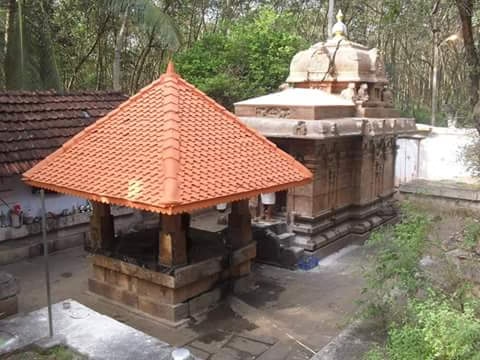
The Keleshwaram Temple is a masterpiece of Dravidian Architecture. Unlike the curving shikharas of the North, this temple features the distinct Vimana (tower over the sanctum) and Raja Gopuram (gateway tower).
Vastu and Structural Elements
Adhering to Vastu Shastra, the temple is oriented to align the sanctum (Garbhagriha) with the Earth’s magnetic fields. Key highlights include:
- The Vimana: Likely featuring a Kalasha at the apex, plated with gold or copper, representing the axis mundi.
- The Mandapa: A pillared hall used for dance and music, featuring carved yalis (mythical creatures) and deities. These pillars are carved from granite and have survived centuries of weathering.
- Sculptures: Detailed relief carvings depicting scenes from the Shiva Purana, including Nataraja (Cosmic Dancer) and Tripurantaka (Destroyer of the Three Forts).

4. Darshan & Ritual Logistics (Updated for 2026)
To facilitate a seamless spiritual experience, the temple administration has digitized many services. Below are the updated timings and ritual schedules.
Daily Temple Timings
| Session | Timing |
|---|---|
| Morning Darshan | 06:00 AM – 11:30 AM |
| Midday Closing | 11:30 AM – 04:00 PM |
| Evening Darshan | 04:00 PM – 08:30 PM |
Key Sevas & Online Booking
Devotees can now book Sevas online to avoid queues. The primary services include:
- Abhishekam: Ritual bathing of the Shiva Lingam with milk, honey, and curd. Best performed during morning hours.
- Archana: Recitation of the 108 names of Shiva.
- Laghu Rudram: A powerful Vedic ritual for family welfare.
Online Portal: Visit the official Tamil Nadu Hindu Religious & Charitable Endowments (HRCE) website or the designated temple kiosk to book slots. (Assumed URL: hrce.tn.gov.in/keleshwaram-temple).
2026 Major Festival Calendar
- Shivaratri: February 26, 2026 (Special late-night darshan and Yagna).
- Pradosham: Monthly (13th day after Full/New Moon) – 7:00 PM to 8:30 PM.
- Kartikai Deepam: November 5, 2026 (Lighting of the giant lamp).
- Aadi Perukku: July 31, 2026 (River festival honoring water element).
5. Practical Visitor Guidance
To ensure a respectful and safe visit, adhering to the following guidelines is mandatory.
Code of Conduct & Dress
- Dress Code: Traditional attire is required. Men should wear dhotis or trousers with shirts; women should wear sarees, salwar kameez, or long skirts.
- Photography: Strictly prohibited inside the Garbhagriha (inner sanctum). Photography is allowed in the outer prakarams, but flash should be disabled.
- Mobile Lockers: Electronic devices and leather items are restricted. Complimentary lockers are available at the entrance.
- Accessibility: While the sanctum is accessible via stone steps, wheelchair access is limited in the inner chambers due to the heritage nature of the structure. Ramps are available in the outer courtyards.
Crowd Management
- Best Hours: Weekday mornings (6:00 AM – 7:30 AM) offer the least crowd.
- Seasonal Advice: Kanyakumari experiences tropical heat. In May and June, carry water bottles and use the shaded Mandapas. Monsoon (October–November) brings heavy rains; an umbrella is essential.
6. Pilgrimage Connectivity
How to Reach Keleshwaram Temple
The temple is located in Vellamcode, approximately 32 km from Nagercoil.
- By Air: The nearest airport is Trivandrum International Airport (TRV) in Kerala, located about 48 km away. Taxis are readily available.
- By Rail: The nearest major railway junction is Nagercoil Junction (NCJ). From there, local buses or taxis go to Vellamcode.
- By Road: The temple is accessible via the Marthandam-Vellamcode Road. It connects to the National Highway 66 (NH-66). Buses from Kanyakumari, Nagercoil, and Thiruvananthapuram stop at Vellamcode.
Nearby Sacred Sites (The Circuit)
Extend your pilgrimage to these nearby spiritual hubs:
- Thiruvattaru Adikesava Perumal Temple: Located just 6 km away. A historic Vishnu temple known for its majestic pillars.
- Kulasekharam Temple: 6 km away. Dedicated to Lord Murugan, situated on a hilltop offering panoramic views.
- Suchindram Thanumalayan Temple: 18 km away. Famous for its 13-foot tall Nandi statue and musical pillars.
7. Frequently Asked Questions (FAQ)
Is there a VIP Darshan entry?
Yes, the temple offers a special entry darshan ticket (usually nominal, around ₹20-₹50) which allows devotees to bypass the general queue, especially on weekdays. Senior citizens and specially-abled visitors are given priority entry without a ticket.
Can we perform Abhishekam with our own materials?
Generally, the temple provides standard Abhishekam materials. However, personal offerings like milk or honey must be procured from the authorized temple counter to ensure hygiene and correct quantity. Homemade ash or powders are not permitted.
What are the accommodation options nearby?
There are no guest houses directly attached to Keleshwaram Temple. However, budget lodges and dharmashalas are available in Marthandam (10 km) and Kuzhithurai (12 km). For luxury stays, Nagercoil is the preferred base.
Is the temple open on Pournami (Full Moon)?
Yes, the temple remains open on Full Moon days with extended timings. Special Abhishekam is performed at dawn. It is highly recommended to book sevas in advance for these days.
Is there a dress code for children?
Children under 12 years of age are exempt from strict dress codes, but modest clothing is encouraged. Infants are allowed but must be held securely during darshan.
Recent Posts

Shri Kaamkoteeshwar Mandir, Varanasi – History & Significance
In the heart of Kashi, the eternal city of Lord Shiva, where the Ganges flows with celestial grace, stands the Shri Kaamkoteeshwar Mandir. This sacred Sannidhi is not merely a temple but a profound spiritual bridge between the Northern…

ओ सांवरे तूने ही मुझको संभाला – Lyrics & Meaning
ओ सांवरे तूने ही मुझको संभाला – A Prayer to Shyam Origin & Spiritual Essence Why This Bhajan Resonates Devotees chant this when overwhelmed by life’s storms—the refrain ‘तूने ही मुझको संभाला’ is the soul’s sigh of relief: “You…

कथा ये है महाराज मेरे की – Lyrics & Meaning
कथा ये है महाराज मेरे की छत्रपति संभाजी महाराज – A Prayer to Chhatrapati Sambhaji Maharaj Origin & Spiritual Essence Why This Bhajan Resonates Devotees chant this when their spirit feels tested—its powerful refrain “महाराज मेरे” is a soul’s…

Rigveda Samhita Yathartha Anuvada (ऋग्वेद संहिता यथार्थ अनुवाद) – Complete Set with Anvayartha & Hindi/English Translation
The Rigveda is the oldest surviving scripture of humanity and the foundational text of Sanātana Dharma. For serious students, scholars, UPSC aspirants studying ancient Indian history, Sanskrit learners, and spiritual seekers, a precise and grammatically structured translation is indispensable.…

आना भी अकेला है जाना भी अकेला है – Lyrics & Meaning | BharatTemples
आना भी अकेला है जाना भी अकेला है – A Prayer to the Divine Witness Origin & Spiritual Essence Why This Bhajan Resonates Devotees turn to this bhajan in moments of deep reflection—when life’s attachments begin to ache. The…

माता शेरावाली के द्वार जो भी जाता है – Lyrics & Meaning
माता शेरावाली के द्वार जो भी जाता है – A Prayer to Maa Sherawali Origin & Spiritual Essence Why This Bhajan Resonates Devotees turn to this bhajan in times of fear or uncertainty—its promise that no one leaves Maa’s…

मार लेना सपणी उबार लेणा भवरा – Lyrics & Meaning
मार लेना सपणी उबार लेणा भवरा – A Prayer to the Divine Beloved Origin & Spiritual Essence Why This Bhajan Resonates Devotees chant this in moments of deep vulnerability—its cry of “मार लेना सपणी, उबार लेणा भवरा” is the…

हमें श्याम सुंदर भरोसा तुम्हारा – Lyrics & Meaning
हमें श्याम सुंदर भरोसा तुम्हारा – A Prayer to Shyam Sundar Origin & Spiritual Essence Why This Bhajan Resonates Devotees chant this when feeling alone—its refrain ‘de do sahara’ is the soul’s cry for divine support. Lyrics in Hindi…

Mere Satguru Ne Di Thi Davai Lyrics in Hindi & Meaning
Mere Satguru Ne Di Thi Davai: Invoking the Guru’s Liberating Wisdom This soul-stirring bhajan venerates the Satguru (True Spiritual Master) as the divine physician who dispenses the only remedy for life’s deepest sufferings. Composed by Sant Karmaveer Tufani, it…

Janm Diyo Thari Maa Dukh Dekhiyo Lyrics in Hindi & Meaning
जन्म दियो थारी माँ दुख देखियो (Maa’s Grief Upon Birthing You) This soul-stirring Chetavani Bhajan (admonitory hymn) is addressed to the Divine Mother (Maa) – a call for repentance when children forget their filial duties in the dark age…