
Contents
- 1 Thiruavinankudi Temple, Palani: The Sacred First Abode of Lord Murugan
- 1.1 1. Introduction & Spiritual Essence
- 1.2 2. Historical Origins & Scriptural Legend
- 1.3 3. Architectural Marvels
- 1.4 4. Darshan & Ritual Logistics
- 1.5 5. Practical Visitor Guidance
- 1.6 6. Pilgrimage Connectivity
- 1.7 7. Frequently Asked Questions (FAQ)
- 1.7.1 Is there a VIP darshan entry at Thiruavinankudi Temple?
- 1.7.2 Can I visit Thiruavinankudi if I am not able to climb the Palani Hills?
- 1.7.3 Is there a dress code for children?
- 1.7.4 What is the best time to visit for a peaceful Darshan?
- 1.7.5 Are there accommodation facilities near the temple?
- 1.7.6 Can I perform ancestral rituals (Pithru Puja) here?
- 1.8 Photo Gallery
- 1.9 Contact Details
Thiruavinankudi Temple, Palani: The Sacred First Abode of Lord Murugan
Keywords: Thiruavinankudi Temple Palani, Lord Muruga temple history, Palani darshan timings
| Date built: | ~ 2000 Years Ago (Sangam Period) |
|---|---|
| Deity: | Lord Murugan (Dandayudhapani Swamy) |
| Architectural style: | Dravidian / Ancient Tamil Architecture |
| Major festivals | Thai Poosam, Panguni Uthiram, Skanda Shashti |
| Locale: | Palani, Palani Hills |
| District: | Dindigul |
| Address: | Thiruavinankudi, Palani, Tamil Nadu 624601 |
| Phone | +91 4545 242 233 (Palani Temple Office) |
1. Introduction & Spiritual Essence
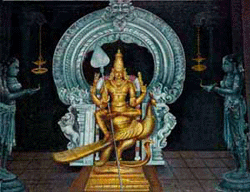
Thiruavinankudi Temple, located at the foothills of the Palani Malai (Palani Hills), is the first of the Arupadaiveedus (Six Abodes) of Lord Murugan. While the main Palani Hill Temple is visited by millions, Thiruavinankudi holds a unique spiritual significance as the place where Lord Murugan first revealed himself to his parents, Lord Shiva and Goddess Parvati, following the creation of the Vel (divine spear).
Phalaśruti: The Benefits of Visiting
Devotees visit this sanctum to seek blessings for:
- Healing and Vitality: The presiding deity is known as Nedumaran, the one who grants longevity and strength. The temple is renowned for curing chronic illnesses.
- Relief from ‘Rahu Kethu’ Dosham: The temple is strongly associated with planets Rahu and Kethu, helping to alleviate their malefic effects.
- Wish Fulfillment: As the abode of ancestral gratitude, it is a key site for performing rites to cleanse pitru dosham (ancestral karma).
The primary deity, Dandayudhapani Swamy, is in a standing posture with a bamboo staff (dandam). Unlike the main hill temple, here he is without the elephant-faced Lord Vinayagar (Ganesh) by his side, making the Dravida Vimana (tower) unique in its structure.
2. Historical Origins & Scriptural Legend
Roots in Sangam Literature
According to temple records and scholarly consensus, Thiruavinankudi is approximately 2,000 years old. It finds mention in the classical Tamil poetry Thirumurugattrupadai (circa 2nd century BCE), written by the poet Nakkirar. In 18 lines of intense lyricism, Nakkirar describes the deities, the medicinal nature of the soil, and the sages (Siddhars) who worshipped here.
Tradition holds: The place was originally ruled by the feudatory chief Velavi Koman during the Sangam period. The name ‘Avi’ represents a clan, often linked to the Velir dynasty. The transformation of the region’s name from ‘Podini’ to ‘Palani’ is attributed to linguistic evolution, though the spiritual potency of the land remains unchanged.
The Legend of Nedumaran
After consuming the Divya Ozhundhu (divine nectar) offered by Agathiyar (Agastya), the child Murugan grew in stature and strength. This location, blessed by the sage Agathiyar, is where Murugan was first worshipped by heavenly beings (Devas), Moolavars, and his divine parents. It is the site of the first of the six Padai Veedus of Lord Murugan.
3. Architectural Marvels
The temple architecture reflects the early Dravidian style, distinct from the later Chola and Pandya influences found in larger complexes. While there is no massive gopuram (gateway tower) here, the sanctity lies in its compact, powerful design.
- Vimana: The Vimana (the tower above the sanctum sanctorum) is unique. It houses the Dravida Vimana, distinct from the Ashtaanga Vimana seen in the main hill temple.
- Sanctum Layout: The shrine for Dandayudhapani Swamy is small and intimate. The Lord holds a bamboo stick (Dandam) and a whip, which is unique to this Padai Veedu.
- The Holy Tree: The Stala Vriksham (sacred tree) is the Nelli (Gooseberry/Amlaka) tree. Devotees consider the leaves of this tree to have high medicinal value.
- Therapeutic Architecture: The layout of the temple and the nature of the soil were designed to heal the mind and body, a concept rooted in ancient Tamil Vastu.
Note: The temple is a protected monument, preserved for its antiquity and connection to ancient Tamil literature.
4. Darshan & Ritual Logistics
Visitors to Thiruavinankudi can book various Sevas (ritual services) through the official Palani Temple administration, managed by the Arulmigu Dhandayuthapani Swamy Temple Board.
Daily Temple Timings (2026 Schedule)
Note: Timings are subject to change during festival seasons.
| Session | Opening Time | Closing Time |
|---|---|---|
| Morning | 06:00 AM | 12:00 PM |
| Afternoon Break | 12:00 PM | 03:00 PM |
| Evening | 03:00 PM | 08:00 PM |
Key Sevas & Online Booking
To perform rituals, visit the official website: https://palanitemple.tnhrce.in/ (Tamil Nadu Hindu Religious and Charitable Endowments Department).
- Abhishekam (Holy Bath): Performed with milk, sandalwood paste, and lime. Best time: 7:00 AM – 8:30 AM.
- Archana: Chanting of the Lord’s names. Available in Tamil and Sanskrit.
- Vazhipadu (Offerings): Includes deepa aradhana (lamp offering) and vastra dharanam (clothing).
2026 Major Festival Dates
- Thai Poosam: January 13, 2026 (Significant for abhishekam)
- Skanda Shashti: June 26, 2026 – July 2, 2026
- Panguni Uthiram: March 29, 2026
5. Practical Visitor Guidance
- Dress Code: Traditional attire is mandatory. Men: Shirt and Dhoti (or formal trousers with a shirt). Women: Saree, Half-Saree, or Chudithar/Kurti.
- Photography: Strictly prohibited inside the sanctum sanctorum. Mobile phones are allowed but must be switched to silent mode.
- Lockers: Free mobile lockers are available near the temple entrance, provided by the temple administration for convenience and security.
- Accessibility: The temple is at the foothills. It is wheelchair accessible for the main mandapam, though the stone steps to the inner sanctum are steep.
- Crowd Management: Weekends (Saturday/Sunday) and public holidays see heavy crowds. It is advisable to visit on weekdays (Tuesday to Thursday) between 9:00 AM and 11:00 AM.
- Seasonal Advice: Summers (April–June) in Palani are scorching. Carry a reusable water bottle, but ensure it is empty before entering the sanctum. Winters (November–February) offer pleasant weather for walking.
6. Pilgrimage Connectivity
How to Reach Thiruavinankudi
The temple is located 1.5 kilometers from the base of the Palani Hill (Palani Bus Stand/Ambalappadi).
- By Air: The nearest airport is Coimbatore International Airport (CJB), approximately 100 km away (2.5 to 3 hours drive). Regular flights connect Coimbatore to Ahmedabad, Bangalore, Chennai, Hyderabad, and Mumbai.
- By Train: The nearest railway station is Palani Railway Station (PLNI), well-connected to Madurai, Coimbatore, and Chennai. The Palani Express (Chennai Central to Palani) is a major train on this route.
- By Bus: Palani is a major hub for the Tamil Nadu State Transport Corporation (TNSTC). Frequent buses ply from Palani to Coimbatore (100 km), Madurai (100 km), Dindigul (60 km), and Trichy (130 km).
Nearby Sacred Sites (Pilgrimage Circuit)
Visitors often combine a trip to Thiruavinankudi with these nearby holy sites:
- Palani Hill Temple (Murugan Sanctuary): Located just 2 km uphill. The main deity is Sri Dhandayuthapani in a meditative state.
- Tirupparaankundram Murugan Temple: Located near Madurai (approx. 90 km). This is the second Padai Veedu of Lord Murugan.
- Swami Malai Temple: Located near Kumbakonam (approx. 150 km), this is the third Padai Veedu.
7. Frequently Asked Questions (FAQ)
Is there a VIP darshan entry at Thiruavinankudi Temple?
Yes, the temple management provides a special entry darshan (seva) for an additional fee. However, during peak festival times (Thai Poosam, Skanda Shashti), the general queue is often faster for this specific sub-temple due to its location at the foothills.
Can I visit Thiruavinankudi if I am not able to climb the Palani Hills?
Absolutely. Thiruavinankudi is the perfect alternative for devotees who find it physically challenging to climb the steep steps of the Palani Hill temple. Here, the deity is easily accessible without strenuous climbing.
Is there a dress code for children?
While there is no strict enforcement for very young children, it is culturally appropriate for all visitors to dress modestly. For boys over 5 years, a dhoti or formal trousers are recommended.
What is the best time to visit for a peaceful Darshan?
Between 7:00 AM and 9:00 AM on weekdays. This is after the opening ritual but before the bulk of the daily crowds arrive.
Are there accommodation facilities near the temple?
Yes. The Palani Temple administration runs guest houses (Choultries) near the base of the hill, such as the Varadaraja Perumal Choultry and KTDC Hotel. Private hotels are also available in the town center, 2 km away.
Can I perform ancestral rituals (Pithru Puja) here?
Yes, Thiruavinankudi is a renowned place for Tharpanam (ancestral rites). Devotees believe that rituals performed here bring peace to the souls of departed ancestors.
Disclaimer: While every effort is made to provide accurate information regarding temple timings and rituals, these are subject to change based on the temple administration’s circulars and astronomical calculations (Panchangam). Please check the official Palani Temple website before planning your visit in 2026.
Photo Gallery
Contact Details
Official Address:
Executive Officer,
Arulmigu Dhandayuthapani Swamy Temple,
Palani, Dindigul District – 624601.
Tamil Nadu, India.
Recent Posts

Shri Kaamkoteeshwar Mandir, Varanasi – History & Significance
In the heart of Kashi, the eternal city of Lord Shiva, where the Ganges flows with celestial grace, stands the Shri Kaamkoteeshwar Mandir. This sacred Sannidhi is not merely a temple but a profound spiritual bridge between the Northern…

ओ सांवरे तूने ही मुझको संभाला – Lyrics & Meaning
ओ सांवरे तूने ही मुझको संभाला – A Prayer to Shyam Origin & Spiritual Essence Why This Bhajan Resonates Devotees chant this when overwhelmed by life’s storms—the refrain ‘तूने ही मुझको संभाला’ is the soul’s sigh of relief: “You…

कथा ये है महाराज मेरे की – Lyrics & Meaning
कथा ये है महाराज मेरे की छत्रपति संभाजी महाराज – A Prayer to Chhatrapati Sambhaji Maharaj Origin & Spiritual Essence Why This Bhajan Resonates Devotees chant this when their spirit feels tested—its powerful refrain “महाराज मेरे” is a soul’s…

Rigveda Samhita Yathartha Anuvada (ऋग्वेद संहिता यथार्थ अनुवाद) – Complete Set with Anvayartha & Hindi/English Translation
The Rigveda is the oldest surviving scripture of humanity and the foundational text of Sanātana Dharma. For serious students, scholars, UPSC aspirants studying ancient Indian history, Sanskrit learners, and spiritual seekers, a precise and grammatically structured translation is indispensable.…

आना भी अकेला है जाना भी अकेला है – Lyrics & Meaning | BharatTemples
आना भी अकेला है जाना भी अकेला है – A Prayer to the Divine Witness Origin & Spiritual Essence Why This Bhajan Resonates Devotees turn to this bhajan in moments of deep reflection—when life’s attachments begin to ache. The…

माता शेरावाली के द्वार जो भी जाता है – Lyrics & Meaning
माता शेरावाली के द्वार जो भी जाता है – A Prayer to Maa Sherawali Origin & Spiritual Essence Why This Bhajan Resonates Devotees turn to this bhajan in times of fear or uncertainty—its promise that no one leaves Maa’s…

मार लेना सपणी उबार लेणा भवरा – Lyrics & Meaning
मार लेना सपणी उबार लेणा भवरा – A Prayer to the Divine Beloved Origin & Spiritual Essence Why This Bhajan Resonates Devotees chant this in moments of deep vulnerability—its cry of “मार लेना सपणी, उबार लेणा भवरा” is the…

हमें श्याम सुंदर भरोसा तुम्हारा – Lyrics & Meaning
हमें श्याम सुंदर भरोसा तुम्हारा – A Prayer to Shyam Sundar Origin & Spiritual Essence Why This Bhajan Resonates Devotees chant this when feeling alone—its refrain ‘de do sahara’ is the soul’s cry for divine support. Lyrics in Hindi…

Mere Satguru Ne Di Thi Davai Lyrics in Hindi & Meaning
Mere Satguru Ne Di Thi Davai: Invoking the Guru’s Liberating Wisdom This soul-stirring bhajan venerates the Satguru (True Spiritual Master) as the divine physician who dispenses the only remedy for life’s deepest sufferings. Composed by Sant Karmaveer Tufani, it…

Janm Diyo Thari Maa Dukh Dekhiyo Lyrics in Hindi & Meaning
जन्म दियो थारी माँ दुख देखियो (Maa’s Grief Upon Birthing You) This soul-stirring Chetavani Bhajan (admonitory hymn) is addressed to the Divine Mother (Maa) – a call for repentance when children forget their filial duties in the dark age…