
Contents
Introduction & Spiritual Essence
Deep in the southern tip of Tamil Nadu, nestled in the village of Anjugramam, lies a spiritual beacon that holds immense significance for followers of the Ayyavazhi faith: the Ayya Vaikundar Temple. While the temple complex is deeply revered in its local setting, the deity worshipped here represents the supreme consciousness of the Ayyavazhi theology.
The Deity and Form
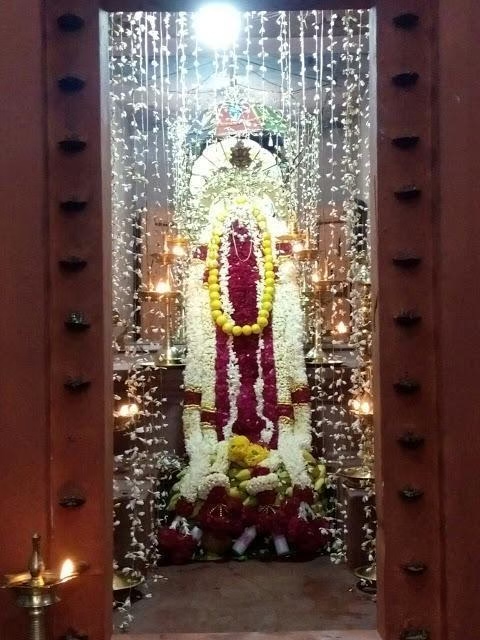
The primary deity is Ayya Vaikundar, also revered as Swamithoppe or Poopathi. Unlike traditional murtis (idols) carved from stone, the presiding deity here is often represented symbolically or through the sanctity of the Swayambhu (self-manifested) concept central to Ayyavazhi shrines. He is considered the incarnation of Vishnu-Narayana who descended to the earth to eradicate evil and establish righteousness (Dharma).
Phalaśruti: The Benefits of Visiting
Devotees undertake this pilgrimage seeking spiritual liberation and the dissolution of Karma. The Phalaśruti (scriptural promise of merit) associated with a visit to this temple includes:
- Ancestral Cleansing: It is believed that offering prayers here helps redeem the ancestral karma of the devotee’s lineage, bringing peace to forefathers.
- Mental Solace: Being a center of the Ekam (Oneness), pilgrims report immense mental clarity and the removal of despair.
- Social Harmony: The temple was founded on principles of social equality; visitors partake in the abolition of caste distinctions through the shared communal meal (Annadhana).
Historical Origins & Scriptural Legend
Scriptural Foundations
While specific dates for the original construction are not recorded in stone inscriptions (likely due to the site’s indigenous, non-feudal origins), the temple’s history is intrinsically linked to the 19th-century Ayyavazhi revival. According to the Ekam Narayana tradition and the Akilathirattu Ammanai (the primary scripture of Ayyavazhi), the area surrounding Kanyakumari serves as the divine stage for Lord Vaikundar’s earthly activities.
Local Legend (Sthala Purana)
Tradition holds that Ayya Vaikundar appeared at the seashore of Swamithoppe (located very close to Anjugramam) to spread the message of the ‘Dharma Yukam’ (Truth Era). The Anjugramam temple serves as a vital spiritual node in the Pancha Lakshana Marga (five-fold path) established by Ayya Vaikundar. It is believed that the deity performed miracles here to uplift the oppressed masses, establishing the first community kitchens and prayer halls known as Kalyana Salais (Marriage Halls of Truth).
Architectural Marvels
Dravidian Style & Ayyavazhi Distinctiveness
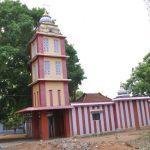
The temple follows the traditional Dravidian architectural style, characterized by its towering gateway towers (Gopurams) and spacious courtyards. However, the interiors of Ayyavazhi temples, including this one in Anjugramam, bear unique distinctions.
Key Features
- The Sanctum: The Garbhagriha (sanctum sanctorum) is designed to allow the natural light to illuminate the central deity, symbolizing the light of consciousness.
- Mandapas: The pillared halls (Mandapas) are constructed with large, open spaces to accommodate the community of devotees during congregational prayers, reflecting the Ayyavazhi emphasis on equality.
- Sculpture: While stone carvings are present, the focus remains on the purity of the space rather than excessive ornamentation, aligning with the philosophy of Ekam (Oneness).
Darshan & Ritual Logistics
Visiting the Ayya Vaikundar Temple is a serene experience. Unlike the overcrowded mega-temples, Anjugramam offers a peaceful environment for contemplation. Below are the standard operational timings, though it is always advisable to verify with local caretakers as Ayyavazhi temples often adjust timings based on community schedules.
| Darshan Session | Timings |
|---|---|
| Morning Darshan | 06:00 AM – 11:00 AM |
| Midday Break | 11:00 AM – 04:00 PM |
| Evening Darshan | 04:00 PM – 08:00 PM |
Key Sevas and Rituals
Common sevas performed at the temple include Abhishekam (ritual bathing of the deity) and Archana (chanting of hymns). Since Ayyavazhi focuses on the ‘Ekam’, the rituals are community-oriented.
Online Seva Booking
While physical presence is highly valued for rituals, administrative updates and festival bookings can be tracked through the Tamil Nadu Hindu Endowments Board portal or by contacting the temple office directly.
2026 Festival Calendar
- Masi Magam: February/March 2026 (Exact date based on the Tamil calendar). This is a major festival in the Kanyakumari district.
- Ayya Vaikunda Avataram: December 2025 (Moving to January 2026). This is the most significant celebration marking the birth of Lord Vaikundar.
- Poopathi Ekadesi: Observed monthly with special prayers.
Practical Visitor Guidance
Dress Code & Etiquette
As with most temples in Tamil Nadu, modest clothing is required. Men should wear dhotis or formal trousers/shirts, and women should wear sarees or salwar kameez. Western casual wear like shorts or sleeveless tops may be restricted at the inner sanctum.
Photography & Electronics
- Photography: Strictly prohibited inside the inner sanctum and the sanctum sanctorum.
- Mobile Lockers: Available near the entrance for depositing electronic devices and leather items.
Crowd Management & Seasonal Advice
For a meditative experience, it is best to visit during the Morning Session (6 AM – 8 AM) or Evening Session (4 PM – 6 PM) on weekdays.
Seasonal Tip: Kanyakumari experiences high humidity from March to May. Carry a reusable water bottle and a light cotton cloth to cover your head. Monsoons (November–January) bring cooler breezes but occasional heavy rains; an umbrella is recommended.
Pilgrimage Connectivity
How to Reach
By Road: The temple is well-connected by the East Coast Road (ECR) and local state highways. It is approximately 12 km from Kanyakumari town.
- Nearest Railway Station: Kanyakumari Railway Station (CAPE) – Approx. 12 km.
- Nearest Airport: Trivandrum International Airport (TVC) – Approx. 90 km (in neighboring Kerala).
Nearby Sacred Sites
To complete your spiritual circuit in Kanyakumari, consider visiting:
- Swamithoppe Pathi: Located just a few kilometers from Anjugramam, this is a primary Pathi (worship center) of the Ayyavazhi faith.
- Kumari Amman Temple: The iconic temple at the southernmost tip of India, dedicated to Goddess Kanyakumari (Devi).
- Suchindram Thanumalayan Temple: Located about 20 km away, famous for its monolithic statue of Hanuman.
Photo Gallery


How to Reach
Ayya Vaikundar Temple is located in Kanahappapuram in Anjugramam in the Kanyakumari District of Tamilnadu. The Temple is situated at about 3 Kms from Anjugramam, 9 Kms from Kottaram, 5 Kms from Vattakkottai, 12 Kms from Kanyakumari, 25 Kms from Koodankulam and 110 Kms from Thiruvananthapuram. Nearest Railway Station is located at Kanyakumari and Nearest Airport is located at Thiruvananthapuram.
Frequently Asked Questions (FAQs)
1. What is the historical significance of the Ayya Vaikundar Temple in Anjugramam?
The temple is a vital center for the Ayyavazhi faith, a spiritual path that emerged in the 19th century in South India. Its significance lies in its historical role in promoting social equality and spiritual awakening during a time of caste rigidity.
2. Is there a VIP darshan entry at the temple?
Ayyavazhi temples traditionally emphasize social equality. While special arrangements for groups or elderly visitors may be available upon request with the temple administrators, there is generally no hierarchical distinction like VIP entry, aligning with the core philosophy of Ayya Vaikundar.
3. Are there accommodation facilities in Anjugramam?
Basic guest houses are available in Anjugramam and nearby Swamithoppe managed by the Ayyavazhi community. For more luxurious amenities, Kanyakumari town (12 km) offers numerous hotels and lodges.
4. Can non-Hindus visit the temple?
Generally, temples associated with Ayyavazhi are open to all people regardless of their caste, creed, or religion, reflecting the universal message of Ayya Vaikundar. However, entry into the inner sanctum may be restricted based on local customs.
5. What is the best time of year to visit?
The ideal time to visit is between October and March. The weather is pleasant, and it coincides with the festival season, including the grand celebration of Ayya Vaikunda Avataram.
Contact Details
Official Address: Ayya Vaikundar Temple, Anjugramam, Kanyakumari District, Tamil Nadu.
Note: As specific contact numbers for smaller temples can vary, it is recommended to contact the local district administrative office or the Tamil Nadu Hindu Religious and Charitable Endowments (HR&CE) board for the most current contact information.
Recent Posts

Shri Kaamkoteeshwar Mandir, Varanasi – History & Significance
In the heart of Kashi, the eternal city of Lord Shiva, where the Ganges flows with celestial grace, stands the Shri Kaamkoteeshwar Mandir. This sacred Sannidhi is not merely a temple but a profound spiritual bridge between the Northern…

ओ सांवरे तूने ही मुझको संभाला – Lyrics & Meaning
ओ सांवरे तूने ही मुझको संभाला – A Prayer to Shyam Origin & Spiritual Essence Why This Bhajan Resonates Devotees chant this when overwhelmed by life’s storms—the refrain ‘तूने ही मुझको संभाला’ is the soul’s sigh of relief: “You…

कथा ये है महाराज मेरे की – Lyrics & Meaning
कथा ये है महाराज मेरे की छत्रपति संभाजी महाराज – A Prayer to Chhatrapati Sambhaji Maharaj Origin & Spiritual Essence Why This Bhajan Resonates Devotees chant this when their spirit feels tested—its powerful refrain “महाराज मेरे” is a soul’s…

Rigveda Samhita Yathartha Anuvada (ऋग्वेद संहिता यथार्थ अनुवाद) – Complete Set with Anvayartha & Hindi/English Translation
The Rigveda is the oldest surviving scripture of humanity and the foundational text of Sanātana Dharma. For serious students, scholars, UPSC aspirants studying ancient Indian history, Sanskrit learners, and spiritual seekers, a precise and grammatically structured translation is indispensable.…

आना भी अकेला है जाना भी अकेला है – Lyrics & Meaning | BharatTemples
आना भी अकेला है जाना भी अकेला है – A Prayer to the Divine Witness Origin & Spiritual Essence Why This Bhajan Resonates Devotees turn to this bhajan in moments of deep reflection—when life’s attachments begin to ache. The…

माता शेरावाली के द्वार जो भी जाता है – Lyrics & Meaning
माता शेरावाली के द्वार जो भी जाता है – A Prayer to Maa Sherawali Origin & Spiritual Essence Why This Bhajan Resonates Devotees turn to this bhajan in times of fear or uncertainty—its promise that no one leaves Maa’s…

मार लेना सपणी उबार लेणा भवरा – Lyrics & Meaning
मार लेना सपणी उबार लेणा भवरा – A Prayer to the Divine Beloved Origin & Spiritual Essence Why This Bhajan Resonates Devotees chant this in moments of deep vulnerability—its cry of “मार लेना सपणी, उबार लेणा भवरा” is the…

हमें श्याम सुंदर भरोसा तुम्हारा – Lyrics & Meaning
हमें श्याम सुंदर भरोसा तुम्हारा – A Prayer to Shyam Sundar Origin & Spiritual Essence Why This Bhajan Resonates Devotees chant this when feeling alone—its refrain ‘de do sahara’ is the soul’s cry for divine support. Lyrics in Hindi…

Mere Satguru Ne Di Thi Davai Lyrics in Hindi & Meaning
Mere Satguru Ne Di Thi Davai: Invoking the Guru’s Liberating Wisdom This soul-stirring bhajan venerates the Satguru (True Spiritual Master) as the divine physician who dispenses the only remedy for life’s deepest sufferings. Composed by Sant Karmaveer Tufani, it…

Janm Diyo Thari Maa Dukh Dekhiyo Lyrics in Hindi & Meaning
जन्म दियो थारी माँ दुख देखियो (Maa’s Grief Upon Birthing You) This soul-stirring Chetavani Bhajan (admonitory hymn) is addressed to the Divine Mother (Maa) – a call for repentance when children forget their filial duties in the dark age…