
Contents
- 1 Definitive Pilgrimage Guide: Kuzhandai Velappar Temple, Palani
- 1.1 1. Introduction & Spiritual Essence
- 1.2 2. Historical Origins & Scriptural Legend
- 1.3 3. Architectural Marvels
- 1.4 4. Darshan & Ritual Logistics
- 1.5 5. Practical Visitor Guidance
- 1.6 6. Pilgrimage Connectivity
- 1.7 7. Frequently Asked Questions (FAQs)
- 1.8 Photo Gallery
- 1.9 How to Reach
- 1.10 Contact Details
Definitive Pilgrimage Guide: Kuzhandai Velappar Temple, Palani
1. Introduction & Spiritual Essence
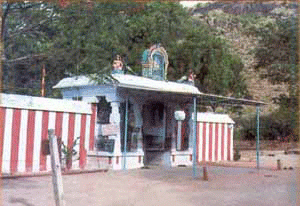
Nestled at the foothills of Ottanchathiram in the holy town of Palani, the Arulmigu Kuzhandai Vellappar Temple stands as a beacon of grace for devotees. The presiding deity here is Lord Murugan, worshipped specifically in his form as Kuzhandai Velappar (the Infant Vel God).
The Deity: The central idol is a unique Swayambhu (self-manifested) or naturally formed stone sculpture. Unlike the standing idols found in many Murugan temples, the Kuzhandai Velappar idol depicts the Lord as an infant seated on a peacock. This form symbolizes innocence, unconditional love, and the protective nature of the divine. The idol was formed in a single stone, radiating a gentle, nurturing energy that attracts parents and childless couples.
Phalaśruti (Spiritual Benefits):
- Removal of Ancestral Karma: It is strongly believed that performing specific abhishekams here cleanses Pitru Dosha (ancestral curses).
- Blessings for Children: Devotees visit to seek blessings for conceiving healthy children and for the well-being of their offspring.
- Protection (Vel): Worshipping the infant Vel protects devotees from evil forces and guides them through life’s difficulties.
2. Historical Origins & Scriptural Legend
The Legend of Ottanchathiram
Tradition holds that the temple dates back to ancient times, though specific dynastic inscriptions are less prominent here compared to the main Palani Murugan Temple. The name “Ottanchathiram” translates to “Protected Path.” Legend says Lord Murugan appeared as an infant at this specific spot to protect a devotee who was seeking refuge from worldly tribulations.
Scriptural Context: While the Thirupugalur Sthala Purana references are strong for Murugan, this specific shrine is highlighted in local Tamil devotional folklore. The idol is revered as the Dhakshina Murthy (teacher) form in an infant guise, representing the source of all wisdom.
Construction and Administration
The temple is administered by the Palani Devasthanam, the governing body of the six abodes (Arupadaiveedu) of Lord Murugan. The hill temple at the back of the Sri Kuzhandai Vellappar temple features an idol facing westward, a distinct architectural feature. Historically, stone footsteps were carved to connect the hill temple to this foothill shrine.
3. Architectural Marvels
The temple follows the classical Dravidian architectural style, characterized by its tiered gateway towers (Gopurams) and enclosed sanctum.
- The Sanctum (Garbhagriha): The main shrine is compact, focusing attention entirely on the infant idol. The sanctum is designed to create a womb-like atmosphere, emphasizing the “Kuzhandai” (infant) aspect.
- The Peacock Motif: The peacock, Lord Murugan’s vahana, is intricately carved around the base of the idol. In Dravidian art, the peacock represents beauty and the subjugation of ego.
- Hill Integration: The architecture is unique because it incorporates the natural landscape. The temple is built at the base of the slope, allowing devotees to visually connect with the hill temple above.
- Halls (Mandapas): The Palani Devasthanam has constructed three large halls (Dharmashalas) within the complex to provide free accommodation for devotees during festivals.
While the main Palani temple is a UNESCO-recognized architectural site, Kuzhandai Velappar Temple serves as a vital subsidiary shrine that showcases the softer, familial side of Dravidian temple art.
4. Darshan & Ritual Logistics
The Palani Devasthanam manages the rituals strictly to ensure order. Below are the daily operational timings.
| Session | Timings | Details |
|---|---|---|
| Morning Darshan | 06:00 AM – 12:00 PM | Includes Ushakalam (early morning) and Kalasandhi rituals. |
| Afternoon Break | 12:00 PM – 04:00 PM | Sanctum remains closed for deity rest. |
| Evening Darshan | 04:00 PM – 08:00 PM | Includes Sayarakshai rituals. Note: Festivals may extend this time. |
Key Sevas & Online Booking
Devotees can book specific services via the official Palani Devasthanam portal.
- Abhishekam (Thaila Kappu): Performed with sesame oil and milk. Ideally done on Tuesdays or Fridays.
- Archana: Chanting of Skanda Sashti Kavacham and Om Muruga mantras.
- Special Entry Darshan: Available for families with infants or elderly members.
How to Book: Visit the official Palani Devasthanam website or use the “Temple Festivals” section to schedule 2026 offerings.
2026 Major Festival Calendar
The following dates are calculated based on the Tamil calendar for the year 2026.
- Thai Poosam: January 2026 (Exact date TBD by Panchangam) – The most important festival here, marking the conferral of the Vel weapon upon Lord Murugan.
- Chithirai Thiruvizha (Tamil New Year): April 14, 2026.
- Adi 18 Festival: August 2026 – Special procession in the surrounding villages.
- Kanda Sasthi: November 2026 – Celebration of the return of Murugan after vanquishing Surapadman.
- Panguni Uthiram: March/April 2026 – Celebrating the celestial wedding of Lord Murugan.
5. Practical Visitor Guidance
Temple Etiquette & Rules
- Dress Code: Traditional attire is mandatory. Men must wear dhotis or trousers with shirts; women must wear sarees, salwar kameez, or long skirts. Casual wear like shorts and t-shirts is strictly prohibited.
- Photography: Photography is strictly prohibited inside the sanctum and the inner prakaram (corridor).
- Mobile Lockers: Lockers are available near the entrance for electronic devices and leather items, as these are not allowed inside.
- Accessibility: The temple is accessible via a paved path from the main road. However, it is located at the base of a hill slope; please wear comfortable footwear. Wheelchair access is available in the outer precincts but may be challenging inside the inner sanctum due to steps.
Crowd Management & Seasonal Advice
- Best Hours: 06:00 AM – 07:30 AM (least crowded) or 05:00 PM – 06:00 PM. Avoid weekends if possible.
- Seasonal Tips:
- May (Summer): Palani temperatures can exceed 38°C. Carry plenty of water; the Devasthanam provides free buttermilk.
- November (Northeast Monsoon): Carry an umbrella. Rain can cause slippery conditions on the hill slope paths.
6. Pilgrimage Connectivity
How to Reach Kuzhandai Velappar Temple
The temple is located in Ottanchathiram, on the outskirts of Palani.
- By Air: The nearest airport is Coimbatore International Airport (CJB), approximately 100 km away. From there, you can hire a taxi or take a bus to Palani.
- By Train: The Palani Railway Station is the closest railhead. It connects to Madurai, Coimbatore, and Chennai via the Palani Express and other lines.
- By Road: Palani is well-connected via National Highways. Buses (TNSTC) and private operators run frequent services from major cities like Chennai (420 km), Madurai (110 km), and Coimbatore (100 km).
Nearby Sacred Sites (Pilgrimage Circuit)
- Palani Murugan Temple (The Main Hill Temple): The primary seat of Murugan, located just a short drive from Ottanchathiram.
- Idumban Temple: Located at the foot of the Palani hill. Devotees typically visit Idumban before ascending the main Palani hill.
- Varathamanathi Temple: A historic temple dedicated to Lord Shiva (as Varathamanathar) and Goddess Parvati, located about 15 km from Palani.
7. Frequently Asked Questions (FAQs)
Is there a VIP darshan entry?
Yes, the Palani Devasthanam offers a Special Entry Darshan ticket. However, for the Kuzhandai Velappar Temple, the crowd is generally manageable, and VIP entry is rarely needed unless during major festivals like Thai Poosam.
Can I carry food inside the temple?
Food items are not allowed inside the sanctum. However, there is a dining hall (Annadhanam) run by the Devasthanam near the temple complex where free meals are served to devotees.
Is there accommodation available?
The temple management maintains three large halls for free accommodation within the Ottanchathiram complex. For more comfortable lodging, the main Palani temple has various choultries and private hotels nearby.
What is the best way to book seva online?
Visit the official Palani Devasthanam portal. Navigate to the “Online Seva” section, select “Kuzhandai Velappar Temple,” and choose the date and service. Payment can be made via UPI or credit/debit cards.
How old is the idol?
The exact date of construction is not documented in available records, but the idol is considered ancient, referenced in local folklore dating back several centuries. The current structure and halls have been updated by the Palani Devasthanam in recent decades.
Photo Gallery
How to Reach
Palani is approximately 100 kilometers from Coimbatore. Mode of transport from Coimbatore to Palani includes taxi, bus, and train.
By Plane
The nearest airport is in Coimbatore. Coimbatore has regular flights from Ahmedabad, Bangalore, Calicut, Chennai, Cochin, Hyderabad, Mumbai, New Delhi and Sharjah. Air India, Indigo, Spicejet, and other airlines operate flights out of Coimbatore Airport.
By Train
There is a rail line through Palani station, stretching Madurai to Coimbatore via Pollachi. Now Tiruchendur to Palani via Madurai, Chennai central – Palani Express, operating on this line.
By Bus
The state transport corporation and a lot of private bus operators ply bus from Palani to major cities in Tamil Nadu (Chennai, Coimbatore, Madurai, Trichy, Tuticorin etc.) and also to the neighboring Kerala (Palakkadu, Kochi).
Contact Details
Official Address: Palani Devasthanam, Palani, Dindigul District, Tamil Nadu – 624601
Recent Posts

Shri Kaamkoteeshwar Mandir, Varanasi – History & Significance
In the heart of Kashi, the eternal city of Lord Shiva, where the Ganges flows with celestial grace, stands the Shri Kaamkoteeshwar Mandir. This sacred Sannidhi is not merely a temple but a profound spiritual bridge between the Northern…

ओ सांवरे तूने ही मुझको संभाला – Lyrics & Meaning
ओ सांवरे तूने ही मुझको संभाला – A Prayer to Shyam Origin & Spiritual Essence Why This Bhajan Resonates Devotees chant this when overwhelmed by life’s storms—the refrain ‘तूने ही मुझको संभाला’ is the soul’s sigh of relief: “You…

कथा ये है महाराज मेरे की – Lyrics & Meaning
कथा ये है महाराज मेरे की छत्रपति संभाजी महाराज – A Prayer to Chhatrapati Sambhaji Maharaj Origin & Spiritual Essence Why This Bhajan Resonates Devotees chant this when their spirit feels tested—its powerful refrain “महाराज मेरे” is a soul’s…

Rigveda Samhita Yathartha Anuvada (ऋग्वेद संहिता यथार्थ अनुवाद) – Complete Set with Anvayartha & Hindi/English Translation
The Rigveda is the oldest surviving scripture of humanity and the foundational text of Sanātana Dharma. For serious students, scholars, UPSC aspirants studying ancient Indian history, Sanskrit learners, and spiritual seekers, a precise and grammatically structured translation is indispensable.…

आना भी अकेला है जाना भी अकेला है – Lyrics & Meaning | BharatTemples
आना भी अकेला है जाना भी अकेला है – A Prayer to the Divine Witness Origin & Spiritual Essence Why This Bhajan Resonates Devotees turn to this bhajan in moments of deep reflection—when life’s attachments begin to ache. The…

माता शेरावाली के द्वार जो भी जाता है – Lyrics & Meaning
माता शेरावाली के द्वार जो भी जाता है – A Prayer to Maa Sherawali Origin & Spiritual Essence Why This Bhajan Resonates Devotees turn to this bhajan in times of fear or uncertainty—its promise that no one leaves Maa’s…

मार लेना सपणी उबार लेणा भवरा – Lyrics & Meaning
मार लेना सपणी उबार लेणा भवरा – A Prayer to the Divine Beloved Origin & Spiritual Essence Why This Bhajan Resonates Devotees chant this in moments of deep vulnerability—its cry of “मार लेना सपणी, उबार लेणा भवरा” is the…

हमें श्याम सुंदर भरोसा तुम्हारा – Lyrics & Meaning
हमें श्याम सुंदर भरोसा तुम्हारा – A Prayer to Shyam Sundar Origin & Spiritual Essence Why This Bhajan Resonates Devotees chant this when feeling alone—its refrain ‘de do sahara’ is the soul’s cry for divine support. Lyrics in Hindi…

Mere Satguru Ne Di Thi Davai Lyrics in Hindi & Meaning
Mere Satguru Ne Di Thi Davai: Invoking the Guru’s Liberating Wisdom This soul-stirring bhajan venerates the Satguru (True Spiritual Master) as the divine physician who dispenses the only remedy for life’s deepest sufferings. Composed by Sant Karmaveer Tufani, it…

Janm Diyo Thari Maa Dukh Dekhiyo Lyrics in Hindi & Meaning
जन्म दियो थारी माँ दुख देखियो (Maa’s Grief Upon Birthing You) This soul-stirring Chetavani Bhajan (admonitory hymn) is addressed to the Divine Mother (Maa) – a call for repentance when children forget their filial duties in the dark age…