
Contents
Introduction & Spiritual Essence
Tiruparankundram Temple (also known as Tiruparankunram) is revered as the foremost and primary abode among the Arupadai Veedu (Six Sacred Battle Camps) of Lord Murugan (Subrahmanya). Situated approximately 8 kilometers southwest of Madurai, this cave temple is carved into a massive granite rock, rising 500 feet above the surrounding plain. It is uniquely associated with the element of Earth (Bhumi) among the six abodes.
Phalaśruti (Spiritual Benefits): Why do millions undertake this pilgrimage?
- Cleansing Ancestral Karma: It is believed that performing rituals here, particularly during the Pankuni Uttiram festival, aids in the redemption of ancestral debts and promotes familial harmony.
- Divine Union: As the site of Lord Murugan’s celestial wedding, it is the most auspicious destination for devotees seeking blessings for a harmonious marriage and removing delays in matrimony.
- Elemental Healing: Being a cave temple dedicated to the Earth element, it provides grounding energy and stability to the devotee’s mind.
Historical Origins & Scriptural Legend
The Celestial Wedding
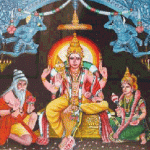
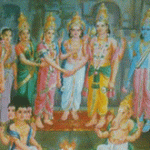
According to the Skanda Purana and Tamil hagiographies, Tiruparankundram is the site where Lord Murugan married Devayanai, the daughter of Indra (King of Devas). Following his victory over the demon Surapadma at Tiruchendur, Murugan arrived here with the liberated Devas.
Tradition holds that Indra, grateful for the victory, requested Murugan to marry his foster daughter, Devayanai. The wedding was solemnized on the hill, attended by Lord Shiva, Goddess Parvati, and the celestial assembly. The hill itself is revered as the “Southern Himalaya” where the gods converge.
Builders and Renovations
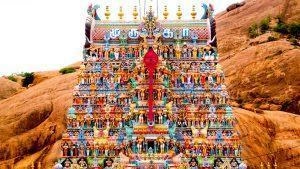
While the cave sanctum is ancient, historical records indicate significant contributions from the Pandya dynasty, with later enhancements by the Nayak rulers of Madurai during the 16th and 17th centuries. The massive Gopurams (gateway towers) were constructed under the patronage of the Nayak kings, specifically by Thirumalai Nayak. Temple records (Sthalavartham) date the structure to be over 2,000 years old in tradition, though the masonry structures are historically traced to the medieval period.
Architectural Marvels
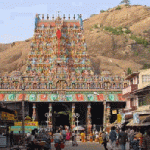
The architecture of Tiruparankundram is a sublime blend of Dravidian style and Rock-Cut engineering.
- Rock-Cut Sanctum: The inner sanctum (Garbhagriha) is a natural cave carved out of the living rock, housing the presiding deity.
- Shikhara (Vimana): Unlike typical towering Shikharas, the main shrine follows the Pandya style of rock-cut architecture, while the towering Rajagopuram (entrance tower) exhibits the Nayak architectural grandeur.
- Vastu Shastra: The temple is built according to strict Vastu principles, oriented to align with the rising sun, symbolizing the light of knowledge. The presence of a natural spring at the foot of the hill, known as Teppakulam, is a vital Vastu water element.
- Notable Sculptures: The cave walls feature exquisite carvings of deities, dancers, and mythical beasts, preserving the artistic traditions of the Pandya era.
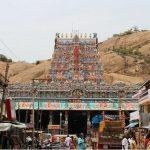
[Image Placeholder: Exterior view of the Dravidian gopuram against the rock face]
Darshan & Ritual Logistics (2026 Guide)
Below are the standard timings for Darshan and Sevas. Please note that timings may vary during festivals.
| Session | Time Slot | Description |
|---|---|---|
| Morning Darshan | 05:00 AM – 01:00 PM | Includes Ushathkalam (Early Morning) and Kalasha Pooja. |
| Afternoon Break | 01:00 PM – 04:00 PM | Temple remains closed for Abhishekam and Deeparadhana. |
| Evening Darshan | 04:00 PM – 09:30 PM | Includes Nadai Andhippazham and Palliyarai Pooja. |
| Special Poojas | 07:00 AM – 08:30 AM | Weekly Tuesdays are particularly significant for Murugan worship. |
Online Seva Booking
Devotees can book Abhishekam (ritual bathing of the deity) and Archana (chanting of names) through the official Tamil Nadu Temple Portal or the specific temple administration website. Look for the “Tiruparankundram Online Seva” section.
2026 Major Festival Dates
- Pankuni Uttiram (Wedding Festival): March 12 – March 14, 2026. (The most important festival, celebrating the divine wedding).
- Thaipusam: January 2026 (Exact date based on Tamil Calendar).
- Vaikasi Visakam: May 23, 2026 (Birth Anniversary of Lord Murugan).
- Karthigai Deepam: December 2026.
Practical Visitor Guidance
Dress Code: Traditional attire is mandatory. Men should wear Veshti (dhoti) or formal trousers with a shirt; women should wear saree, half-saree, or churidar. Shorts and t-shirts are strictly prohibited.
Photography & Mobiles: Photography is prohibited inside the sanctum sanctorum. Electronic devices must be kept silent. Dedicated lockers are available at the entrance for bags and mobile phones.
Accessibility: The hilltop temple requires climbing approximately 1,000 steps. A walking path (pathway) is available for elderly pilgrims, but it is steep. Wheelchair access is limited to the lower courtyards.
Crowd Management:
- Best Hours: 5:00 AM – 7:00 AM (Early Morning) or 6:00 PM – 8:30 PM (Evening).
- Seasonal Advice: April to June is extremely hot in Madurai; carry water and wear head coverings. The Margazhi season (Dec-Jan) is pleasant but crowded.
Pilgrimage Connectivity
How to Reach
- By Air: The nearest airport is Madurai International Airport (IXM), located 12 km away. Coimbatore is 100 km away (as per original text, though Madurai is closer).
- By Rail: Tiruparankundram Railway Station is the nearest railhead. Alternatively, Madurai Junction (MDU) is a major hub just 8 km away.
- By Road: Well-connected via NH 38 and State Highways. Frequent city buses run from Madurai Mattuthavani Bus Stand.
Nearby Sacred Sites (Circuit)
- Meenakshi Amman Temple (Madurai): The central temple of the city, 8 km away.
- Kallazhagar Temple (Alagar Hill): A Vishnu temple located 20 km from Tiruparankundram.
- Pazhamudircholai: One of the other Arupadai Veedu of Lord Murugan, located 25 km north.
Frequently Asked Questions (FAQ)
1. Is there a VIP Darshan entry available?
Yes, the temple administration offers special darshan tickets for VIPs and senior citizens. These can be purchased at the counter near the entrance upon production of valid ID.
2. Can we conduct weddings at Tiruparankundram?
Yes, since this is the site of Lord Murugan’s wedding, it is highly auspicious. However, booking the marriage hall requires advance reservation through the temple executive officer.
3. What is the significance of the name ‘Tiruparankundram’?
The name derives from the Tamil words Tiru (Holy), Paranku (Cleft/Gap in the rock), and Kundram (Hill), referring to the cleft in the massive rock structure.
4. Is the temple open on all days?
Yes, the temple is open daily, including weekends. However, hours may change during major festival days like Pankuni Uttiram.
5. What are the food facilities?
The temple provides free meals (Annadhanam) at specific times. Several vegetarian restaurants are located at the base of the hill.
Photo Gallery
How to Reach:
Palani is approximately 100 kilometers from the Coimbatore. Mode of transport from the Coimbatore to the Palani includes taxi, bus and train.
By plane
The nearest air port is in Coimbatore. Coimbatore has has regular flights from Ahmedabad, Bangalore, Calicut, Chennai, Cochin, Hyderabad, Mumbai, New Delhi and Sharjah. Air India, Kingfisher,Indigo,Spicejet and Jet Airways operate flights out of Coimbatore Airport.
By Train
There is a rail line through Palani station, stretching Madurai to Coimbatore via Pollachi. Now Tiruchendur to palani via madurai, Chennai central – Palani Express, operating on this line.
By bus
The state transport corporation and a lot of private bus operators ply bus from Palani to major cities in Tamil Nadu (Chennai, Coimbatore, Madurai, Trichy, Tuticorin etc) and also to the neighboring Kerala(Palakkadu, Kochin).
Contact Details
Official Address
Recent Posts

Shri Kaamkoteeshwar Mandir, Varanasi – History & Significance
In the heart of Kashi, the eternal city of Lord Shiva, where the Ganges flows with celestial grace, stands the Shri Kaamkoteeshwar Mandir. This sacred Sannidhi is not merely a temple but a profound spiritual bridge between the Northern…

ओ सांवरे तूने ही मुझको संभाला – Lyrics & Meaning
ओ सांवरे तूने ही मुझको संभाला – A Prayer to Shyam Origin & Spiritual Essence Why This Bhajan Resonates Devotees chant this when overwhelmed by life’s storms—the refrain ‘तूने ही मुझको संभाला’ is the soul’s sigh of relief: “You…

कथा ये है महाराज मेरे की – Lyrics & Meaning
कथा ये है महाराज मेरे की छत्रपति संभाजी महाराज – A Prayer to Chhatrapati Sambhaji Maharaj Origin & Spiritual Essence Why This Bhajan Resonates Devotees chant this when their spirit feels tested—its powerful refrain “महाराज मेरे” is a soul’s…

Rigveda Samhita Yathartha Anuvada (ऋग्वेद संहिता यथार्थ अनुवाद) – Complete Set with Anvayartha & Hindi/English Translation
The Rigveda is the oldest surviving scripture of humanity and the foundational text of Sanātana Dharma. For serious students, scholars, UPSC aspirants studying ancient Indian history, Sanskrit learners, and spiritual seekers, a precise and grammatically structured translation is indispensable.…

आना भी अकेला है जाना भी अकेला है – Lyrics & Meaning | BharatTemples
आना भी अकेला है जाना भी अकेला है – A Prayer to the Divine Witness Origin & Spiritual Essence Why This Bhajan Resonates Devotees turn to this bhajan in moments of deep reflection—when life’s attachments begin to ache. The…

माता शेरावाली के द्वार जो भी जाता है – Lyrics & Meaning
माता शेरावाली के द्वार जो भी जाता है – A Prayer to Maa Sherawali Origin & Spiritual Essence Why This Bhajan Resonates Devotees turn to this bhajan in times of fear or uncertainty—its promise that no one leaves Maa’s…

मार लेना सपणी उबार लेणा भवरा – Lyrics & Meaning
मार लेना सपणी उबार लेणा भवरा – A Prayer to the Divine Beloved Origin & Spiritual Essence Why This Bhajan Resonates Devotees chant this in moments of deep vulnerability—its cry of “मार लेना सपणी, उबार लेणा भवरा” is the…

हमें श्याम सुंदर भरोसा तुम्हारा – Lyrics & Meaning
हमें श्याम सुंदर भरोसा तुम्हारा – A Prayer to Shyam Sundar Origin & Spiritual Essence Why This Bhajan Resonates Devotees chant this when feeling alone—its refrain ‘de do sahara’ is the soul’s cry for divine support. Lyrics in Hindi…

Mere Satguru Ne Di Thi Davai Lyrics in Hindi & Meaning
Mere Satguru Ne Di Thi Davai: Invoking the Guru’s Liberating Wisdom This soul-stirring bhajan venerates the Satguru (True Spiritual Master) as the divine physician who dispenses the only remedy for life’s deepest sufferings. Composed by Sant Karmaveer Tufani, it…

Janm Diyo Thari Maa Dukh Dekhiyo Lyrics in Hindi & Meaning
जन्म दियो थारी माँ दुख देखियो (Maa’s Grief Upon Birthing You) This soul-stirring Chetavani Bhajan (admonitory hymn) is addressed to the Divine Mother (Maa) – a call for repentance when children forget their filial duties in the dark age…