
Contents
Introduction & Spiritual Essence
Nestled in the heart of Vaniyambadi, Vellore, the Azhagu Perumal Temple stands as a timeless beacon of Dravidian heritage and unwavering devotion. The presiding deity, Sundararaja Perumal (locally revered as Azhagu Perumal), is a majestic manifestation of Lord Vishnu. The name “Azhagu” translates to “Beauty” in Tamil, while “Sundara” means “Beautiful” in Sanskrit—a linguistic harmony reflecting the temple’s dual roots. Unlike typical depictions where the Lord rests on the serpent Anantha, here He stands in the Prayoga Chakra posture, ready to deploy His Sudarsana Chakra to annihilate evil and protect dharma.
Phalaśruti (Spiritual Benefits): Devotees believe that a darshan of Sundararaja Perumal here aids in the cleansing of ancestral karma. Specifically, performing rituals for departed souls (Shraddha) is believed to grant them Moksha (liberation). The temple is also renowned for resolving disputes in legal matters and bestowing marital harmony.
Historical Origins & Scriptural Legend
The Legacy of the Chola Dynasty
Historical evidence and temple inscriptions trace the origins of this sacred shrine to the 11th Century CE. According to temple records, the structure was commissioned by King Madurantaka Cholan, a ruler who preceded the legendary Rajaraja Cholan. This lineage offers a fascinating historical context: Rajaraja Cholan’s father was named Sundara Cholan, which likely inspired the name of the presiding deity, Sundararaja Perumal.
The Legend of the Beautiful Lord
Tradition holds that the land of Vaniyambadi was once a dense forest (Kaadu) where sages performed intense austerities. Overwhelmed by the devotion of the sages and the local populace, Lord Vishnu manifested here to bestow His grace. The unique Prayoga Chakra form signifies that the Lord is actively engaging to restore cosmic balance, a feature that distinguishes this temple from other Vishnu shrines in the Vellore district.
Architectural Marvels
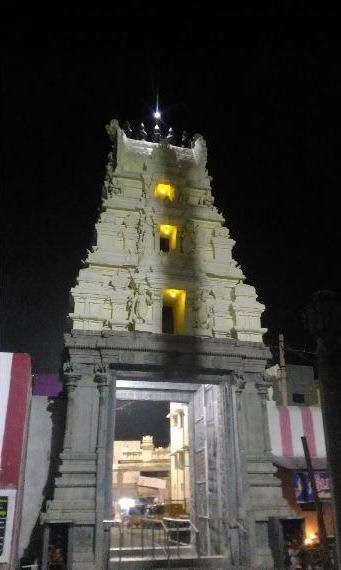
The Azhagu Perumal Temple is a quintessential example of the Dravidian architectural style. The structure emphasizes horizontal planes and intricate sculptural detailing rather than the towering verticality typical of the Nagara style found in the north.
- The Shikhara (Vimana): The temple tower above the sanctum sanctorum (Garbhagriha) features the classic Dravidian tiered structure, adorned with stucco figures depicting stories from the Puranas.
- The Mandapa: A spacious hall supported by ornate pillars allows devotees to gather for prayers and festivals. The pillars feature carvings of Dwarapalakas (guardian deities).
- The Sanctum: The inner sanctum houses the Swayambhu (self-manifested) idol of Sundararaja Perumal. The craftsmanship highlights the Chola influence in the bronze-like finish and the graceful curvature of the Lord’s posture.
While specific ASI (Archaeological Survey of India) protected status details are currently under verification, the temple remains a protected heritage site under the local HR&CE department due to its inscriptional history dating back over a millennium.
Darshan & Ritual Logistics
Planning your visit to the Azhagu Perumal Temple ensures a serene spiritual experience. Below are the standard operational timings. Please note that timings may vary slightly during festival seasons.
Daily Timings
| Darshan Session | Timings |
|---|---|
| Morning | 06:00 AM – 12:00 PM |
| Evening | 04:00 PM – 08:30 PM |
Key Sevas & Online Booking
Devotees can participate in various rituals to deepen their connection with the deity. The temple facilitates online seva booking through the Tamil Nadu HR&CE portal.
- Thirumanjanam (Abhishekam): Performed daily at 09:00 AM. This ritual involves bathing the deity with holy water, milk, and honey.
- Archana (Recitation of Names): Available throughout temple hours. Focused on Lakshmi Narasimhar and Hanuman.
- Special Alankaram: Reserved for Fridays and festival days.
Booking Link: Visit the official Arulmigu Sundararaja Perumal Temple, Vaniyambadi page on the Tamil Nadu Tourism/HR&CE website.
2026 Festival Calendar (Projected)
Mark your calendars for these significant dates in 2026:
- Brahmotsavam: April 12 – April 20 (Tentative – Check for local announcements).
- Varsha Thiruvizha (Annual Festival): Mid-April to coincide with Brahmotsavam.
- Rama Navami: April 5, 2026.
- Vaikuntha Ekadashi: December 29, 2026.
Practical Visitor Guidance
To ensure a respectful visit, please adhere to the following guidelines:
- Dress Code: Traditional attire is mandatory. Men must wear Dhoti or trousers with a shirt; women should wear Saree, Salwar Kameez, or traditional skirt and blouse. Avoid shorts and sleeveless tops.
- Photography Rules: Photography is prohibited inside the Garbhagriha (Sanctum Sanctorum). Discretion is advised in the outer prakaram.
- Mobile Lockers: Small locker facilities are available at the entrance for electronic devices if visitors wish to keep them.
- Crowd Management: The temple sees moderate crowds on weekends. Best Time to Visit: Tuesday and Friday mornings are ideal for peaceful darshan. Avoid visiting during peak midday heat in May.
- Accessibility: The temple complex is on level ground, making it accessible for senior citizens, though wheelchair access is limited due to the age of the structure.
Pilgrimage Connectivity
How to Reach
The Azhagu Perumal Temple is centrally located in Vaniyambadi, making it easily accessible.
- Nearest Railway Station: Vaniyambadi Railway Station (approx. 2 km).
- Nearest Airport: Chennai International Airport (approx. 205 km). The alternative is Bengaluru Kempegowda International Airport (approx. 150 km).
- By Road: Vaniyambadi is located on National Highway NH75 (connecting Bengaluru to Chennai) and National Highway NH48. Buses are frequent from Vellore (69 km), Tirupattur (22 km), and Ambur (20 km).
Nearby Sacred Sites (Pilgrimage Circuit)
- Narayanavanam Temple: Located ~20 km away, famous for the marriage place of Lord Venkateswara and Padmavathi Thayar.
- Kailasanathar Temple, Vaniyambadi: An ancient Shiva temple within the same town, completing the Pancha Bhoota circuit locally.
- Jolarpettai Big Temple: Approximately 19 km away, dedicated to Lord Shiva (Thyagaraja Swamy).
Frequently Asked Questions (FAQ)
1. What is the significance of the “Prayoga Chakra” at this temple?
The Prayoga Chakra represents Lord Vishnu in the act of using his Sudarsana Chakra. Unlike the resting (Yogic) or dancing (Ananda) forms, this posture symbolizes the Lord actively protecting his devotees from evil forces and intervening in karmic justice.
2. Is there a VIP Darshan entry available?
Yes, the temple administration provides a Special Darshan option for elderly citizens, differently-abled devotees, and those purchasing special entry tickets. However, in its spiritual essence, all devotees are treated equally by Lord Sundararaja.
3. Are there accommodation facilities near the temple?
While the temple complex does not have attached guest houses, Vaniyambadi town offers several lodging options and choultries at affordable rates. For better amenities, devotees often stay in Vellore (69 km away) or at the Tourist Bungalow managed by the Tourism Department in Vaniyambadi.
4. What is the historical connection to Sundara Cholan?
The temple was built by Madurantaka Cholan. His father was Sundara Cholan, and his son was the famous Raja Raja Cholan. The deity is named Sundararaja Perumal as a tribute to the father of the great king Raja Raja Cholan.
5. Can we perform Thirumanjanam for personal reasons?
Absolutely. Thirumanjanam can be performed for personal milestones such as birthdays, marriage anniversaries, or for the well-being of family members. It is highly recommended to book this at least one day in advance via the temple office.

Contact Details
Azhagu Perumal Temple (Sundararaja Perumal Temple)
Vaniyambadi, Vellore District
Tamil Nadu, India
Pro-Tip from the Architect: To truly appreciate the 11th-century stone work, visit during the early morning hours when the sun’s angle highlights the intricate carvings on the Garuda Mandapa pillars.
Recent Posts

Shri Kaamkoteeshwar Mandir, Varanasi – History & Significance
In the heart of Kashi, the eternal city of Lord Shiva, where the Ganges flows with celestial grace, stands the Shri Kaamkoteeshwar Mandir. This sacred Sannidhi is not merely a temple but a profound spiritual bridge between the Northern…

ओ सांवरे तूने ही मुझको संभाला – Lyrics & Meaning
ओ सांवरे तूने ही मुझको संभाला – A Prayer to Shyam Origin & Spiritual Essence Why This Bhajan Resonates Devotees chant this when overwhelmed by life’s storms—the refrain ‘तूने ही मुझको संभाला’ is the soul’s sigh of relief: “You…

कथा ये है महाराज मेरे की – Lyrics & Meaning
कथा ये है महाराज मेरे की छत्रपति संभाजी महाराज – A Prayer to Chhatrapati Sambhaji Maharaj Origin & Spiritual Essence Why This Bhajan Resonates Devotees chant this when their spirit feels tested—its powerful refrain “महाराज मेरे” is a soul’s…

Rigveda Samhita Yathartha Anuvada (ऋग्वेद संहिता यथार्थ अनुवाद) – Complete Set with Anvayartha & Hindi/English Translation
The Rigveda is the oldest surviving scripture of humanity and the foundational text of Sanātana Dharma. For serious students, scholars, UPSC aspirants studying ancient Indian history, Sanskrit learners, and spiritual seekers, a precise and grammatically structured translation is indispensable.…

आना भी अकेला है जाना भी अकेला है – Lyrics & Meaning | BharatTemples
आना भी अकेला है जाना भी अकेला है – A Prayer to the Divine Witness Origin & Spiritual Essence Why This Bhajan Resonates Devotees turn to this bhajan in moments of deep reflection—when life’s attachments begin to ache. The…

माता शेरावाली के द्वार जो भी जाता है – Lyrics & Meaning
माता शेरावाली के द्वार जो भी जाता है – A Prayer to Maa Sherawali Origin & Spiritual Essence Why This Bhajan Resonates Devotees turn to this bhajan in times of fear or uncertainty—its promise that no one leaves Maa’s…

मार लेना सपणी उबार लेणा भवरा – Lyrics & Meaning
मार लेना सपणी उबार लेणा भवरा – A Prayer to the Divine Beloved Origin & Spiritual Essence Why This Bhajan Resonates Devotees chant this in moments of deep vulnerability—its cry of “मार लेना सपणी, उबार लेणा भवरा” is the…

हमें श्याम सुंदर भरोसा तुम्हारा – Lyrics & Meaning
हमें श्याम सुंदर भरोसा तुम्हारा – A Prayer to Shyam Sundar Origin & Spiritual Essence Why This Bhajan Resonates Devotees chant this when feeling alone—its refrain ‘de do sahara’ is the soul’s cry for divine support. Lyrics in Hindi…

Mere Satguru Ne Di Thi Davai Lyrics in Hindi & Meaning
Mere Satguru Ne Di Thi Davai: Invoking the Guru’s Liberating Wisdom This soul-stirring bhajan venerates the Satguru (True Spiritual Master) as the divine physician who dispenses the only remedy for life’s deepest sufferings. Composed by Sant Karmaveer Tufani, it…

Janm Diyo Thari Maa Dukh Dekhiyo Lyrics in Hindi & Meaning
जन्म दियो थारी माँ दुख देखियो (Maa’s Grief Upon Birthing You) This soul-stirring Chetavani Bhajan (admonitory hymn) is addressed to the Divine Mother (Maa) – a call for repentance when children forget their filial duties in the dark age…