
Contents
In the sacred geography of Brij Bhoomi, the villages of Barsana and Nandgaon stand as eternal monuments to the dual nature of the Divine. Located approximately 7 kilometers apart, these two hill towns represent the homes of Srimati Radha Rani and Lord Shri Krishna, respectively. For centuries, pilgrims have traveled between these two peaks, retracing the path of messengers and divine lovers, experiencing a landscape where every stone is steeped in Madhurya Rasa (the mellow of sweet devotion).
Phalaśruti: Why Visit Barsana & Nandgaon?
According to Vedic scriptures, a pilgrimage to the hills of Bhanugarh (Barsana) and Nandishwar (Nandgaon) is essential for cleansing Paused Karma and awakening the dormant Bhakti Rasa within the soul. Unlike the majestic temples of Mathura or the royal courts of Dwarka, these villages offer a unique spiritual benefit—the ability to witness the Lord in his most accessible, childlike form. Devotees believe that walking the path between these two villages removes the barriers of the material world, allowing one to experience the Gopi Bhava—the selfless, intense love that Radha Rani feels for Krishna.
Historical Origins & Scriptural Legend
The spiritual power of these locations is rooted in the Sthala Purana (local oral legends) and ancient texts. Tradition holds that the Bhagavata Purana explicitly details the divine pastimes (Leelas) that occurred on these very hills.
Barsana: The Birth of Radha Rani
Barsana is situated atop Bhanugarh Hill and is the birthplace of Radha Rani, the personification of Hladini Shakti (the pleasure potency of the Divine). The town is built across four peaks of the Brahmagiri Mountain, said to represent the four heads of Lord Brahma. While historical records are scarce due to the age of the site, temple priests trace the establishment of the primary worship deities back to King Vajranabha (Krishna’s great-grandson), who later restored the shrines during the 16th century to preserve the ancient energy of the site.
Nandgaon: The Abode of Nanda Maharaja
Nandgaon is situated on Nandishwar Hill. It is said that when Krishna was a child, Nanda Maharaja moved his family from Gokul to this fortified hill to protect the infant Lord from the attacks of Kansa. The hill was shaped by the footprints (Padukas) of Nanda Baba, making it a site of immense patriarchal energy and protection.
Architectural Marvels
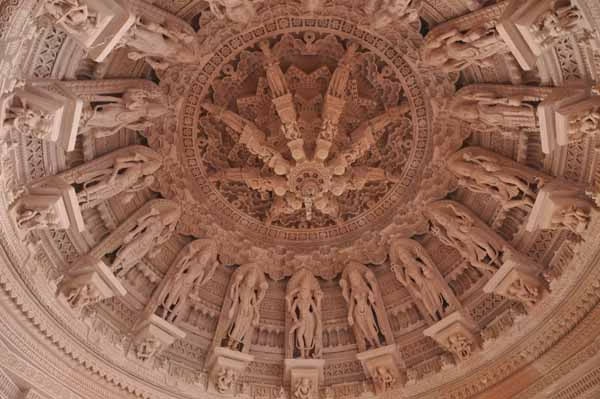
The temples of Barsana and Nandgaon are prime examples of North Indian temple architecture, specifically the Nagara style, characterized by tall shikharas (spires) and intricate carvings. They reflect the deep-rooted Vastu Shastra principles, aligning the energy of the earth (Bhumi) with the sky (Nabhas).
Shriji Temple (Barsana)
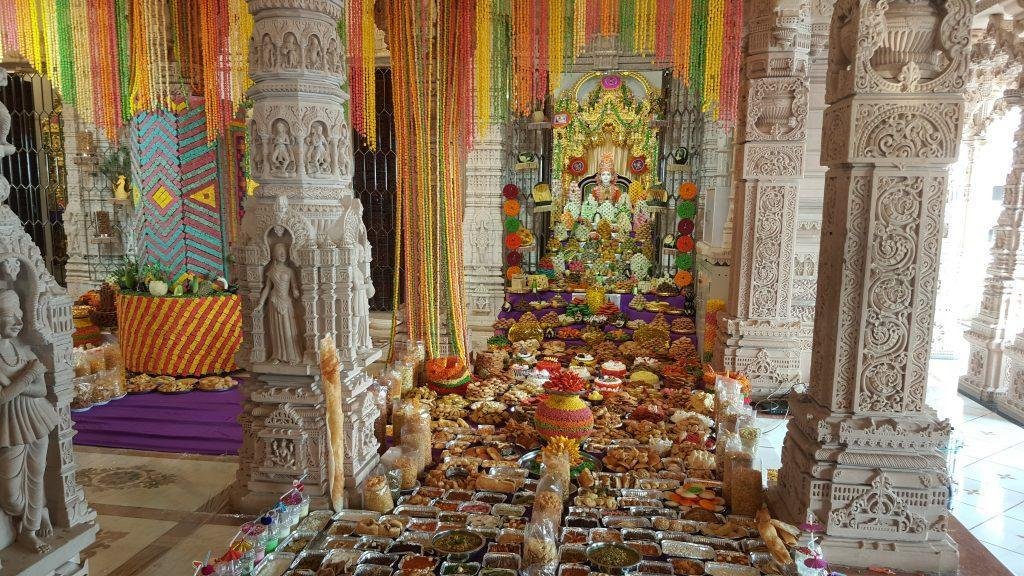
The spiritual crown of Barsana is the Shriji Temple (Radha Rani Mandir). Constructed from red sandstone, this temple is an architectural marvel of the medieval period. The main sanctum is accessible by climbing over 250 steps, symbolizing the arduous but rewarding ascent of the soul toward divine love. The temple features a towering Shikhara adorned with finials and miniature spires. The interiors house the mesmerizing deities of Shri Laali Ji (Radha) and her companions, adorned with traditional jewelry and floral motifs.
Nand Bhavan (Nandgaon)
The main temple, Nand Bhavan, sits at the highest point of the hill and is famously known as Chaurasi Khamba (84 Pillars). The architecture here is distinct; the 84 pillars are not merely structural supports but symbolic representations of the 8.4 million species of life that seek shelter under the Lord’s protection. The temple layout facilitates a circular darshan of the entire family—Nanda Baba, Yashoda Maiya, Lord Krishna, and Lord Balarama.
Darshan & Ritual Logistics
To facilitate a smooth spiritual experience, devotees should be aware of the temple schedules and seva opportunities. Below are the general timings for the 2026 pilgrimage season. Note: Timings may vary slightly during festivals.
| Temple | Morning Darshan | Evening Darshan | Aarti/Abhishek |
|---|---|---|---|
| Shriji Temple (Barsana) | 5:30 AM – 12:30 PM | 4:00 PM – 9:00 PM | Mangala 5:30 AM Shayan 9:00 PM |
| Nand Bhavan (Nandgaon) | 6:00 AM – 1:00 PM | 4:30 PM – 8:30 PM | Mangala 6:00 AM Shayan 8:30 PM |
Key Sevas & Online Booking
Devotees can book specific sevas (services) such as Abhishekam (ritual bathing of the deity), Archana (recitation of names), and Pushpanjali (flower offering). For the 2026 season, these can be booked via the official district tourism portals or at the temple counters.
2026 Festival Calendar
Planning your visit around these festivals is highly recommended for a vibrant experience:
- Radha Ashtami: August 27, 2026 (Major festival in Barsana).
- Janmashtami: September 14, 2026 (Celebrated with grandeur in Nandgaon).
- Holi (Lathmar Holi): March 2026 (Dates vary by lunar calendar; typically begins 15 days before the main event).
- Devshayani Ekadashi: July 5, 2026.
Practical Visitor Guidance
Preparation is key to a comfortable pilgrimage to the hills of Brij.
Rules & Code of Conduct
| Category | Advice for Devotees |
|---|---|
| Attire | Modest traditional clothing is mandatory. Men should wear dhoti/kurta or trousers; women should wear sarees or salwar kameez. Avoid shorts and sleeveless tops. |
| Footwear | You must remove footwear before climbing temple steps. Wear easy-to-slip-on footwear like sandals or chappals. |
| Mobiles & Lockers | Photography is strictly prohibited inside the inner sanctum. Mobile phones and leather items must be deposited at free cloakrooms provided at the base of the hills. |
| Monkeys | Both towns have a large population of monkeys. Do not carry open food items, snacks, or shiny objects (sunglasses, glasses) visibly. If approached, stay calm and avoid eye contact. |
| Accessibility | The climbs are steep. Doli (Palanquin) services and electric rickshaws are available at the base of both hills for elderly devotees and those with mobility issues (subject to availability). |
Crowd Management & Seasonal Advice
Best Time to Visit: October to March offers pleasant weather. Summers (April–June) are extremely hot; carry ample water and cover your head.
Avoiding Crowds: Weekends and festivals see massive influxes. For a peaceful Darshan, visit on a weekday morning (Tuesday to Thursday) between 8:00 AM and 11:00 AM. The evening Aarti (around 6:30 PM) is crowded but spiritually charged; arrive at least an hour early to secure a spot.
Pilgrimage Connectivity
Barsana and Nandgaon are integral parts of the Braj Parikrama (circuit) and are well-connected by road.
How to Reach
- By Air: The nearest airport is Indira Gandhi International Airport, New Delhi (approx. 150 km). From there, hire a taxi or take a bus to Mathura/Vrindavan.
- By Rail: The nearest major railway junction is Mathura Junction (MTJ) (approx. 40-50 km). Prem Nagar and Barsana Railway Station are smaller stops nearby but have limited trains.
- By Road: Both villages are connected via State Highway 151 (Uttar Pradesh) and link roads from Mathura. Regular buses and shared auto-rickshaws run from Mathura and Radha Kund.
Nearby Sacred Sites
To complete the Braj Bhoomi experience, visit these nearby locations:
- Radha Kund (Near Barsana): A highly sacred tank believed to be created by Radha Rani herself. Located 2 km from Shriji Temple.
- Vrindavan (30 km away): Home to Banke Bihari and ISKCON temples.
- Goverdhan (15 km away): The site of the Annakut mountain lifted by Lord Krishna.
Frequently Asked Questions (FAQ)
While there is no formal VIP entry like in South Indian temples, devotees can perform Nitya Seva or book special Puja tickets in advance to bypass general queues during non-festival days. During peak festivals, all devotees are treated equally, and queues can be 2-3 hours long.
Yes, absolutely. The distance is approximately 7 km and takes about 20 minutes by taxi. A typical itinerary starts with the morning Darshan of Radha Rani in Barsana, followed by a visit to Radha Kund, and then an evening Darshan of Nanda Maharaja in Nandgaon.
Yes. In Barsana, there are several Dharamshalas and guest houses (such as Sriji Seva Sadan). In Nandgaon, the Nand Bhavan complex and nearby Vrindavan offer a wide range of accommodations from budget lodges to mid-range hotels.
Lathmar Holi is a unique tradition where women of Barsana playfully beat men from Nandgaon with sticks, while men defend themselves with shields. It symbolizes the divine teasing between Radha and Krishna. This ritual reinforces the eternal bond between the two villages and is the most anticipated event in the Braj calendar.
The temples are atop hills and require climbing stairs. For the elderly and young children, the Doli (palanquin) service is available, which allows devotees to be carried up the hill. Electric rickshaws are also available for the approach roads.
Recent Posts

Shri Kaamkoteeshwar Mandir, Varanasi – History & Significance
In the heart of Kashi, the eternal city of Lord Shiva, where the Ganges flows with celestial grace, stands the Shri Kaamkoteeshwar Mandir. This sacred Sannidhi is not merely a temple but a profound spiritual bridge between the Northern…

ओ सांवरे तूने ही मुझको संभाला – Lyrics & Meaning
ओ सांवरे तूने ही मुझको संभाला – A Prayer to Shyam Origin & Spiritual Essence Why This Bhajan Resonates Devotees chant this when overwhelmed by life’s storms—the refrain ‘तूने ही मुझको संभाला’ is the soul’s sigh of relief: “You…

कथा ये है महाराज मेरे की – Lyrics & Meaning
कथा ये है महाराज मेरे की छत्रपति संभाजी महाराज – A Prayer to Chhatrapati Sambhaji Maharaj Origin & Spiritual Essence Why This Bhajan Resonates Devotees chant this when their spirit feels tested—its powerful refrain “महाराज मेरे” is a soul’s…

Rigveda Samhita Yathartha Anuvada (ऋग्वेद संहिता यथार्थ अनुवाद) – Complete Set with Anvayartha & Hindi/English Translation
The Rigveda is the oldest surviving scripture of humanity and the foundational text of Sanātana Dharma. For serious students, scholars, UPSC aspirants studying ancient Indian history, Sanskrit learners, and spiritual seekers, a precise and grammatically structured translation is indispensable.…

आना भी अकेला है जाना भी अकेला है – Lyrics & Meaning | BharatTemples
आना भी अकेला है जाना भी अकेला है – A Prayer to the Divine Witness Origin & Spiritual Essence Why This Bhajan Resonates Devotees turn to this bhajan in moments of deep reflection—when life’s attachments begin to ache. The…

माता शेरावाली के द्वार जो भी जाता है – Lyrics & Meaning
माता शेरावाली के द्वार जो भी जाता है – A Prayer to Maa Sherawali Origin & Spiritual Essence Why This Bhajan Resonates Devotees turn to this bhajan in times of fear or uncertainty—its promise that no one leaves Maa’s…

मार लेना सपणी उबार लेणा भवरा – Lyrics & Meaning
मार लेना सपणी उबार लेणा भवरा – A Prayer to the Divine Beloved Origin & Spiritual Essence Why This Bhajan Resonates Devotees chant this in moments of deep vulnerability—its cry of “मार लेना सपणी, उबार लेणा भवरा” is the…

हमें श्याम सुंदर भरोसा तुम्हारा – Lyrics & Meaning
हमें श्याम सुंदर भरोसा तुम्हारा – A Prayer to Shyam Sundar Origin & Spiritual Essence Why This Bhajan Resonates Devotees chant this when feeling alone—its refrain ‘de do sahara’ is the soul’s cry for divine support. Lyrics in Hindi…

Mere Satguru Ne Di Thi Davai Lyrics in Hindi & Meaning
Mere Satguru Ne Di Thi Davai: Invoking the Guru’s Liberating Wisdom This soul-stirring bhajan venerates the Satguru (True Spiritual Master) as the divine physician who dispenses the only remedy for life’s deepest sufferings. Composed by Sant Karmaveer Tufani, it…

Janm Diyo Thari Maa Dukh Dekhiyo Lyrics in Hindi & Meaning
जन्म दियो थारी माँ दुख देखियो (Maa’s Grief Upon Birthing You) This soul-stirring Chetavani Bhajan (admonitory hymn) is addressed to the Divine Mother (Maa) – a call for repentance when children forget their filial duties in the dark age…