
Contents
- 1 Choleeswarar Temple, Sengalipuram: A Definitive Pilgrimage Guide
- 1.1 1. Introduction & Spiritual Essence
- 1.2 2. Historical Origins & Scriptural Legend
- 1.3 3. Architectural Marvels
- 1.4 4. Darshan & Ritual Logistics
- 1.5 5. Practical Visitor Guidance
- 1.6 6. Pilgrimage Connectivity
- 1.7 7. Frequently Asked Questions (FAQs)
- 1.7.1 1. Is there a VIP Darshan entry at Choleeswarar Temple?
- 1.7.2 2. What is the significance of the name ‘Choleeswarar’?
- 1.7.3 3. Are there accommodation facilities available in Sengalipuram?
- 1.7.4 4. What is the significance of the Naga (Serpent) shrine here?
- 1.7.5 5. Can I visit this temple along with a Kumbakonam temple tour?
- 1.8 Photo Gallery
- 1.9 How to Reach
- 1.10 Contact Details
Choleeswarar Temple, Sengalipuram: A Definitive Pilgrimage Guide
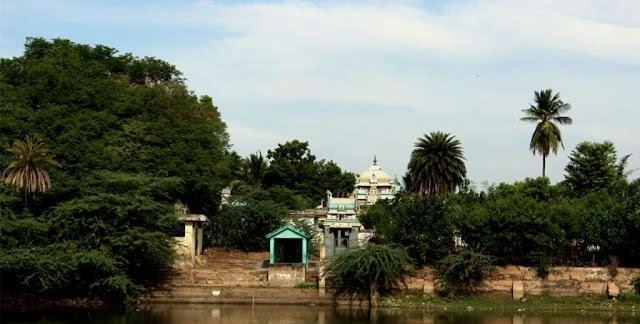
Welcome to the sacred grounds of Choleeswarar Temple, a timeless Abode of Lord Shiva nestled in the serene village of Sengalipuram, Thiruvarur district. As we look toward a spiritual journey in 2026, this guide serves as your comprehensive roadmap to understanding the divine energy, architectural brilliance, and logistical details of this ancient shrine.
1. Introduction & Spiritual Essence
The Choleeswarar Temple is a sanctuary of devotion, revered as one of the Pancha Ishwarams (five primary Shiva temples) of the ancient Chola kingdom. Here, the primary deity, Lord Choleeswarar, is enshrined as a Swayambhu (self-manifested) Lingam, radiating an aura of primordial power.
Why Devotees Visit: The Phalaśruti
According to ancient hymns and local tradition, the temple holds immense spiritual potency. Devotees flock here seeking:
- Resolution of Ancestral Karma: Rituals performed here are believed to liberate ancestors from celestial debts, offering them peace.
- Divine Union: Unmarried devotees pray to Mangalambal, the consort of Choleeswarar, for an auspicious marriage alliance.
- Removal of Doshas: The temple is associated with the Naga (serpent) shrine, making it a potent site for the removal of Naga Dosha and related afflictions.
2. Historical Origins & Scriptural Legend
Builders and Dynasties
While specific structural inscriptions are still being cataloged by archaeologists, the architectural style strongly points to the Medieval Chola Period (circa 9th-12th Century CE). The temple was likely commissioned by a local Chola chieftain under the patronage of the great Chola emperors who ushered in a golden age of temple architecture.
The Sthala Purana (Legend of Sengalipuram)
Tradition holds that the village was once dense with Sengal (Red Lime) trees, giving it the name Sengalipuram. It is believed that two great sages, Agastya and Kubera, worshipped Lord Shiva at this very site.
According to local lore, Kubera, the custodian of wealth, was cursed with poverty and physical deformity. He performed intense penance here to Lord Choleeswarar. Pleased by his devotion, Lord Shiva granted him redemption and restored his prosperity. Hence, the temple is viewed as a place where material lack is transformed into abundance.
3. Architectural Marvels
The Choleeswarar Temple stands as a testament to the zenith of Dravidian Architecture. The complex is designed according to the principles of Vastu Shastra, aligning cosmic energies with terrestrial structures.
- The Shikhara (Vimana): The sanctum sanctorum features a pyramidal tower (Vimana) typical of the Dravidian style, adorned with intricate carvings of deities, mythical beasts, and floral motifs.
- Prakaram (Circumambulation Path): The temple is enclosed by a massive compound wall, allowing for the traditional Pradakshina (circumambulation). The corridors feature carved pillars that produce musical notes when tapped.
- The Nandi: Facing the presiding deity is the majestic Nandi (the bull mount of Shiva), carved from a single block of stone.
4. Darshan & Ritual Logistics
To assist your visit in the upcoming year, we have compiled the anticipated timings and ritual schedules for 2026. Please note that timings may vary slightly during festivals.
Daily Timings
| Period | Timing | Pooja Details |
|---|---|---|
| Morning | 6:00 AM – 12:00 PM | Ushatkalam, Kalasanthi, Uchikalam |
| Afternoon | 12:00 PM – 4:00 PM | Temple remains closed |
| Evening | 4:00 PM – 8:30 PM | Sayarakshai, Arthajama Pooja |
Key Sevas & Booking
While local administrative systems are traditional, many Tamil Nadu temples are adopting digital booking. For Choleeswarar Temple, specific sevas include:
- Abhishekam: Performed on Mondays and Pradosham.
- Archana: Personalized prayers offered to the deity.
- Online Seva Booking: Currently, bookings are primarily handled at the temple counter. However, devotees are advised to check the Tamil Nadu Hindu Religious and Charitable Endowments (HR&CE) website for potential online integration in 2026.
2026 Major Festival Dates
- Pradosham: 14th January & 29th January 2026 (Typically observed bi-monthly).
- Maha Shivaratri: 26th February 2026 (Major celebration, likely including late-night Vishwaroopa Darshan).
- Aadi Perukku: 29th July 2026 (Celebrated with river rituals near Kudavasal).
- Arudra Darshan: 6th January 2026 (Celebration of Nataraja).
5. Practical Visitor Guidance
Ensuring a hassle-free pilgrimage requires preparation.
Code of Conduct & Dress Code
As a traditional temple, modesty is key. Men are required to remove shirts and wear dhotis or formal trousers. Women are expected to wear sarees, salwar kameez, or other traditional attire. Western clothing like shorts and t-shirts are generally discouraged.
Photography & Mobiles
Photography is strictly prohibited inside the Garbhagriha (Sanctum Sanctorum). Mobile phones should be kept on silent mode. Lockers are not available on-site; hence, it is advisable to travel light.
Crowd Management & Seasonal Advice
- Best Hours: The early morning slot (6:00 AM – 7:30 AM) offers the most peaceful darshan.
- Summer (May 2026): The Thiruvarur district experiences high humidity. Carry a water bottle, a handkerchief, and wear open footwear. The stone floors become extremely hot by midday.
- Monsoon: Carry an umbrella during October to December.
6. Pilgrimage Connectivity
Sengalipuram is well-connected by road, making it accessible for pilgrims traveling across the Cauvery Delta.
How to Reach
- By Road: The temple is located approximately 4 Kms from Kudavasal. It is 20 Kms from Thiruvarur, 22 Kms from Kumbakonam, and 8 Kms from Engan. The roads are well-maintained, falling under the State Highway network.
- By Train: The nearest Railway Station is Koradacherry (approx. 16 Kms). The major rail hub is Kumbakonam.
- By Air: The nearest Airport is Trichy (Tiruchirappalli) International Airport, located approximately 113 Kms away.
Nearby Sacred Sites
- Abiramieswarar Temple (Thirukkuzhanthai): Located nearby, this is another historic Shiva temple dedicated to the destruction of poison (Visham).
- Kalyana Pasupatheeswarar Temple (Thiruvidaimarudur): A significant temple just a short drive away, representing the scene of Lord Shiva’s marriage.
- Kumbeshwarar Temple (Kumbakonam): The iconic central temple of the town, featuring towering gopurams.
7. Frequently Asked Questions (FAQs)
1. Is there a VIP Darshan entry at Choleeswarar Temple?
As a smaller, community-centric temple, VIP darshan facilities are limited. However, donors contributing to temple maintenance may receive priority access. It is best to consult the temple executive officer upon arrival.
2. What is the significance of the name ‘Choleeswarar’?
The name translates to “The Lord of the Cholas.” It signifies the temple’s historical patronage by the Chola dynasty and the belief that the deity protects the boundaries of the Chola territory.
3. Are there accommodation facilities available in Sengalipuram?
Sengalipuram is a small village with limited lodging. For comfortable stays, we recommend booking accommodation in the nearby towns of Kumbakonam or Thiruvarur, where a range of hotels and choultries are available.
4. What is the significance of the Naga (Serpent) shrine here?
The temple is renowned for its powerful Naga Sthapanam (installation of serpent deities). Devotees perform milk abhishekam to the Nagas here to remove Sarpa Dosha and seek blessings for fertility and progeny.
5. Can I visit this temple along with a Kumbakonam temple tour?
Absolutely. The temple is located just 22 km from Kumbakonam and fits perfectly into the popular “Panchakshara” temple tour circuit of the delta region.
Photo Gallery




How to Reach
Choleeswarar Temple is located at about 4 Kms from Kudavasal. 20 Kms from Thiruvarur, 22 Kms from Kumbakonam, 4 Kms from Simizhi, 2.5 Kms from Pudukkudi, 8 Kms from Engan, 16 Kms from Koradacherry and 113 Kms from Trichy. Nearest Railway Station is located at Koradacherry and Nearest Airport is located at Trichy.
Contact Details
Official Address: Choleeswarar Temple, Sengalipuram, Thiruvarur District, Tamil Nadu.
Recent Posts

ओ सांवरे तूने ही मुझको संभाला – Lyrics & Meaning
ओ सांवरे तूने ही मुझको संभाला – A Prayer to Shyam Origin & Spiritual Essence Why This Bhajan Resonates Devotees chant this when overwhelmed by life’s storms—the refrain ‘तूने ही मुझको संभाला’ is the soul’s sigh of relief: “You…

कथा ये है महाराज मेरे की – Lyrics & Meaning
कथा ये है महाराज मेरे की छत्रपति संभाजी महाराज – A Prayer to Chhatrapati Sambhaji Maharaj Origin & Spiritual Essence Why This Bhajan Resonates Devotees chant this when their spirit feels tested—its powerful refrain “महाराज मेरे” is a soul’s…

Rigveda Samhita Yathartha Anuvada (ऋग्वेद संहिता यथार्थ अनुवाद) – Complete Set with Anvayartha & Hindi/English Translation
The Rigveda is the oldest surviving scripture of humanity and the foundational text of Sanātana Dharma. For serious students, scholars, UPSC aspirants studying ancient Indian history, Sanskrit learners, and spiritual seekers, a precise and grammatically structured translation is indispensable.…

आना भी अकेला है जाना भी अकेला है – Lyrics & Meaning | BharatTemples
आना भी अकेला है जाना भी अकेला है – A Prayer to the Divine Witness Origin & Spiritual Essence Why This Bhajan Resonates Devotees turn to this bhajan in moments of deep reflection—when life’s attachments begin to ache. The…

माता शेरावाली के द्वार जो भी जाता है – Lyrics & Meaning
माता शेरावाली के द्वार जो भी जाता है – A Prayer to Maa Sherawali Origin & Spiritual Essence Why This Bhajan Resonates Devotees turn to this bhajan in times of fear or uncertainty—its promise that no one leaves Maa’s…

मार लेना सपणी उबार लेणा भवरा – Lyrics & Meaning
मार लेना सपणी उबार लेणा भवरा – A Prayer to the Divine Beloved Origin & Spiritual Essence Why This Bhajan Resonates Devotees chant this in moments of deep vulnerability—its cry of “मार लेना सपणी, उबार लेणा भवरा” is the…

हमें श्याम सुंदर भरोसा तुम्हारा – Lyrics & Meaning
हमें श्याम सुंदर भरोसा तुम्हारा – A Prayer to Shyam Sundar Origin & Spiritual Essence Why This Bhajan Resonates Devotees chant this when feeling alone—its refrain ‘de do sahara’ is the soul’s cry for divine support. Lyrics in Hindi…

Mere Satguru Ne Di Thi Davai Lyrics in Hindi & Meaning
Mere Satguru Ne Di Thi Davai: Invoking the Guru’s Liberating Wisdom This soul-stirring bhajan venerates the Satguru (True Spiritual Master) as the divine physician who dispenses the only remedy for life’s deepest sufferings. Composed by Sant Karmaveer Tufani, it…

Janm Diyo Thari Maa Dukh Dekhiyo Lyrics in Hindi & Meaning
जन्म दियो थारी माँ दुख देखियो (Maa’s Grief Upon Birthing You) This soul-stirring Chetavani Bhajan (admonitory hymn) is addressed to the Divine Mother (Maa) – a call for repentance when children forget their filial duties in the dark age…
Bhadi Sabha Mein Thane Manaun Lyrics in Hindi & Meaning
Bhadi Sabha Mein Thane Manaun: Invoking the Spear-Wielding Mother Mata Bhawani (श्री ज्वाला भवानी), the fiery manifestation of Shakti worshipped as the Protector of Dharma in Her Dhaulagarh sanctum. Origin & Spiritual Essence Composed in Rajasthani folk tradition by…