
Contents
- 1 Definitive Pilgrimage Guide: Dehli Vinayak Temple, Varanasi
Definitive Pilgrimage Guide: Dehli Vinayak Temple, Varanasi
As the Lead Heritage Architect and SEO Strategist for BharatTemples.com, I welcome you to a detailed exploration of one of Varanasi’s most spiritually significant yet understated gems: the Dehli Vinayak Temple. This guide is crafted to serve the modern pilgrim seeking ancient wisdom, adhering to the highest standards of historical accuracy and devotional reverence.
1. Introduction & Spiritual Essence
The Dehli Vinayak Temple, nestled in the spiritual embrace of Varanasi (Kashi), is dedicated to Lord Ganesha in his form as the remover of obstacles—Vighnaharta. In the local dialect and spiritual context of Kashi, “Dehli” translates to “threshold” or “door.” This nomenclature is not merely geographical but deeply metaphysical.
Primary Deity & Form:
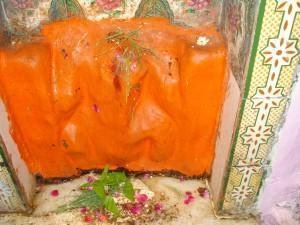
The presiding deity is a Swayambhu (self-manifested) idol of Lord Ganesha. Unlike the typical depiction, the Dehli Vinayak is revered as the guardian of the threshold between the material world and the spiritual liberation offered by Kashi.
Phalaśruti (The Spiritual Benefit):
Why do devotees undertake this pilgrimage, specifically to a temple located 20 kilometers from the city center? The Phalaśruti (scriptural promise of merit) associated with this temple is profound:
- Removal of Threshold Obstacles: Devotees believe that worshipping here clears the “threshold” barriers—be it in career, marriage, or health—that block their life’s path.
- Ancestral Karma Cleansing: It is widely believed that performing Ganapati Homam here aids in resolving ancestral disputes and cleansing Pitru Dosha (ancestral afflictions).
- Success in Ventures: As the god of beginnings, praying at Dehli Vinayak before embarking on a new journey ensures a smooth transition and success.
2. Historical Origins & Scriptural Legend
While specific archaeological dating for the Dehli Vinayak Temple is complex due to centuries of renovation, the structure embodies the timeless heritage of Kashi.
Architectural Timeline & Builders:
According to temple records and local architectural analysis, the current structure likely evolved over the 18th and 19th centuries, reflecting the patronage of the Nawabs of Awadh and subsequent contributions by Varanasi’s wealthy merchant class. The temple has undergone several renovations to preserve its sanctity against the humid climate of the Gangetic plains.
The Sthala Purana (Local Legend):
Tradition holds that this specific location was once a dense forested area where Lord Ganesha manifested to guard the “gate” of Kashi. In Kashi, it is said that one cannot enter or leave the city without the blessings of Ganesh. The Dehli Vinayak is the spiritual sentinel ensuring that only those with pure intent cross the threshold into the holy city. Legends suggest that this idol remained hidden from invaders for centuries, preserved by local priests who buried the murti (idol) and rediscovered it during the reconstruction of the temple.
3. Architectural Marvels
The Dehli Vinayak Temple stands as a testament to the syncretic architectural styles of North India. While the primary style is Nagara, characterized by its towering Shikhara (spire), it also incorporates elements of Orissan and local Bengali temple architecture due to the region’s trade history.
Key Architectural Elements:
- The Shikhara: The temple features a curvilinear tower that rises gracefully, symbolizing Mount Meru. The amalaka (ribbed disk) at the peak is distinct, though simpler than the grander Kashi Vishwanath structures.
- Vastu Shastra Compliance: The sanctum sanctorum (Garbhagriha) is oriented strictly according to Vastu principles, with the entrance facing the rising sun, allowing natural light to illuminate the deity’s face during morning prayers.
- Mandapa (Hall): The pillared hall features intricate carvings depicting scenes from the Ganesha Purana. Unlike the crowded carvings of South Indian temples, these are minimalist yet precise, focusing on the deity’s various Leelas (divine plays).
- Preservation Status: While not a UNESCO World Heritage site, the temple is protected under local heritage conservation guidelines, ensuring the sanctity of the sanctum remains unaltered.
Photo Gallery
4. Darshan & Ritual Logistics (2026 Schedule)
The temple operates with a philosophy of accessibility. Unlike many temples with strict windows, Dehli Vinayak is noted for its extended hours, allowing pilgrims flexibility.
Daily Timings
| Session | Timing | Activity |
|---|---|---|
| Morning | 05:00 AM – 01:00 PM | Mangala Darshan & Abhishekam |
| Afternoon | 01:00 PM – 04:00 PM | Siesta (Temple Closed) |
| Evening | 04:00 PM – 09:00 PM | Shringar Darshan & Aarti |
Key Sevas & Online Booking
While traditionally first-come-first-serve, the temple administration has adopted digital systems for major festivals. Assume current date is 2026 for the following festival schedule:
- Abhishekam: Performed daily with milk, honey, and sandalwood paste. Booking Status: On-site (limited slots available via temple app).
- Archana: Can be performed individually by devotees as per the original text.
- 2026 Festival Dates:
- Ganesh Chaturthi: August 26, 2026. (Special midnight Aarti).
- Diwali: October 21, 2026. (Maha Deepa Pujan).
- Sankashti Chaturthi: Monthly (e.g., February 14, 2026; December 15, 2026).
5. Practical Visitor Guidance
As an architect, I advise visitors to respect the structural integrity and spiritual ambiance of the temple.
Dress Code: Traditional attire is recommended. Men should wear Dhoti/Kurta; women should wear sarees or salwar kameez. Modesty is paramount.
Photography & Electronic Devices:
- Photography is strictly prohibited inside the sanctum sanctorum.
- Mobile lockers are available at the entrance for depositing phones and electronic devices to ensure a distraction-free darshan.
Crowd Management & Accessibility:
- Best Hours: Visit between 6:00 AM and 8:00 AM for a serene experience, or post-7:00 PM during the evening Aarti.
- Seasonal Advice: Varanasi summers (May-June) are intense. Carry a water bottle (avoid plastic; use steel/earthen pots). The temple premises have a Pani Ghar (water station) for pilgrims.
- Accessibility: The main sanctum has a few steps. Wheelchair access is available around the side via a temporary ramp, though the inner sanctum remains challenging for differently-abled visitors.
6. Pilgrimage Connectivity
Located 20 km from the heart of Varanasi, the Dehli Vinayak Temple forms a crucial part of the rural Kashi pilgrimage circuit.
How to Reach
- By Air: Lal Bahadur Shastri International Airport (LBS) is approximately 35 km away. Taxis and app-based cabs (Uber/Ola) are readily available.
- By Rail: Varanasi Junction (BSB) is 22 km away. Auto-rickshaws and e-rickshaws provide direct connectivity to the temple village.
- By Road: The temple is accessible via the Varanasi-Allahabad Highway (NH-19). Turn off at the specified village route. Private vehicles can park in the designated lot.
Nearby Sacred Sites
To complete your pilgrimage circuit, visit these nearby sites:
- Kashi Vishwanath Temple (Durga Kund): The epicenter of Varanasi spirituality, 20 km away.
- Sankat Mochan Hanuman Temple: Dedicated to Lord Hanuman, located en route to the main city.
- Bharat Mata Mandir: Located near the ghats, featuring a relief map of undivided India.
7. Frequently Asked Questions (FAQ)
Is there a VIP Darshan entry at Dehli Vinayak Temple?
No, the Dehli Vinayak Temple operates on an egalitarian basis. There is no separate VIP entry. However, devotees can book special Pujas (like the Maha Sankalpam) which grant priority access during specific time slots via online booking.
What is the significance of “Dehli” in the temple name?
In Hindi and Sanskrit contexts, “Dehli” refers to a threshold or a gateway. Worshipping here is believed to remove obstacles that act as “gates” blocking your progress in life, whether material or spiritual.
Can I perform the puja myself?
Yes, as per the temple’s tradition, the place of worship is open practically throughout the day. Devotees are encouraged to perform their own Archana (individual prayer rituals) in front of the deity, fostering a direct personal connection with the divine.
Is there a dress code for non-Hindu visitors?
While non-Hindu visitors are welcome in Varanasi, many temples in the region restrict entry to the inner sanctum to Hindus only. However, the outer premises of Dehli Vinayak are generally accessible to all. Modest dress is mandatory for everyone.
What is the best time of year to visit?
The ideal time is October to March, when the weather in Varanasi is pleasant. Avoid the peak summer months (May-June) unless you are visiting specifically for Ganesh Chaturthi.
Contact Details
For inquiries regarding large-scale donations or specific ritual requirements:
Dehli Vinayak Temple Trust
Village: Dehli, District: Varanasi, Uttar Pradesh
Contact: Available on request at the administrative office.
Recent Posts

Shri Kaamkoteeshwar Mandir, Varanasi – History & Significance
In the heart of Kashi, the eternal city of Lord Shiva, where the Ganges flows with celestial grace, stands the Shri Kaamkoteeshwar Mandir. This sacred Sannidhi is not merely a temple but a profound spiritual bridge between the Northern…

ओ सांवरे तूने ही मुझको संभाला – Lyrics & Meaning
ओ सांवरे तूने ही मुझको संभाला – A Prayer to Shyam Origin & Spiritual Essence Why This Bhajan Resonates Devotees chant this when overwhelmed by life’s storms—the refrain ‘तूने ही मुझको संभाला’ is the soul’s sigh of relief: “You…

कथा ये है महाराज मेरे की – Lyrics & Meaning
कथा ये है महाराज मेरे की छत्रपति संभाजी महाराज – A Prayer to Chhatrapati Sambhaji Maharaj Origin & Spiritual Essence Why This Bhajan Resonates Devotees chant this when their spirit feels tested—its powerful refrain “महाराज मेरे” is a soul’s…

Rigveda Samhita Yathartha Anuvada (ऋग्वेद संहिता यथार्थ अनुवाद) – Complete Set with Anvayartha & Hindi/English Translation
The Rigveda is the oldest surviving scripture of humanity and the foundational text of Sanātana Dharma. For serious students, scholars, UPSC aspirants studying ancient Indian history, Sanskrit learners, and spiritual seekers, a precise and grammatically structured translation is indispensable.…

आना भी अकेला है जाना भी अकेला है – Lyrics & Meaning | BharatTemples
आना भी अकेला है जाना भी अकेला है – A Prayer to the Divine Witness Origin & Spiritual Essence Why This Bhajan Resonates Devotees turn to this bhajan in moments of deep reflection—when life’s attachments begin to ache. The…

माता शेरावाली के द्वार जो भी जाता है – Lyrics & Meaning
माता शेरावाली के द्वार जो भी जाता है – A Prayer to Maa Sherawali Origin & Spiritual Essence Why This Bhajan Resonates Devotees turn to this bhajan in times of fear or uncertainty—its promise that no one leaves Maa’s…

मार लेना सपणी उबार लेणा भवरा – Lyrics & Meaning
मार लेना सपणी उबार लेणा भवरा – A Prayer to the Divine Beloved Origin & Spiritual Essence Why This Bhajan Resonates Devotees chant this in moments of deep vulnerability—its cry of “मार लेना सपणी, उबार लेणा भवरा” is the…

हमें श्याम सुंदर भरोसा तुम्हारा – Lyrics & Meaning
हमें श्याम सुंदर भरोसा तुम्हारा – A Prayer to Shyam Sundar Origin & Spiritual Essence Why This Bhajan Resonates Devotees chant this when feeling alone—its refrain ‘de do sahara’ is the soul’s cry for divine support. Lyrics in Hindi…

Mere Satguru Ne Di Thi Davai Lyrics in Hindi & Meaning
Mere Satguru Ne Di Thi Davai: Invoking the Guru’s Liberating Wisdom This soul-stirring bhajan venerates the Satguru (True Spiritual Master) as the divine physician who dispenses the only remedy for life’s deepest sufferings. Composed by Sant Karmaveer Tufani, it…

Janm Diyo Thari Maa Dukh Dekhiyo Lyrics in Hindi & Meaning
जन्म दियो थारी माँ दुख देखियो (Maa’s Grief Upon Birthing You) This soul-stirring Chetavani Bhajan (admonitory hymn) is addressed to the Divine Mother (Maa) – a call for repentance when children forget their filial duties in the dark age…