
Contents
Introduction & Spiritual Essence
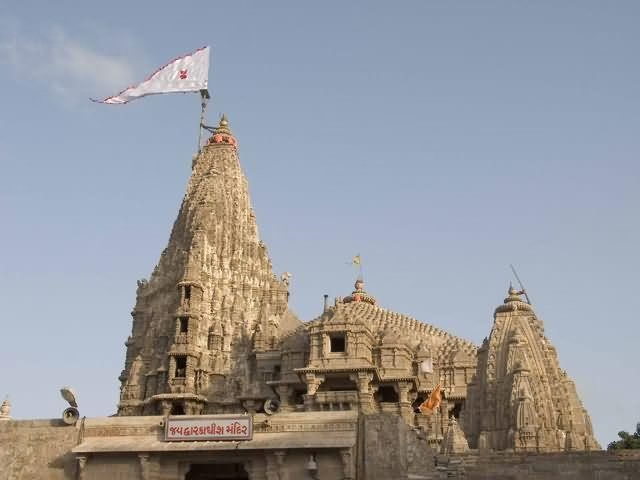
Nestled in the serene landscape of Kaseti village within the Kangra district of Himachal Pradesh, Dudheshwar Mahadev stands as a profound testament to divine grace and local devotion. Known locally as the Mahadev Temple, this sacred shrine is dedicated to Lord Shiva, revered here in his self-manifested (Swayambhu) form. The temple derives its name from a miraculous local legend: Dudh (Milk) and Ishwar (Lord), signifying the origin of the Shiva Lingam.
The spiritual essence of Dudheshwar Mahadev revolves around the alleviation of Pitra Dosha (ancestral karma) and the granting of mental peace. Devotees flock here not only for general blessings but to perform specific rituals for the salvation of their ancestors. The sanctity of the site is amplified by the natural surroundings, offering a tranquil atmosphere ideal for meditation and introspection.
Phalaśruti (Spiritual Benefits):
- Ancestral Liberation: Performing Shradh and Tarpan here is believed to bring peace to departed souls.
- Removal of Afflictions: Offering raw milk and Bilva leaves to the Lingam is said to remove negative planetary influences.
- Mental Clarity: Chanting the Maha Mrityunjaya Mantra within the temple premises amplifies spiritual energy.
Historical Origins & Scriptural Legend
While Himachal Pradesh is dotted with ancient temples, the history of Dudheshwar Mahadev is a blend of antiquity and community resilience. According to local folklore and temple records, the original Shiva Lingam of Bhadreshwar Mahadev was situated on the banks of the Sabarmati River (a tributary flowing through the region).
The Legend of the Miracle:
Tradition holds that centuries ago, a severe flood in the Sabarmati River made it perilous for villagers to access the riverside temple. During this period of separation, a divine phenomenon occurred: the original Shiva Lingam manifested itself through the sacred milk of a cow in the village of Bhat. Recognizing this as a divine sign to keep the deity accessible, the villagers constructed a new temple in Bhat village to house the Lingam. Thus, the temple was named Dudheshwar Mahadev (The Lord who appeared from Milk).
Renovations:
The temple has undergone several renovations over the centuries, primarily funded by local trusts and devotees. While the structure reflects a humble hill-architecture style rather than grand royal dynasties, its endurance through the devastating 1905 Kangra earthquake is often cited as a miracle of the deity’s protection.
Architectural Marvels
The architecture of Dudheshwar Mahadev is a classic example of Himachali Hill Architecture blended with traditional Hindu temple elements. Unlike the towering Nagara style of North India, this temple focuses on sturdy construction suitable for the seismic and climatic conditions of the Dhauladhar range.
Key Architectural Elements:
- The Sanctum (Garbhagriha): The inner sanctum houses the Swayambhu Shiva Lingam, which is bathed daily in fresh milk. The low ceiling creates an intimate, cave-like atmosphere conducive to Darshan.
- The Mandapa: A spacious pillared hall allows devotees to gather for prayers and Jagrans (night vigils). The wooden beams utilized in the roof are traditional to the region, showcasing local craftsmanship.
- Sculptures: While the exterior is relatively modest, the entrance Dvarapalas (guardian figures) and carved wooden pillars depict motifs from Hindu mythology.
- Vastu Shastra: The temple layout follows the traditional Panchayatana style, with the main shrine at the center and subsidiary shrines for Ganesha and Nandi surrounding it.
Although it does not currently hold UNESCO or major ASI conservation status, its local significance makes it a protected heritage site under the State Archaeology Department of Himachal Pradesh.
Darshan & Ritual Logistics
To facilitate a smooth pilgrimage experience, the temple trust has standardized timings and rituals. Please note that while general darshan is open throughout the day, specific Sevas require prior booking.
Daily Darshan Timings
Timings may vary slightly during festivals.
| Session | Timings |
|---|---|
| Morning Opening | 06:00 AM |
| Morning Puja Break | 12:00 PM – 12:30 PM |
| Evening Opening | 01:00 PM |
| Evening Aarti | 07:00 PM |
| Closing | 08:30 PM |
Key Sevas & 2026 Festivals
Devotees can book specific rituals via the temple office or authorized online portals. For 2026, the following dates are crucial:
- Abhishekam: Performed daily with milk, honey, and water. Cost: ₹500 (approx).
- Maha Shivaratri (Feb 26, 2026): The primary festival. The temple remains open all night for Jagaran. Bael leaves are the most sacred offering.
- Shravan Month (July – Aug 2026): Mondays during this month see the highest footfall. Special Alankaram (decoration) is performed.
- Kanwar Yatra: Occurs in July/August; devotees carry holy water from local streams to offer here.
Online Seva Booking:
While Dudheshwar Mahadev is a regional temple, basic donations and remote pujas can often be coordinated through general Himachal religious trust portals. For on-site booking, contact the administrative office directly.
Practical Visitor Guidance
Visiting a mountain temple requires preparation. Here are essential tips to ensure a respectful and comfortable Darshan.
- Dress Code: Traditional attire is preferred (Kurta-Pajama for men, Saree/Salwar Kameez for women). Avoid shorts and sleeveless tops to respect the sanctity of the shrine.
- Photography: Photography inside the Garbhagriha (main sanctum) is strictly prohibited. Mobile photography in the courtyard is generally allowed but avoid using flash during Aarti.
- Footwear: There is a designated footwear stand near the entrance. A nominal fee (₹5-10) is usually charged for maintenance.
- Mobile Lockers: Due to the small size of the temple, large bags are not allowed. Carry minimal belongings. Public lockers are not available, so keep valuables secure in your vehicle.
- Accessibility: The temple is located on a slight elevation with stone steps. It is accessible for senior citizens, though walking aids are recommended due to uneven terrain.
Crowd Management & Seasonal Advice
Best Time to Visit:
– Early Morning (6 AM – 8 AM): Ideal for a peaceful Darshan.
– Winter (Oct – March): Pleasant weather, but mornings are cold (carry woolens).
– Summer (April – June): Days can be warm, but evenings are cool. Carry water as dehydration can occur at altitude.
Avoid: Late evenings during weekdays due to poor lighting on approach roads, and weekends in peak summer when local tourist crowds peak.
Pilgrimage Connectivity
Dudheshwar Mahadev is well-connected via the road network of Himachal Pradesh.
How to Reach
- By Air: The nearest airport is Gaggal Airport (Dharamshala), approximately 35 km away (1 hour drive).
- By Rail: The nearest broad-gauge railway station is Pathankot Junction (approx. 85 km / 3 hours drive).
- By Road: The temple is accessible via NH 154 (formerly NH 88). It connects Pathankot to Kangra and Dharamshala. Buses and taxis are readily available from Kangra town (10 km away).
Nearby Sacred Sites
- Brajeshwari Devi Temple (Kangra): Located roughly 10 km away, this is one of the 51 Shakti Peethas, highly significant for Tantric worship.
- Chintpurni Temple (Una District): About 70 km from Kangra, dedicated to Goddess Chinnamastika.
- Haripur Guler (Heritage Walk): An ancient town with ruins of forts and temples, located nearby for history enthusiasts.
Frequently Asked Questions (FAQs)
1. Is there a VIP or special entry darshan available?
Unlike larger commercial temples, Dudheshwar Mahadev operates on a community basis. However, elderly citizens and differently-abled devotees are assisted by temple volunteers to bypass the general queue. There is no paid VIP entry system currently in place.
2. Can we offer milk or water from home?
It is recommended to purchase milk and water from the stalls set up near the temple entrance. This supports the local economy and ensures hygiene. Carrying open liquids from long distances is not advised.
3. Is accommodation available near the temple?
Basic guest houses (Dharamshalas) are available in Kaseti and Bhat villages. For better amenities, hotels in Kangra town (10-15 mins away) are recommended. Advance booking is suggested during Shivratri and the Shravan month.
4. What is the significance of Bael leaves?
Scientifically, Bael leaves (Bilva Patra) have medicinal properties that cool the body and mind. Scripturally, offering Bael leaves to Shiva is believed to be equivalent to offering the rarest jewels. It is said that a single leaf offered with devotion washes away lifetimes of sin.
5. Are there any strict security checks?
Security is standard for Himachal temples. Expect checks for prohibited items (alcohol, tobacco, non-veg food). It is advisable to leave sharp objects like knives or metal utensils in your vehicle.
Recent Posts

ओ सांवरे तूने ही मुझको संभाला – Lyrics & Meaning
ओ सांवरे तूने ही मुझको संभाला – A Prayer to Shyam Origin & Spiritual Essence Why This Bhajan Resonates Devotees chant this when overwhelmed by life’s storms—the refrain ‘तूने ही मुझको संभाला’ is the soul’s sigh of relief: “You…

कथा ये है महाराज मेरे की – Lyrics & Meaning
कथा ये है महाराज मेरे की छत्रपति संभाजी महाराज – A Prayer to Chhatrapati Sambhaji Maharaj Origin & Spiritual Essence Why This Bhajan Resonates Devotees chant this when their spirit feels tested—its powerful refrain “महाराज मेरे” is a soul’s…

Rigveda Samhita Yathartha Anuvada (ऋग्वेद संहिता यथार्थ अनुवाद) – Complete Set with Anvayartha & Hindi/English Translation
The Rigveda is the oldest surviving scripture of humanity and the foundational text of Sanātana Dharma. For serious students, scholars, UPSC aspirants studying ancient Indian history, Sanskrit learners, and spiritual seekers, a precise and grammatically structured translation is indispensable.…

आना भी अकेला है जाना भी अकेला है – Lyrics & Meaning | BharatTemples
आना भी अकेला है जाना भी अकेला है – A Prayer to the Divine Witness Origin & Spiritual Essence Why This Bhajan Resonates Devotees turn to this bhajan in moments of deep reflection—when life’s attachments begin to ache. The…

माता शेरावाली के द्वार जो भी जाता है – Lyrics & Meaning
माता शेरावाली के द्वार जो भी जाता है – A Prayer to Maa Sherawali Origin & Spiritual Essence Why This Bhajan Resonates Devotees turn to this bhajan in times of fear or uncertainty—its promise that no one leaves Maa’s…

मार लेना सपणी उबार लेणा भवरा – Lyrics & Meaning
मार लेना सपणी उबार लेणा भवरा – A Prayer to the Divine Beloved Origin & Spiritual Essence Why This Bhajan Resonates Devotees chant this in moments of deep vulnerability—its cry of “मार लेना सपणी, उबार लेणा भवरा” is the…

हमें श्याम सुंदर भरोसा तुम्हारा – Lyrics & Meaning
हमें श्याम सुंदर भरोसा तुम्हारा – A Prayer to Shyam Sundar Origin & Spiritual Essence Why This Bhajan Resonates Devotees chant this when feeling alone—its refrain ‘de do sahara’ is the soul’s cry for divine support. Lyrics in Hindi…

Mere Satguru Ne Di Thi Davai Lyrics in Hindi & Meaning
Mere Satguru Ne Di Thi Davai: Invoking the Guru’s Liberating Wisdom This soul-stirring bhajan venerates the Satguru (True Spiritual Master) as the divine physician who dispenses the only remedy for life’s deepest sufferings. Composed by Sant Karmaveer Tufani, it…

Janm Diyo Thari Maa Dukh Dekhiyo Lyrics in Hindi & Meaning
जन्म दियो थारी माँ दुख देखियो (Maa’s Grief Upon Birthing You) This soul-stirring Chetavani Bhajan (admonitory hymn) is addressed to the Divine Mother (Maa) – a call for repentance when children forget their filial duties in the dark age…
Bhadi Sabha Mein Thane Manaun Lyrics in Hindi & Meaning
Bhadi Sabha Mein Thane Manaun: Invoking the Spear-Wielding Mother Mata Bhawani (श्री ज्वाला भवानी), the fiery manifestation of Shakti worshipped as the Protector of Dharma in Her Dhaulagarh sanctum. Origin & Spiritual Essence Composed in Rajasthani folk tradition by…