
Contents
- 1 The Definitive Pilgrimage Guide: Dwi Mukh Vinayak Temple, Varanasi
The Definitive Pilgrimage Guide: Dwi Mukh Vinayak Temple, Varanasi
1. Introduction & Spiritual Essence
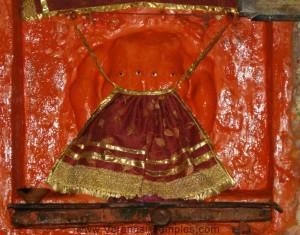
Deep within the spiritual labyrinth of Varanasi lies the Dwi Mukh Vinayak Temple, a sanctuary of profound significance for devotees of Lord Ganesha. Here, the deity manifests in a rare and powerful Swayambhu (self-manifested) form. As the name suggests—Dwi meaning “two” and Mukh meaning “face”—the primary idol features two faces, symbolizing the Lord’s omnipresence and his ability to oversee all directions simultaneously.
Unlike a standard carved murti, this self-risen manifestation is believed to contain immense energy, acting as the guardian of the western quadrant of Varanasi.
Phalaśruti: Why Devotees Visit
According to popular belief, the Phalaśruti (benefits of worship) of this temple are boundless. The two-faced form of Ganesha represents the removal of dualities—the balance of past and future, and the removal of obstacles (Vighnas) from all aspects of life. Devotees flock here specifically to:
- Cleansing Ancestral Karma: It is believed that praying here with a sincere heart helps cleanse Pitru Dosha (ancestral defects) and brings peace to forefathers.
- Prosperity and Success: The temple records suggest that Lord Ganesha blesses devotees with all-round prosperity (Sarva Siddhi) in their professional and personal lives.
- Protection: Worshipping the twin-faced deity is said to offer protection against negative energies and sudden misfortunes.
2. Historical Origins & Scriptural Legend
The exact chronology of the temple’s construction remains veiled in the mists of antiquity, a common trait among ancient shrines in Kashi. However, the spiritual lineage is unbroken.
Architectural and Historical Context
Tradition holds that the temple structure dates back several centuries, though the specific dynasty records have been lost to the relentless flow of time and various historical upheplashes in Varanasi. The current architectural restoration and maintenance have been undertaken by local trusts to preserve the sanctity of the site.
Scriptural Legend & Sthala Purana
The Sthala Purana (local legend) of Dwi Mukh Vinayak is deeply connected to the geological formation of Varanasi itself. Local lore suggests that the Swayambhu murti emerged from the earth at this specific location to protect the spiritual grid of Kashi.
Ancient texts allude to the concept of Kashyapa Kshetra, where Lord Ganesha is one of the primary protectors. The two faces are symbolic of Ishana (North-East) and Nairutya (South-West) corners, balancing the energies of the cosmos. Worshipping here is considered equivalent to worshipping the entire pantheon of Ganesha manifestations.
3. Architectural Marvels
The temple is a subtle yet profound representation of traditional Nagara style temple architecture, infused with the unique organic aesthetics of Varanasi.
Vastu Shastra Elements
The temple is oriented according to strict Vastu Shastra principles. The main sanctum (Garbhagriha) is positioned to ensure that the deity faces the east, allowing the first rays of the sun to illuminate the idol.
Visual Details
- The Shikhara: While the temple is compact, the Shikhara (spire) is distinct, carved with motifs of nature and divine geometric patterns.
- The Mandapa: A pillared hall allows devotees to gather for prayers. The stone carvings often depict scenes from the Trimurti and the Ashtavinayak (eight forms of Ganesha).
- The Idol: The focal point is the naturally formed two-faced Ganesha. It is usually adorned with a turban (Mukut) and a gold chain, radiating a serene yet powerful presence.
While not designated as an ASI-protected monument, the temple is a vital part of Varanasi’s heritage landscape.
4. Darshan & Ritual Logistics
The temple offers a tranquil environment for worship. Below are the operational details for your visit.
Daily Timings
The temple follows the traditional opening hours of Varanasi temples, accommodating the daily rhythm of rituals.
| Session | Opening Time | Closing Time |
|---|---|---|
| Morning | 05:00 AM (Brahma Muhurta) | 11:00 AM |
| Evening | 04:30 PM (Sandhya) | 09:00 PM |
*Note: Timings may vary slightly during major festivals.
Key Sevas and Booking
Assumed Current Year: 2026
The temple offers traditional sevas. While many small shrines in Varanasi operate on an on-site basis, modernized trusts are increasingly adopting digital systems.
- Abhishekam: Ritual bathing of the deity with milk, honey, and curd. Best performed on Sankashti Chaturthi.
- Archana: Personalized chanting of names. Available throughout the day.
- Modak Offering: A special offering of 21 modaks (sweet dumplings).
Online Seva Booking: While some local priests manage bookings directly at the temple, visitors are advised to check the official Uttar Pradesh Tourism or Bharat Temples portal for updates on online seva booking capabilities for the 2026 season.
2026 Major Festival Dates
- Varad Vinayak Chaturthi: Saturday, January 25, 2026
- Magh Shukla Chaturthi: Monday, February 24, 2026
- Angarki Chaturthi: Tuesday, March 25, 2026
- Sankashti Chaturthi: Monthly (Check lunar calendar specific to Varanasi)
- Diwali / Angarkata: October/November 2026 (Dates vary by lunar calendar)
5. Practical Visitor Guidance
Dress Code & Etiquette
Visitors must dress modestly. Traditional Indian attire (Kurta-Pajama for men, Saree/Salwar Kameez for women) is recommended. Shorts or sleeveless tops are not permitted within the sanctum.
Photography & Electronics
Photography is strictly prohibited inside the Garbhagriha. Mobile phones should be kept on silent mode. Several shops outside the temple offer locker facilities for a nominal fee, as electronic devices are generally not allowed while performing worship.
Crowd Management & Seasonal Advice
- Best Hours: The ideal time for a peaceful darshan is between 6:00 AM and 8:00 AM or late evening after 8:00 PM.
- Summer (April-June): Varanasi can be very hot. Carry a water bottle, but drink only purified water.
- Monsoon (July-September): Humidity is high. Light cotton clothes and an umbrella are essential.
Accessibility
The temple is located in the D-51/90 sector, West of Saamba Aditya, near Suraj Kund. The lanes are narrow, typical of Varanasi’s old city. It is not wheelchair accessible due to the uneven stone pathways.
6. Pilgrimage Connectivity
How to Reach
- Nearest Airport: Varanasi Lal Bahadur Shastri International Airport (VNS) – Approx. 25 km (1 hour drive).
- Nearest Railway Station: Varanasi Junction (BSB) – Approx. 6 km. Auto-rickshaws are readily available.
- By Road: The temple is located in the heart of the city. From the Railway Station, take the Varanasi-Allahabad Highway (NH 19) heading towards the city center. Note: Due to the congested old city, it is often faster to walk from the main ghat areas or take a e-rickshaw up to the Suraj Kund drop-off point.
Nearby Sacred Sites (Pilgrimage Circuit)
Combine your visit to Dwi Mukh Vinayak with these nearby spiritual landmarks:
- Kashi Vishwanath Temple: Located approximately 3 km away. The epicenter of Varanasi’s spirituality.
- Sankat Mochan Hanuman Temple: About 2.5 km away. Famous for its soothing bell chiming and monkey population.
- Shri Durga Temple (Durga Kund): Roughly 2 km away. A striking red temple dedicated to Goddess Durga.
7. Frequently Asked Questions (FAQs)
1. Is there a VIP darshan entry at Dwi Mukh Vinayak Temple?
No, VIP darshan is generally not available here. Being a smaller, ancient shrine, the darshan process is simple and open to all. However, visiting early in the morning avoids the rush.
2. Can I perform the Abhishekam myself?
While the temple is open for devotees to perform simple puja, specific rituals like Abhishekam are usually performed by the resident priest. You can request the priest to perform the Abhishekam on your behalf.
3. Is there parking available near the temple?
Parking in the old city lanes is extremely limited. It is recommended to park your vehicle at the designated parking lots near Dashashwamedh Ghat or Godaulia and proceed to the temple via e-rickshaw or on foot.
4. What is the significance of the “Two Faces”?
The two faces symbolize the Lord’s ability to see both the material and spiritual worlds, and his protection over all eight directions. It represents supreme awareness and the removal of hidden obstacles.
5. What is the exact address and contact number?
Address: D-51/90, West of Saamba Aditya, Suraj Kund, Varanasi, Uttar Pradesh 221001.
Contact: As the shrine is managed locally, a centralized contact number may not always be available. Refer to the local priest trust present on-site.
Recent Posts

Shri Kaamkoteeshwar Mandir, Varanasi – History & Significance
In the heart of Kashi, the eternal city of Lord Shiva, where the Ganges flows with celestial grace, stands the Shri Kaamkoteeshwar Mandir. This sacred Sannidhi is not merely a temple but a profound spiritual bridge between the Northern…

ओ सांवरे तूने ही मुझको संभाला – Lyrics & Meaning
ओ सांवरे तूने ही मुझको संभाला – A Prayer to Shyam Origin & Spiritual Essence Why This Bhajan Resonates Devotees chant this when overwhelmed by life’s storms—the refrain ‘तूने ही मुझको संभाला’ is the soul’s sigh of relief: “You…

कथा ये है महाराज मेरे की – Lyrics & Meaning
कथा ये है महाराज मेरे की छत्रपति संभाजी महाराज – A Prayer to Chhatrapati Sambhaji Maharaj Origin & Spiritual Essence Why This Bhajan Resonates Devotees chant this when their spirit feels tested—its powerful refrain “महाराज मेरे” is a soul’s…

Rigveda Samhita Yathartha Anuvada (ऋग्वेद संहिता यथार्थ अनुवाद) – Complete Set with Anvayartha & Hindi/English Translation
The Rigveda is the oldest surviving scripture of humanity and the foundational text of Sanātana Dharma. For serious students, scholars, UPSC aspirants studying ancient Indian history, Sanskrit learners, and spiritual seekers, a precise and grammatically structured translation is indispensable.…

आना भी अकेला है जाना भी अकेला है – Lyrics & Meaning | BharatTemples
आना भी अकेला है जाना भी अकेला है – A Prayer to the Divine Witness Origin & Spiritual Essence Why This Bhajan Resonates Devotees turn to this bhajan in moments of deep reflection—when life’s attachments begin to ache. The…

माता शेरावाली के द्वार जो भी जाता है – Lyrics & Meaning
माता शेरावाली के द्वार जो भी जाता है – A Prayer to Maa Sherawali Origin & Spiritual Essence Why This Bhajan Resonates Devotees turn to this bhajan in times of fear or uncertainty—its promise that no one leaves Maa’s…

मार लेना सपणी उबार लेणा भवरा – Lyrics & Meaning
मार लेना सपणी उबार लेणा भवरा – A Prayer to the Divine Beloved Origin & Spiritual Essence Why This Bhajan Resonates Devotees chant this in moments of deep vulnerability—its cry of “मार लेना सपणी, उबार लेणा भवरा” is the…

हमें श्याम सुंदर भरोसा तुम्हारा – Lyrics & Meaning
हमें श्याम सुंदर भरोसा तुम्हारा – A Prayer to Shyam Sundar Origin & Spiritual Essence Why This Bhajan Resonates Devotees chant this when feeling alone—its refrain ‘de do sahara’ is the soul’s cry for divine support. Lyrics in Hindi…

Mere Satguru Ne Di Thi Davai Lyrics in Hindi & Meaning
Mere Satguru Ne Di Thi Davai: Invoking the Guru’s Liberating Wisdom This soul-stirring bhajan venerates the Satguru (True Spiritual Master) as the divine physician who dispenses the only remedy for life’s deepest sufferings. Composed by Sant Karmaveer Tufani, it…

Janm Diyo Thari Maa Dukh Dekhiyo Lyrics in Hindi & Meaning
जन्म दियो थारी माँ दुख देखियो (Maa’s Grief Upon Birthing You) This soul-stirring Chetavani Bhajan (admonitory hymn) is addressed to the Divine Mother (Maa) – a call for repentance when children forget their filial duties in the dark age…