
Contents
- 1 Ekambaranathar Temple, Minjur: The Ancient Abode of the Cosmic Lord
Ekambaranathar Temple, Minjur: The Ancient Abode of the Cosmic Lord
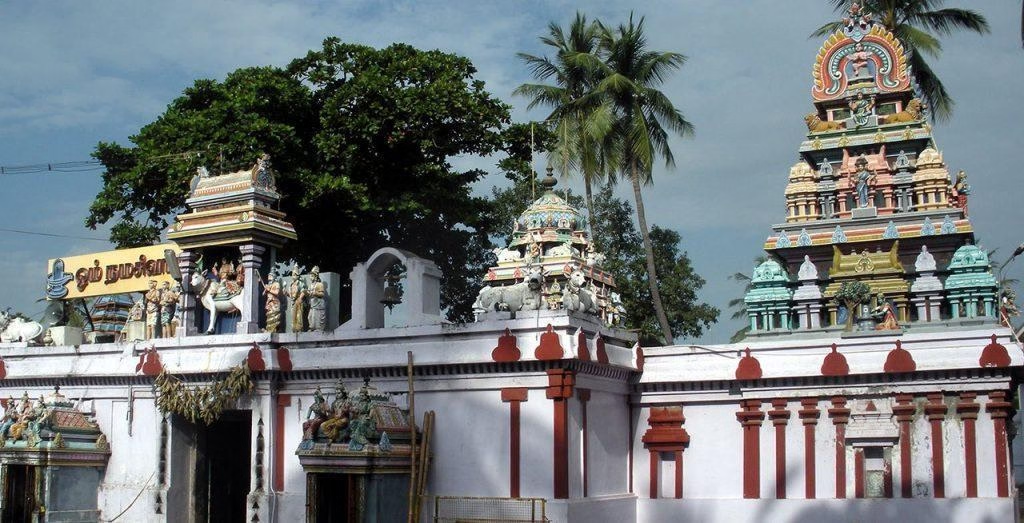
Welcome to Ekambaranathar Temple, Minjur, Thiruvallur. Nestled in the heart of Minjur town, this ancient shrine stands as a beacon of spiritual tranquility and architectural grandeur. For the devotee, this is not merely a stone structure but a living organism breathing with the energy of millennia. In this definitive guide, we explore the history, significance, and practical logistics for your pilgrimage in 2026.
| Date built: | – |
|---|---|
| Deity: | Ekambaranathar |
| Architectural style: | Dravidian architecture |
| Major festivals | – |
| Locale: | Minjur |
| District:: | Thiruvallur |
| Address: | – |
| Phone | – |
1. Introduction & Spiritual Essence
The Ekambaranathar Temple derives its name from the Sanskrit words Eka (One) and Ambara (Sky/Cloud), signifying Lord Shiva as the One who dwells in the Infinite Sky or One who wears the Sky as his garment. While this title is famously shared with the Pancha Bhoota Stalam in Kanchipuram, the Minjur shrine holds its own unique potency.
Primary Deity and Form
Presiding Deity: Lord Ekambaranathar is enshrined as a Swayambhu Lingam (self-manifested), facing east. He represents the element of Aether (Space), the source of all creation.
Consort: Kamakshi Amman, the Goddess of Desire and Wisdom, is housed in a separate shrine facing east.
Phalaśruti: Spiritual Benefits
According to Vedic traditions, worshipping Lord Ekambaranathar brings:
- Cleansing of Ancestral Karma: It is believed that prayers offered here help the ancestors attain Moksha (liberation).
- Removal of Planetary Obstacles: The presence of a dedicated Navagraha shrine allows devotees to pacify malefic planetary alignments in their birth chart.
- Granting of Progeny & Prosperity: Devotees seeking the blessings of Lord Shiva and Goddess Parvati for marriage or childbirth find solace here.
2. Historical Origins & Scriptural Legend
Scriptural Legend & Sthala Purana
While specific Puranic tales for this Minjur shrine are deeply woven into local folklore, the temple is architecturally significant. Tradition holds that the temple is approximately 500 years old. The name “Minjur” is believed to be derived from “Meenjoor” (a place surrounded by water bodies), reflecting the region’s ancient hydrological landscape.
Renovations and Builders
While the original builders during the medieval Vijayanagara or Nayak eras remain a subject of historical research, the temple has seen significant renovations. Notable is the recently built Rajagopuram (Main Tower), which stands majestically, inviting devotees from afar. The inscriptions within the temple complex likely date back to the 16th century, recording land grants by local chieftains loyal to the Nayak overlords.
3. Architectural Marvels
The Ekambaranathar Temple is a classic example of the Dravidian style of architecture, characterized by its stepped pyramidal towers and expansive courtyards.
Vastu Shastra Elements
As per Vastu Shastra, the temple is oriented to the East, allowing the first rays of the sun to fall directly on the sanctum sanctorum, energizing the Lingam. The Prakaram (enclosed precincts) is spacious, facilitating the Pradakshina (circumambulation) ritual.
Notable Sculptures and Shrines
The inner prakaram houses a galaxy of deities, reflecting the syncretic nature of Shaivism:
- Dakshinamurthy: The silent teacher facing south.
- Lingothbavar: A unique form of Shiva emerging from a Lingam.
- Navagraha Shrine: A crucial element for astrological remedies.
- Six-faced Murugan (Arumugam): With his consorts Valli and Devasena.
- Kasi Viswanathar & Visalakshi: A miniature representation of the Varanasi shrine.
4. Darshan & Ritual Logistics
For devotees planning a visit in 2026, the temple follows a traditional schedule. Note that timings may vary slightly during festivals.
Daily Timings
| Session | Timing |
|---|---|
| Morning Darshan | 06:00 AM – 12:00 PM |
| Afternoon Break | 12:00 PM – 04:00 PM |
| Evening Darshan | 04:00 PM – 08:30 PM |
| Important Note | Timings are subject to change during specific festivals. Please verify with the temple office. |
Key Sevas and Online Booking
Devotees can book specific Sevas to enhance their spiritual experience. While direct online booking for smaller local temples can sometimes be limited to on-site registration, major rituals can often be coordinated through local priests or district tourism portals.
- Abhishekam: Ritual bathing of the Lingam with milk, honey, and sandalwood paste.
- Archana: Recitation of hymns dedicated to the deity.
- Deepa Aradhanai: Waving of camphor and oil lamps.
2026 Festival Calendar
- Shivaratri (Feb 26, 2026): The primary festival; night-long vigil and special Abhishekams.
- Pradosham: Monthly event occurring twice every lunar month (Thrayodashi). The most significant ones in 2026 are March 11th and March 25th.
- Ardra Darshanam (Dec 2026 – Date TBC): Celebration of the cosmic dance of Shiva.
- Navratri: Dedicated to Goddess Kamakshi Amman (Oct 2026).
5. Practical Visitor Guidance
Dress Code and Etiquette
To maintain the sanctity of the temple, visitors are requested to wear traditional Indian attire. Men should wear Dhoti or formal trousers with a shirt. Women should opt for Saree, Salwar Kameez, or long skirts. Avoid shorts or sleeveless tops.
Facilities
- Mobile Lockers: Available near the entrance for storing electronic devices (phones/cameras) as photography is restricted inside the sanctum.
- Shoe Rack: Free shoe storage is provided at the entrance.
- Accessibility: The inner sanctum requires climbing a few steps. Elders can request assistance from the temple staff.
Crowd Management
Best Hours to Visit: Early morning (6:00 AM – 8:00 AM) on weekdays offers the most peaceful darshan. Weekends and festival evenings see higher footfall.
Seasonal Advice:
- Summer (May – July): Carry a water bottle and an umbrella. The granite floors can get extremely hot.
- Monsoon (Oct – Nov): Carry a raincoat; the temple courtyard may be slippery.
6. Pilgrimage Connectivity
How to Reach Ekambaranathar Temple
The temple is strategically located in Minjur town, making it accessible via road and rail.
- By Air: Chennai International Airport (MAA) is the nearest airport, approximately 45 km away via NH 16.
- By Rail: Minjur Railway Station is the nearest stop, just 1 km from the temple. It is well-connected to Chennai Central via the suburban network.
- By Road:
- From Chennai (Parrys/Chennai Central): Take the NH 16 (Chennai-Kolkata Highway) towards Tada. Take the deviation towards Minjur.
- Bus: Frequent buses are available from Pattabiram to Minjur (via Tada).
- Private Vehicle: Drive time from Central Chennai is approx. 1 hour 15 minutes.
Nearby Sacred Sites (Pilgrimage Circuit)
Combine your visit to Ekambaranathar Temple with these nearby spiritual destinations:
- Thiruvudai Amman Temple: Located just 3 km from Minjur. A dedicated shrine to Goddess Parvati.
- Devadanam (Narasinghapureeswarar Temple): Located about 8 km away. Known for its unique architectural style.
- Kashi Vishwanathar Temple, Akkaram: Approximately 15 km away. Another ancient Shiva temple in the Thiruvallur district.
7. Frequently Asked Questions (FAQ)
Is there a VIP Darshan entry available?
Unlike the larger temple complexes, the Ekambaranathar Temple in Minjur operates on a community-based darshan system. However, donations for special Abhishekam allow for priority access to the sanctum during specific ritual times.
What are the peak crowd timings?
The temple is generally crowded during Monday mornings, Pradosham evenings, and specific festival days like Shivaratri. Visiting between 10:00 AM and 3:00 PM on weekdays ensures a shorter queue.
Is there accommodation available nearby?
Basic guest houses and lodges are available in Minjur town. For a wider range of hotels and amenities, it is recommended to stay in Ponneri (11 km) or Chennai (26 km).
Can non-Hindus visit the temple?
While Shiva is regarded as the supreme universal consciousness welcoming all, standard practice in this region restricts non-Hindus from entering the inner sanctum. They may view the architecture from the outer courtyards.
Where can I get the temple contact details?
As specific phone numbers for smaller ancient temples can vary, it is advisable to contact the Temple Executive Officer (EO) or the Thiruvallur District Administration for the most current contact information.
Photo Gallery
Explore the visual splendor of the Ekambaranathar Temple through these images.
Contact Details & Map
Official Address:
Ekambaranathar Temple,
Minjur, Thiruvallur District,
Tamil Nadu, India.
Locate the Temple on Map
For navigation purposes, please use the following Google Maps link:
Recent Posts

Shri Kaamkoteeshwar Mandir, Varanasi – History & Significance
In the heart of Kashi, the eternal city of Lord Shiva, where the Ganges flows with celestial grace, stands the Shri Kaamkoteeshwar Mandir. This sacred Sannidhi is not merely a temple but a profound spiritual bridge between the Northern…

ओ सांवरे तूने ही मुझको संभाला – Lyrics & Meaning
ओ सांवरे तूने ही मुझको संभाला – A Prayer to Shyam Origin & Spiritual Essence Why This Bhajan Resonates Devotees chant this when overwhelmed by life’s storms—the refrain ‘तूने ही मुझको संभाला’ is the soul’s sigh of relief: “You…

कथा ये है महाराज मेरे की – Lyrics & Meaning
कथा ये है महाराज मेरे की छत्रपति संभाजी महाराज – A Prayer to Chhatrapati Sambhaji Maharaj Origin & Spiritual Essence Why This Bhajan Resonates Devotees chant this when their spirit feels tested—its powerful refrain “महाराज मेरे” is a soul’s…

Rigveda Samhita Yathartha Anuvada (ऋग्वेद संहिता यथार्थ अनुवाद) – Complete Set with Anvayartha & Hindi/English Translation
The Rigveda is the oldest surviving scripture of humanity and the foundational text of Sanātana Dharma. For serious students, scholars, UPSC aspirants studying ancient Indian history, Sanskrit learners, and spiritual seekers, a precise and grammatically structured translation is indispensable.…

आना भी अकेला है जाना भी अकेला है – Lyrics & Meaning | BharatTemples
आना भी अकेला है जाना भी अकेला है – A Prayer to the Divine Witness Origin & Spiritual Essence Why This Bhajan Resonates Devotees turn to this bhajan in moments of deep reflection—when life’s attachments begin to ache. The…

माता शेरावाली के द्वार जो भी जाता है – Lyrics & Meaning
माता शेरावाली के द्वार जो भी जाता है – A Prayer to Maa Sherawali Origin & Spiritual Essence Why This Bhajan Resonates Devotees turn to this bhajan in times of fear or uncertainty—its promise that no one leaves Maa’s…

मार लेना सपणी उबार लेणा भवरा – Lyrics & Meaning
मार लेना सपणी उबार लेणा भवरा – A Prayer to the Divine Beloved Origin & Spiritual Essence Why This Bhajan Resonates Devotees chant this in moments of deep vulnerability—its cry of “मार लेना सपणी, उबार लेणा भवरा” is the…

हमें श्याम सुंदर भरोसा तुम्हारा – Lyrics & Meaning
हमें श्याम सुंदर भरोसा तुम्हारा – A Prayer to Shyam Sundar Origin & Spiritual Essence Why This Bhajan Resonates Devotees chant this when feeling alone—its refrain ‘de do sahara’ is the soul’s cry for divine support. Lyrics in Hindi…

Mere Satguru Ne Di Thi Davai Lyrics in Hindi & Meaning
Mere Satguru Ne Di Thi Davai: Invoking the Guru’s Liberating Wisdom This soul-stirring bhajan venerates the Satguru (True Spiritual Master) as the divine physician who dispenses the only remedy for life’s deepest sufferings. Composed by Sant Karmaveer Tufani, it…

Janm Diyo Thari Maa Dukh Dekhiyo Lyrics in Hindi & Meaning
जन्म दियो थारी माँ दुख देखियो (Maa’s Grief Upon Birthing You) This soul-stirring Chetavani Bhajan (admonitory hymn) is addressed to the Divine Mother (Maa) – a call for repentance when children forget their filial duties in the dark age…