
Contents
Introduction & Spiritual Essence
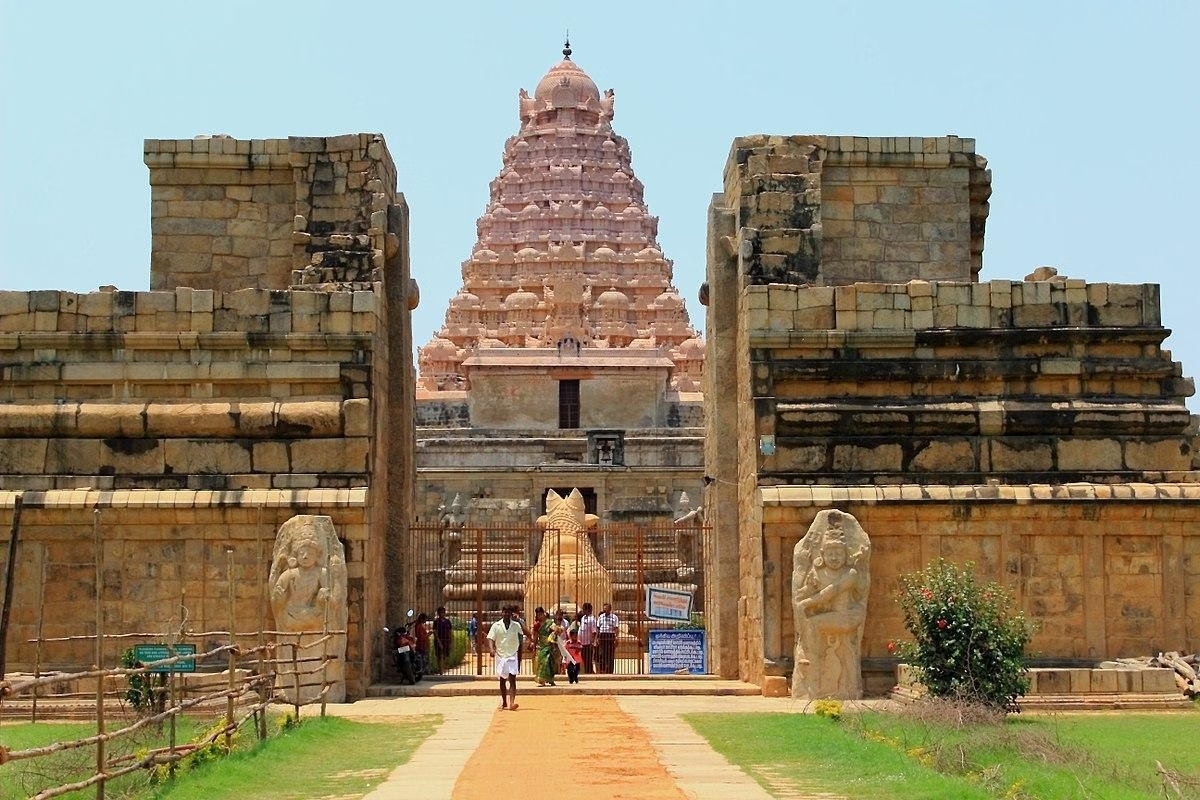
The Brihadeeswarar Temple at Gangaikonda Cholapuram, located in the Ariyalur district of Tamil Nadu, is a monument of celestial devotion and imperial grandeur. Constructed by the visionary King Rajendra Chola I in the 11th century, this temple stands as the primary shrine dedicated to Lord Shiva, revered here as Gangaikondacholisvarar (The Conqueror of the Ganges). The presiding deity is a Swayambhu (self-manifested) Lingam, radiating immense spiritual energy.
Devotees flock to this sacred abode seeking spiritual liberation and worldly harmony. The Phalaśruti (spiritual benefits) of visiting this temple is believed to be profound. According to local tradition, circumambulating the sanctum and offering prayers here helps in:
- Cleansing Ancestral Karma: Performing rites for forefathers alleviates Pitru Dosha (ancestral afflictions).
- Victory and Success: As the temple commemorates the conquest of the Ganges, worshipping here blesses devotees with courage and triumph over obstacles.
- Mental Clarity: The serene atmosphere and the powerful Shiva Tattva assist in attaining inner peace and focus.
Historical Origins & Scriptural Legend
The Founding of the Capital:
According to historical records, Rajendra Chola I (c. 1014–1044 CE) established Gangaikonda Cholapuram as his new capital around 1025 CE, following his victorious military campaign to the banks of the River Ganges. The name translates to “The City of the Chola who Conquered the Ganga.”
Scriptural and Oral Legends:
The Sthala Purana narrates a fascinating legend tied to the temple’s inception. Upon his return from the north, Rajendra Chola I sought to sanctify his victory by bringing the holy waters of the Ganges to the Tamil land. He ordered the defeated northern kings to pour pots of Ganga water into a specially constructed well, which remains in the temple courtyard to this day. This act transformed the land into a holy Tirtha (pilgrimage site).
Timeline of Construction:
– 1023–1027 CE: Construction of the city and the temple began.
– 1035 CE: The temple was completed, as evidenced by inscriptions from the reign of Rajendra I and his successor, Virarajendra.
– Later History: While the city faced destruction during the later invasions of the Delhi Sultanate and the Madurai Sultanate, the Brihadeeswarar Temple miraculously survived, with the Vijayanagara Empire later undertaking restorative measures.
Architectural Marvels
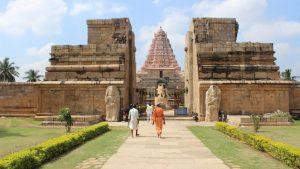
The temple is a masterpiece of Dravidian Architecture, specifically the Pallava-Chola style. It stands as a testament to the structural engineering prowess of the medieval era.
Vastu Shastra & Layout:
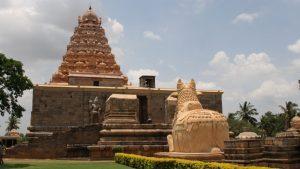
Unlike the towering Vimana (tower) of the Thanjavur Brihadeeswarar Temple, the Shikhara (dome) at Gangaikonda Cholapuram is pyramidal and curves inward, creating a softer, more elegant silhouette. The temple complex is designed according to Vastu Shastra, aligning with cosmic principles.
Notable Features:
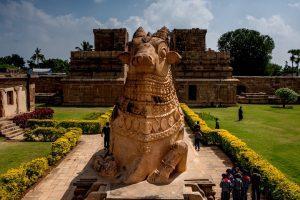
– The Nandi: The Nandi (sacred bull) is a monolithic masterpiece, larger than life, housed in a separate mandapa facing the sanctum.
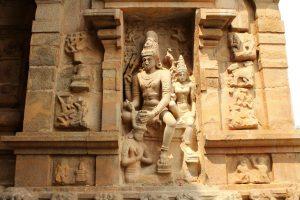
– Sculptures: The temple walls and niches are adorned with over 100 exquisite sculptures. Notable among them are Chandeswarar Anugraha Murthy (one of the finest sculptures of Shiva blessing his devotee Chandikesvara) and Saraswati (Goddess of Knowledge) in a dancing posture.
– War Trophies: Many sculptures and architectural elements brought from Andhra, Karnataka, and Bengal as symbols of victory are preserved here.
Heritage Status:
In 2004, the temple was declared a UNESCO World Heritage Site under the “Great Living Chola Temples” category. It is currently maintained jointly by the Archaeological Survey of India (ASI) and the Hindu Religious and Charitable Endowments (HR&CE) Department.
Darshan & Ritual Logistics
Visitors are encouraged to check the latest schedule before planning their visit, as timings may vary slightly during festival seasons.
Daily Darshan Timings
| Session | Timing |
|---|---|
| Morning Darshan | 06:00 AM – 12:30 PM |
| Afternoon Break | 12:30 PM – 04:00 PM |
| Evening Darshan | 04:00 PM – 08:00 PM |
Key Sevas and Online Booking
Devotees can perform various Sevas (ritual services) to Lord Gangaikondacholisvarar. While the temple is under ASI conservation, certain daily rituals are managed by HR&CE.
- Abhishekam: Ritual bathing of the deity. Best performed on Mondays and during Pradosham.
- Archana: Recitation of holy names. Can be performed by the devotee or by the temple priest.
- Deepa Aradhana: Offering of lamps.
Online Booking: For booking specific Sevas and tickets, devotees should visit the official Tamil Nadu HR&CE website or the dedicated portal for Gangaikondacholisvarar Temple. (Note: Physical tickets are also available at the temple counter subject to availability).
2026 Festival Calendar (Key Dates)
Pradosham: Occurs every 13th and 28th day of the lunar month. In 2026, notable Pradoshams fall on January 9, January 25, February 8, and continue throughout the year.
Other Major Festivals:
- Navaratri: October 2026 (9 nights of Goddess worship).
- Deepavali: October/November 2026 (Special lighting and Abhishekam).
- Arudra Darshanam: Celebration of Lord Nataraja (typically in December/January).
Practical Visitor Guidance
To ensure a seamless and respectful darshan experience, please adhere to the following guidelines.
Code of Conduct & Dress Code
- Dress Code: Traditional attire is mandatory. Men should wear Dhoti or trousers with a shirt; women should wear Saree, Salwar Kameez, or traditional skirts and blouses. Western attire (shorts, jeans, t-shirts) is strictly prohibited within the temple sanctum.
- Photography: As this is a UNESCO site, photography is allowed in the outer corridors and courtyards. However, strictly prohibited inside the inner sanctum (Garbhagriha). Video recording may require special permission from the ASI office.
- Electronics: Mobile phones should be kept on silent mode. Lockers are available near the entrance for depositing bags and electronics.
Crowd Management & Best Times to Visit
- Best Hours: The least crowded time is between 10:00 AM and 11:30 AM, or after 5:00 PM in the evening.
- Seasonal Advice:
– Summer (April–June): Temperatures in Ariyalur can be high. Carry a water bottle and wear light cotton fabrics. Visit early morning or late evening.– Monsoon (October–December): Light showers are possible; carrying an umbrella is advisable.
Pilgrimage Connectivity
How to Reach Gangaikonda Cholapuram
- By Air: The nearest major airport is Tiruchirappalli International Airport (TRZ), located approximately 80 km away. From the airport, taxis and buses are available to Ariyalur and the temple town.
- By Rail: The nearest railway head is Ariyalur Railway Station, situated about 18–20 km from the temple. It is well-connected to major cities like Chennai, Tiruchirappalli, and Villupuram.
- By Road: The town is well-connected via State Highways. It is approximately 70 km northeast of Thanjavur and 280 km from Chennai. Buses frequently operate from Ariyalur and Thanjavur to Gangaikonda Cholapuram.
Nearby Sacred Sites
Extend your pilgrimage to include these significant sites in the vicinity:
- Thiruvaiyaru (Panchanadeeswarar Temple): Located about 35 km from Thanjavur, this temple is famous for the five-noded Shiva Lingam and the memorial of Saint Tyagaraja.
- Thanjavur Brihadeeswarar Temple: The “Big Temple” built by Rajendra’s father, Rajaraja Chola. It is the primary UNESCO site of the Chola dynasty and a must-visit sibling monument.
- Kumbakonam: Located about 55 km away, this temple town is surrounded by the Kaveri River and hosts over 40 temples, including the Adi Kumbeswarar and Nageswaran temples.
Photo Gallery
Frequently Asked Questions (FAQ)
1. Is there a VIP darshan entry available?
Yes, the temple administration provides a special entry darshan for senior citizens, differently-abled devotees, and occasionally for donors. However, strictly no VIP protocols are in place for political figures or celebrities without prior written permission from the ASI and HR&CE departments.
2. What is the entry fee for the temple?
Entry to the temple complex is generally free for general darshan. However, there is a nominal fee for taking a camera inside the complex. Video cameras require a higher ticket and prior permission.
3. How far is the temple from Thanjavur?
The temple is approximately 70 kilometers (about 43 miles) northeast of Thanjavur. The drive typically takes 1.5 to 2 hours depending on traffic conditions.
4. Can we perform Shradh ceremonies here?
Yes, the temple is a powerful spot for ancestral rites. Many families perform Shradh and Tharpanam rituals here, particularly invoking the blessings of Lord Shiva for the peace of their ancestors’ souls. Priests are available on-site to assist with these rituals.
5. What are the restrictions for foreign tourists?
Foreign tourists are welcome but must adhere to the dress code (trousers and covered shoulders). Entry is free for foreign nationals as per the new mandate for Indian archaeology sites, though donations are appreciated.
Contact Details
Official Address:
The Executive Officer,
Arulmigu Gangaikondacholisvarar Thirukoil,
Gangaikonda Cholapuram – 621 801,
Ariyalur District, Tamil Nadu, India.
Recent Posts

Shri Kaamkoteeshwar Mandir, Varanasi – History & Significance
In the heart of Kashi, the eternal city of Lord Shiva, where the Ganges flows with celestial grace, stands the Shri Kaamkoteeshwar Mandir. This sacred Sannidhi is not merely a temple but a profound spiritual bridge between the Northern…

ओ सांवरे तूने ही मुझको संभाला – Lyrics & Meaning
ओ सांवरे तूने ही मुझको संभाला – A Prayer to Shyam Origin & Spiritual Essence Why This Bhajan Resonates Devotees chant this when overwhelmed by life’s storms—the refrain ‘तूने ही मुझको संभाला’ is the soul’s sigh of relief: “You…

कथा ये है महाराज मेरे की – Lyrics & Meaning
कथा ये है महाराज मेरे की छत्रपति संभाजी महाराज – A Prayer to Chhatrapati Sambhaji Maharaj Origin & Spiritual Essence Why This Bhajan Resonates Devotees chant this when their spirit feels tested—its powerful refrain “महाराज मेरे” is a soul’s…

Rigveda Samhita Yathartha Anuvada (ऋग्वेद संहिता यथार्थ अनुवाद) – Complete Set with Anvayartha & Hindi/English Translation
The Rigveda is the oldest surviving scripture of humanity and the foundational text of Sanātana Dharma. For serious students, scholars, UPSC aspirants studying ancient Indian history, Sanskrit learners, and spiritual seekers, a precise and grammatically structured translation is indispensable.…

आना भी अकेला है जाना भी अकेला है – Lyrics & Meaning | BharatTemples
आना भी अकेला है जाना भी अकेला है – A Prayer to the Divine Witness Origin & Spiritual Essence Why This Bhajan Resonates Devotees turn to this bhajan in moments of deep reflection—when life’s attachments begin to ache. The…

माता शेरावाली के द्वार जो भी जाता है – Lyrics & Meaning
माता शेरावाली के द्वार जो भी जाता है – A Prayer to Maa Sherawali Origin & Spiritual Essence Why This Bhajan Resonates Devotees turn to this bhajan in times of fear or uncertainty—its promise that no one leaves Maa’s…

मार लेना सपणी उबार लेणा भवरा – Lyrics & Meaning
मार लेना सपणी उबार लेणा भवरा – A Prayer to the Divine Beloved Origin & Spiritual Essence Why This Bhajan Resonates Devotees chant this in moments of deep vulnerability—its cry of “मार लेना सपणी, उबार लेणा भवरा” is the…

हमें श्याम सुंदर भरोसा तुम्हारा – Lyrics & Meaning
हमें श्याम सुंदर भरोसा तुम्हारा – A Prayer to Shyam Sundar Origin & Spiritual Essence Why This Bhajan Resonates Devotees chant this when feeling alone—its refrain ‘de do sahara’ is the soul’s cry for divine support. Lyrics in Hindi…

Mere Satguru Ne Di Thi Davai Lyrics in Hindi & Meaning
Mere Satguru Ne Di Thi Davai: Invoking the Guru’s Liberating Wisdom This soul-stirring bhajan venerates the Satguru (True Spiritual Master) as the divine physician who dispenses the only remedy for life’s deepest sufferings. Composed by Sant Karmaveer Tufani, it…

Janm Diyo Thari Maa Dukh Dekhiyo Lyrics in Hindi & Meaning
जन्म दियो थारी माँ दुख देखियो (Maa’s Grief Upon Birthing You) This soul-stirring Chetavani Bhajan (admonitory hymn) is addressed to the Divine Mother (Maa) – a call for repentance when children forget their filial duties in the dark age…