
Contents
Gautameshwar Temple Varanasi: The Definitive Pilgrimage Guide
Introduction & Spiritual Essence
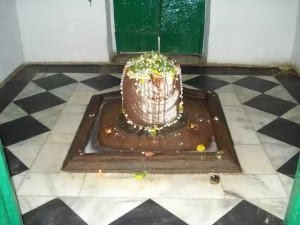
Nestled within the eternal spiritual labyrinth of Kashi (Varanasi) lies the Gautameshwar Temple, a sanctum dedicated to Lord Shiva. Unlike the grandiose, newly constructed temples that dominate the skyline, Gautameshwar Temple is a timeless treasure, deeply rooted in ancient scriptures and local folklore. It is known locally as Kashi Naresh Shivala, signifying its direct association with the royal lineage of Varanasi.
The primary deity here is a Shiva Lingam installed by the revered Sage Gautam. In the Shaivite tradition, this specific Lingam is believed to be a Swayambhu (self-manifested) or divinely revealed presence, radiating a potent spiritual energy that distinguishes it from thousands of other Shiva shrines in the city.
Phalaśruti: The Benefits of Darshan
According to the sacred texts and the belief of local devotees, offering prayers at Gautameshwar Temple carries profound spiritual merit. The Kashi Khand of the Skanda Purana explicitly mentions this shrine:
“Among various Lingas, Kashi Khand mentions one important Shiv Ling named Gautameshwar in the vicinity of Muchkundeshwar. This Shiv Ling is supposed to have been installed by Sage Gautam. Devotees who worship this Ling will derive all happiness and will attain Moksha.”
It is believed that worshiping here helps in:
- Cleansing Ancestral Karma: Performing rituals for departed souls here is considered highly effective.
- Attaining Moksha: As per Kashi Khand, the ultimate liberation is attainable through the grace of Gautameshwar.
- Mental Peace: The serene atmosphere within the complex offers a respite from the chaotic sounds of the bustling Godowlia market.
Historical Origins & Scriptural Legend
Scriptural Foundations: The Kashi Khand
The temple’s legitimacy is anchored in the Skanda Purana, specifically the Kashi Khand, Chapter 97. This chapter enumerates the various Shiva Lingas scattered across Kashi. The Gautameshwar Lingam is highlighted as a major spiritual site installed by the great sage himself, marking it as a locus of ancient Vedic energy.
Local Legends & The Royal Patronage
While the scriptural origins are ancient, the temple’s physical structure and current identity are intertwined with the history of the Kashi Naresh (the King of Varanasi). Historical accounts and oral traditions reveal a fascinating legal history regarding the temple’s ownership.
According to old timers and temple records, there was an intense dispute regarding the worship of this deity. The matter was referred to the then Kashi Naresh (the Maharaja of Varanasi). After protracted legal cases and deliberations, the King acquired the entire area and constructed the temple structure as it stands today.
Therefore, the temple is revered as Kashi Naresh Shivala, a testament to the royal protection granted to this ancient site. The architecture and the land title reflect the patronage of the royal family, ensuring the continuity of rituals for centuries.
Architectural Marvels
The Gautameshwar Temple is a classic example of the Nagara style of temple architecture, adapted to the vernacular building traditions of Varanasi.
Structural Elements
- The Shikhara (Spire): The temple features a towering shikhara that rises above the dense urban fabric of Godowlia. Unlike the towering spires of South Indian temples, this Nagara-style spire is curvilinear, symbolizing the cosmic mountain, Meru.
- The Mandapa (Pillared Hall): The prayer hall is designed to allow for congregational worship. The pillars are carved with motifs of deities and floral patterns typical of medieval North Indian architecture.
- Sanctum Sanctorum (Garbhagriha): The inner shrine is compact, housing the ancient Lingam. The low ceiling and confined space create a sense of intimacy and enclosure, focusing the devotee’s attention entirely on the deity.
Sculptural Details
Though the exterior has undergone renovations, remnants of intricate stone carvings can be seen on the temple walls. These sculptures depict scenes from Hindu mythology and various forms of Shiva and Parvati. The temple is not listed as an ASI-protected monument, but it is maintained under the direct supervision of the Kashi Naresh trust, preserving its traditional aesthetic.
Darshan & Ritual Logistics
Visiting Gautameshwar Temple requires an understanding of the ritualistic schedule. Being a significant Shiva shrine, the temple follows the traditional Vedic timing system.
Daily Darshan Timings
| Session | Timing | Details |
|---|---|---|
| Morning | 05:00 AM – 12:00 PM | Mangala Aarti (early morning) is the most auspicious time. |
| Evening | 05:00 PM – 10:00 PM | Sandhya Aarti (sunset) concludes with Shayan Darshan. |
Sevas and Online Booking
Key rituals performed daily include:
- Maha Abhishekam: Ritual bathing of the Lingam with milk, honey, and Gangajal.
- Rudrabhishekam: A powerful Vedic ritual for peace and prosperity.
- Archana: Individual prayers offered with flowers and Bilva leaves.
Booking Process: While the temple is managed by the Kashi Naresh trust, for specific Sevas, it is advisable to check the official Varanasi temple trust portals or inquire at the temple office upon arrival. Most daily rituals are performed on a first-come, first-served basis.
2026 Festival Schedule
The temple comes alive during:
- Maha Shivaratri (Feb 26, 2026): Night-long vigil, special Abhishekam, and grand decorations.
- Pradosh Vrat (Monthly): Specifically the Shani Pradosh (Saturday evenings).
- Somvar Vrat: Every Monday, devotees flock in large numbers.
- Haritalika Teej (Sep 06, 2026): Special arrangements for female devotees.
Practical Visitor Guidance
Located in the heart of the old city, visiting Gautameshwar Temple requires preparation.
Code of Conduct & Dress Code
- Dress Code: Traditional attire is recommended. Men should wear dhotis or full-length trousers and shirts; women should wear sarees or salwar kameez. Avoid shorts or sleeveless tops.
- Footwear: Shoes must be removed at the designated stand outside the temple (often there is a nominal fee for safekeeping).
- Photography: Photography of the inner sanctum (Garbhagriha) is strictly prohibited. Discretion should be used in the outer courtyard to respect other devotees’ privacy.
Crowd Management & Best Time to Visit
- Best Hours: Early morning (6:00 AM – 8:00 AM) or late evening (after 8:00 PM) offer the most peaceful darshan.
- Seasonal Advice:
- Summer (May–June): Varanasi temperatures exceed 40°C. Carry a water bottle and cover your head. The temple provides free water (Charnamrit) in the afternoon.
- Monsoon (July–Sept): The old city drains poorly. Wear non-slippery footwear.
- Accessibility: The temple is accessible via a narrow lane (gali). It is not wheelchair friendly due to the age of the structure. Elderly visitors should be assisted.
Pilgrimage Connectivity
Gautameshwar Temple is situated in D.37/33, Kashinaresh Shivala, Godowlia, Varanasi. It is in the proximity of Marwari Hospital.
How to Reach
- By Air: Lal Bahadur Shastri International Airport (LBS) Varanasi is the nearest airport (approx. 30 km). From the airport, a taxi to Godowlia takes about 1 hour (depending on traffic).
- By Rail: Varanasi Junction (BSB) is the closest major railway station (approx. 6 km). Kashi Vishwanath Express is a popular train option. From the station, take an auto-rickshaw to Godowlia.
- By Road: The temple is located off the Lahartara–Godowlia Road. Due to narrow lanes, vehicles cannot go directly to the temple gate. One must park at the designated parking areas near Dashashwamedh Ghat or Godowlia and walk approximately 5-10 minutes.
Nearby Sacred Sites (Pilgrimage Circuit)
- Muchkundeshwar Temple: Located in the immediate vicinity as mentioned in the Kashi Khand, making it a natural part of the pilgrimage route.
- Kashi Vishwanath Temple (New Vishwanath Temple): Approximately 15 minutes away by vehicle (depending on traffic), the Birla Temple offers a grand contrast to the historic Gautameshwar.
- Dashashwamedh Ghat: Just a short walk away, this is the site of the grand Ganga Aarti performed every evening.
Frequently Asked Questions (FAQ)
1. Is there a VIP Darshan entry at Gautameshwar Temple?
No, unlike large commercial temples, Gautameshwar Temple operates as a community and heritage shrine. There is no official VIP entry. Darshan is based on a queue system, though it is generally less crowded than the main Kashi Vishwanath Temple.
2. Can I perform my own Abhishekam?
Generally, the temple priests (Pandas) perform the Abhishekam. However, devotees can bring their own milk, honey, and flowers, which the priests will use during the ritual on your behalf. It is advisable to consult the head priest upon arrival.
3. Is there a dress code for foreigners?
While foreigners are welcome, respectful attire is required. Loose-fitting cotton clothes that cover shoulders and knees are recommended. Traditional Indian clothing (Kurta-Pajama or Saree) is not mandatory but is highly respected and makes blending in easier.
4. What is the significance of “Kashi Naresh Shivala”?
This title refers to the historical patronage of the temple by the King (Naresh) of Kashi. It indicates that the temple administration falls under the royal trust, preserving the rituals and architecture without modern alterations.
5. Are mobile lockers available?
Small lockers are available for keeping mobile phones and bags at the entrance, but they operate on a first-come basis. It is recommended to carry minimal belongings to avoid inconvenience.
Recent Posts

ओ सांवरे तूने ही मुझको संभाला – Lyrics & Meaning
ओ सांवरे तूने ही मुझको संभाला – A Prayer to Shyam Origin & Spiritual Essence Why This Bhajan Resonates Devotees chant this when overwhelmed by life’s storms—the refrain ‘तूने ही मुझको संभाला’ is the soul’s sigh of relief: “You…

कथा ये है महाराज मेरे की – Lyrics & Meaning
कथा ये है महाराज मेरे की छत्रपति संभाजी महाराज – A Prayer to Chhatrapati Sambhaji Maharaj Origin & Spiritual Essence Why This Bhajan Resonates Devotees chant this when their spirit feels tested—its powerful refrain “महाराज मेरे” is a soul’s…

Rigveda Samhita Yathartha Anuvada (ऋग्वेद संहिता यथार्थ अनुवाद) – Complete Set with Anvayartha & Hindi/English Translation
The Rigveda is the oldest surviving scripture of humanity and the foundational text of Sanātana Dharma. For serious students, scholars, UPSC aspirants studying ancient Indian history, Sanskrit learners, and spiritual seekers, a precise and grammatically structured translation is indispensable.…

आना भी अकेला है जाना भी अकेला है – Lyrics & Meaning | BharatTemples
आना भी अकेला है जाना भी अकेला है – A Prayer to the Divine Witness Origin & Spiritual Essence Why This Bhajan Resonates Devotees turn to this bhajan in moments of deep reflection—when life’s attachments begin to ache. The…

माता शेरावाली के द्वार जो भी जाता है – Lyrics & Meaning
माता शेरावाली के द्वार जो भी जाता है – A Prayer to Maa Sherawali Origin & Spiritual Essence Why This Bhajan Resonates Devotees turn to this bhajan in times of fear or uncertainty—its promise that no one leaves Maa’s…

मार लेना सपणी उबार लेणा भवरा – Lyrics & Meaning
मार लेना सपणी उबार लेणा भवरा – A Prayer to the Divine Beloved Origin & Spiritual Essence Why This Bhajan Resonates Devotees chant this in moments of deep vulnerability—its cry of “मार लेना सपणी, उबार लेणा भवरा” is the…

हमें श्याम सुंदर भरोसा तुम्हारा – Lyrics & Meaning
हमें श्याम सुंदर भरोसा तुम्हारा – A Prayer to Shyam Sundar Origin & Spiritual Essence Why This Bhajan Resonates Devotees chant this when feeling alone—its refrain ‘de do sahara’ is the soul’s cry for divine support. Lyrics in Hindi…

Mere Satguru Ne Di Thi Davai Lyrics in Hindi & Meaning
Mere Satguru Ne Di Thi Davai: Invoking the Guru’s Liberating Wisdom This soul-stirring bhajan venerates the Satguru (True Spiritual Master) as the divine physician who dispenses the only remedy for life’s deepest sufferings. Composed by Sant Karmaveer Tufani, it…

Janm Diyo Thari Maa Dukh Dekhiyo Lyrics in Hindi & Meaning
जन्म दियो थारी माँ दुख देखियो (Maa’s Grief Upon Birthing You) This soul-stirring Chetavani Bhajan (admonitory hymn) is addressed to the Divine Mother (Maa) – a call for repentance when children forget their filial duties in the dark age…
Bhadi Sabha Mein Thane Manaun Lyrics in Hindi & Meaning
Bhadi Sabha Mein Thane Manaun: Invoking the Spear-Wielding Mother Mata Bhawani (श्री ज्वाला भवानी), the fiery manifestation of Shakti worshipped as the Protector of Dharma in Her Dhaulagarh sanctum. Origin & Spiritual Essence Composed in Rajasthani folk tradition by…