
Contents
Introduction & Spiritual Essence
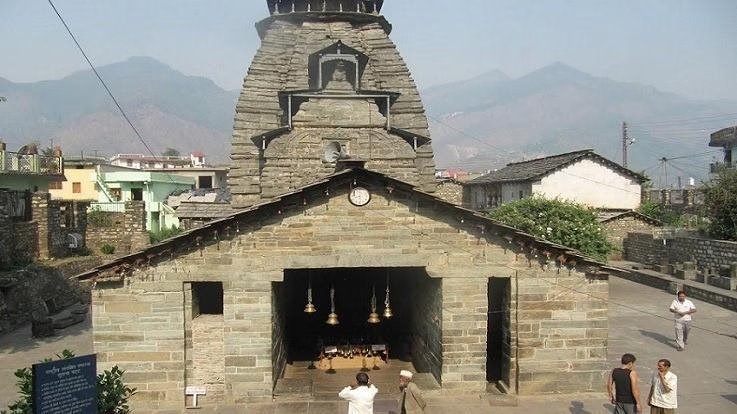
The Gopinath Mandir in Gopeshwar, Chamoli District, stands as a timeless sentinel of devotion in the Garhwal Himalayas. Dedicated primarily to Lord Shiva, this ancient shrine is revered for its spiritual potency and historical grandeur. The temple derives its name from the local dialect, where ‘Gopeshwar’ translates to the ‘Lord of the Cowherds,’ an epithet for Shiva in his benevolent form.
Deity and Form: The presiding deity is a Swayambhu (self-manifested) Shiva Lingam, representing the formless aspect of the universe. Unlike temples where the idol is carved, the Lingam here is believed to have emerged naturally from the earth, radiating a primal energy that attracts devotees from across the globe.
Phalaśruti (Spiritual Benefits): According to Vedic tradition, offering prayers at Gopinath Mandir is believed to yield profound benefits. The primary significance lies in the cleansing of ancestral karma. Devotees believe that performing rituals here liberates their lineage from past burdens. Additionally, the temple is a powerful center for meditation; it is said that a sincere prayer here brings peace to the mind, removes obstacles in professional endeavors, and grants the devotee the strength to overcome life’s adversities, much like Lord Shiva consumed the poison of the ocean to save the world.
Historical Origins & Scriptural Legend
The history of Gopinath Mandir is a tapestry woven with mythology and recorded royal patronage.
Architectural Patronage: While the exact date of the initial construction is lost in the mists of time, historical records and the architectural style suggest a foundation dating back to the Katyuri dynasty (approximately 7th–11th century CE). Later, significant renovations and additions were patronized by the Chand Kings. The temple complex bears witness to centuries of devotion, having survived the ravages of time and nature.
The Legend of the Trident (Trishul): The most defining feature of the temple’s history is the massive 5-meter Trident (Trishul) standing in the courtyard. Inscriptions on this trident attribute it to Anekmalla, the King of Nepal, who reigned in the 13th century. This artifact serves as a tangible link to the medieval era of temple construction.
Sthala Purana (Oral Legends):
- The Kamadeva Encounter: Tradition holds that when Lord Shiva incinerated Kamadeva (the God of Love) with his third eye for disturbing his meditation, Kamadeva’s wife, Rati, performed intense penance at this very spot. Pleased by her devotion, Lord Shiva appeared here as Gopinath and granted the boon of Kamadeva’s resurrection. The Trident in the courtyard is believed to be the very weapon Shiva threw at Kamadeva, which became fixed to the ground. It is said that while no amount of force can move it, it trembles at the touch of a true devotee.
- The Parashurama Connection: Another local legend suggests that the trident belongs to Lord Parashurama (the sixth avatar of Vishnu). It is said that while pacifying the enraged Lord Shiva, Parashurama’s trident broke into three parts, and this fragment remained at Gopeshwar.
Architectural Marvels
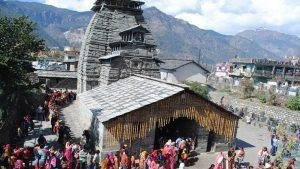
The Gopinath Mandir is a masterpiece of Nagara-style architecture, characteristic of the temples in the North Indian Himalayan region.
Structure and Design:
- The Shikhara (Spire): The temple features a towering, curvilinear Shikhara that rises majestically against the backdrop of the Himalayas. The spire is adorned with intricate carvings and smaller miniature spires (Urushringas) that ascend towards the pinnacle.
- The Mandapa (Hall): The sanctum is accessible through a spacious Mandapa characterized by massive stone columns. These columns feature detailed sculptural work depicting celestial beings, mythical creatures, and various forms of Shiva and Vishnu.
- The Sanctum Sanctorum: The inner shrine (Garbhagriha) is relatively compact (approx. 30 sq ft) but accessible through 24 doors, a unique feature allowing circumambulation and viewing from multiple angles. The roof of the sanctum is crowned by a magnificent dome, an architectural anomaly in the Nagara style, suggesting a confluence of regional artistic influences over centuries of renovation.
While not currently listed by UNESCO, the temple is a protected monument under the Archaeological Survey of India (ASI) due to its historical significance and the presence of the ancient Trident.
Darshan & Ritual Logistics
To ensure a seamless spiritual experience, devotees should familiarize themselves with the daily schedule and ritual offerings. Note: Specific timings are subject to change during festivals and seasonal variations (winters may see shorter daylight hours).
| Session | Timing | Activity |
|---|---|---|
| Morning | 5:00 AM – 12:00 PM | Mangala Aarti, Abhishekam, General Darshan |
| Afternoon | 12:00 PM – 4:00 PM | Temple Cleaning & Rest (Darshan restricted) |
| Evening | 4:00 PM – 8:30 PM | Sandhya Aarti, Shayan Darshan |
Key Sevas & Online Booking
Devotees can book specific rituals to enhance their pilgrimage. Given the year 2026, most bookings are facilitated through the Uttarakhand Char Dham Devasthanam Management Board portal or the temple’s official counter.
- Abhishekam: Ritual bathing of the Shiva Lingam with milk, honey, and water (Timing: 6:00 AM – 7:00 AM).
- Rudrabhishek: A powerful Vedic ritual for purification (Requires advance booking).
- Archana: Individual name chanting (Available throughout open hours).
- Online Seva: Visit the official Devasthanam Board website to select “Gopinath Mandir, Gopeshwar.” In 2026, the portal supports UPI and credit card payments for global devotees.
2026 Major Festival Dates
Visiting during these festivals offers a vibrant spiritual atmosphere but requires planning due to larger crowds.
- Maha Shivaratri: March 6, 2026 (A 3-day festival with night-long vigils).
- Amarnath Yatra Season: July 2026 (Passing through the Chamoli region, increased spiritual energy).
- Kartik Purnima: November 5, 2026 (Deep Daan and special Aarti).
- Makar Sankranti: January 14, 2026 (Marking the transition of the sun).
Practical Visitor Guidance
Dress Code: As this is a traditional Hindu temple, modest attire is mandatory. Men should wear dhotis or long trousers and shirts (no shorts). Women should wear sarees, salwar kameez, or long skirts.
Photography Rules: Photography is strictly prohibited inside the inner sanctum (Garbhagriha). Visitors may take photos in the courtyard and Mandapa, but flash usage is discouraged to maintain the sanctity of the space.
Lockers & Mobile Phones: Electronic devices are considered a disturbance during meditation. While specific mobile lockers may not always be available, it is advised to keep phones on silent mode or in your vehicle. Large bags and leather items (belts, wallets) are often restricted at the entrance.
Crowd Management:
- Best Hours: For a tranquil darshan, visit immediately after the morning Aarti (around 6:30 AM) or in the late evening (after 6:00 PM).
- Seasonal Advice: The temple is accessible year-round, but May and June see pre-monsoon heat; carry a water bottle and cover your head. Winters (Dec-Jan) bring snow; heavy woolens are essential.
Pilgrimage Connectivity
How to Reach Gopinath Mandir:
- By Air: The nearest airport is Jolly Grant Airport (DED) in Dehradun, approximately 258 km away. Taxis are readily available from the airport to Gopeshwar.
- By Rail: The closest railway head is Rishikesh, located about 220 km from Gopeshwar. From Rishikesh, one can hire a taxi or take a bus to Chamoli.
- By Road: Gopeshwar is well-connected via National Highway (NH) 7. It is 10 km from the district headquarters, Chamoli, and roughly 212 km from Rishikesh. Regular bus services ply from Dehradun, Rishikesh, and Haridwar to Chamoli/Gopeshwar.
Nearby Sacred Sites
Extend your pilgrimage by visiting these nearby temples to form a complete spiritual circuit:
- Adi Badri (18 km): A cluster of 16 temples from the Gupta period, part of the Panch Badri circuit, located near Chandpur.
- Kedarnath (125 km): One of the 12 Jyotirlingas and a major Char Dham site. Gopeshwar serves as a base for acclimatization before the Kedarnath trek.
- Badrinath (110 km): Another vital Char Dham temple dedicated to Lord Vishnu, situated on the banks of the Alaknanda river.
Frequently Asked Questions (FAQ)
Is there a VIP darshan entry available?
The Gopinath Mandir follows a traditional darshan system. While there is no formal VIP ticket like in Tirupati, donations to the temple trust can sometimes facilitate a quicker view of the deity during non-peak hours. It is best to inquire with the temple committee upon arrival.
What is the significance of the Trident in the courtyard?
The 5-meter high Trident is made of eight different metals and dates back to the 13th century. According to legend, it was thrown by Lord Shiva to destroy Kamadeva or broken from Parashurama’s weapon. It is a symbol of the temple’s ancient lineage and is said to tremble at the touch of a true devotee.
Are there accommodation facilities near the temple?
Yes, Gopeshwar town offers various guest houses and budget hotels run by the GMVN (Garhwal Mandal Vikas Nigam) and private operators. For pilgrims, basic Dharamshalas are also available near the temple premises.
Is the temple accessible for senior citizens and differently-abled visitors?
The temple has a paved courtyard, but the main sanctum requires climbing a few steps. The path from the road to the temple is motorable. Wheelchairs may be difficult to maneuver inside the inner complex due to the traditional architecture, but assistance is usually available from local volunteers.
What is the best time of year to visit Gopinath Mandir?
The ideal months are April to June and September to November. The weather is pleasant, and the skies are clear. The monsoon season (July-August) should be avoided due to landslide risks, and winters (December-February) offer a serene, snow-clad view but with very cold temperatures.

Recent Posts

Shri Kaamkoteeshwar Mandir, Varanasi – History & Significance
In the heart of Kashi, the eternal city of Lord Shiva, where the Ganges flows with celestial grace, stands the Shri Kaamkoteeshwar Mandir. This sacred Sannidhi is not merely a temple but a profound spiritual bridge between the Northern…

ओ सांवरे तूने ही मुझको संभाला – Lyrics & Meaning
ओ सांवरे तूने ही मुझको संभाला – A Prayer to Shyam Origin & Spiritual Essence Why This Bhajan Resonates Devotees chant this when overwhelmed by life’s storms—the refrain ‘तूने ही मुझको संभाला’ is the soul’s sigh of relief: “You…

कथा ये है महाराज मेरे की – Lyrics & Meaning
कथा ये है महाराज मेरे की छत्रपति संभाजी महाराज – A Prayer to Chhatrapati Sambhaji Maharaj Origin & Spiritual Essence Why This Bhajan Resonates Devotees chant this when their spirit feels tested—its powerful refrain “महाराज मेरे” is a soul’s…

Rigveda Samhita Yathartha Anuvada (ऋग्वेद संहिता यथार्थ अनुवाद) – Complete Set with Anvayartha & Hindi/English Translation
The Rigveda is the oldest surviving scripture of humanity and the foundational text of Sanātana Dharma. For serious students, scholars, UPSC aspirants studying ancient Indian history, Sanskrit learners, and spiritual seekers, a precise and grammatically structured translation is indispensable.…

आना भी अकेला है जाना भी अकेला है – Lyrics & Meaning | BharatTemples
आना भी अकेला है जाना भी अकेला है – A Prayer to the Divine Witness Origin & Spiritual Essence Why This Bhajan Resonates Devotees turn to this bhajan in moments of deep reflection—when life’s attachments begin to ache. The…

माता शेरावाली के द्वार जो भी जाता है – Lyrics & Meaning
माता शेरावाली के द्वार जो भी जाता है – A Prayer to Maa Sherawali Origin & Spiritual Essence Why This Bhajan Resonates Devotees turn to this bhajan in times of fear or uncertainty—its promise that no one leaves Maa’s…

मार लेना सपणी उबार लेणा भवरा – Lyrics & Meaning
मार लेना सपणी उबार लेणा भवरा – A Prayer to the Divine Beloved Origin & Spiritual Essence Why This Bhajan Resonates Devotees chant this in moments of deep vulnerability—its cry of “मार लेना सपणी, उबार लेणा भवरा” is the…

हमें श्याम सुंदर भरोसा तुम्हारा – Lyrics & Meaning
हमें श्याम सुंदर भरोसा तुम्हारा – A Prayer to Shyam Sundar Origin & Spiritual Essence Why This Bhajan Resonates Devotees chant this when feeling alone—its refrain ‘de do sahara’ is the soul’s cry for divine support. Lyrics in Hindi…

Mere Satguru Ne Di Thi Davai Lyrics in Hindi & Meaning
Mere Satguru Ne Di Thi Davai: Invoking the Guru’s Liberating Wisdom This soul-stirring bhajan venerates the Satguru (True Spiritual Master) as the divine physician who dispenses the only remedy for life’s deepest sufferings. Composed by Sant Karmaveer Tufani, it…

Janm Diyo Thari Maa Dukh Dekhiyo Lyrics in Hindi & Meaning
जन्म दियो थारी माँ दुख देखियो (Maa’s Grief Upon Birthing You) This soul-stirring Chetavani Bhajan (admonitory hymn) is addressed to the Divine Mother (Maa) – a call for repentance when children forget their filial duties in the dark age…