

Contents
Introduction & Spiritual Essence
Perched on the banks of the holy Hooghly River in the industrial town of Bansberia, the Hangseshwari Temple (also spelled Hanseswari) stands as a unique spiritual beacon. Unlike conventional temple structures, this shrine is a profound architectural manifestation of the human spiritual system.
The primary deity is Maa Hanseswari, a manifestation of Goddess Shakti (often associated with Kali). According to local tradition, the name “Hanseswari” is derived from Rani Hanseswari, the mother of the builder Raja Nrisingha Deb Roy. However, in mythology, the term “Hansa” represents the eternal truth or the supreme soul, and “Ishwari” means Goddess.
Phalaśruti (Spiritual Benefits):
Devotees visit this temple to seek spiritual awakening and liberation. The temple is built upon the principles of Tantric Satchakrabhed (the six chakras of the human body). It is believed that meditating here helps cleanse ancestral karma and aids in the awakening of the Kundalini energy. For spiritual aspirants, this is not just a place of worship but a yantra (instrument) for self-realization.
Historical Origins & Scriptural Legend
The history of Hangseshwari Temple is a tale of visionary leadership and tragic loss. The construction began in the early 19th century, initiated by Raja Nrisingha Deb Roy Mahasay.
The Legend of Raja Nrisingha:
According to temple records and oral tradition, Raja Nrisingha spent time in Varanasi between 1792 and 1798. There, he immersed himself in the study of Kundalini Yoga and the Tantric scriptures. He cancelled a planned visit to England to fulfill a divine vision: to construct a temple that mirrored the structure of the human body, representing the path of spiritual ascent.
To achieve this, he imported expensive white marble from Chunar (near Varanasi) and brought skilled artisans to Bansberia. However, the King passed away in 1802, leaving the temple unfinished. It was his widow, Rani Sankari, who took up the mantle and completed the monumental structure in 1814.
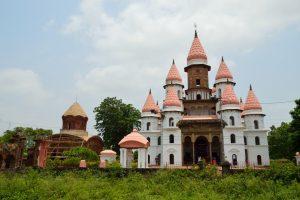
Adjacent to the main complex stands the Ananta Basudeba Temple (built circa 1788), which features exquisite terracotta panels depicting scenes from the Puranas, alongside the Swanbhaba Kali Temple.
Architectural Marvels
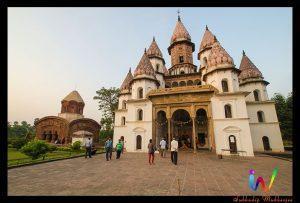
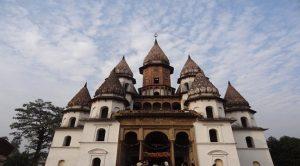
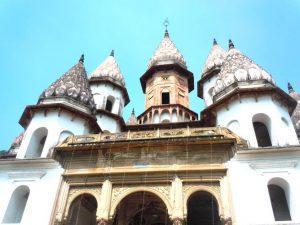
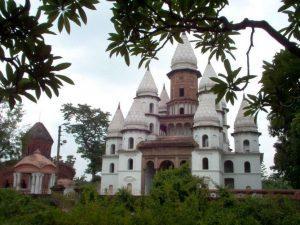
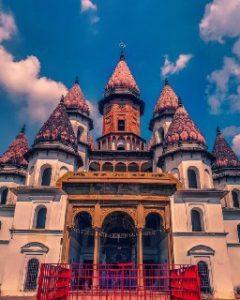
The Hangseshwari Temple is a masterpiece of the Navaratna style, but with a distinct Tantric influence that sets it apart from the more common Dravida or Nagara styles found in the region.
- Structure & Anatomy: The temple is five stories high, corresponding to the five major layers of the human subtle body: Bajraksha, Ira, Chitrini, Pingala, and Sushumna.
- The Minarets: The temple boasts 13 minarets (Ratnas), each topped with a finial shaped like a blooming lotus bud. The central tower rises to 21 meters.
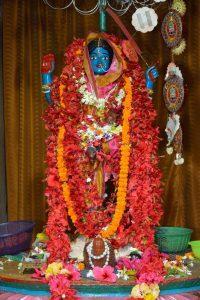
- The Deity: Inside the sanctum, the four-armed idol of Maa Hanseswari is made of blue neem wood. She is depicted standing on one leg, resting the other on her thigh—a posture symbolizing the Sadhana (practice) of Tantra.
- The Sanctum Sanctorum: Beneath the central minar, a white marble Shivlinga resides, symbolizing the union of Shiva (consciousness) and Shakti (energy).
While the exterior is predominantly white with terracotta embellishments, the inner layout strictly follows the Sat-Chakra (Six Chakras) system of Tantric philosophy.
Darshan & Ritual Logistics
The temple follows a traditional schedule of daily rituals, typically concluding with the Pushpanjali offering. The atmosphere shifts from the quiet serenity of early morning to the devotional vibrancy of evening Aarti.
Daily Darshan Timings
| Session | Timing |
|---|---|
| Morning Darshan | 06:00 AM – 11:30 AM |
| Afternoon Break | 11:30 AM – 04:30 PM |
| Evening Darshan | 04:30 PM – 08:30 PM |
| Major Aarti | 07:00 PM (Sandhya Aarti) |
Sevas & Booking
Key rituals include Mangal Aarti (early morning), Abhishekam (ritual bathing of the deity), and Chandipatha (recitation of hymns).
Online Seva Booking: While the temple administration maintains a traditional setup, major festivals often utilize local administrative portals for crowd management. For daily sevas, it is recommended to contact the temple trust office directly upon arrival.
2026 Festival Calendar
- Kali Puja & Diwali: October/November 2026 (Exact date based on lunar calendar; typically the new moon night of Kartik). This is the most significant festival here, drawing thousands of devotees.
- Durga Puja: October 2026 (The temple celebrates the victory of Devi with special Yajnas).
- Wednesdays: Considered auspicious for Maa Kali; special morning Aarti is performed.
Practical Visitor Guidance
Visiting Hangseshwari Temple requires preparation regarding attire and timing, especially during the peak winter and festival seasons.
- Dress Code: Traditional attire is preferred (Kurta-Pajama for men, Saree/Salwar Kameez for women). Avoid shorts or sleeveless tops to maintain the sanctity of the temple.
- Photography: Photography is generally prohibited inside the sanctum sanctorum. However, the exterior architecture and the courtyard are photogenic spots. Always seek permission from the temple guards for specific shots.
- Luggage/Storage: Mobile lockers are available near the entrance for electronics and bags, as carrying phones inside the sanctum is discouraged.
- Accessibility: The temple has steps leading to the main entrance. While there is some ramp access in the courtyard, the inner sanctum may be difficult for those with mobility issues. Wheelchair assistance may be available through the temple trust—please call ahead.
Crowd Management & Best Times to Visit
Peak Crowds: Sunday evenings and festival nights (especially Kali Puja). If you seek a peaceful Darshan, visit on a weekday morning (Tuesday or Wednesday).
Seasonal Advice:
- Summer (May-June): Hooghly can get very hot. Carry a water bottle and an umbrella. Visit early morning or late evening to avoid heat exhaustion.
- Monsoon (July-September): The area is near the river; humidity is high. Rain gear is essential.
- Winter (October-February): The best time to visit. The weather is pleasant for walking around the temple complex.
Pilgrimage Connectivity
Bansberia is well-connected by road and rail, making it an accessible destination for a day trip from Kolkata or a stop on a larger Bengal pilgrimage tour.
How to Reach
- By Air: The nearest airport is Netaji Subhas Chandra Bose International Airport (CCU) in Kolkata, approximately 70 km away (2.5 hours by car via NH 12).
- By Train: The nearest railway station is Bansberia Station (part of the Howrah-Bardhaman main line). It is a 5-minute walk from the station. Alternatively, Bandel Junction (5 km away) is a major rail hub.
- By Road: The temple is located right on State Highway 13 (formerly NH 2). It is well connected to Howrah and Hooghly. Private buses and autorickshaws are readily available from Bandel and Chinsurah.
Nearby Sacred Sites (The Hooghly Circuit)
- Ananta Basudeba Temple: Located adjacent to Hangseshwari, this terracotta temple is a must-visit for its detailed panels depicting the life of Lord Krishna.
- Bandel Church (Basilica of the Holy Rosary): Just 5 km away, this is one of the oldest Christian monuments in Bengal, offering a serene counterpoint to the Hindu temple architecture.
- Chinsurah Rajbari: Located about 10 km south, this Dutch colonial building sits on the banks of the Hooghly and offers a glimpse into the colonial history of the region.
Frequently Asked Questions (FAQs)
1. Is there a VIP or Special Entry darshan available?
Unlike larger temples like Tirupati, Hangseshwari Temple does not have a formal paid VIP entry system. However, devotees with specific needs (elderly or disabled) can request assistance from the temple caretakers for priority access.
2. What is the significance of the 13 towers (Minarets)?
The 13 towers represent the 13 energy centers in the subtle human body according to Tantric philosophy. The architecture is designed to replicate the flow of energy from the root chakra to the crown chakra.
3. Are non-Hindus allowed inside the temple?
While the temple is a center for Hindu worship, the architecture is a historical monument. Generally, entry is permitted for all to view the structure, but participation in rituals is reserved for devotees. Please respect the local customs and dress code.
4. What is the best time to visit during Kali Puja?
Kali Puja is an extremely crowded night. The best time for a safe and unhurried darshan is the Pradosh Kaal (twilight) just before the main Aarti begins, or early in the morning after the Balidan (sacrifice) rituals have concluded (around 6:00 AM).
5. Is there accommodation available nearby?
There are no major hotels within the temple complex. However, Hooghly town (Chinsurah) and Serampore have decent lodges and hotels. For a spiritual retreat, the nearest facility is often in the greater Kolkata area (approx. 40-50 km).
Recent Posts

Shri Kaamkoteeshwar Mandir, Varanasi – History & Significance
In the heart of Kashi, the eternal city of Lord Shiva, where the Ganges flows with celestial grace, stands the Shri Kaamkoteeshwar Mandir. This sacred Sannidhi is not merely a temple but a profound spiritual bridge between the Northern…

ओ सांवरे तूने ही मुझको संभाला – Lyrics & Meaning
ओ सांवरे तूने ही मुझको संभाला – A Prayer to Shyam Origin & Spiritual Essence Why This Bhajan Resonates Devotees chant this when overwhelmed by life’s storms—the refrain ‘तूने ही मुझको संभाला’ is the soul’s sigh of relief: “You…

कथा ये है महाराज मेरे की – Lyrics & Meaning
कथा ये है महाराज मेरे की छत्रपति संभाजी महाराज – A Prayer to Chhatrapati Sambhaji Maharaj Origin & Spiritual Essence Why This Bhajan Resonates Devotees chant this when their spirit feels tested—its powerful refrain “महाराज मेरे” is a soul’s…

Rigveda Samhita Yathartha Anuvada (ऋग्वेद संहिता यथार्थ अनुवाद) – Complete Set with Anvayartha & Hindi/English Translation
The Rigveda is the oldest surviving scripture of humanity and the foundational text of Sanātana Dharma. For serious students, scholars, UPSC aspirants studying ancient Indian history, Sanskrit learners, and spiritual seekers, a precise and grammatically structured translation is indispensable.…

आना भी अकेला है जाना भी अकेला है – Lyrics & Meaning | BharatTemples
आना भी अकेला है जाना भी अकेला है – A Prayer to the Divine Witness Origin & Spiritual Essence Why This Bhajan Resonates Devotees turn to this bhajan in moments of deep reflection—when life’s attachments begin to ache. The…

माता शेरावाली के द्वार जो भी जाता है – Lyrics & Meaning
माता शेरावाली के द्वार जो भी जाता है – A Prayer to Maa Sherawali Origin & Spiritual Essence Why This Bhajan Resonates Devotees turn to this bhajan in times of fear or uncertainty—its promise that no one leaves Maa’s…

मार लेना सपणी उबार लेणा भवरा – Lyrics & Meaning
मार लेना सपणी उबार लेणा भवरा – A Prayer to the Divine Beloved Origin & Spiritual Essence Why This Bhajan Resonates Devotees chant this in moments of deep vulnerability—its cry of “मार लेना सपणी, उबार लेणा भवरा” is the…

हमें श्याम सुंदर भरोसा तुम्हारा – Lyrics & Meaning
हमें श्याम सुंदर भरोसा तुम्हारा – A Prayer to Shyam Sundar Origin & Spiritual Essence Why This Bhajan Resonates Devotees chant this when feeling alone—its refrain ‘de do sahara’ is the soul’s cry for divine support. Lyrics in Hindi…

Mere Satguru Ne Di Thi Davai Lyrics in Hindi & Meaning
Mere Satguru Ne Di Thi Davai: Invoking the Guru’s Liberating Wisdom This soul-stirring bhajan venerates the Satguru (True Spiritual Master) as the divine physician who dispenses the only remedy for life’s deepest sufferings. Composed by Sant Karmaveer Tufani, it…

Janm Diyo Thari Maa Dukh Dekhiyo Lyrics in Hindi & Meaning
जन्म दियो थारी माँ दुख देखियो (Maa’s Grief Upon Birthing You) This soul-stirring Chetavani Bhajan (admonitory hymn) is addressed to the Divine Mother (Maa) – a call for repentance when children forget their filial duties in the dark age…