

Contents
- 1 Definitive Pilgrimage Guide: Hatimura Temple, Nagaon, Assam
Definitive Pilgrimage Guide: Hatimura Temple, Nagaon, Assam
A Beacon of Shakta Faith and Ahom Legacy on the Banks of the Brahmaputra
1. Introduction & Spiritual Essence
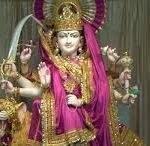
Amidst the verdant landscape of Assam, where the mighty Brahmaputra carves its path through the silghat (river bank) region, stands the Hatimura Temple. This is not merely a structure of stone and mortar; it is a Shakti Peeth pulsating with the divine energy of the Divine Mother. The presiding deity here is Mahisamardini Durga—the slayer of the buffalo demon Mahishasura.
Unlike a standard murti, the deity here is revered in a form that embodies the primordial energy of the universe. According to temple records and local devotees, the Goddess here offers a specific spiritual benefit known as Phalaśruti: the eradication of deep-seated ancestral karma. It is believed that offering prayers at this ancient altar cleanses the sins of past generations, protecting the family lineage from misfortune.
For the devotee, a visit to Hatimura is a surrender to the fierce yet benevolent protection of Mahisamardini, seeking strength to overcome the “buffalo” demons of ignorance and ego within oneself.
2. Historical Origins & Scriptural Legend
The history of Hatimura Temple is deeply intertwined with the religious patronage of the Ahom Dynasty. The temple was constructed during the reign of the benevolent Ahom king Pramatta Singha (also known as Sunyeophaa) in the year 1667 of the Sakabda era.
- Timeline: 1745–1746 AD.
- Architectural Style: Indigenous Assamese Temple Architecture (Influenced by Ahom engineering).
- Deity: Mahisamardini Durga (A form of Shakti).
The Sthala Purana (Local Legend)
Tradition holds that this site was chosen due to its auspicious geographical location at Silghat, a major entry point to the Brahmaputra Valley. Historically, this temple served as the central Shakti (power) center for the Koch dynasty and later the Ahoms. It was a seat of royal worship where the installation of the deity was performed to ensure the protection of the kingdom and the prosperity of the land.
Note on Rituals: While historical records document that human sacrifices were once performed at the altars of such Shakti temples in ancient times to appease the fierce deities, these practices are no longer part of the modern worship protocol. Today, the rituals are strictly Vedic, focusing on Yajnas (fire sacrifices) and Bali (offering of symbolic items).
3. Architectural Marvels
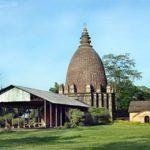
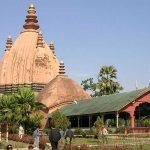
The Hatimura Temple is a testament to the indigenous temple architecture of Assam, distinct from the Nagara or Dravida styles of Northern or Southern India, yet sharing similarities with the architectural principles outlined in Vastu Shastra adapted for the flood-prone geography of the Brahmaputra Valley.
Key Features:
- The Sanctum (Garbhagriha): The main shrine houses the deity in a way that allows for circumambulation (Pradakshina), a crucial aspect of Shakta worship.
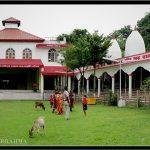
- The Mandapa: A spacious pillared hall allows devotees to gather for rituals. The pillars are carved with traditional motifs, though much of the original intricacy has been smoothed by the flow of time.
- Materials: The temple was traditionally built with indigenous materials suitable for Assam’s humid climate, though restoration efforts have preserved the structural integrity.
- Preservation Status: The temple is a protected monument, maintained by the state archaeology department, ensuring that the sanctity and structure remain intact for future generations.
4. Darshan & Ritual Logistics (2026 Guide)
To ensure a seamless spiritual experience, devotees are encouraged to plan their visit according to the temple’s daily schedule. As we approach the year 2026, these timings remain the standard, though they may shift slightly during major festivals.
Daily Darshan Timings
| Session | Timing | Activity |
|---|---|---|
| Morning | 06:00 AM – 11:00 AM | Mangala Arati, Alankara (Abhishekam) |
| Midday | 11:00 AM – 04:00 PM | Temple opens for general Darshan (limited) |
| Evening | 05:00 PM – 08:00 PM | Sandhya Arati, Shayan Aarti |
Online Seva Booking
For devotees unable to travel physically or wishing to book specific rituals in advance:
- Website: Visit the official Assam Temple Trust portal (search for “Hatimura Temple Seva”) to book Abhishekam (ritual bathing of the deity) or Archana (recitation of names).
- Payment: UPI and digital payment gateways are accepted.
2026 Festival Calendar (Important Dates)
Visiting during these times offers a heightened spiritual atmosphere but requires early arrival due to crowds.
- Navaratri (March/April): The grandest festival here. March 30 – April 7, 2026 (Chaitra Navratri).
- Deepavali (Durga Puja): The autumn festival celebrating the Goddess. October 2026 (Exact dates TBA by lunar calendar).
- Makar Sankranti: A major pilgrimage day with holy dips in the nearby Brahmaputra. January 14, 2026.
5. Practical Visitor Guidance
Respect for the sanctity of the temple is paramount. Here is the protocol for a hassle-free visit.
- Dress Code: Traditional attire is preferred. Men should wear Dhoti/Kurta; women should wear Saree/Salwar Kameez. Avoid shorts and sleeveless tops.
- Photography: Photography is strictly prohibited inside the inner sanctum (Garbhagriha). Landscape photography in the courtyard may be permitted, but always ask the temple authorities first.
- Crowd Management:
- Best Time to Visit: Tuesday and Saturday mornings (auspicious for Durga), and during the non-festival weekdays.
- Seasonal Advice: Assam summers (May-June) are hot and humid. Carry a water bottle (plastic bottles are discouraged; use steel flasks if possible) and a handkerchief. The monsoon (June-August) brings lush greenery but also humidity; wear non-slip footwear.
- Mobile & Lockers: While not mandatory, devotees are encouraged to leave electronic devices switched off or in their vehicles to maintain a distraction-free environment. Small personal belongings can be carried; large bags may be checked at the entry.
6. Pilgrimage Connectivity
How to Reach Hatimura Temple
Location: Silghat, Nagaon District, Assam.
- By Air: The nearest airport is Lokpriya Gopinath Bordoloi International Airport (GAU) in Guwahati, approximately 180 km away. Taxis and buses are available from Guwahati to Nagaon.
- By Rail: The nearest major railway station is Jakhalabandha (JKB) (approx. 20 km) or Nagaon (NGAN). From there, local cabs can take you directly to Silghat.
- By Road: The temple is well connected via the NH-37. It is a scenic drive from Guwahati or Kaziranga National Park. Private taxis and Assam State Transport buses ply frequently.
Nearby Sacred Sites (Pilgrimage Circuit)
Extend your spiritual journey by visiting these nearby sites:
- Bhairabi Temple (Tezpur): Located about 40 km from Silghat, this is another powerful Shakti shrine dedicated to Goddess Bhairabi.
- Maha Mrityunjaya Temple (Tezpur): A short drive from Tezpur, known for its unique architecture and association with Lord Shiva.
- Kaziranga National Park: While a UNESCO World Heritage Site for wildlife, the reverence for nature in Assam blends wildlife with spirituality, offering a holistic experience of the region.
7. Frequently Asked Questions (FAQs)
1. Is there a VIP Darshan entry at Hatimura Temple?
Yes, while there is no specific “VIP” category, devotees who book Abhishekam or Archana online are allowed a closer darshan during the ritual times. Senior citizens and differently-abled pilgrims are given priority entry.
2. What is the significance of Mahisamardini in Assam?
Mahisamardini represents the triumph of good over evil. In Assam, she is often equated with Kamakhya energy. Worshipping her at Hatimura is believed to remove obstacles in one’s career and health.
3. Is the temple accessible for senior citizens?
Yes. The main temple area is on ground level, but the courtyard is large. Wheelchair access is limited to the perimeter; assistance may be required to enter the sanctum.
4. Can non-Hindus visit the temple?
Hatimura Temple is a place of traditional worship. While many temples in Assam are open to all seeking spiritual solace, entry into the inner sanctum is typically restricted to devotees of the Hindu faith.
5. Where can I stay near the temple?
Accommodation is available in Nagaon town (15-20 km) and the Assam Tourism Development Corporation (ATDC) guest house at Kaziranga. Silghat has limited lodges; booking in advance is recommended during festivals.

Contact Details
Official Address:
Hatimura Temple
Hatimura Bill, Silghat
Nagaon, Assam 782103
Phone: 09864300295
Recent Posts

ओ सांवरे तूने ही मुझको संभाला – Lyrics & Meaning
ओ सांवरे तूने ही मुझको संभाला – A Prayer to Shyam Origin & Spiritual Essence Why This Bhajan Resonates Devotees chant this when overwhelmed by life’s storms—the refrain ‘तूने ही मुझको संभाला’ is the soul’s sigh of relief: “You…

कथा ये है महाराज मेरे की – Lyrics & Meaning
कथा ये है महाराज मेरे की छत्रपति संभाजी महाराज – A Prayer to Chhatrapati Sambhaji Maharaj Origin & Spiritual Essence Why This Bhajan Resonates Devotees chant this when their spirit feels tested—its powerful refrain “महाराज मेरे” is a soul’s…

Rigveda Samhita Yathartha Anuvada (ऋग्वेद संहिता यथार्थ अनुवाद) – Complete Set with Anvayartha & Hindi/English Translation
The Rigveda is the oldest surviving scripture of humanity and the foundational text of Sanātana Dharma. For serious students, scholars, UPSC aspirants studying ancient Indian history, Sanskrit learners, and spiritual seekers, a precise and grammatically structured translation is indispensable.…

आना भी अकेला है जाना भी अकेला है – Lyrics & Meaning | BharatTemples
आना भी अकेला है जाना भी अकेला है – A Prayer to the Divine Witness Origin & Spiritual Essence Why This Bhajan Resonates Devotees turn to this bhajan in moments of deep reflection—when life’s attachments begin to ache. The…

माता शेरावाली के द्वार जो भी जाता है – Lyrics & Meaning
माता शेरावाली के द्वार जो भी जाता है – A Prayer to Maa Sherawali Origin & Spiritual Essence Why This Bhajan Resonates Devotees turn to this bhajan in times of fear or uncertainty—its promise that no one leaves Maa’s…

मार लेना सपणी उबार लेणा भवरा – Lyrics & Meaning
मार लेना सपणी उबार लेणा भवरा – A Prayer to the Divine Beloved Origin & Spiritual Essence Why This Bhajan Resonates Devotees chant this in moments of deep vulnerability—its cry of “मार लेना सपणी, उबार लेणा भवरा” is the…

हमें श्याम सुंदर भरोसा तुम्हारा – Lyrics & Meaning
हमें श्याम सुंदर भरोसा तुम्हारा – A Prayer to Shyam Sundar Origin & Spiritual Essence Why This Bhajan Resonates Devotees chant this when feeling alone—its refrain ‘de do sahara’ is the soul’s cry for divine support. Lyrics in Hindi…

Mere Satguru Ne Di Thi Davai Lyrics in Hindi & Meaning
Mere Satguru Ne Di Thi Davai: Invoking the Guru’s Liberating Wisdom This soul-stirring bhajan venerates the Satguru (True Spiritual Master) as the divine physician who dispenses the only remedy for life’s deepest sufferings. Composed by Sant Karmaveer Tufani, it…

Janm Diyo Thari Maa Dukh Dekhiyo Lyrics in Hindi & Meaning
जन्म दियो थारी माँ दुख देखियो (Maa’s Grief Upon Birthing You) This soul-stirring Chetavani Bhajan (admonitory hymn) is addressed to the Divine Mother (Maa) – a call for repentance when children forget their filial duties in the dark age…
Bhadi Sabha Mein Thane Manaun Lyrics in Hindi & Meaning
Bhadi Sabha Mein Thane Manaun: Invoking the Spear-Wielding Mother Mata Bhawani (श्री ज्वाला भवानी), the fiery manifestation of Shakti worshipped as the Protector of Dharma in Her Dhaulagarh sanctum. Origin & Spiritual Essence Composed in Rajasthani folk tradition by…