
Contents
- 1 Hayagreeva Keshav Temple, Varanasi: The Definitive Pilgrimage Guide
- 1.1 1. Introduction & Spiritual Essence
- 1.2 2. Historical Origins & Scriptural Legend
- 1.3 3. Architectural Marvels
- 1.4 4. Darshan & Ritual Logistics
- 1.5 5. Practical Visitor Guidance
- 1.6 6. Pilgrimage Connectivity
- 1.7 7. Frequently Asked Questions (FAQ)
- 1.8 Photo Gallery
- 1.9 How to Reach:
- 1.10 Contact Details
Hayagreeva Keshav Temple, Varanasi: The Definitive Pilgrimage Guide
| Date built: | – |
|---|---|
| Deity: | Hayagreeva Keshav |
| Architectural style: | Hindu Temple architecture |
| Major festivals | – |
| Locale: | Vraranasi |
| District:: | Vraranasi |
| Address: | – |
| Phone | – |
Kashi Khand mentions one Hayagreev Teerth where Lord Vishnu is present in the form of Hayagreev Keshav.The devotees worshipping Hayagreev Keshav will reach Lord’s Lotus feet. Hayagreev Teerth is not in existence now.
1. Introduction & Spiritual Essence
In the heart of Varanasi (Kashi), specifically in the Bhadaini locality, lies the sacred abode of Hayagreeva Keshav. This temple is not merely a physical structure but a spiritual anchor within the cosmic geography described in the ancient texts. The presiding deity is Lord Vishnu in his unique Hayagreeva avatar—a horse-headed form symbolizing the restoration of stolen knowledge and wisdom.
Phalaśruti: The Fruits of Visiting
According to the Kashi Khand of the Skanda Purana, this site is designated as the Hayagreeva Teerth. While the physical water body (Teerth) is no longer visible, the potency of the location remains intact. Devotees visit this temple for specific spiritual benefits:
- Restoration of Knowledge: As Hayagreeva is the deity of the Vedas, students and scholars visit to seek clarity and memory retention.
- Ancestral Liberation: Performing rituals here is believed to help cleanse ancestral karma, aiding forefathers in attaining Moksha (liberation).
- Devotional Fulfillment: As the text states, “The devotees worshipping Hayagreeva Keshav will reach Lord’s Lotus feet.”
2. Historical Origins & Scriptural Legend
While specific dynastic construction dates for this particular shrine are not recorded in modern ASI databases, its origins are deeply rooted in scriptural antiquity.
Scriptural References
The primary authority for this temple’s existence is the Kashi Khand (Chapter 45). Tradition holds that this location marks the spot where Lord Vishnu manifested as Hayagreeva Keshav to vanquish demons (Madhu and Kaitabha) and retrieve the stolen Vedas from the creator god Brahma.
The Legend of Hayagreeva Yogini
Unique to this location is the presence of Hayagreeva Yogini. While Kashi is famous for the 52 Shakti Peethas and associated Yognis, the presence of Hayagreeva Yogini here signifies the masculine (Vishnu) and feminine (Shakti) convergence of esoteric knowledge. The temple houses this idol mentioned explicitly in Kashi Khand, Chapter 45, making it a rare site of Tantric and Vedic synthesis.
3. Architectural Marvels
The Hayagreeva Keshav Temple reflects the traditional Nagara style of temple architecture, adapted to the spatial constraints of the dense Varanasi neighborhood of Bhadaini.
Vastu Shastra Elements
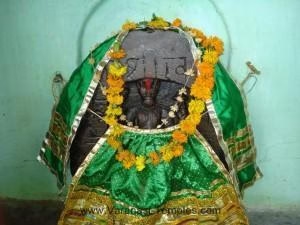
Located near the Anandmayee Hospital, the temple orientation follows standard Vastu principles facing East. The sanctum (Garbhagriha) houses the central Murti (idol) of Lord Hayagreeva Keshav, adorned with a white horse head and four arms holding the Sudarshana Chakra, Shankha, and resting on the lotus.
Sculptural Details
The niche sculptures often depict the Dasha Avatara (ten incarnations) of Vishnu. The wall panels feature motifs common to Kashi artisans, using local sandstone which absorbs the vibrational energy of the Ganges breeze.
4. Darshan & Ritual Logistics
Devotees planning a visit in 2026 should note that this is a functioning, traditional temple. Below are the standard timings and ritual schedules.
Daily Timings
| Session | Timing | Description |
|---|---|---|
| Morning | 06:00 AM – 12:00 PM | Temple opens with Mangala Aarti. Best time for serene darshan. |
| Afternoon | 12:00 PM – 04:00 PM | Mid-day closure for deity rest (varies by season). |
| Evening | 04:00 PM – 09:00 PM | Temple reopens. Includes Sandhya Aarti (approx 6:30 PM). |
Key Sevas & Booking
While online booking for this specific minor temple may not be centralized like the Kashi Vishwanath Corridor, general offerings include:
- Abhishekam: Ritual bathing of the deity (Milk, Honey, Ghee).
- Archana: Recitation of 108 names of Hayagreeva Keshav.
- Sri Sukta Homa: Performed for prosperity (seasonal).
Note: For specialized Sevas, coordinate with the local Purohits at the temple or the Kashi Vishwanath Trust administration.
2026 Festival Calendar
Major festivals celebrated with fervor include:
- Janmashtami: Birth of Lord Krishna (August 14-15, 2026). Expect crowds; early morning darshan recommended.
- Naraka Chaturdashi/Diwali: Oct 20-24, 2026. The temple is illuminated with traditional earthen lamps.
- Guru Purnima: July 3, 2026. Special knowledge-seeking puja.
5. Practical Visitor Guidance
Dress Code & Etiquette
Modesty is strictly advised. Men should wear dhotis or full-length trousers/shirts; women should wear sarees or salwar kameez. Avoid western attire (shorts, sleeveless tops) to maintain the sanctity of the space.
Photography & Lockers
Photography inside the sanctum is generally prohibited. Mobile phones should be kept in silent mode. While this is a smaller temple compared to Vishwanath, small lockers are available near the entrance for a nominal fee.
Crowd Management & Seasonal Advice
- Best Hours: 07:00 AM – 09:00 AM offers the most peaceful Darshan.
- Summer (May-June): Varanasi temperatures can exceed 40°C. Carry a water bottle and cover your head while walking between sites.
- Monsoon (July-Sept): Be prepared for humidity and sudden showers; carry an umbrella.
6. Pilgrimage Connectivity
How to Reach
The temple is situated in the Bhadaini area, close to Anandmayee Hospital.
- Nearest Airport: Lal Bahadur Shastri International Airport (LBS) (approx. 25 km).
- Nearest Railway Station: Varanasi Junction (approx. 5-6 km).
- Local Transport: From Sonarpura area, take an auto-rickshaw or cycle rickshaw directly to Anandmayee Hospital. The temple is just before the hospital entrance.
Nearby Sacred Sites (Pilgrimage Circuit)
To maximize your spiritual journey in Kashi, consider visiting these nearby locations:
- Shri Kashi Vishwanath Temple (Main): Approximately 2 km away. The central deity of Varanasi.
- Annapurna Devi Temple: Located near Vishwanath, the provider of nourishment.
- Sankat Mochan Hanuman Temple: Located on the southern bank of the Ganges, known for removing troubles.
7. Frequently Asked Questions (FAQ)
Is there a VIP Darshan entry?
Unlike the Kashi Vishwanath Corridor, the Hayagreeva Keshav temple usually does not have a formal VIP entry system. However, visiting during early morning hours (before 8:00 AM) offers a crowd-free experience.
Can I perform Puja for my ancestors here?
Yes. Given its association with the Teerth and liberation of ancestors, this is an auspicious spot for performing Shraddha rituals. You may need to bring your own Pandit or request one from the local caretakers.
Is the temple accessible by car?
Bhadaini is a narrow lane area. While you can reach the vicinity by car/auto, the last 100 meters may require walking due to lane constraints.
What is the significance of the Hayagreeva form?
Hayagreeva represents the victory of knowledge over ignorance. The horse head signifies high intelligence and speed in understanding scriptures.
Are there accommodation facilities nearby?
Yes, the Anandmayee Hospital complex offers guest houses, and the Bhadaini area has several Dharamshalas and guest houses catering to pilgrims.
Photo Gallery
How to Reach:
Hayagreev Keshav is located at B.3/25 near Anandmayee Hospital at Bhadaini. People can reach this place by auto/car or cycle rickshaw. If one approaches from Sonarpura area, Hayagreev Keshav will be just before the Hospital. This place of worship also houses Hayagreeva Yogini which is mentioned in Kashi Khand, Chapter 45.
Contact Details
Official Address
Recent Posts

Shri Kaamkoteeshwar Mandir, Varanasi – History & Significance
In the heart of Kashi, the eternal city of Lord Shiva, where the Ganges flows with celestial grace, stands the Shri Kaamkoteeshwar Mandir. This sacred Sannidhi is not merely a temple but a profound spiritual bridge between the Northern…

ओ सांवरे तूने ही मुझको संभाला – Lyrics & Meaning
ओ सांवरे तूने ही मुझको संभाला – A Prayer to Shyam Origin & Spiritual Essence Why This Bhajan Resonates Devotees chant this when overwhelmed by life’s storms—the refrain ‘तूने ही मुझको संभाला’ is the soul’s sigh of relief: “You…

कथा ये है महाराज मेरे की – Lyrics & Meaning
कथा ये है महाराज मेरे की छत्रपति संभाजी महाराज – A Prayer to Chhatrapati Sambhaji Maharaj Origin & Spiritual Essence Why This Bhajan Resonates Devotees chant this when their spirit feels tested—its powerful refrain “महाराज मेरे” is a soul’s…

Rigveda Samhita Yathartha Anuvada (ऋग्वेद संहिता यथार्थ अनुवाद) – Complete Set with Anvayartha & Hindi/English Translation
The Rigveda is the oldest surviving scripture of humanity and the foundational text of Sanātana Dharma. For serious students, scholars, UPSC aspirants studying ancient Indian history, Sanskrit learners, and spiritual seekers, a precise and grammatically structured translation is indispensable.…

आना भी अकेला है जाना भी अकेला है – Lyrics & Meaning | BharatTemples
आना भी अकेला है जाना भी अकेला है – A Prayer to the Divine Witness Origin & Spiritual Essence Why This Bhajan Resonates Devotees turn to this bhajan in moments of deep reflection—when life’s attachments begin to ache. The…

माता शेरावाली के द्वार जो भी जाता है – Lyrics & Meaning
माता शेरावाली के द्वार जो भी जाता है – A Prayer to Maa Sherawali Origin & Spiritual Essence Why This Bhajan Resonates Devotees turn to this bhajan in times of fear or uncertainty—its promise that no one leaves Maa’s…

मार लेना सपणी उबार लेणा भवरा – Lyrics & Meaning
मार लेना सपणी उबार लेणा भवरा – A Prayer to the Divine Beloved Origin & Spiritual Essence Why This Bhajan Resonates Devotees chant this in moments of deep vulnerability—its cry of “मार लेना सपणी, उबार लेणा भवरा” is the…

हमें श्याम सुंदर भरोसा तुम्हारा – Lyrics & Meaning
हमें श्याम सुंदर भरोसा तुम्हारा – A Prayer to Shyam Sundar Origin & Spiritual Essence Why This Bhajan Resonates Devotees chant this when feeling alone—its refrain ‘de do sahara’ is the soul’s cry for divine support. Lyrics in Hindi…

Mere Satguru Ne Di Thi Davai Lyrics in Hindi & Meaning
Mere Satguru Ne Di Thi Davai: Invoking the Guru’s Liberating Wisdom This soul-stirring bhajan venerates the Satguru (True Spiritual Master) as the divine physician who dispenses the only remedy for life’s deepest sufferings. Composed by Sant Karmaveer Tufani, it…

Janm Diyo Thari Maa Dukh Dekhiyo Lyrics in Hindi & Meaning
जन्म दियो थारी माँ दुख देखियो (Maa’s Grief Upon Birthing You) This soul-stirring Chetavani Bhajan (admonitory hymn) is addressed to the Divine Mother (Maa) – a call for repentance when children forget their filial duties in the dark age…