
Contents
- 1 Definitive Pilgrimage Guide: Jalakandeswarar Temple, Vellore
Definitive Pilgrimage Guide: Jalakandeswarar Temple, Vellore
By Bharat Temples Heritage Team | Updated for 2026 Pilgrimage Season
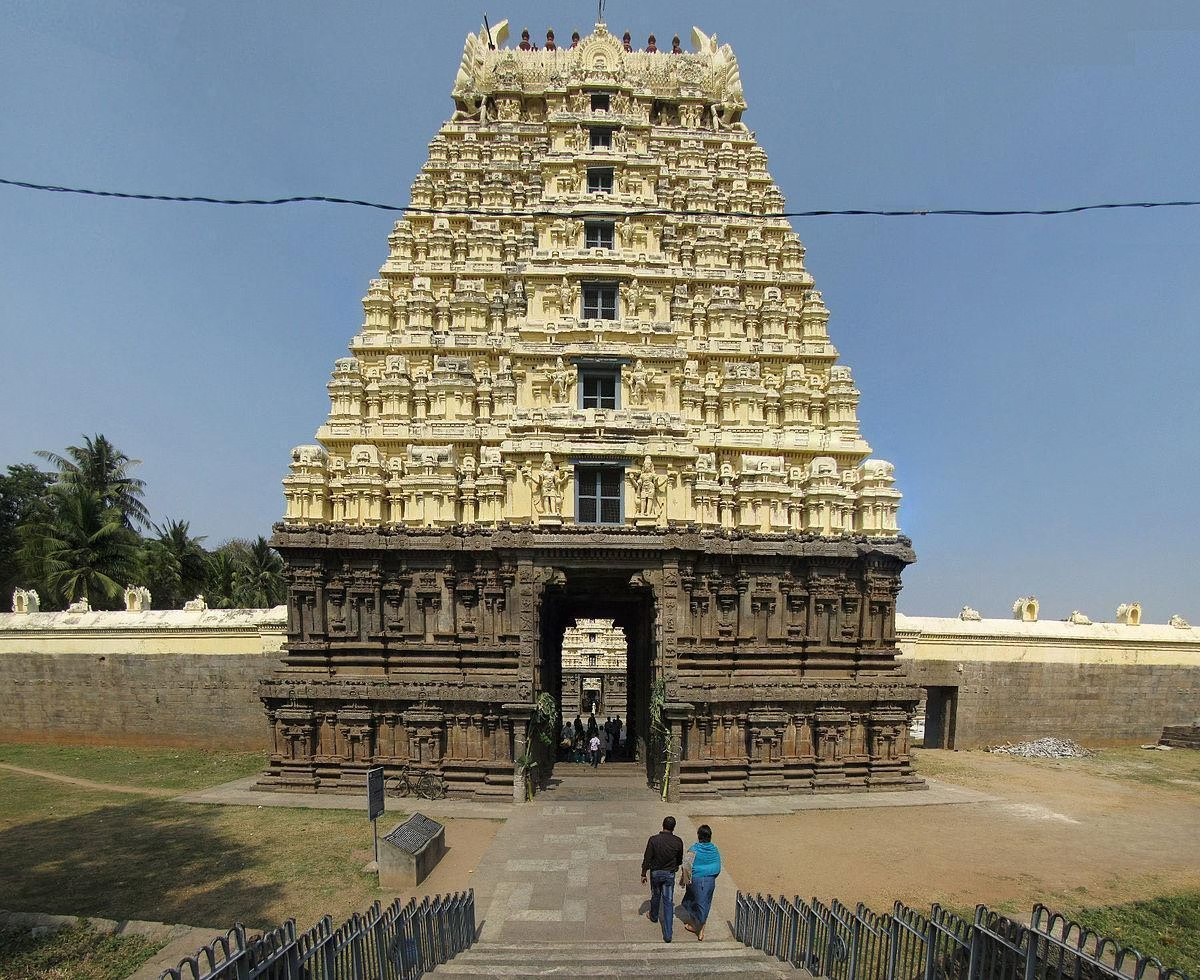
Deep within the granite walls of the historic Vellore Fort, rising serenely from the middle of a grand water tank, stands the Jalakandeswarar Temple. A masterpiece of the Vijayanagara era, this temple is not merely a structure of stone but a living spiritual ocean. For the devotee, it represents the cosmic abode of Lord Shiva, where the element of water (Jala) meets the divine consciousness (Isvara).
1. Introduction & Spiritual Essence
The Deity: Jalakandeswarar
The primary deity here is Lord Shiva, worshipped in the form of a Swayambhu (self-manifested) Shiva Lingam. He is revered as Jalakandeswarar, meaning “The Lord of the Water.” His consort, Akhilandeshwari, graces the southern shrine. Unlike many temples where the water surrounds the outer precincts, here the sanctum sanctorum is actually located at the center of the tank, creating a mesmerizing island effect.
Phalaśruti: Why Devotees Visit
According to ancient traditions and the Skanda Purana, worshipping Jalakandeswarar brings profound spiritual benefits:
- Removal of Water Doshas: It is believed that prayers here cleanse negative planetary influences related to water elements in one’s horoscope.
- Ancestral Liberation (Pitra Shanti): Performing rites here is considered highly effective for ancestors’ souls, helping them attain moksha.
- Victory over Enemies: Located within a fortress, the Lord here is known as Vijaya Tripurantakeswarar, granting victory over obstacles and adversities.
2. Historical Origins & Scriptural Legend
The Vijayanagara Legacy
Construction Date: Circa 1550 AD.
Builder: Chinna Bommi Nayaka, a chieftain under the Vijayanagara Emperor Sadasivadeva Maharaya.
Legend of the Ant-Hill
The Sthala Purana narrates a fascinating origin story. Originally, the site of the current sanctum was a massive ant-hill (Puli) surrounded by stagnant rainwater. Local devotees placed a Shiva Lingam amidst the water near this ant-hill for worship. Centuries later, Chinna Bommi Nayaka, the local governor, had a divine dream in which the Lord instructed him to build a formal temple structure.
Upon demolishing the ant-hill to excavate the foundation, the workers discovered the Shiva Lingam. To preserve this sacred spot, Nayaka widened the surrounding water body and raised the temple on an island, preserving the original Lingam. Thus, the temple earned the name Jalakandeswarar (The Lord in the Water).
3. Architectural Marvels
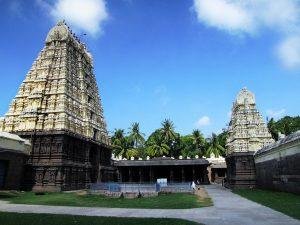
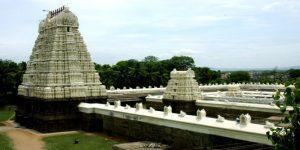
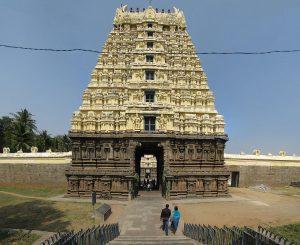
The temple is a textbook example of Vijayanagara Architecture, characterized by ornate pillars, massive gopurams, and strategic integration with water.
Key Structural Elements
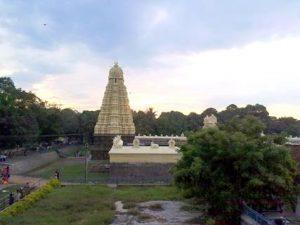
- The Gopuram: The towering Raja Gopuram (main gateway tower) stands over 100 feet tall, visible from across the fort. Its intricate stucco work depicts mythological scenes.
- The Water Tank (Agazhi): The temple tank is unique; it is not a peripheral feature but surrounds the sanctum entirely. With a circumference of approximately 8,000 feet, it creates a cooling microclimate essential for the stone structure.
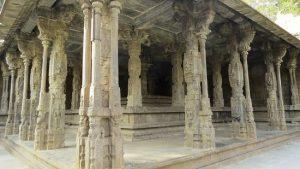
- Mandapas: The Maha Mandapam features exquisitely carved stone pillars. These pillars are distinctively Vijayanagara, often hollow and supported by mythological figures like Yalis (mythical lion-like creatures) and horses.
- The Wedding Hall: The Kalyana Mandapam houses a rare two-faced sculpture—a bull (Nandi) and an elephant.
- Ritual Water Source: The water used for the Abhishekam is drawn from the ancient Ganga Gouri Theertham well located within the temple complex, not from the tank water.
While the temple is not a UNESCO site, it is protected under the Archaeological Survey of India (ASI) as it is situated within the Vellore Fort complex.

4. Darshan & Ritual Logistics
Daily Temple Timings (2026 Schedule)
The temple generally remains closed on Fridays for maintenance, though this may vary during festivals. Below are the standard timings.
| Session | Timings | Details |
|---|---|---|
| Morning Darshan | 06:00 AM – 12:00 PM | Includes Ushathkalam (Morning) and Kalasandhi poojas. |
| Afternoon Closure | 12:00 PM – 04:00 PM | Temple is closed for deity rest. |
| Evening Darshan | 04:00 PM – 08:30 PM | Includes Sayarakshai (Evening) pooja. |
Key Sevas & Online Booking
Devotees can book special poojas through the official Tamil Nadu Hindu Religious and Charitable Endowments (HR&CE) website.
- Abhishekam: Performed with Ganga Gouri Theertham water. Timing: 6:30 AM.
- Archana: Recitation of names with offering of flowers.
- Kalyana Utsavam: Marriage ceremony for the deities (conducted on request).
Booking: Visit TN Tourism or the specific HRCE portal for Vellore temples to book seva 30 days in advance.
2026 Major Festivals
- Arudra Darshanam: January 2026 (Date TBD based on Tamil Calendar) – Celebrating Lord Nataraja.
- Mahashivratri: February/March 2026 – Special all-night abhishekam and chanting.
- Ambal Festival (Brahmotsavam): May/June 2026 – 10-day festival for Akhilandeshwari.
- Skanda Sashti: October/November 2026 – Dedicated to Lord Murugan (widely celebrated across Vellore).
5. Practical Visitor Guidance
Dress Code & Etiquette
As the temple is under ASI purview within a fort, strict dress code is enforced. Men must remove shirts and wear dhotis or trousers; women should wear sarees or salwar kameez. Shorts and sleeveless tops are generally prohibited.
Photography & Electronics
- Sanctum Sanctorum: Strictly no photography allowed inside the inner sanctum.
- Phones: Mobile phones are allowed but must be kept silent. Photography of the outer mandapams is usually permitted, but verify with ASI guards on duty.
- Lockers: There are no official locker facilities inside the temple. It is advised to travel light and avoid carrying expensive items.
Crowd Management Strategy
- Best Time to Visit: Monday to Thursday mornings (8 AM – 10 AM) are the least crowded.
- Weekends: Expect high footfall from local devotees and tourists visiting the fort.
- Seasonal Advice:
- Summer (May-June): Vellore is extremely hot. Carry a water bottle (fill at the temple well) and wear light cotton clothes.
- Monsoon (Oct-Nov): The fort grounds can get slippery; wear rubber-soled sandals.
Accessibility
The temple features stone steps leading to the island tank. While there is a bridge, it is not wheelchair accessible due to uneven surfaces and heritage restrictions.
6. Pilgrimage Connectivity
How to Reach
- By Air: The nearest airport is Chennai International Airport (MAA), approximately 130 km away (3.5 hours drive). Alternatively, Vellore Airport (VLR) handles limited domestic flights.
- By Rail: Vellore Cantt Railway Station is the primary junction, well-connected to Chennai, Bangalore, and Tirupati. The station is 8 km from the temple.
- By Road: Vellore lies on the National Highway 48 (NH48) connecting Chennai and Bangalore. Frequent buses are available from Chennai Koyambedu (CMBT) and Bengaluru Satellite Bus Stand.
Nearby Sacred Circuit
Extend your pilgrimage by visiting these nearby spiritual landmarks:
- Jain Temple (Vellore Fort): Located just a walkable distance within the fort complex, featuring intricate marble idols.
- Pancha Pandava Bhima Temple: An ancient cave temple carved out of a single rock, located near the fort moat.
- Sripuram Golden Temple (Thirumalaikodi): Located 8 km from Vellore, this massive spiritual park features the Mahalakshmi Golden Temple. A must-visit for devotees traveling this route.
7. Frequently Asked Questions (FAQ)
Is there a VIP Darshan entry at Jalakandeswarar Temple?
Unlike Tirupati, there is no formal VIP ticket system here. However, during weekdays, the crowd is minimal, allowing for a swift darshan. For special access, contact the Executive Officer at the temple office one day prior.
Can we perform rituals like Mundan or Namakaranam?
Yes, the temple administration allows basic rituals like Mundan (first hair cut) and Namakaranam (naming ceremony) in the outer mandapam. Prior booking is required through the HRCE office.
Is the temple tank used for public bathing?
No, the water inside the fort tank is not meant for public bathing. It is exclusively for drawing water for the deity’s Abhishekam (ritual bathing) and maintaining the ecosystem.
What are the security protocols at the Vellore Fort?
Since the temple is inside a protected fort, visitors must pass through a security check. Bags may be scanned. Firearms, sharp objects, and large luggage are strictly prohibited.
Where can I park my vehicle?
There is a paid parking lot outside the Vellore Fort main gate. Vehicles are not allowed inside the fort. From the parking, it is a 10-minute walk to the temple.
Is the temple open on all days?
Generally, yes. However, it remains closed on Fridays for tank cleaning and maintenance. Always check the local holiday list before planning, especially during festival weeks.
Recent Posts

ओ सांवरे तूने ही मुझको संभाला – Lyrics & Meaning
ओ सांवरे तूने ही मुझको संभाला – A Prayer to Shyam Origin & Spiritual Essence Why This Bhajan Resonates Devotees chant this when overwhelmed by life’s storms—the refrain ‘तूने ही मुझको संभाला’ is the soul’s sigh of relief: “You…

कथा ये है महाराज मेरे की – Lyrics & Meaning
कथा ये है महाराज मेरे की छत्रपति संभाजी महाराज – A Prayer to Chhatrapati Sambhaji Maharaj Origin & Spiritual Essence Why This Bhajan Resonates Devotees chant this when their spirit feels tested—its powerful refrain “महाराज मेरे” is a soul’s…

Rigveda Samhita Yathartha Anuvada (ऋग्वेद संहिता यथार्थ अनुवाद) – Complete Set with Anvayartha & Hindi/English Translation
The Rigveda is the oldest surviving scripture of humanity and the foundational text of Sanātana Dharma. For serious students, scholars, UPSC aspirants studying ancient Indian history, Sanskrit learners, and spiritual seekers, a precise and grammatically structured translation is indispensable.…

आना भी अकेला है जाना भी अकेला है – Lyrics & Meaning | BharatTemples
आना भी अकेला है जाना भी अकेला है – A Prayer to the Divine Witness Origin & Spiritual Essence Why This Bhajan Resonates Devotees turn to this bhajan in moments of deep reflection—when life’s attachments begin to ache. The…

माता शेरावाली के द्वार जो भी जाता है – Lyrics & Meaning
माता शेरावाली के द्वार जो भी जाता है – A Prayer to Maa Sherawali Origin & Spiritual Essence Why This Bhajan Resonates Devotees turn to this bhajan in times of fear or uncertainty—its promise that no one leaves Maa’s…

मार लेना सपणी उबार लेणा भवरा – Lyrics & Meaning
मार लेना सपणी उबार लेणा भवरा – A Prayer to the Divine Beloved Origin & Spiritual Essence Why This Bhajan Resonates Devotees chant this in moments of deep vulnerability—its cry of “मार लेना सपणी, उबार लेणा भवरा” is the…

हमें श्याम सुंदर भरोसा तुम्हारा – Lyrics & Meaning
हमें श्याम सुंदर भरोसा तुम्हारा – A Prayer to Shyam Sundar Origin & Spiritual Essence Why This Bhajan Resonates Devotees chant this when feeling alone—its refrain ‘de do sahara’ is the soul’s cry for divine support. Lyrics in Hindi…

Mere Satguru Ne Di Thi Davai Lyrics in Hindi & Meaning
Mere Satguru Ne Di Thi Davai: Invoking the Guru’s Liberating Wisdom This soul-stirring bhajan venerates the Satguru (True Spiritual Master) as the divine physician who dispenses the only remedy for life’s deepest sufferings. Composed by Sant Karmaveer Tufani, it…

Janm Diyo Thari Maa Dukh Dekhiyo Lyrics in Hindi & Meaning
जन्म दियो थारी माँ दुख देखियो (Maa’s Grief Upon Birthing You) This soul-stirring Chetavani Bhajan (admonitory hymn) is addressed to the Divine Mother (Maa) – a call for repentance when children forget their filial duties in the dark age…
Bhadi Sabha Mein Thane Manaun Lyrics in Hindi & Meaning
Bhadi Sabha Mein Thane Manaun: Invoking the Spear-Wielding Mother Mata Bhawani (श्री ज्वाला भवानी), the fiery manifestation of Shakti worshipped as the Protector of Dharma in Her Dhaulagarh sanctum. Origin & Spiritual Essence Composed in Rajasthani folk tradition by…